Biology & CS Evolution organisms over time Ecology - - PDF document

biology cs
SMART_READER_LITE
LIVE PREVIEW

Biology & CS Evolution organisms over time Ecology - - PDF document

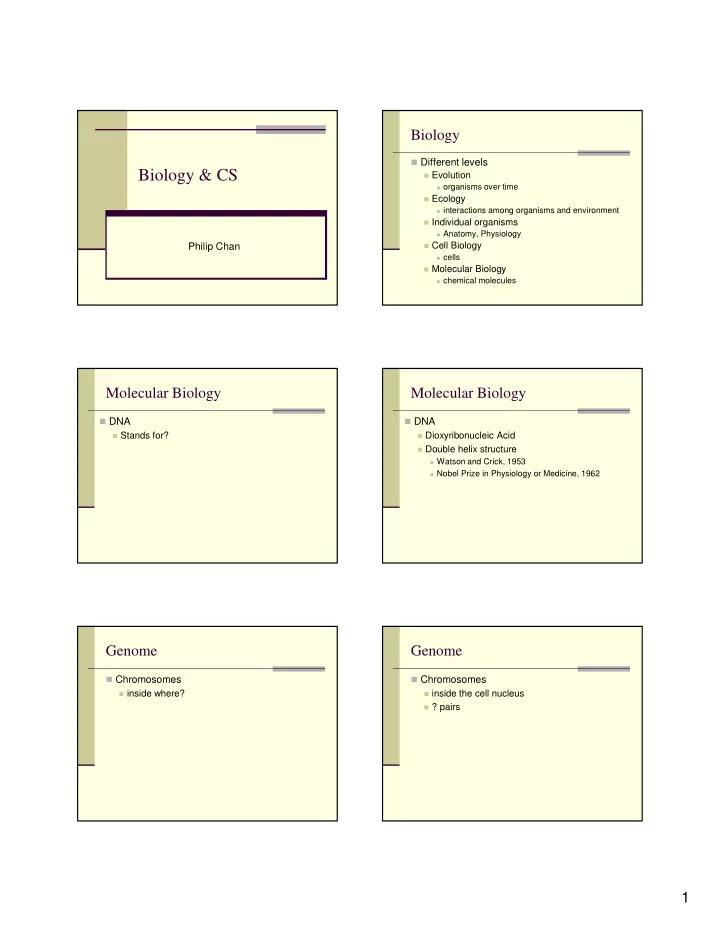
Biology Different levels Biology & CS Evolution organisms over time Ecology interactions among organisms and environment Individual organisms Anatomy, Physiology Philip Chan Cell Biology cells Molecular


slide-1
SLIDE 1

1

Biology & CS

Philip Chan

Biology

Different levels

Evolution

  • rganisms over time

Ecology

interactions among organisms and environment

Individual organisms

Anatomy, Physiology

Cell Biology

cells

Molecular Biology

chemical molecules

Molecular Biology

DNA

Stands for?

Molecular Biology

DNA

Dioxyribonucleic Acid Double helix structure

Watson and Crick, 1953 Nobel Prize in Physiology or Medicine, 1962

Genome

Chromosomes

inside where?

Genome

Chromosomes

inside the cell nucleus ? pairs

slide-2
SLIDE 2

2 Genome

Chromosomes

inside the cell nucleus 23 pairs (one determines what?)

Genome

Chromosomes

inside the cell nucleus 23 pairs (one determines gender)

Genome

Chromosomes

inside the cell nucleus 23 pairs (one determines gender) contains genetic information copied during cell division made of DNA Gene

?

Genome

Chromosomes

inside the cell nucleus 23 pairs (one determines gender) contains genetic information copied during cell division made of DNA Gene

(roughly) segments of DNA that encode proteins

Genome

Human: ? genes

Genome

Chromosomes

inside the cell nucleus 23 pairs (one determines gender) contains genetic information copied during cell division made of DNA Genes

(roughly) segments of DNA that encodes proteins

Genome

Human: 20,000-25,000 genes

DNA to Protein

Transcription

DNA -> RNA

Translation

RNA -> Protein

slide-3
SLIDE 3

3 DNA Encoding for Proteins

DNA

Sequence of nucleotides

4 possible nucleotides:

Adenine (A), Cytosine (C), Guanine (G), Thymine (T) [Thymine (T) becomes Uracil (U) in RNA]

Protein

Sequence of amino acids

20 possible amino acids

How many nucleotides are needed to encode

  • ne amino acid?

Sequencing Human Genome

Human Genome Project

International (governments/universities)

Celera Corporation (US)

Many short sequences Algorithms to merge them into longer

sequences Complete genome sequence in ~2003

Why Study the Genome?

Understanding how genes, proteins, …

interact with each other

Understanding diseases

Mistakes in copying DNA Mutations cause changes in DNA

Comparing Genes

After a gene is found

Biologist might not know its function Find “similarities” with genes of known function

Cancer (1984)

Cancer-causing gene is similar to a normal

growth gene

Cancer might be caused by a normal growth

gene being switched on at the wrong time

A good gene doing the right thing at the

wrong time

Cystic Fibrosis (1989)

Cystic Fibrosis is a fatal disease associated

with abnormal secretions (clogs in lungs).

A segment of the Cystic Fibrosis gene is

similar to the sequence for ATP binding proteins.

These proteins affect cell membrane and

secretions

slide-4
SLIDE 4

4 Similarity/Distance of Sequences

Position by position

ACACAC CACACA Hamming Distance = 6

Similarity/Distance of Sequences

Position by position

ACACAC CACACA Hamming Distance = 6

Shift the second sequence by one character

ACACAC_ _CACACA Distance = 2

Longest Common Subsequence

Problem 1

Subsequence

Subsequence

Sequence of characters that might NOT be

consecutive ATTGCTA

TTGC -> subsequence AGCA -> subsequence ATTA -> subsequence TGTT -> not a subsequence TCG -> not a subsequence

Common Subsequence

Given two sequences

ATCTGAT TGCATA

Common subsequences ?

Common Subsequence

Given two sequences

ATCTGAT TGCATA

Common subsequences

TCTA TA

slide-5
SLIDE 5

5

Longest Common Subsequence (LCS)

Many different common subsequences Want to find the longest Length of LCS helps determine similarity of

two sequences/genes

Problem Formulation

Given (input)

Two sequences v, w

Find (output)

Longest common substring of v and w (simpler

problem)

Algorithm

Any ideas?

Algorithm 1

Find common subsequence of length 1 Find common subsequence of length 2 …

Algorithm 1

Find common substring of length 1 Find common substring of length 2 … What is the time complexity?

Algorithm 1

Find common substring of length 1 Find common substring of length 2 … What is the time complexity? Are we repeating unnecessary work?

slide-6
SLIDE 6

6 Algorithm 2

Observation:

If common substring of length L+1 exists

Common substring of length L must also exists

Idea?

Algorithm 2

Observation:

If common substring of length L+1 exists

Common substring of length L must also exists

Idea

Use common substring of length L to find

common substring of length L+1

Algorithm 2

Observation:

If common substring of length L+1 exists

Common substring of length L must also exists

Idea

Use common substring of length L to find

common substring of length L+1 Time complexity?

Algorithm ?

Tree Search What would be the nodes and branches? Could recursion help? Time complexity?

Algorithm 3

Consider

String v, indexed by i String w, indexed by j

LCS(i, j) returns the length of LCS ending at

i,j

Algorithm 3

Consider

String v, indexed by i String w, indexed by j

LCS(i, j) returns the length of LCS ending at

i,j

LCS(i, j) =

LCS(i - 1, j - 1) + 1 if v[i] = w[j] 0 otherwise

slide-7
SLIDE 7

7 Algorithm 3

Consider

String v, indexed by i String w, indexed by j

LCS(i, j) returns the length of LCS ending at

i,j

LCS(i, j) =

LCS(i - 1, j - 1) + 1 if v[i] = w[j] 0 otherwise

Different initial i,j pairs

Algorithm 3

Consider

String v, indexed by i String w, indexed by j

LCS(i, j) returns the length of LCS ending at

i,j

LCS(i, j) =

LCS(i - 1, j - 1) + 1 if v[i] = w[j] 0 otherwise

Different initial i,j pairs Any redundant work?

Algorithm 3

Dynamic programming

Eliminate redundant work By storing partial answers

LCS[] is a table LCS[i, j] is the length of LCS ending at i, j LCS[i, j] =

LCS[i - 1, j - 1] + 1 if v[i] = w[j] 0 otherwise

Algorithm 3

A B A B B A B A

Algorithm 3

A B A B B 1 1 A B A

Algorithm 3

A B A B B 1 1 A 1 2 B A

slide-8
SLIDE 8

8 Algorithm 3

A B A B B 1 1 A 1 2 B 2 3 A 1 3

Algorithm 3

A B A B B 1 1 A 1 2 B 2 3 A 1 3

Problem Formulation

Given (input)

Two sequences v, w

Find (output)

Longest common subsequence of v and w Skipping character(s) is allowed

Problem

String editing

Transform one string to another by

keeping/adding/deleting characters Can also be viewed as aligning two strings Any ideas?

  • T

G C A T

  • A
  • C

A T

  • C
  • T

G A T C

LCS: Example

  • T

G

C T G A T C

A

T

  • C

T

  • A
  • C

elements of v elements of w

A

  • 2

1 1 2 2 3 3 3 4 4 5 5 5 6 6 7 6 8 7 j coords: i coords: Matches shown in red positions in v: positions in w: 1 < 3 < 5 < 6 < 7 2 < 3 < 4 < 6 < 8

Every common subsequence is a path in 2-D grid

(0,0)(0,1)(1,2)(2,2)(3,3)(4,3)(5,4)(5,5)(6,6)(6,7)(7,8)

Edit Graph for LCS Problem

T G C A T A C

1 2 3 4 5 6 7 i

A T C T G A T C

1 2 3 4 5 6 7 8 j

slide-9
SLIDE 9

9

Edit Graph for LCS Problem

T G C A T A C

1 2 3 4 5 6 7 i

A T C T G A T C

1 2 3 4 5 6 7 8 j

Edit Graph for LCS Problem

T G C A T A C

1 2 3 4 5 6 7 i

A T C T G A T C

1 2 3 4 5 6 7 8 j

Every path is a common subsequence. Every diagonal edge adds an extra element to common subsequence LCS Problem: Find a path with maximum number of diagonal edges

Computing LCS

si,j = MAX si-1,j + 0 si,j -1 + 0 si-1,j -1 + 1, if vi = wj i,j i-1,j i,j -1 i-1,j -1

1

Computing LCS

The length of LCS(vi,wj) is computed by:

si, j = max si-1, j si, j-1 si-1, j-1 + 1 if vi = wj

Dynamic Programming Example

Initialize 1st row and 1st column to be all zeroes. Or, to be more precise, initialize 0th row and 0th column to be all zeroes.

Dynamic Programming Example

Si,j = Si-1, j-1

max Si-1, j

Si, j-1

value from NW +1, if vi = wj value from North (top) value from West (left)

slide-10
SLIDE 10

10

Dynamic Programming: Backtracing

Arrows show where the score

  • riginated from.

if from the top if from the left if vi = wj

Dynamic Programming Example

Find a match in row and column 2. i=2, j=2,5 is a match (T). j=2, i=4,5,7 is a match (T). Since vi = wj, si,j = si-1,j-1 +1

Dynamic Programming Example

Continuing with the dynamic programming algorithm gives this result.

Now What?

LCS(v,w) created the

alignment grid

Now we need a way to

read the best alignment of v and w

Follow the arrows

backwards from sink

LCS Algorithm

  • !

"  #$!

  • !!
  • %%
  • !
  • & 

%%

  • !
  • %%
  • !!
  • '(

'( '( '( & & & &

Printing LCS: Backtracing

  • !"

!" !" !"

#

  • $
  • !"

!" !" !"

slide-11
SLIDE 11

11 LCS Time Complexity

It takes O(nm) time to fill in the nxm dynamic

programming matrix.

Why O(nm)? The pseudocode consists of a

nested “for” loop inside of another “for” loop to set up a nxm matrix.

Global Sequence Alignment

Problem 2

LCS

simplest form of sequence alignment

Calculating sequence similarity

allows only insertions and deletions (no

mismatches).

score 1 for matches and 0 for indels

(insertions/deletions)

Mismatch and Indel

Indel: insertion/deletion Allowing substitution/mismatch

%&'%' %&'%' %&'%' %&'%'( ( ( ( %' %' %' %' %'&' %'&' %'&' %'&'( ( ( ( '%' '%' '%' '%'

mismatch indel

What do we do with mismatches and indels?

From LCS to Alignment

penalizing indels and mismatches with negative scores Simplest scoring schema:

+1 : match premium

  • : mismatch penalty
  • : indel penalty

the resulting score is:

#matches – (#mismatches) – (#indels)

Global Alignment

Given (input)

Two sequences: v, w Penalty for mismatches and indels

Find (ouput)

Alignment with the maximum score

slide-12
SLIDE 12

12 The Global Alignment Problem

= -

= 1 if match = -µ if mismatch si-1,j-1 +1 if vi = wj si,j = max s i-1,j-1 -µ if vi wj s i-1,j - s i,j-1 -

µ : mismatch penalty

: indel penalty

Scoring Matrices

To generalize scoring, consider a (4+1) x(4+1) scoring matrix . In the case of an amino acid sequence alignment, the scoring matrix would be a (20+1)x(20+1) size. The addition of 1 is to include the score for comparison of a gap character “-”. This will simplify the algorithm as follows: si-1,j-1 + (vi, wj) si,j = max s i-1,j + (vi, -) s i,j-1 + (-, wj)

Local Alignment

Problem 3

Local Alignments: Why?

Two genes in different species

similar over short conserved regions and dissimilar over remaining regions.

Example:

Homeobox genes have a short region

called the homeodomain that is highly conserved between species.

A global alignment would not find the

homeodomain because it would try to align the ENTIRE sequence

Local vs. Global Alignment

  • The Global Alignment Problem tries to find

the longest path between vertices (0,0) and (n,m) in the edit graph.

  • The Local Alignment Problem tries to find the

longest path among paths between arbitrary vertices (i,j) and (i’, j’) in the edit graph.

Local vs. Global Alignment (cont’d)

Global Alignment Local Alignment—better alignment to find

conserved segment

  • -T—-CC-C-AGT—-TATGT-CAGGGGACACG—A-GCATGCAGA-GAC

| || | || | | | ||| || | | | | |||| | AATTGCCGCC-GTCGT-T-TTCAG----CA-GTTATG—T-CAGAT--C tccCAGTTATGTCAGgggacacgagcatgcagagac |||||||||||| aattgccgccgtcgttttcagCAGTTATGTCAGatc

slide-13
SLIDE 13

13 Local Alignment: Example

Global alignment Local alignment

Compute a “mini” Global Alignment to get Local

The Local Alignment Problem

Given (input)

strings v, w scoring matrix

Find (output)

alignment of substrings of v and w whose

alignment score is maximum among all possible alignment of all possible substrings

Algorithm

Any ideas?

Algorithm

For each possible starting point

Call global alignment

(every ending point is considered)

Time complexity?

Algorithm

For each possible starting point

Call global alignment

(every ending point is considered)

Time complexity?

O(n2) pairs of start and end points

Each alignment takes O(n2)

Total O(n4)

Local Alignment: Example

Global alignment Local alignment

Compute a “mini” Global Alignment to get Local

slide-14
SLIDE 14

14 Local Alignment: Running Time

Long run time O(n4):

  • In the grid of size n x n

there are ~n2 vertices (i,j) that may serve as a source.

  • For each such vertex

computing alignments from (i,j) to (i’,j’) takes O(n2) time.

This can be remedied by

giving free rides

Local Alignment: Free Rides

Vertex (0,0)

The dashed edges represent the free rides from (0,0) to every other node. ie, skipping multiple characters in one step.

Yeah, a free ride!

The Local Alignment Recurrence

The largest value of si,j over the whole edit graph is

the score of the best local alignment.

The recurrence:

  • Notice there is only

this change from the

  • riginal recurrence of

a Global Alignment

The Local Alignment Recurrence

The largest value of si,j over the whole edit graph is

the score of the best local alignment.

The recurrence:

  • Power of ZERO: there is
  • nly this change from the
  • riginal recurrence of a

Global Alignment - since there is only one “free ride” edge entering into every vertex

Summary

  • 1. Longest Common Subsequence
  • No penalty on mismatches and indels
  • 2. Global Alignment
  • Penalize mismatches and indels
  • 3. Local Alignment
  • Short highly similarly subsequences