
SLIDE 1
Sandric Leong Biology of dinoflagellates Karlodinium, Karenia and Takayama
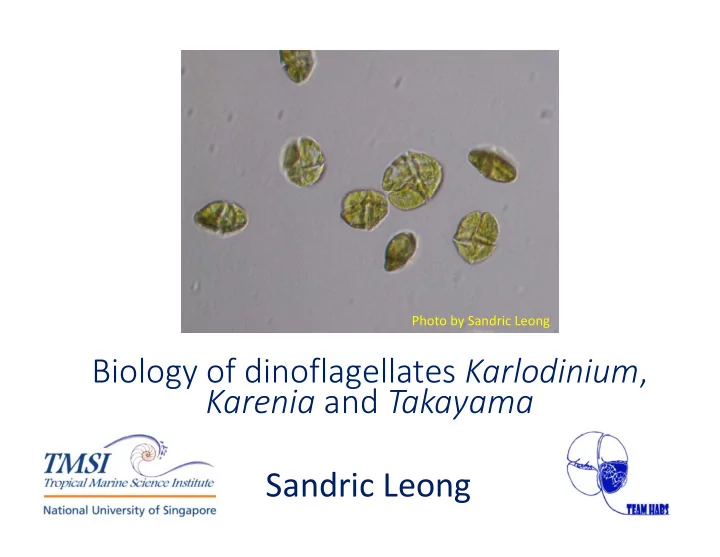
Photo by Sandric Leong
Biology of dinoflagellates Karlodinium , Karenia and Takayama - - PowerPoint PPT Presentation
Photo by Sandric Leong Biology of dinoflagellates Karlodinium , Karenia and Takayama Sandric Leong Kareniaceae The family Kareniaceae was established in 2005 and it consisted of the genera Karenia , Karlodinium and Takayama . Kareniaceae: 30
Photo by Sandric Leong
The family Kareniaceae was established in 2005 and it consisted of the genera Karenia, Karlodinium and Takayama.
Genus Karenia: 12 species Genus Karlodinium: 11 species Genus Takayama: 7 species Species of these genera are known to form harmful blooms around the global coastal areas. Some of the species could produce ichthyotoxins such as brevetoxins and karlotoxins that could cause marine animal illness and even mortality.
http://www.sptimes.com/2004/04/02/State/Dolph in_deaths_still_.shtml
10.Karenia papilionacea 11.Karenia selliformis 12.Karenia umbella
12 species
dinoflagellate
the world in both oceanic and coastal waters.
toxins that could kill fish and other marine
that could kills fish, marine mammals, and other animals, and also causes neurotoxic shellfish poisoning and respiratory distress in humans.
slowly.
and space.
Karenia mikimotoi is the oldest known species firstly described in Japan by Oda (1935)
and a known fish-killer that has caused economic losses in many countries. It produces complex toxic metabolites but the fish-killing mechanisms have not been recognized. Cells size range from 18 - 40μm in length and14 - 35μm in width Known toxins: Gymnocin-A; Gymnocin-B; Hemolysin (lipids and proteins that destroy red blood cells); PUFA (Poly-Unsaturated Fatty Acid) Human impacts: None known Animal impacts: Mortality of fish and invertebrates Distribution: Europe, America, Gulf of Mexico, Australia, New Zealand, Japan, Hong Kong, S. Korea, Singapore, the Philippines, China
Karenia mikimotoi is oldest known species described in Japan by Oda (1935) Light: low to high light (Saturation around 200 µmol photon m-2 s-1) Temperatures: 4 – 31°C Salinity: 9 – 35 PSU Nutrient requirement/preference: Reduced and Oxidized nitrogen (current work) Allelochemistry and toxin production: hemolytic activity; allelopathic effects
Bloom dynamics: form bloom with other species (current observation)
Al‐Kandari et al. (2011)
There are two distinct sub‐groups based on geographical regions (Al‐ Kandari et al. (2011)
Steidinger et al. (2008)
microscope
11 species
unarmored/naked dinoflagellate
throughout the global coastal waters.
mortality.
veneficum and K. australe
10.Karlodinium veneficum 11.Karlodinium vitiligo
Cells size range from 19-26μm in length and16-22μm in width Known toxins: unknown Human impacts: None known Animal impacts: Mortality of fish Distribution: Australia, Malaysia, Singapore
Light: unknown Temperatures: 28 – 32.5°C (Singapore) Salinity: 21 – 30 PSU (Singapore) Nutrient requirement/preference: Reduced nitrogen and organic nitrogen (current work) Allelochemistry and toxin production: unknown Bloom dynamics: ?
Nutrient requirement/preference: Reduced nitrogen and organic nitrogen (current work)
Light: unknown Temperatures: 10 – 30°C Salinity: 5 – 30 PSU Nutrient requirement/preference: Reduced, oxidized and organic nitrogen
Cells size range from 9-17μm in length and 8-14μm in width Known toxins: karlotoxins (higher toxicity when grown in ammonium, low salinity, high temperature) Human impacts: None known Animal impacts: Mortality of fish Distribution: Europe, America, UK, Africa, New Zealand, Australia, Malaysia, Singapore, Korea, China (worldwide distribution)
https://microbewiki.kenyon.edu/ind ex.php/Karlodinium_veneficum
Lim et al. (2014)
de Salas et al. (2005)
7 species
unarmored/naked dinoflagellate
tasmanica
species (e.g. de Salas et al. (2008)
Cells size range from 22-27μm in length and18-22μm in width Known toxins: unknown (capable of producing mucus) Human impacts: None known Animal impacts: Mortality of fish Distribution: Europe, Australia, New Zealand, Singapore
de Salas et al. (2003)
Light: 80 – 700 (Singapore) Temperatures: 28 – 32.5°C (Singapore) Salinity: 21 – 30 PSU (Singapore) Nutrient requirement/preference: Reduced and Oxidized nitrogen (current work) Allelochemistry and toxin production: unknown
de Salas et al. (2008)
1. Morphological descriptions Well covered for most species 2. Toxins Many studies were done on K. brevis & K. veneficum Studies showed a high degree of toxin variability and toxin type among strains.
Place et al. (2012)
1. Killing mechanisms of Kareniaceae species Current status: not fully documented Existing knowledge: limited Knowledge needed: more studies are necessary 2. Toxins 3. Distribution 4. Life cycle of Kareniaceae species 5. Ecophysiology of Kareniaceae species 6. Environmental factors that will promote fish kills 7. Warning system? Mitigation strategy? 8. Resting cysts?