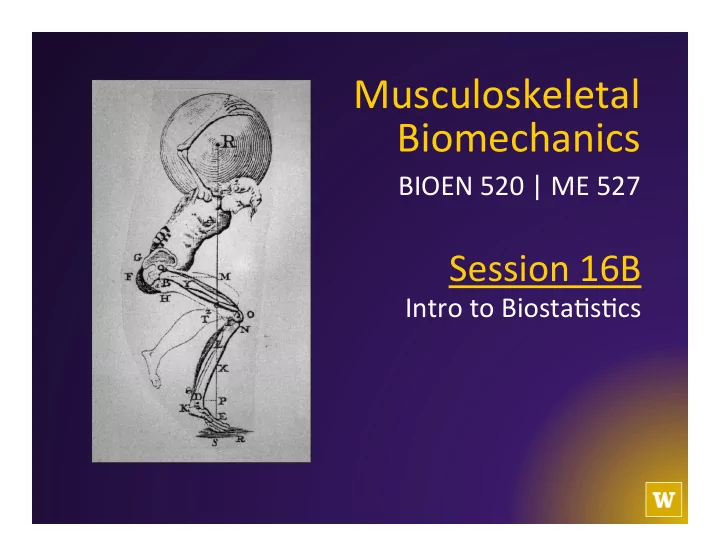
Biomechanics BIOEN 520 | ME 527 Session 16B Intro to - - PowerPoint PPT Presentation
Musculoskeletal Biomechanics BIOEN 520 | ME 527 Session 16B Intro to Biosta>s>cs Sta>s>cal Overview for Biomechanical Engineering Jane Shofer, MS
Sta>s>cal ¡Overview ¡for ¡ Biomechanical ¡Engineering ¡
Jane ¡Shofer, ¡MS ¡ Department ¡of ¡Psychiatry ¡and ¡Behavioral ¡ Medicine ¡and ¡CSDE, ¡UW ¡ RR&D, ¡VAPSH ¡ ¡ ¡ ¡ ¡
Pithy ¡opening ¡quote ¡
- All ¡models ¡are ¡wrong ¡
Pithy ¡opening ¡quote ¡ ¡
- All ¡models ¡are ¡wrong ¡
- Some ¡models ¡are ¡useful ¡
George ¡Box ¡
Example ¡
- 2 ¡groups ¡of ¡pa>ents ¡who ¡had ¡ankle ¡
- steoarthri>s ¡
- Group ¡1 ¡had ¡a ¡coronal ¡plane ¡deformity ¡in ¡the ¡
affected ¡limb, ¡n=48 ¡
- Group ¡2, ¡neutral ¡alignment, ¡n=64 ¡
¡
- Main ¡outcome: ¡MFA—high ¡score ¡means ¡poor ¡
func>oning ¡
Example ¡
- Ques>on: ¡Is ¡mean ¡MFA ¡different ¡between ¡
those ¡with ¡a ¡coronal ¡deformity ¡vs. ¡those ¡ neutrally ¡aligned? ¡
Graphing ¡the ¡ data ¡
Dynamite ¡plot ¡ Problems: ¡ ¡
- 1. ¡A ¡lot ¡of ¡space ¡to ¡summarize ¡4 ¡
numbers ¡
- 2. ¡Error ¡bar ¡in ¡one ¡direc>on ¡
- 3. ¡No ¡informa>on ¡as ¡to ¡the ¡shape
¡
- f ¡distribu>on ¡of ¡MFA ¡between ¡
groups ¡
- 4. ¡No ¡info ¡about ¡poten>al ¡
- utliers ¡
Graphing ¡the ¡ data ¡
¡ Strip ¡plot ¡with ¡means ¡and ¡95% ¡ confidence ¡intervals ¡
Graphing ¡the ¡ data ¡
Another ¡example ¡ ¡ The ¡means ¡of ¡these ¡2 ¡groups ¡ were ¡determined ¡to ¡be ¡ sta>s>cally ¡different ¡
Graphing ¡the ¡ data ¡
Another ¡example ¡ ¡ The ¡means ¡of ¡these ¡2 ¡groups ¡ were ¡determined ¡to ¡be ¡ sta>s>cally ¡different ¡ ¡ However, ¡the ¡mean ¡for ¡the ¡ Nega>ve ¡group ¡was ¡strongly ¡ influenced ¡by ¡an ¡outlier ¡
Why ¡do ¡we ¡use ¡sta>s>cs? ¡
- Separa>ng ¡the ¡signal ¡from ¡the ¡noise ¡
- Using ¡data ¡from ¡a ¡sample ¡to ¡generalize ¡to ¡a ¡
larger ¡popula>on ¡(in ¡this ¡case ¡generalizing ¡to ¡ the ¡popula>on ¡of ¡ankle ¡OA ¡pa>ents ¡in ¡the ¡US.) ¡
2-‑sample ¡t-‑test ¡
- Signal ¡divided ¡by ¡noise ¡(in ¡this ¡case ¡the ¡
difference ¡between ¡the ¡means ¡divided ¡by ¡the ¡ standard ¡devia>on ¡of ¡the ¡difference) ¡
- The ¡larger ¡the ¡ra>o, ¡the ¡stronger ¡the ¡signal ¡
- We ¡assess ¡the ¡strength ¡of ¡the ¡signal ¡by ¡
assigning ¡a ¡probability ¡to ¡its ¡occurrence. ¡
Back ¡to ¡our ¡ example ¡
¡ ¡ The ¡difference ¡in ¡the ¡means ¡ (neutral ¡minus ¡>lted) ¡= ¡6.4; ¡ ¡ Standard ¡devia>on ¡of ¡the ¡ difference ¡(also ¡known ¡as ¡the ¡ standard ¡error ¡of ¡the ¡mean) ¡= ¡2.4 ¡ Signal/noise ¡= ¡mean/SE ¡= ¡2.6 ¡
Hypothesis ¡tes>ng ¡
- Structure ¡your ¡research ¡ques>on ¡as ¡a ¡“null” ¡
hypothesis, ¡H0, ¡vs. ¡an ¡“alterna>ve” ¡hypothesis, ¡H1 ¡
- Null ¡hypothesis-‑ ¡no ¡difference ¡in ¡mean ¡MFA ¡between
¡ those ¡with ¡a ¡coronal ¡deformity ¡and ¡those ¡neutrally ¡ aligned, ¡i.e., ¡no ¡associa>on ¡between ¡MFA ¡and ¡ coronal ¡deformity ¡
- Alterna>ve-‑mean ¡MFA ¡for ¡those ¡with ¡coronal ¡
deformity ¡differs ¡from ¡the ¡mean ¡MFA ¡for ¡those ¡ neutrally ¡aligned, ¡i.e., ¡associa>on ¡between ¡MFA ¡and ¡ coronal ¡deformity ¡ ¡
Just ¡a ¡linle ¡bit ¡of ¡theory ¡
- Why ¡do ¡we ¡set ¡up ¡our ¡hypotheses ¡this ¡way? ¡
- Most ¡sta>s>cal ¡theory ¡based ¡on ¡the ¡
distribu>on ¡of ¡the ¡null ¡hypothesis ¡
- We ¡assume ¡a ¡distribu>on ¡for ¡the ¡null ¡
hypothesis ¡and ¡assign ¡probability ¡of ¡geong ¡a ¡ par>cular ¡outcome ¡based ¡on ¡the ¡null ¡ hypothesis ¡
The ¡Normal ¡ Distribu>on ¡
The ¡“bell” ¡curve ¡ Used ¡to ¡assign ¡probability ¡to ¡the ¡
- ccurrence ¡of ¡a ¡result ¡
Average ¡(mean) ¡is ¡at ¡the ¡peak ¡ Symmetric ¡around ¡the ¡mean ¡ Central ¡limit ¡theorem: ¡if ¡you ¡ have ¡a ¡large ¡enough ¡sample, ¡the ¡ mean ¡of ¡that ¡sample ¡will ¡come ¡ from ¡an ¡approximate ¡normal ¡ distribu>on, ¡regardless ¡of ¡the ¡ distribu>on ¡of ¡the ¡data ¡in ¡the ¡ sample ¡ ¡ ¡
The ¡Normal ¡ Distribu>on ¡
The ¡Standard ¡Normal ¡ Distribu>on ¡ Mean ¡= ¡0 ¡ SD ¡= ¡1 ¡ Any ¡data ¡can ¡be ¡“standardized” ¡ by ¡subtrac>ng ¡the ¡mean ¡and ¡ dividing ¡by ¡the ¡SD ¡ Basis ¡for ¡many ¡sta>s>cal ¡tests ¡ ¡ ¡
Hypothesis ¡ tes>ng ¡
¡ From ¡our ¡example, ¡under ¡our ¡ null ¡hypothesis, ¡the ¡difference ¡in ¡ the ¡mean ¡MFA ¡between ¡those ¡ with ¡coronal ¡deformity ¡and ¡those ¡ neutrally ¡aligned ¡is ¡zero. ¡ ¡ ¡ We ¡assume ¡the ¡standardized ¡ difference ¡comes ¡from ¡a ¡normal ¡ distribu>on ¡with ¡mean ¡zero ¡and ¡ SD ¡1—this ¡is ¡the ¡null ¡hypothesis ¡ Alterna>ve ¡hypothesis: ¡mean ¡ difference ¡is ¡not ¡zero. ¡ ¡ ¡ ¡
Hypothesis ¡ tes>ng ¡
¡ Suppose ¡our ¡standardized ¡mean ¡ difference=1 ¡ Based ¡on ¡the ¡null ¡hypothesis ¡that ¡ the ¡true ¡mean ¡difference ¡is ¡zero, ¡ the ¡probability ¡of ¡geong ¡a ¡ difference ¡of ¡1=0.24 ¡ ¡ ¡
Hypothesis ¡ tes>ng ¡
¡ Note ¡that ¡the ¡probability ¡is ¡the ¡ same ¡if ¡the ¡difference ¡= ¡-‑1 ¡ ¡ i.e., ¡symmetry ¡around ¡zero ¡ ¡ ¡
Hypothesis ¡ tes>ng ¡
¡ Suppose ¡the ¡difference ¡between ¡ groups ¡= ¡2 ¡ Probability ¡that ¡this ¡difference ¡ comes ¡from ¡a ¡standard ¡normal ¡ distribu>on ¡with ¡mean ¡zero ¡= ¡ 0.05 ¡ The ¡farther ¡the ¡difference ¡is ¡from ¡ zero, ¡the ¡less ¡likely ¡that ¡the ¡ difference ¡is ¡zero. ¡ i.e., ¡the ¡more ¡likely ¡the ¡ “alterna>ve” ¡hypothesis ¡is ¡true ¡ ¡ ¡
Hypothesis ¡ tes>ng ¡
¡ In ¡most ¡cases, ¡we ¡are ¡interested ¡ in ¡whether ¡the ¡difference ¡in ¡ means ¡is ¡greater ¡than ¡a ¡certain ¡ value, ¡not ¡whether ¡the ¡ difference ¡equals ¡a ¡certain ¡value. ¡ We ¡obtain ¡this ¡probability ¡using ¡ the ¡area ¡under ¡the ¡curve ¡for ¡the ¡ standard ¡normal ¡where ¡total ¡ AUC= ¡1.0 ¡ The ¡area ¡shaded ¡in ¡red ¡ represents ¡the ¡probability ¡that ¡ the ¡difference ¡between ¡means ¡is ¡ >=1 ¡= ¡0.16 ¡ ¡
Hypothesis ¡ tes>ng ¡
¡ Most ¡>mes ¡we ¡don’t ¡want ¡to ¡ assume ¡the ¡difference ¡is ¡only ¡in ¡
- ne ¡direc>on. ¡
Thus ¡we ¡carry ¡out ¡a ¡“two-‑tailed” ¡
- test. ¡
The ¡shaded ¡area ¡corresponds ¡to ¡ the ¡probability ¡that ¡the ¡ difference ¡between ¡means ¡in ¡ either ¡direc1on ¡is ¡>= ¡1 ¡(or ¡that ¡ the ¡absolute ¡value ¡of ¡the ¡ difference ¡is ¡>=1) ¡ = ¡0.32 ¡ This ¡probability ¡is ¡known ¡as ¡the ¡ p-‑value ¡
Hypothesis ¡ tes>ng ¡
¡ The ¡p-‑value ¡= ¡ The ¡probability, ¡given ¡the ¡null ¡ hypothesis ¡of ¡no ¡differences ¡ between ¡means, ¡that ¡you ¡obtain ¡ a ¡difference ¡at ¡least ¡as ¡large ¡as ¡ (in ¡this ¡case) ¡a ¡difference ¡of ¡1. ¡ The ¡smaller ¡the ¡p-‑value, ¡the ¡ more ¡likely ¡that ¡our ¡alterna>ve ¡ hypothesis ¡is ¡true. ¡
Back ¡to ¡our ¡ example ¡
¡ The ¡absolute ¡value ¡difference ¡in ¡ the ¡means ¡= ¡6.4; ¡ ¡ Standard ¡devia>on ¡of ¡the ¡ difference ¡(also ¡known ¡as ¡the ¡ standard ¡error ¡of ¡the ¡mean) ¡= ¡2.4 ¡ Noise/signal ¡= ¡2.6 ¡ p-‑value ¡= ¡0.009 ¡ i.e., ¡the ¡probability ¡of ¡finding ¡a ¡ difference ¡equal ¡to ¡or ¡larger ¡than ¡ 6.4 ¡in ¡either ¡direc>on, ¡given ¡no ¡ difference ¡ ¡is ¡0.009 ¡
The ¡famous ¡0.05 ¡criteria ¡
- Tradi>onally, ¡the ¡criteria ¡for ¡a ¡significant ¡
difference ¡is ¡p<=0.05. ¡This ¡criteria ¡is ¡known ¡as ¡ the ¡“Type ¡1” ¡error. ¡
- Since ¡the ¡p-‑value ¡for ¡the ¡difference ¡between ¡
means ¡is ¡<=0.05, ¡we ¡reject ¡the ¡null ¡hypothesis ¡
- f ¡no ¡difference. ¡
- We ¡conclude ¡that ¡the ¡difference ¡between ¡the ¡
2 ¡means ¡is ¡significant ¡at ¡p=0.009 ¡ ¡
What ¡does ¡this ¡result ¡mean? ¡
- That, ¡on ¡average, ¡those ¡with ¡a ¡coronal ¡deformity ¡will ¡
have ¡an ¡MFA ¡6.4 ¡less ¡than ¡those ¡with ¡neutral ¡ alignment ¡
- It ¡does ¡not ¡mean ¡that ¡every ¡person ¡with ¡a ¡coronal ¡
deformity ¡will ¡have ¡a ¡lower ¡MFA ¡than ¡those ¡with ¡ neutral ¡alignment ¡
- Sta>s>cal ¡significance ¡does ¡not ¡necessarily ¡imply ¡
biological ¡significance—e.g., ¡is ¡6.4 ¡a ¡meaningful ¡ difference? ¡
- In ¡our ¡example, ¡the ¡difference ¡in ¡the ¡direc>on ¡
- pposite ¡of ¡what ¡we ¡would ¡expect ¡
95% ¡confidence ¡intervals ¡
- The ¡interval ¡which ¡contains ¡the ¡true ¡mean ¡
with ¡probability ¡0.95 ¡
- 95% ¡CI ¡for ¡the ¡mean ¡difference ¡of ¡6.4 ¡is ¡(1.6, ¡
11.2) ¡
- If ¡the ¡mean ¡difference ¡is ¡significant ¡at ¡p=0.05 ¡, ¡
the ¡95% ¡CI ¡will ¡not ¡include ¡0. ¡ ¡
One-‑tailed ¡vs. ¡ two ¡tailed ¡tests ¡
¡ There ¡are ¡>mes ¡when ¡we ¡are ¡
- nly ¡interested ¡in ¡differences ¡in ¡
- ne ¡direc>on. ¡ ¡
H0: ¡no ¡difference ¡in ¡means ¡ H1: ¡mean ¡for ¡MFA ¡worse ¡(higher) ¡ for ¡the ¡>lted ¡group ¡ Prob(difference>=1 ¡if ¡ ¡there ¡is ¡no ¡ difference) ¡ ¡1-‑tailed ¡test: ¡p=0.16 ¡ ¡2-‑tailed ¡test: ¡p=0.32 ¡ One-‑tailed ¡tests ¡mostly ¡produce ¡ lower ¡(more ¡significant) ¡p-‑values ¡ then ¡2 ¡tailed ¡tests. ¡ ¡ ¡
One-‑tailed ¡vs. ¡ two ¡tailed ¡tests ¡
¡ There ¡are ¡>mes ¡when ¡we ¡are ¡
- nly ¡interested ¡in ¡differences ¡in ¡
- ne ¡direc>on. ¡ ¡
H0: ¡no ¡difference ¡in ¡means ¡ H1: ¡mean ¡for ¡MFA ¡worse ¡(higher) ¡ for ¡the ¡>lted ¡group ¡ Prob(difference>=1 ¡if ¡ ¡there ¡is ¡no ¡ difference) ¡ ¡1-‑tailed ¡test: ¡p=0.16 ¡ ¡2-‑tailed ¡test: ¡p=0.32 ¡ One-‑tailed ¡tests ¡mostly ¡produce ¡ lower ¡(more ¡significant) ¡p-‑values ¡ then ¡2 ¡tailed ¡tests. ¡ ¡ ¡
One-‑tailed ¡vs. ¡ two ¡tailed ¡tests ¡
¡ Suppose ¡in ¡our ¡example ¡we ¡are ¡
- nly ¡interested ¡if ¡MFA ¡for ¡a ¡coronal ¡
deformity ¡is ¡worse ¡(higher) ¡than ¡ the ¡MFA ¡for ¡neutral ¡alignment. ¡ In ¡this ¡case ¡whether ¡>lted ¡minus ¡ neutral ¡is ¡higher ¡than ¡a ¡certain ¡
- value. ¡
Here ¡we ¡have ¡>lted ¡minus ¡neutral ¡= ¡
- ‑6.4, ¡standardized ¡difference ¡-‑2.6 ¡
Prob(MFA ¡difference ¡>-‑2.6) ¡=0.99 ¡ We ¡accept ¡the ¡null ¡hypothesis ¡of ¡ no ¡differences ¡in ¡mean ¡MFA. ¡ ¡ ¡ ¡
One-‑tailed ¡vs. ¡ two ¡tailed ¡tests ¡
¡ This ¡is ¡a ¡DIFFERENT ¡finding ¡from ¡ the ¡2-‑tailed ¡test ¡where ¡we ¡ rejected ¡H0 ¡for ¡no ¡differences. ¡ We ¡would ¡miss ¡the ¡fact ¡that ¡the ¡ difference ¡could ¡be ¡in ¡another ¡ direc>on, ¡which ¡may ¡or ¡may ¡not ¡ have ¡biomechanical ¡implica>ons. ¡ ¡ Moral: ¡ ¡(almost) ¡never ¡do ¡a ¡1-‑ sided ¡test ¡ ¡ ¡ ¡
Errors ¡in ¡ Sta>s>cs ¡
Type ¡1 ¡error ¡= ¡the ¡probability ¡of ¡ rejec>ng ¡the ¡null ¡hypothesis ¡when ¡ the ¡null ¡hypothesis ¡is ¡true. ¡ ¡ Prob(choose ¡H1|H0 ¡is ¡true) ¡ Type ¡2 ¡error ¡= ¡the ¡probability ¡of ¡ accep>ng ¡the ¡null ¡hypothesis ¡when ¡ the ¡alterna>ve ¡is ¡true ¡ ¡ Prob(choose ¡H0|H1 ¡is ¡true) ¡ Suppose ¡we ¡define ¡our ¡hypothesis ¡ test ¡that ¡any ¡standardized ¡ difference ¡in ¡our ¡means ¡greater ¡ than ¡2 ¡we ¡reject ¡H0 ¡in ¡favor ¡of ¡H1, ¡ and ¡any ¡difference ¡less ¡than ¡2 ¡we ¡ accept ¡H0. ¡ Type ¡1 ¡error ¡is ¡in ¡red ¡= ¡0.05 ¡ Type ¡2 ¡error ¡is ¡in ¡blue ¡= ¡0.24 ¡
Errors ¡in ¡ Sta>s>cs ¡
Type ¡1 ¡error ¡is ¡in ¡red ¡ ¡ Type ¡2 ¡error ¡is ¡in ¡blue ¡ Given ¡these ¡distribu>ons ¡for ¡H0 ¡ and ¡H1, ¡a ¡decrease ¡in ¡type ¡2 ¡ error ¡results ¡in ¡an ¡increase ¡in ¡ type ¡1 ¡error. ¡
Power ¡
¡ Power ¡= ¡1-‑ ¡type ¡2 ¡error ¡ ¡ ¡ ¡ ¡ ¡ ¡ ¡ ¡ ¡ ¡ ¡ ¡= ¡ ¡the ¡Prob(choose ¡H1|H1 ¡ is ¡true) ¡ ¡ Power ¡is ¡used ¡when ¡designing ¡
- studies. ¡ ¡ ¡
***You ¡want ¡to ¡make ¡sure ¡that ¡ you ¡have ¡adequate ¡power ¡to ¡ detect ¡differences ¡of ¡biological/ clinical ¡interest ¡ ¡ ¡ ¡
Power ¡
¡ For ¡example, ¡suppose ¡prior ¡ research ¡has ¡established ¡that ¡a ¡ meaningful ¡difference ¡in ¡ standardized ¡mean ¡MFA ¡ ¡is ¡“a” ¡
- points. ¡
Power ¡= ¡the ¡shaded ¡por>on ¡of ¡ the ¡plot ¡ Power ¡in ¡this ¡example ¡= ¡0.76 ¡ To ¡increase ¡power, ¡increase ¡ sample ¡size ¡ ¡ ¡
Power ¡
Based ¡on ¡the ¡“law ¡of ¡large ¡ numbers”, ¡increasing ¡your ¡ sample ¡size ¡increases ¡the ¡ precision ¡of ¡the ¡es>mate ¡of ¡the ¡ sample ¡mean ¡
à “skinnier” ¡distribu>ons ¡for ¡
the ¡mean ¡under ¡H0 ¡and ¡H1 ¡
à ¡increase ¡in ¡power ¡
Power ¡
- Only ¡to ¡be ¡used ¡when ¡DESIGNING ¡studies ¡
- Do ¡not ¡carry ¡out ¡post-‑hoc ¡power ¡analyses. ¡
Confounding ¡
- How ¡do ¡we ¡know ¡that ¡the ¡difference ¡between ¡
groups ¡is ¡not ¡due ¡to ¡some ¡other ¡characteris>c, ¡ e.g., ¡age? ¡(i.e., ¡if ¡the ¡mean ¡age ¡of ¡the ¡>lted ¡ group ¡was ¡older, ¡then ¡the ¡decreased ¡ func>oning ¡could ¡be ¡due ¡to ¡age) ¡
- This ¡phenomenon ¡is ¡called ¡confounding ¡
- Can ¡adjust ¡for ¡confounding ¡using ¡sta>s>cs. ¡In ¡
this ¡example ¡we ¡use ¡linear ¡regression ¡
Linear ¡regression ¡
- The ¡2-‑sample ¡t-‑test ¡described ¡above ¡can ¡be ¡
generalized ¡to ¡a ¡linear ¡regression ¡
- Model: ¡Y ¡= ¡b0 ¡+ ¡b1*X ¡+ ¡error ¡
- In ¡our ¡example: ¡MFA ¡= ¡b0 ¡+ ¡b1*group ¡
(group=1 ¡if ¡>lted; ¡=0 ¡if ¡not) ¡= ¡40.1 ¡– ¡6.4*group ¡
Linear ¡regression ¡
- To ¡adjust ¡for ¡confounding ¡due ¡to ¡age, ¡just ¡add ¡
age ¡to ¡the ¡Model: ¡
- MFA ¡= ¡b0 ¡+ ¡b1*group ¡+ ¡b2*age ¡
- 53.1 ¡– ¡6.2*group ¡-‑ ¡0.2*age ¡
- Assump>ons: ¡ ¡
§ Linear ¡associa>on ¡between ¡age ¡and ¡MFA ¡ § The ¡difference ¡in ¡means ¡by ¡coronal ¡deformity ¡is ¡
consistent ¡across ¡age ¡ ¡
Linear ¡regression ¡
- 53.1 ¡– ¡6.2*group ¡-‑ ¡0.2*age ¡
- Adjusted ¡for ¡age, ¡the ¡difference ¡between ¡
group ¡means ¡is ¡6.2. ¡
- This ¡difference ¡is ¡associated ¡with ¡a ¡p-‑value ¡of ¡
0.011 ¡
- S>ll ¡sta>s>cally ¡significant ¡
- Age ¡not ¡a ¡confounder. ¡
“Normaliza>on” ¡
- Control ¡confounding ¡by ¡dividing ¡the ¡outcome ¡
by ¡the ¡confounder ¡
- Results ¡in ¡a ¡“ra>o” ¡variable ¡(outcome/
confounder) ¡ ¡
“Normaliza>on” ¡
- Hypothesis ¡tes>ng ¡using ¡ra>o ¡variables ¡can ¡be ¡
problema>c ¡
§ Can ¡result ¡in ¡extreme ¡values ¡ § Hypothesis ¡test ¡results ¡can ¡be ¡dependent ¡on ¡the ¡
units ¡of ¡the ¡divisor ¡
§ Assumes ¡a ¡linear ¡rela>onship ¡between ¡numerator ¡
and ¡denominator ¡which ¡may ¡not ¡be ¡true ¡
Back ¡to ¡our ¡example ¡
All ¡subjects ¡in ¡our ¡study ¡received ¡surgery ¡for ¡ ankle ¡arthri>s ¡ ¡ They ¡were ¡followed ¡at ¡6 ¡mo, ¡1, ¡2 ¡and ¡3 ¡years ¡ Main ¡ques>ons: ¡
- 1. Did ¡subjects ¡improve ¡azer ¡surgery? ¡
- 2. Did ¡improvement ¡differ ¡by ¡coronal ¡
deformity? ¡
Back ¡to ¡our ¡example ¡
Specific ¡hypotheses ¡
1.
Did ¡subjects ¡improve ¡from ¡preop ¡to ¡1, ¡2 ¡or ¡3 ¡years? ¡
2.
Did ¡subjects ¡improve ¡from ¡1 ¡to ¡2, ¡or ¡2 ¡to ¡3 ¡years? ¡
3.
Did ¡subjects ¡without ¡a ¡coronal ¡deformity ¡improve ¡from ¡preop ¡to ¡1, ¡2 ¡or ¡3 ¡years? ¡
4.
Did ¡subjects ¡without ¡a ¡coronal ¡deformity ¡improve ¡from ¡1 ¡to ¡2, ¡or ¡2 ¡to ¡3 ¡years? ¡
5.
Did ¡subjects ¡with ¡a ¡coronal ¡deformity ¡improve ¡from ¡preop ¡to ¡1, ¡2 ¡or ¡3 ¡years? ¡
6.
Did ¡subjects ¡with ¡a ¡coronal ¡deformity ¡improve ¡from ¡1 ¡to ¡2, ¡or ¡2 ¡to ¡3 ¡years? ¡
7.
Did ¡improvement ¡from ¡pre-‑op ¡to ¡1 ¡year ¡differ ¡by ¡coronal ¡deformity ¡
8.
Did ¡improvement ¡from ¡pre-‑op ¡to ¡2 ¡year ¡differ ¡by ¡coronal ¡deformity ¡
9.
Did ¡improvement ¡from ¡pre-‑op ¡to ¡3 ¡year ¡differ ¡by ¡coronal ¡deformity ¡
- Etc. ¡
¡
Construc>ng ¡hypotheses ¡in ¡ complicated ¡study ¡designs ¡
Problem ¡with ¡this ¡approach– ¡too ¡many ¡pair-‑wise ¡ comparisons!! ¡ The ¡greater ¡the ¡number ¡of ¡tests, ¡the ¡more ¡likely ¡ you ¡will ¡reject ¡H0 ¡when ¡H0 ¡is ¡true—i.e. ¡increase ¡ in ¡type ¡1 ¡error ¡ Carrying ¡out ¡separate ¡tests ¡does ¡not ¡take ¡ advantage ¡of ¡the ¡full ¡data. ¡
Construc>ng ¡hypotheses ¡in ¡ complicated ¡study ¡designs ¡
Bener ¡approach– ¡carry ¡out ¡2 ¡models ¡ To ¡address ¡
- 1. Did ¡subjects ¡improve ¡azer ¡surgery? ¡
- a. ¡Combine ¡data ¡across ¡all ¡>me-‑points ¡
- b. ¡Construct ¡a ¡model ¡to ¡test ¡if, ¡MFA ¡changes ¡over ¡>me ¡—
the ¡“omnibus ¡test” ¡
- c. ¡If ¡significant, ¡then ¡you ¡can ¡carry ¡out ¡pair-‑wise ¡
comparisons ¡(s>ll ¡need ¡to ¡correct ¡for ¡the ¡increase ¡in ¡type ¡ 1 ¡error ¡due ¡to ¡carrying ¡out ¡mul>ple ¡comparisons) ¡ ¡ ¡ ¡
Construc>ng ¡hypotheses ¡in ¡ complicated ¡study ¡designs ¡
2nd ¡model ¡ To ¡address ¡
- 2. ¡Did ¡improvement ¡differ ¡by ¡coronal ¡deformity? ¡
- a. ¡Combine ¡data ¡across ¡all ¡>me-‑points ¡
- b. ¡Carry ¡out ¡omnibus ¡test ¡for ¡whether ¡the ¡panern ¡of ¡
change ¡in ¡MFA ¡across ¡study ¡>me ¡differs ¡by ¡coronal ¡ deformity—in ¡a ¡regression ¡context ¡this ¡is ¡known ¡as ¡a ¡ >me ¡by ¡deformity ¡interac>on ¡term ¡ ¡
- c. ¡If ¡omnibus ¡test ¡significant, ¡then ¡do ¡pair-‑wise ¡
comparisons ¡of ¡interest. ¡ ¡ ¡
Independent ¡vs. ¡dependent ¡data ¡
Independent: ¡occurrence ¡one ¡observa>on ¡has ¡ no ¡bearing ¡on ¡any ¡other ¡observa>ons ¡in ¡a ¡set ¡of ¡ data ¡ In ¡our ¡example, ¡one ¡subject’s ¡MFA ¡at ¡baseline ¡ has ¡no ¡influence ¡on ¡another ¡subject’s ¡MFA ¡at ¡ baseline—the ¡MFA ¡data ¡at ¡baseline ¡are ¡ independent ¡ Many ¡of ¡the ¡standard ¡sta>s>cal ¡models ¡(e.g. ¡ linear ¡regression) ¡assume ¡independent ¡data ¡ ¡
Independent ¡vs. ¡dependent ¡data ¡
Dependent: ¡occurrence ¡of ¡one ¡observa>on ¡could ¡ poten>ally ¡influence ¡another ¡observa>on ¡in ¡a ¡dataset ¡ differen>ally ¡from ¡other ¡observa>ons ¡in ¡that ¡dataset ¡ In ¡our ¡example, ¡one ¡subject’s ¡MFA ¡at ¡baseline ¡may ¡be ¡ related ¡to ¡that ¡subject’s ¡MFA ¡at ¡any ¡follow-‑up, ¡but ¡will ¡ not ¡influence ¡the ¡MFA ¡of ¡any ¡other ¡subject. ¡ ¡Here ¡the ¡ MFA ¡data ¡are ¡considered ¡dependent. ¡ Another ¡way ¡of ¡describing ¡this ¡data: ¡repeated ¡ measures ¡ ¡ ¡
Examples ¡of ¡repeated ¡measure ¡data ¡
- Repeated ¡measures ¡across ¡>me ¡(our ¡MFA ¡example) ¡
- Data ¡on ¡two ¡feet ¡per ¡person ¡(e.g., ¡measuring ¡pressure ¡under ¡the ¡
foot ¡when ¡walking ¡for ¡a ¡sample ¡of ¡subjects ¡
- Data ¡on ¡mul>ple ¡sites ¡within ¡a ¡foot ¡(comparing ¡pressure ¡under ¡the ¡
heel ¡vs. ¡pressure ¡at ¡each ¡of ¡the ¡5 ¡metatarsals) ¡for ¡a ¡sample ¡of ¡ subjects ¡
- Mul>ple ¡trials ¡per ¡subject—looking ¡at ¡speed ¡of ¡walking ¡in ¡
amputees ¡comparing ¡different ¡prosthe>cs ¡
- Comparison ¡of ¡mul>ple ¡procedures ¡carried ¡out ¡on ¡a ¡single ¡
specimen—e.g. ¡simula>ng ¡different ¡surgeries ¡to ¡correct ¡foot ¡ deformi>es ¡in ¡a ¡sample ¡of ¡foot ¡cadavers—first ¡you ¡simulate ¡the ¡ deformity, ¡then ¡you ¡simulate ¡the ¡correc>on ¡
Why ¡repeated ¡measures? ¡
- Ozen ¡you ¡are ¡more ¡interested ¡in ¡within ¡
subject ¡differences. ¡E.g., ¡you ¡may ¡be ¡more ¡ interested ¡if ¡ankle ¡OA ¡surgery ¡improves ¡your ¡ walking ¡speed, ¡as ¡opposed ¡to ¡the ¡surgery ¡ improving ¡walking ¡speed ¡for ¡a ¡popula>on ¡
- Within ¡subject ¡differences ¡are ¡usually ¡
measured ¡with ¡more ¡accuracy ¡than ¡between ¡ subject ¡differences ¡
Why ¡repeated ¡measures? ¡
Caveat: ¡ ¡ It ¡does ¡you ¡no ¡good ¡to ¡have ¡lots ¡of ¡repeated ¡ measures ¡per ¡subject/specimen, ¡if ¡you ¡only ¡ have ¡a ¡few ¡subjects. ¡(e.g., ¡1000 ¡repeated ¡ measures ¡on ¡3 ¡subjects) ¡ Very ¡problema>c ¡in ¡generalizing ¡your ¡results ¡to ¡ a ¡larger ¡popula>on ¡ ¡
How ¡to ¡analyze ¡ repeated ¡ measures? ¡
¡ Spagheo ¡plots ¡ For ¡our ¡example, ¡each ¡colored ¡ line ¡represents ¡an ¡individual ¡ pa>ent ¡MFA ¡trajectory ¡ The ¡thick ¡black ¡line ¡represent ¡the ¡ average ¡MFA ¡at ¡each ¡visit ¡ ¡
Study time (mo) MFA
20 40 60 10 20 30
not tilted
10 20 30
tilted
How ¡to ¡analyze ¡repeated ¡measures ¡ data? ¡
Hypothesis ¡tes>ng: ¡Linear ¡mixed ¡effects ¡regression ¡
- Separate ¡out ¡error ¡into ¡between ¡and ¡within ¡subject. ¡ ¡
- Observa>ons ¡within ¡subject ¡are ¡considered ¡
“independent” ¡of ¡other ¡observa>ons ¡within ¡subject ¡
- Observa>ons ¡between ¡subjects ¡are ¡considered ¡
“independent” ¡of ¡other ¡observa>ons ¡between ¡ subjects ¡
How ¡to ¡analyze ¡repeated ¡measures ¡ data? ¡
Hypothesis ¡tes>ng: ¡Linear ¡mixed ¡effects ¡regression ¡ ¡ Linear ¡regression: ¡Y ¡= ¡b0 ¡+ ¡b1*X ¡+ ¡error ¡ ¡ Linear ¡mixed ¡effects ¡regression: ¡ Y ¡= ¡b0 ¡+ ¡b1*X ¡+ ¡error(between) ¡+ ¡error ¡(within) ¡ ¡ b0 ¡and ¡b1=fixed ¡effects ¡ error(b) ¡and ¡error(w)= ¡random ¡effects ¡ ¡ ¡
Back ¡to ¡our ¡ example ¡
¡ Omnibus ¡test ¡for ¡change ¡in ¡MFA ¡ across ¡study ¡>me: ¡p<0.0001 ¡ MFA ¡= ¡37.1 ¡– ¡11.9*m6 ¡– ¡14.1*y1 ¡ – ¡14.8*y2 ¡– ¡ ¡ ¡ ¡ ¡14.3*y3 ¡ Between ¡subject ¡SD: ¡12.4 ¡ Within ¡subject ¡SD: ¡8.0 ¡ ¡ ¡
Study time (mo) MFA
20 40 60 10 20 30
not tilted
10 20 30
tilted
Back ¡to ¡our ¡ example ¡
¡ Omnibus ¡test ¡for ¡differences ¡in ¡ the ¡panern ¡of ¡change ¡by ¡coronal ¡ deformity: ¡p= ¡0.0008 ¡ Neutral ¡group ¡ ¡ MFA ¡= ¡40.0 ¡– ¡15.5*m6 ¡– ¡16.7*y1 ¡ – ¡17.8*y2 ¡– ¡ ¡ ¡ ¡ ¡17.5*y3 ¡ Tilted ¡group ¡ MFA ¡= ¡ ¡33.2 ¡– ¡7.1*m6 ¡– ¡10.5*y1 ¡ – ¡10.6*y2 ¡– ¡ ¡ ¡ ¡ ¡9.9*y3 ¡ Between ¡subject ¡SD: ¡12.7 ¡ Within ¡subject ¡SD: ¡7.6 ¡ ¡ ¡
Study time (mo) MFA
20 40 60 10 20 30
not tilted
10 20 30
tilted
LME ¡vs. ¡Repeated ¡Measures ¡ANOVA ¡
Advantages ¡of ¡LME ¡
- Can ¡use ¡with ¡missing ¡data ¡
- Can ¡use ¡with ¡unequal ¡subjects ¡per ¡group ¡or ¡
unequal ¡number ¡of ¡repeated ¡measures ¡per ¡ subject ¡
- Can ¡use ¡with ¡>me ¡dependent ¡covariates ¡
Summary ¡of ¡basic ¡concepts ¡
- Goal ¡of ¡sta>s>cs: ¡separa>ng ¡signal ¡from ¡noise ¡
- Visualize ¡your ¡data ¡with ¡appropriate ¡graphics ¡
- Two ¡types ¡of ¡errors: ¡type ¡1 ¡and ¡type ¡2. ¡Control ¡type ¡
1 ¡error ¡in ¡hypothesis ¡tes>ng. ¡ ¡Control ¡type ¡2 ¡error ¡ with ¡good ¡study ¡design. ¡
- Sta>s>cal ¡significance ¡does ¡not ¡necessarily ¡imply ¡
biological ¡or ¡clinical ¡relevance ¡
- Consider ¡confounding ¡in ¡your ¡analysis ¡
- Dis>nguish ¡independent ¡and ¡dependent ¡data ¡