Biophysics of Metalloenzymes Topics and Themes: (Metallo-) Proteins - - PowerPoint PPT Presentation

biophysics of metalloenzymes
SMART_READER_LITE
LIVE PREVIEW

Biophysics of Metalloenzymes Topics and Themes: (Metallo-) Proteins - - PowerPoint PPT Presentation

Biophysics of Metalloenzymes Topics and Themes: (Metallo-) Proteins and Enzymes in the Cell 1) 2) Some Principles of Coordination Chemistry 3) Methods for Investigation at Molecular Level 4) Overview on Metal Cofactors in Biology 5)


slide-1
SLIDE 1

Biophysics of Metalloenzymes

  • M. Haumann

Biophysics of Metalloenzymes

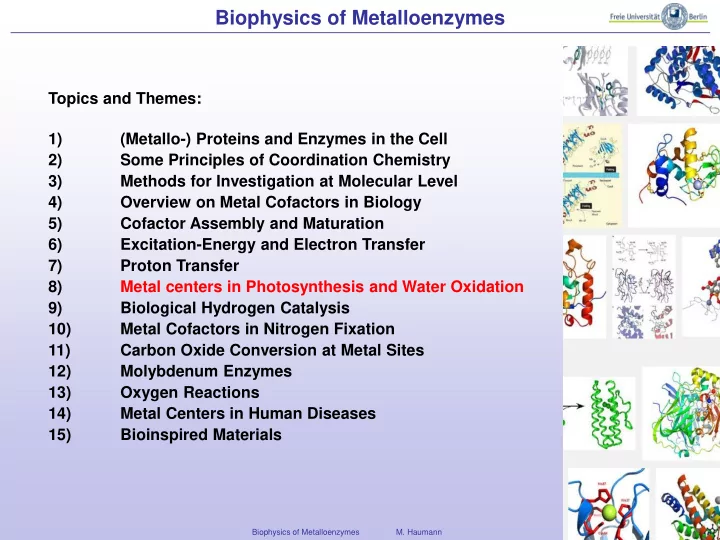
Topics and Themes: 1) (Metallo-) Proteins and Enzymes in the Cell 2) Some Principles of Coordination Chemistry 3) Methods for Investigation at Molecular Level 4) Overview on Metal Cofactors in Biology 5) Cofactor Assembly and Maturation 6) Excitation-Energy and Electron Transfer 7) Proton Transfer 8) Metal centers in Photosynthesis and Water Oxidation 9) Biological Hydrogen Catalysis 10) Metal Cofactors in Nitrogen Fixation 11) Carbon Oxide Conversion at Metal Sites 12) Molybdenum Enzymes 13) Oxygen Reactions 14) Metal Centers in Human Diseases 15) Bioinspired Materials

slide-2
SLIDE 2

Photosynthesis

http://bioenergy.asu.edu/

slide-3
SLIDE 3

O2 H2

fuel cell

H2O

never-ending resources efficient conversion systems sunlight water „fuel“

„Green“ fuel for heating, powering of machines, electricity.... Solar Age – Hydrogen Economy

slide-4
SLIDE 4

Hypothetical Ideal Conversion Machine

slide-5
SLIDE 5

(1) Natural systems (whole organisms, biological catalysts) (2) Tailored biological enzymes for desired function (3) Biomimetic devices (e.g. artificial photosynthesis) (4) Synthetic catalysts (5) Future applications Photosynthesis: Production of atmospheric oxygen (O2), reducing power, biomass Hydrogenases: Biological hydrogen (H2) production Understanding the mechanisms of biological enzymes may pave the road to future biomimetic and biotechnological systems to switch to renewable energy resources.

Coupling Photosynthesis and Hydrogenases

slide-6
SLIDE 6

10 µm

Photo- bioreactors

Systems for O2 and H2

e.g. green algae (Chlamydomonas)

slide-7
SLIDE 7

hydrogenase modul photosystem modul electron donor light

Ihara et al Photochem Photobiol 2006

e- 2H+ H2 PSI / H2ase chimera

Taylored Enzymes

slide-8
SLIDE 8

electrode electrode

... in progress in ongoing (inter)national collaborative research initiatives

Semi-Artificial Hybrid Systems

slide-9
SLIDE 9

light light

https://www.hfpeurope.org/uploads/1103/1597/SOLARH_STYRING_TechDays05_051208.pdf

e-

„Manganese complex“ „Tyrosine linker“ „Chlorophyll“

„Photosystem“ „Hydrogenase“

Supramolecular Chemistry

slide-10
SLIDE 10

Biophysics of Metalloenzymes

  • M. Haumann

SS2014

Thylakoid membrane with proteins

  • f light

reactions

stroma lumen

Chloroplast Leaf Cell Thylakoids

slide-11
SLIDE 11

Photosystem II Photosystem I ATP-Synthase Cytochrome Complex 2H2O O2 + 4H+ ATP NADPH Photosynthetic Electron Transfer Chain

slide-12
SLIDE 12

Z-Scheme Diagram Photosystem II Photosystem I

Conversion of Light into Chemical Energy

slide-13
SLIDE 13

Overall Reactions

Photosystem II dark (CO2 fixation) and light (photosystems) reactions

slide-14
SLIDE 14

Manganese Complex Photosystem II

Subunit composition Antenna proteins Reaction center (D1D2)

slide-15
SLIDE 15

membrane

Loll et al Nature 2005

0.3 mm Manganese Complex PSII Structure

Since 2001 Latest structure 1.9 Å (2011) PSII crystal Electron density Mn complex

slide-16
SLIDE 16

Manganese Complex Tyrosines Chlorophylls Phaeophytins Iron Carotenoids Cytochrome Quinones

Cofactor Arrangement

slide-17
SLIDE 17

Cofactor Distances

http://pubs.rsc.org/en/content/articlehtml/2009/cs/b802262n

slide-18
SLIDE 18

Oxygen Evolution Pattern

Clark O2 electrode O2 + 4e- -> 2H2O damping due to „misses“

O2 from isolated PSII protein under short light flashes

2H2O -> O2 + 4e-

slide-19
SLIDE 19

S-state cycle Manganese Complex

O2

Kok et al. 1970 2 H2O + 4 photons  O2 + 4 protons + 4 electrons

Water Oxidation Cycle

slide-20
SLIDE 20

Manganese Complex Structure

1.9 Å resolution crystal structure: Mn/Ca positions and µO resolved Crystal structure: all Mn-O bonds ~2.2 Å => Mn(II) mostly due to X-ray photoreduction Generation of high-valent structure by in- silico reversion of “damage”

Kamiya et al. Nature 2011

Crystal structure of high-valent Mn4Ca cofactor can not be obtained by conventional X-ray crystallography due to rapid photoreduction

slide-21
SLIDE 21

Fast Mn reduction by X-rays

Haumann et al. 2005

Time-resolved X-ray absorption spectroscopy (XAS) reveals fast Mn reduction and defines irradiation period

  • r X-ray dose for „safe“ measurements

Under crystallography conditions, all Mn(III/IV) ions are reduced within <1 s to Mn(II)

slide-22
SLIDE 22

XFEL Structure

Suga et al, Nature 2015 1.95 Å resolution No radiation damage!

slide-23
SLIDE 23

EPR on Mn Complex

Cox et al, Acc Chem Res 2013

S2 state Mn(IV)3(III)

slide-24
SLIDE 24

XAS on Mn Complex

Mn-O/N Mn-Mn/Ca 20K RT

Haumann et al. Biochemistry 2005

S1 S2 S3 S0

  • interatomic distances at Mn complex
  • metal-metal distances
  • structural changes in reaction cycle

Freeze-quench experiments (20K) and time-resolved experiment (RT) give essentially similar structural parameters

Changes in S-state cycle

20K RT

Haumann et al. Biochemistry 2005

slide-25
SLIDE 25

nn

http://www.springerimages.com/Images/LifeSciences/1-10.1007_s11120-009-9473-8-4

  • linear-dichroism XAS

relying on oriented sample and polarized X-ray beam Orientation of met6al- metal vectors (and metal- ligand) relative to membrane plane 3D structural model of metal complex

LD-XAS

slide-26
SLIDE 26

Structural & Redox Changes

Yz

  • x

Yz, H+ Yz

  • x

Yz Yz

  • x

Yz, H+

S4

Yz

  • x

2H2O Yz, 2H+, O2 IV +IV IV IV

S2

IV +IV IV III

S1

IV +III III IV

S0

III III IV +III

S3

slide-27
SLIDE 27

Mn Mn Mn Mn

µ-O bridge formation µ-OH deprotonation Substrate water binding Manganese

  • xidation

Atomic Level Model of Mn Complex

S1-state

slide-28
SLIDE 28

Electron Transfer

Van Leeuwen, Photosynth Res 1993 Gerenczer, Biochemistry 2010

Absorption difference spectra S1->S2 S2->S3 S0->S1

ET half-time Mn-complex -> TyrZ+ S0-S1 30 µs S1-S2 100 µs S2-S3 250 µs S3-S0 1000 µs (O2)

S1->S2 S2->S3 S3->S0 Laser-flash induced optical transients

slide-29
SLIDE 29

Time-Resolved XAS on Mn Redox Changes

  • 0,3

0,0 0,3 0,6 0,9 1,2

  • 0,3

0,0 0,3 0,6 0,9 1,2

  • 3

3 6 9 12

  • 0,3

0,0 0,3 0,6 0,9 1,2

Time [ms] DF(t) for excitation at 6552 eV

OXIDATION REDUCTION

190 µs 1.1 ms 70 µs  30 µs 10%

A B C D

6570 6560 6550 6540 1

A B

6544 6540 0,1

Energy / eV S1S2 S3 S0 0F1F 2F 3F XANES K-edge shifts due to Mn redox Time traces Kinetics reveals that Mn is oxidized 3-times in S-state cycle

Haumann et al. Science 2005

slide-30
SLIDE 30

Kß Emission on Mn Redox Changes

Kß line energy shifts in reaction cycle due to Mn redox and coordination changes

Zaharieva et al. Biochemistry 2016

slide-31
SLIDE 31

Calibration with Reference Compounds

Mn reference compounds

Zaharieva et al. Biochemistry 2016

slide-32
SLIDE 32

Coordination Changes in S-state Cycle

Kß emission line and K-edge absorption shape changes suggest ligation changes at Mn ions in S-state cycle Zaharieva et al. Biochemistry 2016 XANES Kß PSII model complexes

slide-33
SLIDE 33

Coordination Change during S2->S3

Several options for possible structural changes remain – more research required

Zaharieva et al. Biochemistry 2016

slide-34
SLIDE 34

XFEL results

Kern et al. Nature 2018

slide-35
SLIDE 35

Oxygen binding to manganese

Kern et al. Nature 2018

New oxygen species bound to Mn1 in S3

slide-36
SLIDE 36

Proton Release During Water Oxidation

Haumann & Junge Biochemistry 1994

Lumen

pH- indicator strong pH-buffer (+inhibitors)

Absorption changes of pH-indicator Rapid proton release t1/2 ~ 20 µs on all S-transitions Slow (1 ms) protons on S3->S0 oxygen evolving step in parallel to O2 formation

slide-37
SLIDE 37

pH-Dependent Changes in Stoichiometry

  • Rapid (~20 µs) proton release
  • n all S-transitions
  • pH dependent amplitudes
  • protons are released when

tyrosineZ is still oxidized (prior to electron transfer from Mn complex to YZ+)

  • electrostatic origin of protons

from amino acid side chains in response to positive charges

  • n Mn causing pK shifts

(Bohr-effect)

slide-38
SLIDE 38

PT and ET monitored by XAS

6556 eV

250 µs

  • 1

1 2 3 4 5 0,1 1

Time [ms]

Fmax-F(t)

200 µs 1.1 ms

S0 S3 YZ

+

YZ YZ

+ Intermediate State

< 1 µs

Neither Mn oxidation nor reduction Mn reduction and O2-formation Mn reduction on S3-S0

  • xygen-evolving step

Kinetic deviation from single- exponential behaviour (lag phase of ~250 µs) indicates intermediate formation prior to Mn reduction

slide-39
SLIDE 39

Kinetic H/D Isotope Effects

Zaharieva, Dau, Haumann, Biochemistry 2016

slide-40
SLIDE 40

Protons in PSII studied by PBD

kinetic traces, f(T) activation energy H/D isotope effect

Large H/D effect, large Ea, large pH-dependence have unraveled new proton release associated kinetic phases

Klauss, Haumann, Dau, PNAS 2013

slide-41
SLIDE 41

Reaction Sequence of S2->S3 Transition

Spatio-temporal orchestration of electron and proton transfer essential for efficient water

  • xidation
slide-42
SLIDE 42

D1-TyrZ D1-His190 CP43-Arg357 lumen D1-Asp61

Dau & Haumann Coord Chem Rev 2008

Reaction Sequence of O2 Release Step

slide-43
SLIDE 43

Protons at Acceptor Side

Gated ET following coordination change at iron due to additional change on quinone

Chernev et al. 2011

slide-44
SLIDE 44

Alternating ET and PT

Klauss, Haumann, Dau, PNAS 2013

slide-45
SLIDE 45

Water Oxidation Under Pressure

S0+H++O2 S4 S2

*-OOH

0.2 bar 2 bar 10 bar

pO2

G

60 meV

Hypothesis: O2 product inhibition of water oxidation limits atmospheric O2 level to ~20 % XAS at high pO2

Haumann et al, PNAS 2008

No pO2 limitation of water oxidation! (secondary effects

  • n Mn redox state)
slide-46
SLIDE 46

Cofactor Redox Potentials

Zaharieva & Dau 2009

slide-47
SLIDE 47

Energetics of Water Oxidation

Zaharieva & Dau 2009

slide-48
SLIDE 48

PSII Efficiency

Zaharieva & Dau 2009

slide-49
SLIDE 49

Biophysics of Metalloenzymes

  • M. Haumann

SS2014

QM/MM S-State Cycle

Sproviero et al JACS 2008

slide-50
SLIDE 50

MD on PSII in the Membrane

Pathways for H2O, O2, H+ diffusion Molecular movies!

slide-51
SLIDE 51

Mechanism of O=O Bond Formation

Cox et al, Acc Chem Res 2013

slide-52
SLIDE 52

Artificial Leaf

Nocera, Acc Chem Res 2011

slide-53
SLIDE 53

Summary

Solar fuels Hybrid systems Photosynthetic electron transfer chain Photosystem II Structure Cofactors Water oxidation cycle Manganese complex Spectroscopic characterization Electron transfer Proton transfer Reaction cycle Energetics O=O bond formation Research perspectives

slide-54
SLIDE 54

Literature

Photosynthesis, Lawlor et al, Bios Scientific Publ 2004 Recent developments in research on water oxidation by photosystem II, Dau H, Zaharieva I, Haumann M. Curr Opin Chem Biol. 2012, 16,3-10 Principles, efficiency, and blueprint character of solar-energy conversion in photosynthetic water oxidation, Dau H, Zaharieva I, Acc Chem Res. 2009, 42, 1861-70 Crystal structure of oxygen-evolving photosystem II at a resolution of 1.9 Å, Umena Y, Kawakami K, Shen JR, Kamiya N. Nature, 2011, 473, 55-60 Biological water oxidation, Cox N, Pantazis DA, Neese F, Lubitz W. Acc Chem Res. 2013, 46, 1588-96