biotic and abiotic characteristics . ABIOTIC BIOTIC water - - PDF document

biotic and abiotic characteristics
SMART_READER_LITE
LIVE PREVIEW

biotic and abiotic characteristics . ABIOTIC BIOTIC water - - PDF document

Unit B Chap 3 Class Slides.notebook May 06, 2011 Students will explain that the biosphere is composed of ecosystems, each with distinctive biotic and abiotic characteristics . ABIOTIC BIOTIC water minerals Other organisms Question 1,


slide-1
SLIDE 1

Unit B ­ Chap 3 ­ Class Slides.notebook 1 May 06, 2011

Students will explain that the biosphere is composed of ecosystems, each with distinctive biotic and abiotic characteristics.

BIOTIC ABIOTIC Other organisms water minerals

Question 1, 2, 3 p. 78 ­ Abiotic and Biotic components for pronghorns, humans and starfish

Define and explain the interrelationship among species, population, community and ecosystem

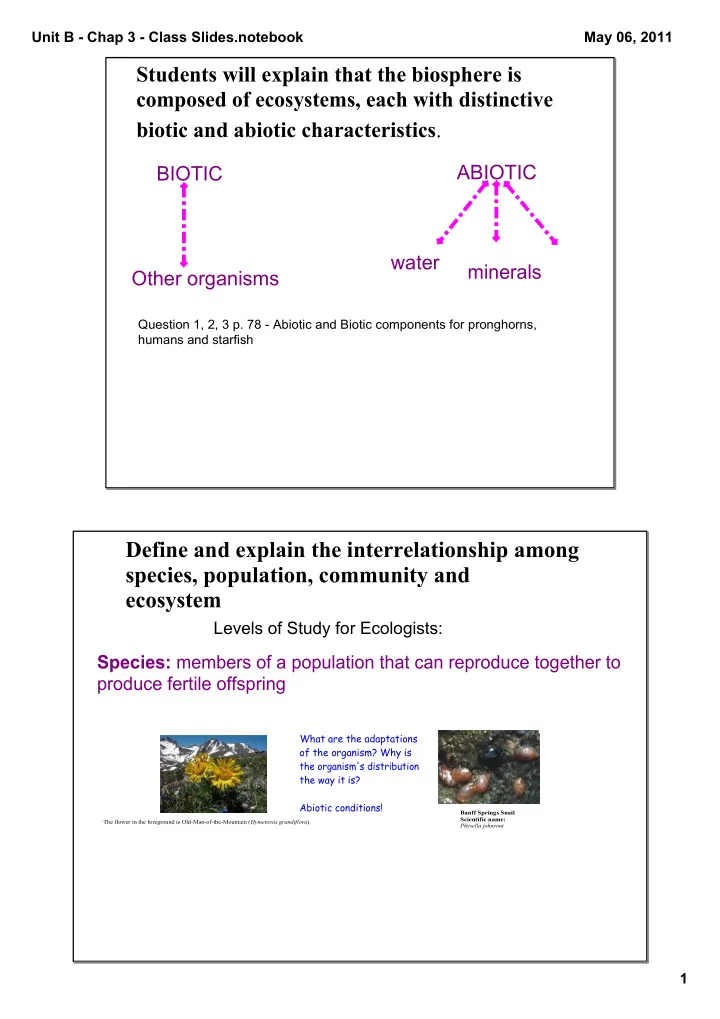
Species: members of a population that can reproduce together to produce fertile offspring

Levels of Study for Ecologists:

The flower in the foreground is Old­Man­of­the­Mountain (Hymenoxis grandiflora). Banff Springs Snail Scientific name: Physella johnsoni

What are the adaptations

  • f the organism? Why is

the organism's distribution the way it is? Abiotic conditions!

slide-2
SLIDE 2

Unit B ­ Chap 3 ­ Class Slides.notebook 2 May 06, 2011

Species: members of a population that can reproduce together to produce fertile offspring Population: members of the same species that are in a defined area at a specific time Community: populations of different organisms that exist in the same area Ecosystem: the interaction of the biotic and abiotic components in a characteristic environment

Levels of Study for Ecologists:

Population: members of the same species that are in a defined area at a specific time

How does the size of the population change?At what rate does the population change, both in size and in nature? Which biotic and abiotic factors influence this?

The collared pica (Ochotona colllaris)

p.80

Community: populations of different organisms that exist in the same area

How many populations are there? How do different populations interact?

  • Competition
  • Predator/Prey
  • Abiotic factors

Forest vs. Forest Fragment Within species Between species Moisture and sunlight

Community: populations of different organisms that exist in the same area Ecosystem: the interaction of the biotic and abiotic components in a characteristic environment

Ecosystem: the interaction of the biotic and abiotic components in a characteristic environment

Environments change over time... as one species/ population/ community/ biotic factor changes, it can make the environment more or less suitable for other organisms! After a forest fire, organisms that live well in open spaces establish

  • themselves. As they do so, they create

shade, alter the soil, and start making the environment more suitable for other

  • rgansims.

Species (biotic) Population (biotic) Community (biotic) Ecosystem (biotic and abiotic)
slide-3
SLIDE 3

Unit B ­ Chap 3 ­ Class Slides.notebook 3 May 06, 2011

The biosphere contains many types of ecosystems. The biosphere can be divided into terrestrial (land) and aquatic (water) ecosystems. Each ecosystem can have distinct parts with different conditions!

Community: populations of different organisms that exist in the same area Ecosystem: the interaction of the biotic and abiotic components in a characteristic environment

Ex: Terrestrial Ecosystem niches: Vertical stratification in forests

Freshwater ecosystems: Lakes and ponds Saltwater ecosystems: Oceans and seas

Explain how limiting factors influence

  • rganism distribution and range

Community: populations of different organisms that exist in the same area Ecosystem: the interaction of the biotic and abiotic components in a characteristic environment

Examples: water availability, temperature, food availability, disease, predators Increases in these factors restrict the range and distribution of populations. Organisms only exist within the range of tolerance to their resources that support them.

Community: populations of different organisms that exist in the same area Ecosystem: the interaction of the biotic and abiotic components in a characteristic environment

Biotic Factors: competition, predators, parasites

Trout Arctic Foxes

slide-4
SLIDE 4

Unit B ­ Chap 3 ­ Class Slides.notebook 4 May 06, 2011

Community: populations of different organisms that exist in the same area Ecosystem: the interaction of the biotic and abiotic components in a characteristic environment

Climate and Biomes: average weather conditions (temperature and rainfall) determine which biomes (large ecosystems) exist in certain areas

Community: populations of different organisms that exist in the same area Ecosystem: the interaction of the biotic and abiotic components in a characteristic environment

Abiotic Factors: soil type, moisture/humidity, temperature range Ex: cottonwood trees in southwestern Alberta Changes to river flow affects the periodic flooding of banks and thus water availability to cottonwood trees.

Community: populations of different organisms that exist in the same area Ecosystem: the interaction of the biotic and abiotic components in a characteristic environment

Habitat and Range: organisms live in their habitat (place with specific abiotic and biotic conditions) throughout their range (geographical area where they are found) Snow leopards inhabit the mountainous regions and alpine meadows of China, India, Kazakhstan, Kyrgyz Republic, Mongolia, Nepal, Pakistan, Russia and Tajikistan. (RANGE) In the summertime, they occur in high altitudes, from 2,700 and 6,000 m., but in the wintertime, they usually don't go above 1,800 m. in altitude. Their population is highly fragmented throughout their range. (SPECIFIC HABITAT)

slide-5
SLIDE 5

Unit B ­ Chap 3 ­ Class Slides.notebook 5 May 06, 2011

Community: populations of different organisms that exist in the same area Ecosystem: the interaction of the biotic and abiotic components in a characteristic environment

Ecological Niche: species can share habitat and range if their niche (role) is different

Classification and Taxonomy Why classify organisms?

Community: populations of different organisms that exist in the same area Ecosystem: the interaction of the biotic and abiotic components in a characteristic environment

  • Predictive value: if several members of a group have a characteristic,

another species in this group will probably also have this characteristic.

For example, if two plants are related (i.e., in the same genus) and one of the plants is a source of food or drug, there is a reasonable chance the other will, too. Consider taxol, from the bark of the Pacific yew (Taxus brevifolia) that is being used to treat breast cancer. Unfortunately, the bark of about 3 trees is required to treat a single patient.A thorough search has shown that taxol also occurs in other species (which from a practical perspective will make this potential medicine more readily available).

slide-6
SLIDE 6

Unit B ­ Chap 3 ­ Class Slides.notebook 6 May 06, 2011

Community: populations of different organisms that exist in the same area Ecosystem: the interaction of the biotic and abiotic components in a characteristic environment

  • Species identification: it is

easier to find out which species an organism belongs with if

  • rganisms are already classified

rather than in a disorganized catalogue.

Paua: Edible Sea Snails

Community: populations of different organisms that exist in the same area Ecosystem: the interaction of the biotic and abiotic components in a characteristic environment

  • Evolutionary links: species that are in the same group probably share

characteristics because they have evolved from a common ancestor, so the classification of groups can be used to predict how they evolved.

(a) Silverswords (Asteraceae) in Hawaii - incredible diversity of form & habitat, adaptive radiation of ancestor from mainland, studies show that the transition from wet → dry occurred several times (b) Southern beech (Notofagus) - are distributed in New Zealand and southern South America. taxonomic studies can help explain this distribution (biogeography) and the date of divergences (ca. 80 mya);

Taxonomy –is the process of classifying or organizing

  • rganisms into groups based on shared characteristics.

It uses a system of rules to group or classify organisms.

Community: populations of different organisms that exist in the same area Ecosystem: the interaction of the biotic and abiotic components in a characteristic environment

slide-7
SLIDE 7

Unit B ­ Chap 3 ­ Class Slides.notebook 7 May 06, 2011

Taxonomy was highly refined by Carl Linnaeus. He developed the system of binomial nomenclature. This means that every organism can be identified using two names. The rules for binomial nomenclature are as follows:

Community: populations of different organisms that exist in the same area Ecosystem: the interaction of the biotic and abiotic components in a characteristic environment

  • The first name is the genus name
  • The genus name is given an upper­case first letter
  • The second name is the species name
  • The species name is given a lower case first letter
  • Italics are used when the name is printed
  • The name is underlined if it is handwritten

Phascolarctos cinereus Alligator mississippiensis

Phascolarctos, is derived from phaskolos "pouch" and arktos "bear". cinereus, means "ash­coloured"

Panthera tigris altaica

Modern taxonomy divides all organisms on the planet in to five kingdoms, each with 8 other subdivisions, the last two always being the genus and

  • species. The 7 levels of classification are: kingdom, phylum, class, order,

family, genus, and species. Species are defined as a group of organisms that can reproduce together to produce fertile offspring.

Community: populations of different organisms that exist in the same area Ecosystem: the interaction of the biotic and abiotic components in a characteristic environment

The three domains of life have been added to this classification. Danish King Phillip Came Over For Green Spinach! See p. 87 - characteristics!

slide-8
SLIDE 8

Unit B ­ Chap 3 ­ Class Slides.notebook 8 May 06, 2011

EXAMPLE ­ Humans and Great White Sharks

Community: populations of different organisms that exist in the same area Ecosystem: the interaction of the biotic and abiotic components in a characteristic environment

Taxon Humans Great white shark Kingdom Animalia Animalia Phylum Chordata Chordata Class Mammalia Condrichthyes ­ Elasmobranchii Order Primate Laminformes Family Hominidae Lamnidae Genus Homo Carcharodon species sapiens carcharias

Dichotomous Keys A classification tool used by taxonomists to identify the name/taxon of an unkown

  • rganism. They consist of a series of numbered statements. Each series consists of

a pair of alternative characteristics. Some alternatives lead to the next set of statements and characteristics while other alternatives state the name of the

  • rganism.

Example: Creating Dichotomous Keys Page 90­91

Complete: Procedure #1-9 Analysis #1-3 and Conclusion #4

slide-9
SLIDE 9

Unit B ­ Chap 3 ­ Class Slides.notebook 9 May 06, 2011

Clade­ a group (large or small, recent­extant or past­extinct) of organisms that evolved from a common ancestor

Cladistics­a method of classifying living

  • rganisms based on the construction and

analysis of cladograms Cladogram­ a tree/bush/branching diagram that illustrates the groups of organisms with common ancestors. It is based on analysis of biochemical differences (amino acids of the same protein, or DNA differences) between species, not the traditional morphological differences. Uses of cladograms­primarily used to determine evolutionary origins of species.

Cladogram Example ­ Parrot Species