Bird blow flies: Benign blood-suckers or RUBL range retraction - PowerPoint PPT Presentation
Bird blow flies: Benign blood-suckers or RUBL range retraction rascals? Charlotte Harding and Carol Foss New Hampshire Audubon Findings from last year Nestling found with larvae attached 26/38 nests with P. shannoni puparia Most
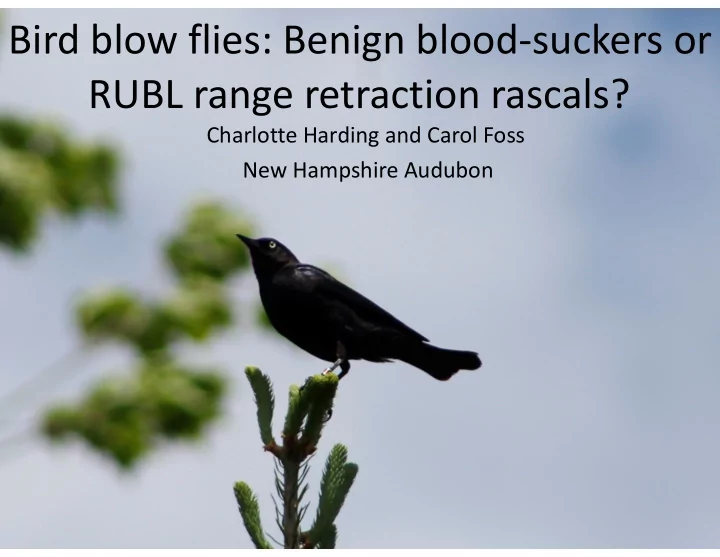
Bird blow flies: Benign blood-suckers or RUBL range retraction rascals? Charlotte Harding and Carol Foss New Hampshire Audubon
Findings from last year • Nestling found with larvae attached • 26/38 nests with P. shannoni puparia • Most severe: DIXI (31), MI14 (35), COBR (77)
Bird blow flies ( Protocalliphora ) 7-14 days or more depending on temp 24-48 hours www.bioflycontrol.co.uk
Bird blow flies ( Protocalliphora ) 7-14 days or more depending on temp 24-48 hours Molt www.bioflycontrol.co.uk
Bird blow flies ( Protocalliphora ) 7-14 days or more depending on temp Non-feeding 24-48 hours prepupal stage Molt Molt www.bioflycontrol.co.uk
Bird blow flies ( Protocalliphora ) 7-14 days Non-feeding 24-48 hours prepupal stage Molt Molt www.bioflycontrol.co.uk
Protocalliphora shannoni Rare in west • Intermediate stratum and • canopy Commonly associated with • American robins Other confirmed hosts: • – Red-winged blackbird, common grackle, eastern bluebird, gray catbird, jays (blue and gray), thrushes (hermit; Swainson’s, wood), sparrows (song and white-throated), cedar waxwing, house wren, yellow-rumped warbler *all IDs confirmed by T. Whitworth
2016 Field Season • Learn more about blow fly parasitism of RUBLs • What makes nests more or less susceptible to severe infestation? • Is blow fly parasitism decreasing RUBL nest success? • Is threat of blow fly parasitism increasing with warmer weather patterns? – Explosion of other blood-sucking ectoparasites
Our Approach • 2 nest camera setups • Monitored nest activity • Nests collected after fledging and sent for analysis • Rearing cages set up for 3 nests that had most severe infestations in 2015
Nest Analysis • 17/25 nests infested • 6 nests - P. shannoni only • 5 nests - P. metallica only • 6 nests - mixed infestations
Nest Analysis • 17/25 nests infested • 6 nests - P. shannoni only • 5 nests - P. metallica only • 6 nests - mixed infestations Protocalliphora metallica • Ubiquitous • Frequently occurs in marsh habitats and infests ground-nesters
Possible correlations • What makes nests more or less susceptible to blow fly infestation? – Nestling hatch date – Nest elevation – Nest latitude – Proximity to water sources – Proximity to roads
2015 2016
Future Directions Future Directions • Continue nest collection • Better-quality nest footage • Nestling telemetry • Anemia testing
Thank you! • Carol Foss • Terry Whitworth • Peter Mason • The 2016 RUBL field season team: Patti Wohner, Shannon Luepold, Cassandra LaVoie, Katrina Fenton and Grace Mitchum
COBR female eating eggshells
COBR nestlings getting fed
DIXI nestlings getting fed
Recommend
More recommend
Explore More Topics
Stay informed with curated content and fresh updates.