Black Hole Growth in Disk Galaxies Mediated by The Secular Evolution - - PowerPoint PPT Presentation

black hole growth in disk galaxies mediated by the
SMART_READER_LITE
LIVE PREVIEW

Black Hole Growth in Disk Galaxies Mediated by The Secular Evolution - - PowerPoint PPT Presentation

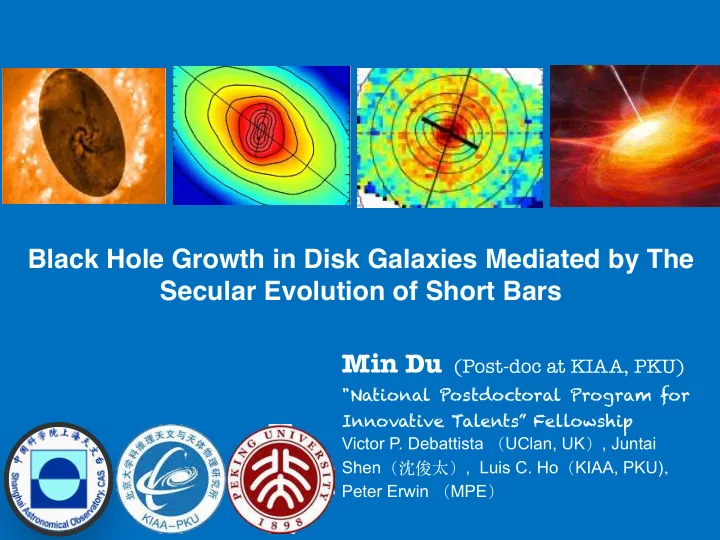
Black Hole Growth in Disk Galaxies Mediated by The Secular Evolution of Short Bars Min Du (Post-doc at KIAA, PKU) "National Postdoctoral Program for Innovative Talents Fellowship Victor P. Debattista UClan, UK , Juntai Shen


slide-1
SLIDE 1

Min Du (Post-doc at KIAA, PKU)

"National Postdoctoral Program for Innovative Talents” Fellowship Victor P. Debattista (UClan, UK), Juntai Shen(沈俊太), Luis C. Ho(KIAA, PKU), Peter Erwin (MPE)

Black Hole Growth in Disk Galaxies Mediated by The Secular Evolution of Short Bars

slide-2
SLIDE 2
  • Yesterday’s story: Gas-rich major mergers
  • Challenges: 


(1) 85% AGN hosts have no signature of major merger at z<1 (Cisternas et al. 2011); 
 (2) AGN hosts seems disk-dominated at z<3

(Schawinski et al. 2011, Kocevski et al. 2012, Simmons et al. 2012); 


(3) Massive BHs exist in disk-dominated galaxies (e.g. Filippenko & Ho 2003; Greene et al. 2010; Simmons et

  • al. 2017)
  • Only triggering most luminous quasars and AGNs

(e.g., Barnes & Hernquist 1996; Hopkins et al. 2008; Treister et

  • al. 2012)
  • Secular processes: “bars within bars” (S2B) system

and spirals (Shlosman, Frank & Begelman 1989; Hopkins and

Quataert 2010; W.-T . Kim & Elmegreen 2017)

3

Drivers of gas inflows feeding black holes (BHs)

slide-3
SLIDE 3

◆ Gas inflows driven by internal non- axisymmetric instabilities. ◆ The growth of bulge can suppress gas inflows. ◆ The short inner/ nuclear bars should play an important role.

3

Secular processes

(Hopkins & Quataert 2008)

slide-4
SLIDE 4

NGC2950 R-band

◆ Common stellar features: ~1/3 of early-type barred galaxies (e.g Erwin

2004; Erwin & Sparke 2002; Laine et al. 2002; Erwin 2003, 2004). No clear in late-type.

◆ Short: semi-major axis 0.1-1.3 kpc. Size ratio of inner and outer bars ~ 0.05-0.3, the median value 0.12 ◆ Generally, rotate faster than its

  • uter counterpart: driven gas

further into the center (Buta & Crocker

1993; Friedli &Martinet 1993; Corsini et al. 2003)

◆ Formation mechanism: the bar instability of a dynamically cold nuclear disk (e.g. Du, Shen & Debattista

2015; Wozniak 2015)

3

Basic properties of nuclear/inner bars

Inner/nuclear/secondary bar Outer/primary bar

(Erwin 2008)

slide-5
SLIDE 5
  • I. N-body simulations of S2Bs (Du et al. 2015)

Cool nuclear disk Hot outer disk Q~2 Toomre-Q R

Q<1

  • =

= ´

  • =
  • ~

~ R =

  • ~

=

  • ~

=

  • =
slide-6
SLIDE 6

NGC 2859 NGC 3941 NGC 2950 S2B MODEL

  • II. A realistic S2B model: similar kinematics

to observations (Du et al. 2016, 2017a) ◆ Velocity dispersion humps perpendicular to inner bars

(named as sigma-hollows in de Lorenzo-Caceres et al. 2008)

slide-7
SLIDE 7

Guard shells

Shen & Sellwood (2004)

  • III. Adding a BH (Du et al. 2017b)
slide-8
SLIDE 8

BH growth

  • III. I. Evolution of bar amplitudes
slide-9
SLIDE 9

Data are adopted from Reine & Volonteri (2015)

  • III. II. Mass ratio of BHs and host galaxies
slide-10
SLIDE 10

2017-6-10

  • Verified with a polar-grid code GALAXY (Sellwood 2014) and a

momentum-conserving treecode gyrfalcON (Dehnen 2000, 2014).

  • Single-nuclear barred models have been tested.
  • The uncertainty of Mbh/M* upper limit: robustness of other non-

axisymmetric structures, pre-existing classical bulge

  • III. III. Robustness of the result
slide-11
SLIDE 11

2017-6-10

SUMMARY

  • Nuclear/inner bars are fragile under the dynamical

influence of a massive BH.

  • The growth of BHs might be self-regulated, thus

generating the observed upper limit of Mbh/M*.

  • On-going work: the relics of bars destroyed by BHs,

bulge?

slide-12
SLIDE 12

2017-6-10

3D morphology Thank you!