
SLIDE 1
Black Kernel Rot Malady of Pecan
B Wood, C Bock, l Wells, T Cottrell, M Hotchkiss
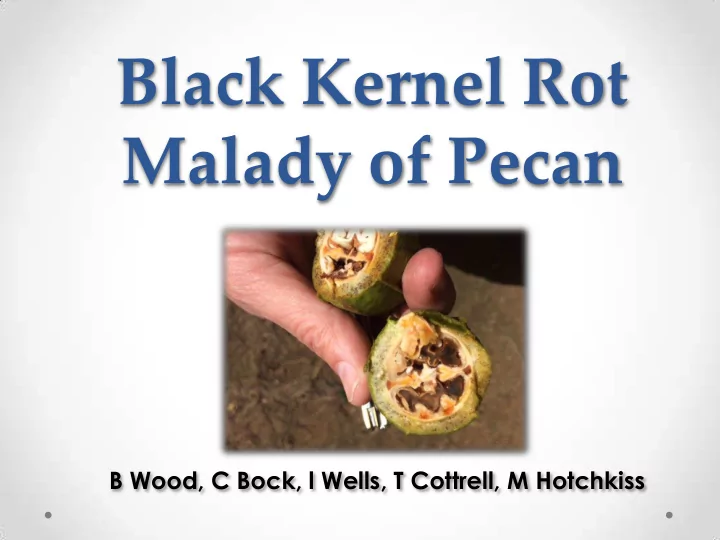
Black Kernel Rot Malady of Pecan B Wood, C Bock, l Wells, T - - PowerPoint PPT Presentation
Black Kernel Rot Malady of Pecan B Wood, C Bock, l Wells, T Cottrell, M Hotchkiss Black Kernel Rot: What is it? Black Kernel Rot: Black Phase Black Kernel Rot: Brown Phase Sampling of Fruit for Black Kernel Rot Malady (Lenny
B Wood, C Bock, l Wells, T Cottrell, M Hotchkiss
10 20 30 40 50 60 70 Oconee Sumner Stuart Desirable Cape Fear
% Rotted Kernels
Wells, L. 2015. Quality Problems Affecting 2015 Pecan Crop. The Pecan Grower Magazine 26(6):4, 6-8.
Seed Coat
Seed Coat?
Interaction?
Laboratories by Dr. John McInroy from Auburn University) of 8 culture samples from kernels exhibiting symptoms
from aerial gall on cut branches of weeping fig)
factor of the malady.
dex=8&ccid=1z2N%2bNdm&simid=608053772389712015&thid=OIP.Md73d8df8d766e49ac2ef0c598d0996a2o0&ajaxhist=0
larrymoorei endophytic bacterium
factor, then what is?
All carefully dissected symptomatic kernel seed coats exhibited splits or tears (i.e., brittle inelastic seed coats), usually in the dorsal (upper side) basal (stem end) half of the seed coat.
Basal half’s of kernel seed coats were darker brown in color than normal (i.e., likely accumulation of polyphenols due to blocked metabolism)
Seed coat tissue is fed by the phloem, so there is a missing factor that is only conditionally phloem mobile (i.e., a non- mobile nutrient)
There was water-stage fruit split in the trees (i.e., slow movement of K+ across seed coat plasma membrane)
causal factor, then was is?
Delayed lignification of shell (i.e., interference of lignin metabolism)
The malady, and water split, were simultaneously random within a tree (i.e., transitory deficiency of a non-mobile micronutrient element)
Incidence of the malady appeared to increase with crop load (i.e., a limited supply, of dilution, of a sparingly-mobile factor)
Poor kernel filling (i.e., inhibited phloem downloading or impaired membrane permabilty)
Exhibited by trees growing on southeastern soils but not by trees in southwestern soils (i.e., a factor limiting in SE soils but not in SW soils)
So, what is the simplest common denominator explaining all of the above symptoms?
Characteristic Zn Cu B Mo Ni Fe Mn N P K S Ca
Major Limiting Factor in SE Soils X X X X X X X X X X X X Seed Coat Polyphenol Accum. X X X X X X Non Mobile Nutrient Element X X X Inelastic Seed Coat X K+ Movement in Fruit X X Blockage of Lignin Metabolism X X X X X X Transitory Deficiency in Rapid Growing Fruit Tissue X X X X Impaired Kernel Filling X X X X X X X Risk of Timely Availability to Seed X X X
July-August leaf analysis shows B sufficiency (i.e., 50-60 ppm), and B is
Feb-Mar. ???
analysis but nuts still be B deficient ?
like pecan, that move sugar as sucrose. B does not mobilize once deposited in tissue.
portion of the vascular system
can be transitory deficiency in rapidly growing fruit or tissues; especially if roots are unable to access B in soils while fruit are rapidly growing.
No xylem connection to seed coat Only a phloem connection to seed coat
Fruit drop 7 days after seed coat splits
Rainfall During Late Kernel Development
Date
08/10/2015 08/17/2015 08/24/2015 08/31/2015 09/07/2015 09/14/2015 09/21/2015
Rainfall (inches)
0.0 0.2 0.4 0.6 0.8 1.0 1.2
Early Water Stage (Split causes fruit drop) Kernel Filling Time of Apparent Latent Damage Due to Late Water-stage Split? All sampled kernels had torn or split seed coats. Late Water Stage (Split does not cause fruit drop)
Instead of typical water-stage split that causes fruit to drop, we get very late stage seed coat split which in turn causes the ‘Brown/Black Kernel Rots’, but not drop?
Or
Zn, Mn, Fe, Cu, Ni regulate shell lignification
Turgor Pressure
K+
K+
Liquid Endosperm (i.e., Kernel Vacuole)
Membrane
H2O H2O
H2O
Seed Coat B enables seed coat elasticity
Kernel (Cotyledons) Shell Shuck Leaf
Split Prone Nut Split Resistant Nut
B*
Lignifying Shell
vacuole, and K+ controls the pressure on the seed coat and shell.
B*
Nut
Lignin as a Secondary Factor: Pathway for Lignin Biosynthesis in Pecan Shells
Insufficient B, Mn, Cu, Zn, Fe, or Ni reduces lignin biosynthesis, so shells are slow to stiffen enough to withstand the turgor pressure exerted from the liquid endosperm---so nuts split.
Key Enzyme Cofactors: Mn, Cu, Zn, Fe, Ni (Transition Metal Micronutrients)
micronutrient !
deficiency of any other plant micronutrient !
accentuated during rapid growth phases, especially if soil is dry when leaves or fruit are rapidly growing
cell walls
yield and quality (i.e., poor filling) and increases fruit drop.
required for lignin deposition.
inelasticity; pollen tube follows B gradient to locate the egg.
rate of K+ influx and efflux of the associated liquid endosperm.
not remobilized in pecan; so, can have plenty of B in leaves; yet, there is a deficiency in the nut due to dry soil during rapid fruit sizing.
i.e., seed coats that are darker brown, or amber grade
phloem; thus, there is only limited mobility to the developing seed and seed coat.
high soil (in feeder root zone) or plant Ca means that the tree’s B requirement is higher (Ca:B ratio of about 3,000:1)
sufficient, unless soil is dry or high in Ca or Al
with season-long moist soil?
Relationship Between Black Kernel Malady and ‘Nut Length:Width Ratio’*
10 20 30 40 50 60 70 1.814 1.785 1.723 1.674 1.64
% Kernel Malady
Oconee Desirable Sumner Stuart Cape Fear * L. Wells. 2015, Pecan Grower
5 10 15 20 25 30 35 40 45 50 2.400 2.330 2.324 1.928 1.844 1.814 1.785 1.723 1.674 1.640 1.608 1.417 1.392 1.350 1.345 1.313 1.266
% Kernel Rot
Oconee Threshold ‘Length:Width Ratio’ for Kernel Rot Malady??? Success
Su Susceptibility sceptibility likely inc likely increases reases as nut as nut length:w length:width idth rat ratio increas io increases? es?
Schley Cape Fear Desirable Choctaw Stuart Pawnee Moneymaker Elliott Wichita Sumner
Nut Length:Width Ratio
Mahan
section
season pistil receptivity, similar to Desirable
1) Ensure excellent Boron availability during fruit sizing
(Metalosate-B @12-18 fluid oz./100 gal/acre, or Solubor @ 1/16 - 1/8 lb B/100 gal/acre; and others)?
tears; enables kernel filling and lignin deposition, and lighter colored kernel meats
endosperm (K+ transfer)
2) Minimize tree water stress during late water stage
beginning of the gel stage
rapid expansion and splitting of the seed coat with rainfall
3) Ensure tree Mn, Zn, Fe, Cu and Ni nutrition is in the mid sufficiency range
shell will be strong enough to withstand the pressure generated by the liquid endosperm upon sudden rainfall, irrigation or cloud cover.
tissue specific Boron deficiency’, then low tissue B during rapid growth is likely causing other profit limiting problems:
Reduced fertilization of flowers by pollen (i.e., bursting
Premature fruit abortion/drop (i.e., inhibited movement
Water-stage fruit split (i.e., K+ pressure regulation)
Poorly filled kernel meats (i.e., low % kernel; unable to load assimilates into cotyledons)
Darker seed coats of kernels (i.e., polyphenol accumulation)
Kernel skin color: ‘Light’, ‘Light Amber’, ‘Amber’ vs. ‘Dark Amber’
and therefore incidental--