
SLIDE 1
18TH INTERNATIONAL CONFERENCE ON COMPOSITE MATERIALS
1 Introduction The widespread use of composites in airframe primary structural components (e.g., fuselage and wing) is driving the need for better understanding of the damage formed during accidental transverse impact loading. Impact damage from sources such as foreign object damage [1], hailstones, and birdstrike can lead to significant damage, particularly to internal components such as stiffeners and brackets, that is difficult to detect in laminated composites [2]. This research is focused on the damage created by accidental contact of ground service equipment (GSE) with the composite aircraft. This is the largest source of damage to commercial aircraft [3]. The geometry, or bluntness, of the indentor plays a direct role in damage formation during impact [4]. Rubber bumpers typically found on GSE distribute the impact load over a large contact area, thereby reducing the stresses causing local failures at the site
- f indentation. Thus higher forces can be applied,
which can damage internal structural components. It was observed that GSE speeds of up to 2 m/s were realistic within close proximity of a commercial aircraft. For low velocity events, dynamic impact can be experimentally represented using equivalent quasi-static indentation tests. Equivalence is shown for fracture tests [5-7] and for impacts to composite plates [8-14] and shells [15, 16]. Since quasi-static indentation can provide more insight to damage progression and mode interactions, the current study on blunt impact was conducted as quasi-static indentation tests. 2 Test Specimen Description Two large (1.83 x 1.17 m) test specimens were designed and fabricated at the University of California, San Diego (UCSD). Specimen materials are intermediate modulus carbon fiber and toughened epoxy matrix (reflecting current aerospace fuselage materials) provided by Cytec Engineered Materials. Specifically these materials are Z60/X840 unidirectional tape and 6k woven
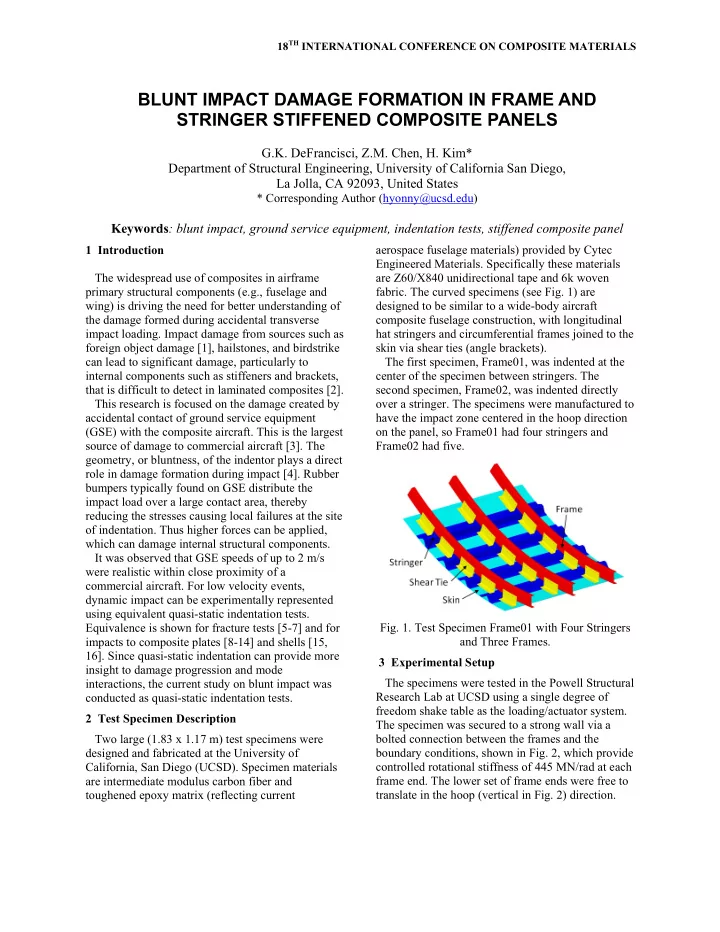
- fabric. The curved specimens (see Fig. 1) are
designed to be similar to a wide-body aircraft composite fuselage construction, with longitudinal hat stringers and circumferential frames joined to the skin via shear ties (angle brackets). The first specimen, Frame01, was indented at the center of the specimen between stringers. The second specimen, Frame02, was indented directly
- ver a stringer. The specimens were manufactured to
have the impact zone centered in the hoop direction
- n the panel, so Frame01 had four stringers and
Frame02 had five.
- Fig. 1. Test Specimen Frame01 with Four Stringers