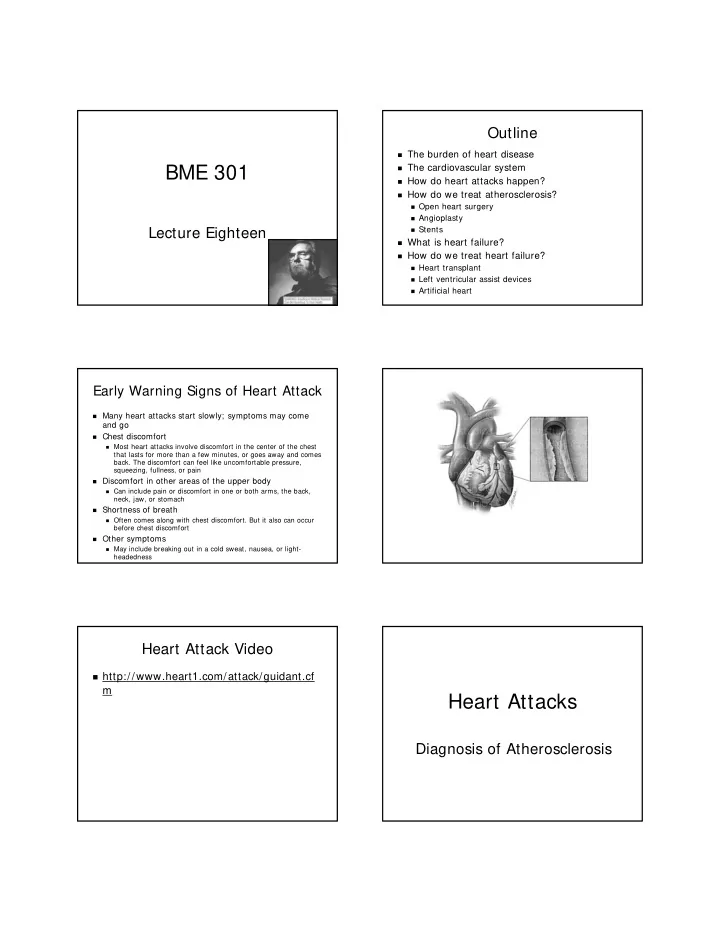
BME 301 How do heart attacks happen? How do we treat - - PDF document

bme 301
SMART_READER_LITE
LIVE PREVIEW

BME 301 How do heart attacks happen? How do we treat - - PDF document

Outline The burden of heart disease The cardiovascular system BME 301 How do heart attacks happen? How do we treat atherosclerosis? Open heart surgery Angioplasty Lecture Eighteen Stents What is heart failure?


slide-1
SLIDE 1

BME 301

Lecture Eighteen Outline

The burden of heart disease The cardiovascular system How do heart attacks happen? How do we treat atherosclerosis?

Open heart surgery Angioplasty Stents

What is heart failure? How do we treat heart failure?

Heart transplant Left ventricular assist devices Artificial heart

Early Warning Signs of Heart Attack

Many heart attacks start slowly; symptoms may come

and go

Chest discomfort

Most heart attacks involve discomfort in the center of the chest

that lasts for more than a few minutes, or goes away and comes

  • back. The discomfort can feel like uncomfortable pressure,

squeezing, fullness, or pain

Discomfort in other areas of the upper body

Can include pain or discomfort in one or both arms, the back,

neck, jaw, or stomach

Shortness of breath

Often comes along with chest discomfort. But it also can occur

before chest discomfort

Other symptoms

May include breaking out in a cold sweat, nausea, or light-

headedness

Heart Attack Video

http://www.heart1.com/attack/guidant.cf

m

Heart Attacks

Diagnosis of Atherosclerosis

slide-2
SLIDE 2

Detection of Atherosclerosis

Heart Attacks

Treatment of Atherosclerosis

How Do We Treat Atherosclerosis?

CABG

slide-3
SLIDE 3

http://www.learnaboutbypass.com/image s/illustrations/bodybypasses.gif

CABG Procedure

Patient is prepped, general anesthesia Chest access is gained, through sternum Graft vessel is retrieved Expose heart through pericardium Divert blood through heart lung machine Stop heart Insert graft Return circulation to heart Close incision

http://www.ctsnet.org/doc/3311

slide-4
SLIDE 4

Heart-Lung Machine

The heart-lung machine:

Consists of a chamber that receives the blood

from the body

Blood is pumped by machine through an

  • xygenator

Oxygenator removes CO2 and adds oxygen Pump then pumps this newly oxygenated

blood back to the body

Connected to patient by a series of tubes that

the surgical team places

Heart Lung Machine

http://www.brucemindich.com/images/bypass1.gif

Heart Lung Machine

http://www.davi dfary.com/hlm_s mall.jpg

Heart Lung Machine

http://engr.smu.edu/~ cd/EE5340/lect31/sld011.gif http://engr.smu.edu/~ cd/EE5340/lect31/sld014.gif

CABG Effectiveness

2001: 516,000 CABG procedures performed Procedure takes 4-6 hours, 5-7 day hospital stay Grafts remain open & functioning for 10-15 yrs Risks:

Heart attack (5% ) Stroke (5%) (risk greatest in those over 70 years old) Death (1-2%) Sternal wound infection (1-4% ) “Post-pericardiotomy syndrome“ (30%)

Occurs few days to 6 months after surgery Symptoms are fever and chest pain

Some people report memory loss and loss of mental

clarity or "fuzzy thinking" following CABG

Innovations

Off-pump CABG:

  • http://www.surgery.usc.edu/divisions/ct/videos-mpeg-offpumpcoronaryarterybypassgrafting.html

Closed chest CABG:

  • http://www.hsforum.com/stories/storyReader$1537
slide-5
SLIDE 5

How Do We Treat Atherosclerosis?

Angioplasty

PTCA: Effectiveness

Cannot always successfully perform

procedure

Diffuse disease Total occlusion Calcified disease

Restenosis

Occurs in 25-54% of patients Usually occurs within 6 months

slide-6
SLIDE 6

How Do We Treat Atherosclerosis?

Stent Stents

http://www2.cajun.net/~ wpharo/stent.jpg http://www.insel.ch/kardio/kardiorehab/bilder/stent.jpg http://www.wbamc.amedd.army.mil/images/newsphotos/stent% 20implantation.jpg

Stents

http://www.priory.com/cmol/stent3.jpg http://www.hybridmedicalanimation.com/media/mdtrnc_stent .jpg

Drug Eluting Stents

http://www.npr.org/features/feature.php?

wfId= 1452217

Comparison of RX Methods

Hospital Stay:

CABG – 4-7 days Angioplasty – 1-2 days Stent – 1-2 days

Restenosis:

CABG – 5-6%, usually after 5 years Angioplasty – 25-45%, usually within 6

months

Stent – 15-20%, usually within 6 months

Comparison of RX Methods

Cost

CABG $35,000 Angioplasty $17,000 Stent $19,000

Cost-effectiveness

Additive procedures:

Within 5 years, 20-40% of patients have second PTCA, 25%

have CABG

Additive costs:

0 years: per patient costs of PTCA 30-50% those of CABG 1 year: 50-60% 3 years: 60-80% > 3 years: > 80%

Moving Target Problem

slide-7
SLIDE 7

What Would You Do?

Angioplasty Stent CABG

Cost-Effectiveness

Therapy Patient Group $ per yr life saved tPA Post MI high risk $3,600 tPA Acute MI, large infarct, treatment started > 2 hours post $24,200 Counseling Smoking cessation $1300-$3900 CABG Two vessel disease, severe angina $9,200-$42,500

http://www.sciencedirect.com/science?_ob= ArticleURL&_aset= B-WA-A-A-A-MsSAYZA-UUA AUYWDCBYZYAUYUBBVZZYBWAUBWEUBAU&_rdoc= 1&_fmt= full&_udi= B6T1048NJXK25&_cover Date= 5%2F22%2F2003&_cdi= 4876&_orig= search&_st= 13&_sort= d&view= c&_acct= C00000437 8&_version 1&_urlVersion= 0&_userid= 108429&md5= 5f493caa5f65762c23c0d90eaea8b92d

Prevention or Treatment?

http://www.nytimes.com/2004/03/21/heal

th/21HEAR.html

Progression of Heart Disease

High Blood Pressure High Cholesterol Levels Atherosclerosis Ischemia Heart Attack Heart Failure