BNF grammars (1/3) BNF grammars offer concise language - - PowerPoint PPT Presentation

bnf grammars 1 3
SMART_READER_LITE
LIVE PREVIEW

BNF grammars (1/3) BNF grammars offer concise language - - PowerPoint PPT Presentation

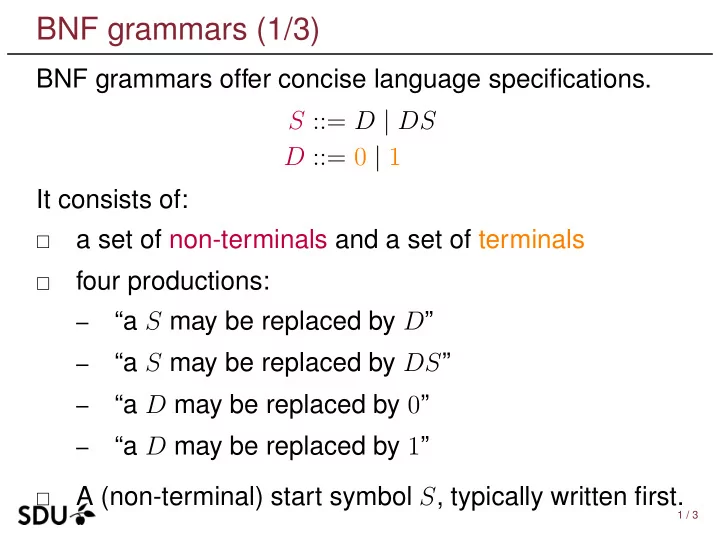
BNF grammars (1/3) BNF grammars offer concise language specifications. S ::= D | DS D ::= 0 | 1 It consists of: a set of non-terminals and a set of terminals four productions: a S may be replaced by D a S may be replaced


slide-1
SLIDE 1

BNF grammars (1/3)

1 / 3

BNF grammars offer concise language specifications. S ::= D | DS D ::= 0 | 1 It consists of:

  • a set of non-terminals and a set of terminals
  • four productions:

“a S may be replaced by D”

“a S may be replaced by DS”

“a D may be replaced by 0”

“a D may be replaced by 1”

  • A (non-terminal) start symbol S, typically written first.
slide-2
SLIDE 2

BNF grammars (2/3)

2 / 3

BNF grammars offer concise language specifications. S ::= D | DS D ::= 0 | 1 They do so by expressing a set of derivable strings. Recipe: Repeatedly replace a non-terminal by a right-hand-side until there’s only terminals left: S → D → 0 S → DS → 0S → 0D → 01 S → DS → 1S → 1DS → 10S → 10D → 101 Q: Which language does this grammar represent?

slide-3
SLIDE 3

BNF grammars (2/3)

2 / 3

BNF grammars offer concise language specifications. S ::= D | DS D ::= 0 | 1 They do so by expressing a set of derivable strings. Recipe: Repeatedly replace a non-terminal by a right-hand-side until there’s only terminals left: S → D → 0 S → DS → 0S → 0D → 01 S → DS → 1S → 1DS → 10S → 10D → 101 Q: Which language does this grammar represent? Exercise: alter the grammar to yield base-10 numbers

slide-4
SLIDE 4

BNF grammars (3/3)

3 / 3

BNF is short for ‘Backus-Naur Form’ named after John Backus and Peter Naur. A BNF can express a ‘Context-Free Language’. These are strictly more powerful than, e.g., regular expressions. Most language specifications today come with a BNF. Q: Which languages do the following grammars define? S ::= 0 | 01 | 01S (terminals: 0, 1) S ::= ab | aSb (terminals: a, b) S ::= e | S + S | S − S (terminals: e, +, −) S ::= s | s;S | {S} (terminals: s, ;, {, })