
SLIDE 1
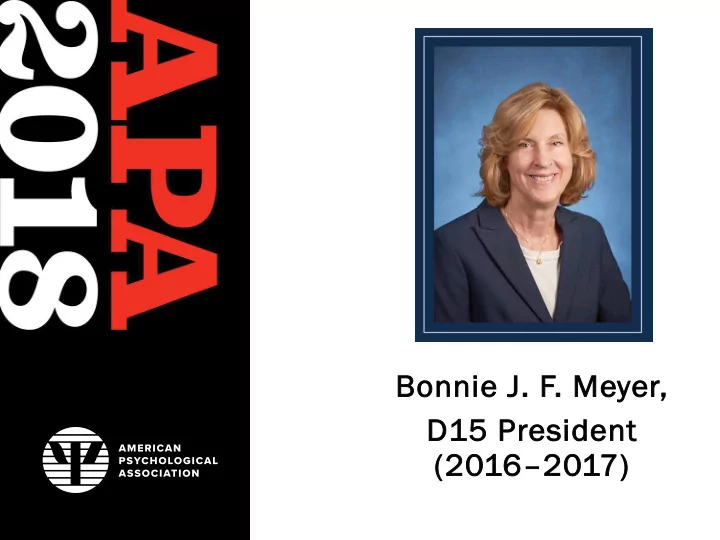
Bo Bonnie ie J. F. Meyer, D1 D15 Presid ident (20 (201620 - - PowerPoint PPT Presentation
Bo Bonnie ie J. F. Meyer, D1 D15 Presid ident (20 (201620 2017) 7) Thank you for the honor of serving our division. Development, , Im Impact, a , and O Outreach of t f the T Text S Structure Strategy t to B Boost Re
But many struggle – 64% of 8th graders at or below basic reading levels (NAEP, 2017) and they lack needed proficiency.
Medical decision- making
th Graders T
e.g .g., M ., Meyer & & Wije Wijekumar (2007, 2 , 2016) In Intelligent T Tutoring
the S Structure S Strategy ( (IT ITSS): A : A R Reading S Strategy T Tutor
Same student’s recall of an article comparing black flying fox bats to leaf- nosed bats after 1 10 IT ITSS l lessons with comparison texts: “There are 2 different kinds of
nosed bat. The Black flying fox bat is
feet wide and weigh more than 3
Leaf-noised is smaller than the Black flying bat. the leaf-nois bat is only 1 foot wide. The leaf-nois bats come in different (colors) and mostley feeds on masquitoes and moths.”
George W. McConkie Sherry L. Willis Wendy Middlemiss Carol H. Walker Michael Marsiske Elena S. Theodorou
Andrew P. Talbot Ana I. Schwartz Brendan J. Bartlett Carlee (Pollard) Ranalli James P. Dillard Bruce K. Britton Connie Russo Carole Young Roy O. Freedle Dorothy Evensen Yu-Chu Lin Leonard W, Poon Melissa N. Ray Karen R. Harris Kausalia (Kay) Wijekumar Gregory Convertino Roy B. Clariana Pui-Wa Lei Kristen M. Weber Ping Li Jennifer J. Ireland John Carroll Steve Graham
Denise H. Solomon
David Brandt; Michael Cook
Three Grown Children: : teacher, veterinarian, & computer scientist Three grandchildren ages two to five years
structure strategy & extensions in Grades 5 – 8
where she integrated the text structure strategy into science, math, and writing classes.
school districts
Her quick Sketch of K-12 Evidence-Based Best Practices Note back of chair: Text Structure as Integral Component
Comprehension Instruction Daughter, a teacher and collaborator –a “homegrown” Productive Partnership in schools
Passion –developing Persistence & Curiosity Past Present
Three Development Grants from the Institute of Education Sciences in the U.S. Department of Education Grants (2003 – 2019+) and Four Efficacy Grants
Co-PI: Wijekumar, Middlemiss, & van Horn; collaborators: Lei & Sperling
Improving Reading Comprehension of Middle Grades English Language Learners by Combining Structure Strategy with Web- Based Adaptive Tutoring for ELLearners (SWELL), Wijekumar [PI], Co-PI: Meyer, Lei, & Schwartz
Development of a web-based writing partner (WE-WRITE
PERSUASIVELY) to improve writing persuasive essays for 5th grade
students, Wijekumar [PI], Co-PI: Harris, Graham, Meyer, & Lei
Two Efficacy Grants from IES
(Another 2 IES efficacy grants just began in July 2018 following up on the SWELL and We-Write grants to TAMU [PI Wijekumar])
Efficacy and Replication Research on the Intelligent Tutoring System for the Structure Strategy -- Rural and Suburban Schools Grades 4, 5, 7, and 8. Wijekumar [PI], Co-PIs: Meyer, Lei, and Kulikowich). Efficacy and Replication Trial of the Individualized Adaptive ITSS with 4th- and 5th-Grade Students in High Poverty
Scientific A American a articles v varied i in l logical s structure ( (outline o
all t text i ideas)
Study Findings Influence on Structure Strategy Interventions Meyer (1971) Meyer & McConkie (1973) Logical structure predicted text recall better than serial position or rated importance. Structure of text was related to aspects of cognitive structures constructed by readers. Method for studying comprehension: Identifying main ideas versus details in the logical structure
Reading t the B Brain a and R Reading i in t the B Brain: In : Integrative Approaches t toward F First a and S Second L Language C Comprehension. . Li, P , P [ [PI] I], , Cla Clariana, R , R. & . & M Meyer, B , B. J . J. F . F. [ . [Co-PI} I}, N , National S Science Foundation, 8 , 8/1/2015-7/ 7/31/ 1/20 2019.
. Fo Follmer, D , D. J . J., F ., Fang, S , S.-Y., ., Cl Clar ariana iana, R , R., M ., Meyer, B , B. J . J. F . F., & ., & L Li, P , P. . (2 (2018). ). Wh What at predicts a adult r readers’ u ’ understanding o
f STEM t texts? Re Reading and W Writing, 31 31(1), 1 , 185-21 214.
Miy Miyat atsu, N , Nguyen, & , & M McDaniel ( (2018). . Cited t the t text s structure s strategy w work f for o
implementation o
f outlining and m marking ( (highlighting a and u underlining)
Free f flowing h hierarchical structure ( (Meyer, 1 , 1971)
Application t to t texts o
multiple paragraphs: G : Grimes’ S ’ Semantic G Grammar
Propositions ( (Meyer, 1 , 1974; 1 ; 1975)
Pattern & type of relationships affect recall high in the structure, but not low (Meyer, 1975) -- Led to ---> Focus on relationships at the top levels of logical hierarchical structures = top-level structures
problem/ solution problem PREVENT OIL SPILLS FROM SUPERTANKER solution (listing) (1) TRAIN OFFICERS (2) BUILD TANKERS (3) INSTALL GROUND CONTROL STATIONS comparison HALT USE description (specifics attributes) explanation cause/effect cause LACK POWER & STEERING description (specifics attributes) description (specifics attributes) effect description cause SPILLS effect KILLS description description 200,000 SEABIRDS subordinate propositions = details problem/ soltuion top- level structure CAPITALIZED WORDS ARE WORDS FOR THE TEXT and lowercase words show interrelationships. description comparison (analogy) AIR TOWERS description
problem/ solution problem PREVENT OIL SPILLS FROM SUPERTANKER solution (listing) (1) TRAIN OFFICERS (2) BUILD TANKERS (3) INSTALL GROUND CONTROL STATIONS comparison HALT USE description (specifics attributes) explanation cause/effect cause LACK POWER & STEERING description (specifics attributes) description (specifics attributes) effect description cause SPILLS effect KILLS description description 200,000 SEABIRDS subordinate propositions = details problem/ soltuion top- level structure CAPITALIZED WORDS ARE WORDS FOR THE TEXT and lowercase words show interrelationships. description comparison (analogy) AIR TOWERS description
Meyer, Brandt, & Bluth, 1980
Authentic E Expository T Text & & S Signaling ( (Meyer, 1 , 1975; ; Meyer, B , Brandt, & , & B Bluth, 1 , 1980) underlined = = s signaling; c ; caps = = m main i idea; l ; lower c case = = major d details; i ; italics = = m minor d details; ;
A PROBLEM OF VITAL CONCERN IS PREVENTION OF OIL SPILLS FROM SUPERTANKERS. A typical supertanker carries a half-million tons of oil and is the size of five football fields. A wrecked supertanker spills oil into the ocean; this oil kills animals, birds, and microscopic plant life. For example, when a tanker crashed off the coast of England, more than 200,000 dead seabirds washed ashore. Oil spills also kill microscopic plant life which provide food for sea life and produces 70 percent of the world's
and steering equipment to handle emergencies, such as storms. Supertankers have only one boiler to provide power and one propeller to steer the ship.
Second p paragraph o
Authentic E Expository T Text & & Signaling ( (Meyer, 1 , 1975; M ; Meyer, e , et a al., 1 ., 1980) underlined = = s signaling; c ; caps = = m main i idea; l ; lower c case = = major d details; i ; italics = = m minor d details; ;
Only 48% of the entire sample of 9th-grade students organized their recall with the same structure as the text on at least one
comparison texts (Meyer et al., 1980). Sample of default list strategy: “This passage is about oil spills. The oil spills on the ocean and poisens them. When the oil spills it kills animals too and, poisens
something about 3 football fields.”
Processing model for use
structure strategy (Meyer, 1984; Meyer & Rice, 1982).
PASSIO ION –for developing programmatic research about text structure
Comparison Signaling Words used in Comparison Structure Relates ideas on the basis of differences and similarities. The main idea is organized in parts that provide comparison between differences and similarities. instead; but; however; or; alternatively; whereas; on the
in comparison; in contrast; in opposition; not everyone; all but; have in common; similarities; share; resemble; the same as; just as; more than; longer than; less than; act like; look like; unlike despite; although; just; options; difference; differentiate; different;...(plus others you can find). For example: Comparing Killer whales and Blue whales on size, color, and life span.
Meyer, Young, & Bartlett, 1989
Problem/Solution Structure Signaling Words used in Problem/Solution Structure The main ideas are organized into two parts: a problem part and a solution part that responds to the problem by trying to eliminate it,
part that responds to the question by trying to answer it. Examples: Scientific articles often first raise a question or problem and then seek to give an answer or solution. ______________________________ Problem of 7 endangered whale species, and solution of a whale sanctuary in Antarctic Ocean Problem: problem, trouble, difficulty, hazard, need to prevent, threat, danger, puzzle, question (?), query, riddle, perplexity, enigma, riddle, issue,...and more you can find.... Solution: to satisfy the problem, ways to reduce the problem, to solve these problems, protection from the problem, solution, response, answer, reply, comeback, recommendation, rejoinder, return, to set the issue at rest, suggestions ...and more you can find....
Meyer, Young, & Bartlett, 1989
Cause and Effect Structure Signaling Words used in Cause and Effect Structure Presents causal or cause and effect-like relationships between ideas. The main idea is organized into cause and effect parts. Directions often follow the Cause and Effect Structure. For example, if you want good pictures, follow these steps (the cause). Your good pictures are the effect. cause, lead to, bring about,
possible owing to, by means of, accomplish, by, since, due to, because, in order to, reasons, give reasons for, the reason why, if/then, this is why, on account of, in explanation, effect, affects, so, influenced by, as a result, result from, consequence, consequent, thus, therefore, accordingly, for the purpose of, ... and more.… For example: Inner ear damage can lead whales to beach themselves. Signaling in example: lead to
Meyer, Young, & Bartlett, 1989
Sequence Signaling Words used in Sequence Structure Ideas grouped by order in time (sometimes order of location). The main idea is the sequence of steps, procedure, or history presented. Examples: history of the Civil War, growth from birth to 12 years old, procedures in a recipe or manual. ______________________________ Growth stages of humpback whale: stage 1 nursing calf – up to 6 months, stage 2 leaving mom – 2 years old, stage 3 jumping high – 3 years old, stage 4 reaching adult size – 6 years old. Later, afterwards, afterward, after, after that, later on, then, subsequently, as time passed, following, continuing on, to end, finally, year(s) ago, at the start of first year…later that year, in the first place, in the second place, first and foremost, first, second, third, 1, 2, 3, 4, ..., next, primarily, secondarily, early, before, to begin with, to start with, more recently, again, finally, until, additionally, the former, the latter, not long after, soon, now, today, after a short while, meanwhile, immediately, last, steps, stages, time line, history, sequence, development………and more – plus look for a series of dates for histories.
Meyer, Young, & Bartlett, 1989
Listing Signaling Words Cueing the Use of a List Listing can go with any of the other
ideas together. Articles are often
about a topic. A sequence always has a listing of ideas, but more than that the list has a set order in time. A listing can occur when groups of causes are presented, groups of effects are listed, groups of problems are stated, groups of solutions are listed, groups of ideas are compared to another idea, and so forth. And, and also, also, in addition, in addition to, and then, further, furthermore, include, besides, moreover, first, second, third, fourth, etc., two, three, four, five, …., subsequent, again, at the same time, another, and so forth, too, plus, together, jointly, likewise, double, to name a few, and more you can find….. For example: My favorite whales include humpbacks, finbacks, minkes, and also the rare Right whale.
Meyer, Young, & Bartlett, 1989
St Study Fi Findings In Influence o
Structure S Strategy In Interventions
Meyer & & Fr Freedle (1978; ; 19 1984)
Training of four structures: description, problem-solution, causation, and comparison by Bartlett (1978) with 9th graders.
Enables learners to:
3. Students to use these text structures to organize their
Passion: T : Text S Structure S Studies
What A About R Readers W Who d do N Not K Know H How t to U Use S Signal W Words o
Text S Structures St Strategic ically?
Emperor penguins and Adelie penguins are ___________ from one another. Emperor penguins are large penguins. They are the largest of all penguins and may grow to 4 feet tall. These penguins can weigh more than 90 pounds. Emperor penguins display orange ear patches. They have long, yellow-orange streaked beaks in black faces. Emperor penguins feed principally
pack ice. ___________ the large emperor penguins, Adelie penguins are ___________ penguins. Adelie penguins grow only about 2 feet
white ringed, beady, black eyes. Adelie penguins have short, feathered beaks on cute faces. Adelie penguins feed almost entirely on krill. ___________ the emperor penguins, Adelie penguins live on Antarctica's pack ice.
Meyer, R , Ray, & , & M Middlemiss ( (2012) S Signaling T Test ( (summed o
two versions ( (Total P Possible = = 5 56) & & F Found L Little C Change T Toward Understanding o
Signals b by L Low C Comprehenders
Meyer, R , Ray, & , & M Middlemiss ( (2012) “U “Unlike” a ” and “S “Same a as” ” (scale i is 1 14 s summed o
two v versions o
the S Signaling t test)
Meyer, Young, & Bartlett, 1989
The structure strategy teaches readers to:
1.
Identify text structures
their signaling words
2.
Write a main idea using a particular pattern for each text structure (Main idea pattern for comparison: ____ and ____ (2 or more ideas) were compared on ______, ______, and ________).
3.
Use the main idea & structure to organize their reading comprehension and recall
Presidents Washington Lincoln Order = 1 Children = 2 Job = Farmer Order = 16 Children = 4 Job = Lawyer
Meyer et al. (2002)
1978; Carrell, 1985; Cook & Mayer, 1988; Culatta et al., 2010; Englert & Hiebert, 1984; Gordon, 1990; Meyer, 1999; Meyer & Poon, 2001; Meyer et al., 2002, Meyer, Young, & Bartlett, 1989; Paris, Cross, & Lipson, 1984; Polley, 1994; Raphael & Kirschner, 1985; Richgels, McGee, Lomax, & Sheard, 1987; Samuel et al., 1988; Slater, Graves, & Piche, 1985; Taylor & Beach, 1984; Weisberg & Balajthy, 1989; Williams et al., 2004, 2005, 2007, 2009)
th gr
+Easy versions at 2 or 3 grade levels
Meyer et al., 2010
From Meyer et al., 2010
From Meyer et al., 2010
From Meyer, Wijekumar, & Lin (2011)
From Meyer, Wijekumar, & Lin (2011)
From Meyer et al., 2010
cause and effect cause DAM BURST effect cause FLOOD effect DEAD & MISSING
First Four Paragraphs for Michael Goldman's (1997) 2-page article
Basic Training You can't teach your dog to read as television's Wishbone does. But you can teach it to be obedient -- and maybe even do a few tricks. Jackie Martin Kaptan, who trains the famous jack Russell terrier, has 20 years' professional experience working with dogs -- and even tigers, bears and wolves! Her plan can help you develop a perfectly behaved pooch. Welcome to the Family, Fido! All dogs need some training. A dog that acts nice and friendly today might not next week. It is, after all, an animal, and can act accordingly. An untrained dog may bite, chew furniture, bark all night or run
Effect
TRAIN DOG TO
BE OBEDIENT
Basic Dog Training Text
Cause
KAPTAN’S DOG TRAINING Comparison TRAINED DOG
IS WELCOME, SAFE FAMILY MEMBER
UNTRAINED
DOG: BITES, CHEWS FURNITURE, BARKS
Effect Train dog to be
Cause Jackie Kaptan’s basic training
Description Sequence
Trained dog is welcome, safe family member Untrained dog: bites, chews furniture, bark all night, run away Comparison Sequence Getting started:
weeks
crate, collar, leash, pack or bag, tennis ball & toys
leash & teach "Come" Teach Basic Commands: "Come" is the most important of basics; other basics = sit & stay List of Basic Rules for 1st 8 weeks of training:
consistently
sharp "NO" or a gentle tug on leash
time close to meals
commands simple. After 1st 8 weeks training: Polish basics & add simple tricks Train yourself to be consistent Basic Dog Training Text
Effect Train dog to be
Cause Jackie Kaptan’s basic training
Description Sequence
Trained dog is welcome, safe family member Untrained dog: bites, chews furniture, bark all night, run away Comparison Comparison Maybe even teach a few tricks: speak, shake, roll
Description Dog has much to offer: want to be with you & work Comparison Not happy sitting in backyard week after week Sequence Getting started:
weeks
crate, collar, leash, pack or bag, tennis ball & toys
leash & teach "Come" Teach Basic Commands: "Come" is the most important of basics; other basics = sit & stay List of Basic Rules for 1st 8 weeks of training:
consistently
sharp "NO" or a gentle tug on leash
time close to meals
commands simple. After 1st 8 weeks training: Polish basics & add simple tricks Train yourself to be consistent Basic Dog Training Text
Meyer, B.J.F., Wijekumar, K.K., Lin, Y. (2011). Individualizing a Web-Based Structure Strategy Intervention for Fifth Graders’ Comprehension of
Standard (n = 66) Individualized (n = 65) t(129) p Number of texts read 51.52 (27.23) 51.72 (23.25) .05 .963 Number of lessons worked 37.11 (15.65) 38.40 (14.01) .50 .619 Number of 30-minute ITSS sessions 34.53 (10.44) 35.06 (9.51) .31 .759
! "#$$%&!'(#! )%*! +#,$-.! /01!2!345! 6,7&!7)#,! 7&!8#9,::! :#$$!;<,&! =(>! "#$$%&!'3! 6,7&!7)#,! 7&!8#9,::! :#$$!;<,&! =(>! ! "#$$%&! '(,#! ?7*! +#,$-.!
Remediation path with easy texts Remediation path with standard and alternate texts Enrichment path with alternate texts Standard ITSS path from Lesson 14 to 15
! "#$%!$&'#! $%!(')#**!! +,-!.(! /('#0'(! 1'22.%!34! 1'22.%!3+#! 5$/! 6#*0'(%#0'7! 89:!;!<=>! ! "#$! %&'()%!'*! +",#!,-)"! ,#!()&"..! /)%%'#!01! /)%%'#!02!
4%5"#-"(-6! 789!:!2;<! ! "#$$%&!'()! *+,!
2345678! 9:;!<! =)+&!+>#)! +&!0#?)..! <!(@;! "#$$%&!':! 9:;!<! =)+&!+>#)! +&!0#?)..! <!(@;! "#$$%&!'(! >%,!
2345(7A!
People Passion Persistence Past
Peppy videos about text students for student and teachers: Focus on strategic memory related to 5 text structures, e.g., http://youtu.be/d_ZL0yEeUac .
Meyer, B. J. F., & Wijekumar, K. K. (2017). Intelligent Tutoring
Crossley & D. S. McNamara (Eds.), Adaptive Educational Technologies for Literacy Instruction, pp. 82-103. New York, NY: Routledge Publishers, Taylor & Francis Group. Wijekumar, K. K., Harris, K. R., Graham, S., & Meyer, B. J. F. (2017). We-Write: A Web-Based Intelligent Tutor for Supporting Elementary Classroom Teachers in Persuasive Writing Instruction. In same book on pp. 184-203.
Meyer, B. J. F., Wijekumar, K., & Lei, P. (2018). Comparative signaling generated for expository texts by 4th–8th graders: Variations by text structure strategy instruction, comprehension skill, and signal word. Reading and Writing, On
Online from Special Issue doi:10.1007/s11145-018- 9871-4
Emperor penguins and Adelie penguins are ___________ from one another. Emperor penguins are large penguins. They are the largest of all penguins and may grow to 4 feet tall. These penguins can weigh more than 90 pounds. Emperor penguins display orange ear patches. They have long, yellow-orange streaked beaks in black faces. Emperor penguins feed principally
pack ice. ___________ the large emperor penguins, Adelie penguins are ___________ penguins. Adelie penguins grow only about 2 feet
white ringed, beady, black eyes. Adelie penguins have short, feathered beaks on cute faces. Adelie penguins feed almost entirely on krill. ___________ the emperor penguins, Adelie penguins live on Antarctica's pack ice.
Meyer et al., 2010; 2011, 2018
Meyer, B. J. F., Wijekumar, K., & Lei, P. (2018). Comparative signaling generated for expository texts by 4th–8th graders: Variations by text structure strategy instruction, comprehension skill, and signal word. Reading and Writing, Online f from S Special Is Issue doi:10.1007/s11145- 018-9871-4
Meyer, B. J. F., Wijekumar, K., & Lei, P. (2018).
Wije Wijekum umar ar, K , K., M ., Meyer, B , B.J .J.F .F., L ., Lei, P , P. e . et a
. Read W Writ ( (2017). Im . Improvi ving Content A Area R Reading C Comprehension o
f Spanish S Speaking E English Learners i in G Grades 4 4 a and 5 5 U Using W Web-based T Text S Structure In
and W
. Online fr from S Special Is Issue https:/ ://doi.o .org/10.1007/s11145-01 017-9802 9802-9
Sentence from text: They feed almost entirely on seals, which are part of Arctic sea mammals.
Wije Wijekum umar ar, K , K., M ., Meyer, B , B.J .J.F .F., L ., Lei, P , P. e . et a
. Read W Writ ( (2017). Im . Improvi ving Content A Area R Reading C Comprehension o
f Spanish S Speaking E English Learners i in G Grades 4 4 a and 5 5 U Using W Web-based T Text S Structure In
and W Writing. .
Wijekumar, K., Meyer, B.J.F., Lei, P. et al. Read Writ (2017). Improving Content Area Reading Comprehension of Spanish Speaking English Learners in Grades 4 and 5 Using Web-based Text Structure
Main research question from SWELL development grant: Do students in Grades 4 and 5 classrooms randomly assigned to SWELL, as a partial substitute for the standard language arts curriculum, outperform students in control classrooms on standardized and researcher-designed measures of reading comprehension? Promising Answer:
Awareness and strategic used of text structure are important skills of good readers (Meyer, Brandt, & Bluth, 1980), and we
The structure strategy provides students with a framework for organizing their learning that is linked to how they interpreted what they read. A reader’s cognitive representation using
Text S Structure S Strategy i integral c component o
reading comprehension i instruction –not j just s supplemental!
Next T Thorndike A Awardee, J , J. P . P. . Williams, t , taught 2 2nd
nd graders t
to use t the t text s structure s strategy
Joanna W William’s ’s v view
Text Structure as Integral Component
Comprehension Instruction
Jennifer Ireland, a “homegrown” Productive Partnership in schools Partners in schools to
settings.
https://ed.psu.edu/directory/bjm8