
NAME: _____________________________________ class period:_____
Bonding Chemistry
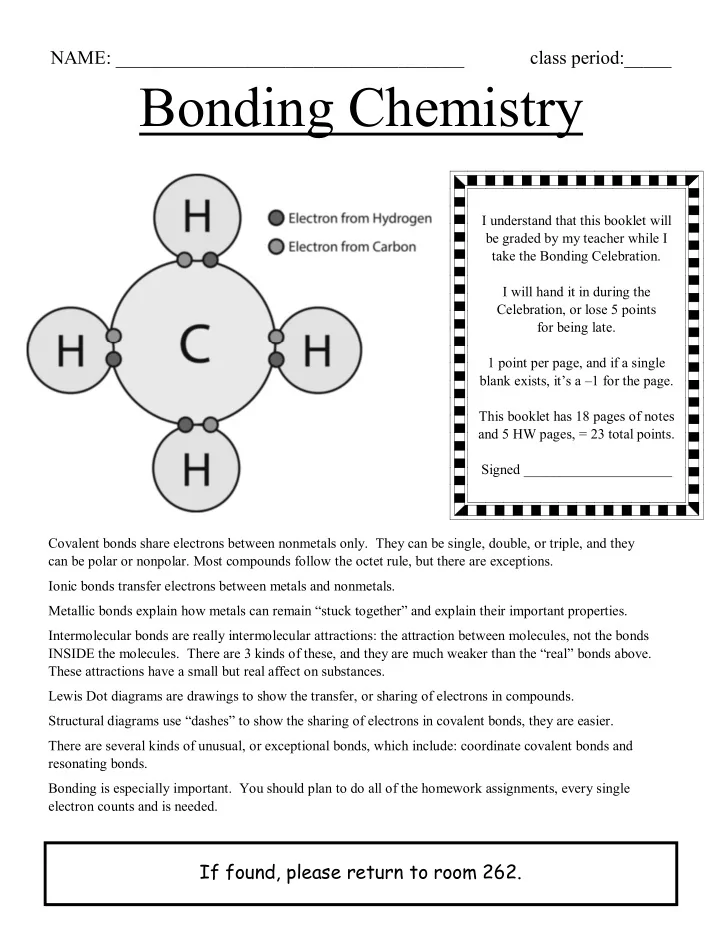
Covalent bonds share electrons between nonmetals only. They can be single, double, or triple, and they can be polar or nonpolar. Most compounds follow the octet rule, but there are exceptions. Ionic bonds transfer electrons between metals and nonmetals. Metallic bonds explain how metals can remain “stuck together” and explain their important properties. Intermolecular bonds are really intermolecular attractions: the attraction between molecules, not the bonds INSIDE the molecules. There are 3 kinds of these, and they are much weaker than the “real” bonds above. These attractions have a small but real affect on substances. Lewis Dot diagrams are drawings to show the transfer, or sharing of electrons in compounds. Structural diagrams use “dashes” to show the sharing of electrons in covalent bonds, they are easier. There are several kinds of unusual, or exceptional bonds, which include: coordinate covalent bonds and resonating bonds. Bonding is especially important. You should plan to do all of the homework assignments, every single electron counts and is needed. I understand that this booklet will be graded by my teacher while I take the Bonding Celebration. I will hand it in during the Celebration, or lose 5 points for being late. 1 point per page, and if a single blank exists, it’s a –1 for the page. This booklet has 18 pages of notes and 5 HW pages, = 23 total points. Signed _____________________
If found, please return to room 262.