Bookkeeping Due last night: Introduction survey If you havent - - PowerPoint PPT Presentation

bookkeeping
SMART_READER_LITE
LIVE PREVIEW

Bookkeeping Due last night: Introduction survey If you havent - - PowerPoint PPT Presentation

Artificial Intelligence Class 2: Intelligent Agents Dr. Cynthia Matuszek CMSC 671 Slides adapted with thanks from: Dr. Marie desJardin Bookkeeping Due last night: Introduction survey If you havent Academic integrity done


slide-1
SLIDE 1

Slides adapted with thanks from: Dr. Marie desJardin

Artificial Intelligence

Class 2: Intelligent Agents

  • Dr. Cynthia Matuszek – CMSC 671
slide-2
SLIDE 2

Bookkeeping

  • Due last night:
  • Introduction survey
  • Academic integrity
  • HW 1
  • Writing sections: 2 readings, 1 short essay, 6 questions
  • http://tiny.cc/mc-what-is-ai
  • http://ai100.stanford.edu/2016-report
  • Coding problems: out this afternoon
  • We will update on Piazza
  • Due 11:59pm, 9/19

2

If you haven’t done these, do!

slide-3
SLIDE 3

Today’s Class

  • What’s an agent?
  • Definition of an agent
  • Rationality and autonomy
  • Types of agents
  • Properties of environments

3

slide-4
SLIDE 4

Pre-Reading: Quiz

  • What are sensors and percepts?
  • What are actuators (aka effectors) and actions?
  • What are the six environment characteristics that R&N

use to characterize different problem spaces?

4

Observable Deterministic Static # of Agents Episodic Discrete

slide-5
SLIDE 5
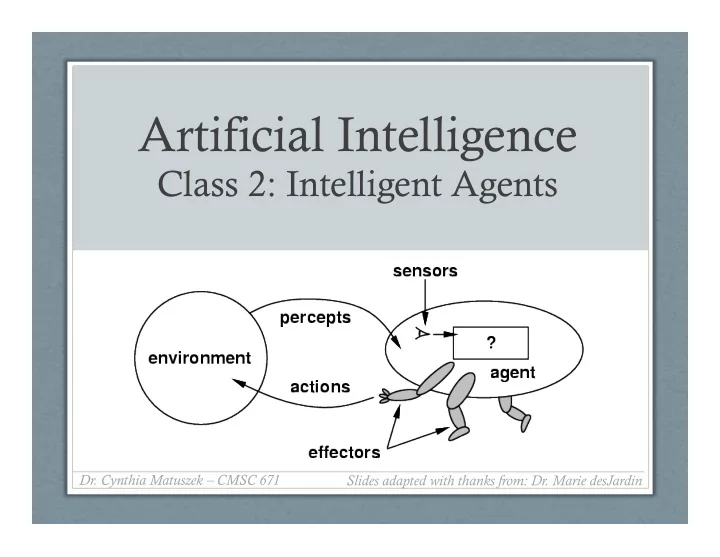
  • An intelligent agent:
  • Perceives its environment via sensors
  • Acts upon that environment with its effectors (or actuators)
  • A discrete agent:
  • Receives percepts one at a time
  • Maps this percept sequence to a sequence of discrete actions
  • Properties:
  • Autonomous
  • Reactive to the

environment

  • Pro-active (goal-directed)
  • Interacts with other agents

via the environment

5

How Do You Design an Agent?

slide-6
SLIDE 6

Human Sensors/Percepts, Actuators/Actions

  • Sensors:
  • Eyes (vision), ears (hearing), skin (touch), tongue (gustation), nose

(olfaction), neuromuscular system (proprioception), …

  • Percepts: “that which is perceived”
  • At the lowest level – electrical signals from these sensors
  • After preprocessing – objects in the visual field (location, textures, colors,

…), auditory streams (pitch, loudness, direction), …

  • Actuators/effectors:
  • Limbs, digits, eyes, tongue, …
  • Actions:
  • Lift a finger, turn left, walk, run, carry an object, …

6

slide-7
SLIDE 7

Human Sensors/Percepts, Actuators/Actions

  • Sensors:
  • Eyes (vision), ears (hearing), skin (touch), tongue (gustation), nose

(olfaction), neuromuscular system (proprioception), …

  • Percepts: “that which is perceived”
  • At the lowest level – electrical signals from these sensors
  • After preprocessing – objects in the visual field (location, textures, colors,

…), auditory streams (pitch, loudness, direction), …

  • Actuators/effectors:
  • Limbs, digits, eyes, tongue, …
  • Actions:
  • Lift a finger, turn left, walk, run, carry an object, …

7

The Point:

  • Percepts and actions need

to be carefully defined

  • Sometimes at different

levels of abstraction!

slide-8
SLIDE 8

E.g.: Automated Taxi

  • Percepts: Video, sonar, speedometer, odometer, engine sensors, keyboard

input, microphone, GPS, …

  • Actions: Steer, accelerate, brake, horn, speak/display, …
  • Goals: Maintain safety, reach destination, maximize profits (fuel, tire wear),
  • bey laws, provide passenger comfort, …
  • Environment: U.S. urban streets, freeways, traffic, pedestrians, weather,

customers, …

  • Different aspects of driving may require different types of

agent programs!

8

slide-9
SLIDE 9

Rationality

  • An ideal rational agent, in every possible world state, does

action(s) that maximize its expected performance

  • Based on:
  • The percept sequence (world state)
  • Its knowledge (built-in and acquired)
  • Rationality includes information gathering
  • If you don’t know something, find out!
  • No “rational ignorance”
  • Need a performance measure
  • False alarm (false positive) and false dismissal (false negative) rates, speed,

resources required, effect on environment, constraints met, user satisfaction, …

9

slide-10
SLIDE 10

Autonomy

  • An autonomous system determines its own

behavior

  • But not if all its decisions are included in its design
  • I.e., all decisions are made by its designer according to a

priori decisions

  • Good autonomous agents need:
  • Enough built-in knowledge to survive
  • The ability to learn
  • In practice this can be a bit slippery

10

slide-11
SLIDE 11

Some Types of Agent (1)

  • 1. Table-driven agents
  • Use a percept sequence/action table to find the next action
  • Implemented by a (large) lookup table
  • 2. Simple reflex agents
  • Based on condition-action rules
  • Implemented with a production system
  • Stateless devices which do not have memory of past world states
  • 3. Agents with memory
  • Have internal state
  • Used to keep track of past states of the world

11

slide-12
SLIDE 12

Some Types of Agent

  • 4. Agents with goals
  • Have internal state information, plus
  • Goal information about desirable situations
  • Agents of this kind can take future events into consideration
  • 5. Utility-based agents
  • Base their decisions on classic axiomatic utility theory
  • In order to act rationally

12

slide-13
SLIDE 13

(1) Table-Driven Agents

13

  • Table lookup of:
  • Percept-action pairs mapping
  • Every possible perceived state ßà optimal action for that state
  • Problems:
  • Too big to generate and store
  • Chess has about 10120 states, for example
  • No knowledge of non-perceptual parts of the current state
  • E.g., background knowledge
  • Not adaptive to changes in the environment
  • Change by updating entire table
  • No looping
  • Can’t make actions conditional on previous actions/states
slide-14
SLIDE 14

(1) Table-Driven/Reflex Agent

slide-15
SLIDE 15

(2) Simple Reflex Agents

  • Rule-based reasoning
  • To map from percepts to optimal action
  • Each rule handles a collection of perceived states
  • Problems
  • Still usually too big to generate and to store
  • Still no knowledge of non-perceptual parts of state
  • Still not adaptive to changes in the environment
  • Change by updating collection of rules
  • Actions still not conditional on previous state

15

slide-16
SLIDE 16

(3) Agents With Memory

  • Encode “internal state” of the world
  • Used to remember the past (earlier percepts)
  • Why?
  • Sensors rarely give the whole state of the world at each input
  • So, must build up environment model over time
  • “State” is used to encode different “world states”
  • Different worlds generate the same (immediate) percepts
  • Requires ability to represent change in the world
  • Could represent just the latest state
  • But then can’t reason about hypothetical courses of action
  • Example: Rodney Brooks’ Subsumption Architecture.

16

slide-17
SLIDE 17

(3) Architecture for an Agent with Memory

17

slide-18
SLIDE 18

(4) Goal-Based Agents

  • Choose actions that achieve a goal
  • Which may be given, or computed by the agent
  • A goal is a description of a desirable state
  • Need goals to decide what situations are “good”
  • Keeping track of the current state is often not enough
  • Deliberative instead of reactive
  • Must consider sequences of actions to get to goal
  • Involves thinking about the future
  • “What will happen if I do...?”

19

slide-19
SLIDE 19

(4) Architecture for Goal-Based Agent

20

slide-20
SLIDE 20

(5) Utility-Based Agents

  • How to choose from multiple alternatives?
  • What action is best?
  • What state is best?
  • Goals à crude distinction between “happy” / “unhappy” states
  • Often need a more general performance measure (how “happy”?)
  • Utility function gives success or happiness at a given state
  • Can compare choice between:
  • Conflicting goals
  • Likelihood of success
  • Importance of goal (if achievement is uncertain)

21

slide-21
SLIDE 21

(4) Architecture for a complete utility-based agent

22

slide-22
SLIDE 22

Properties of Environments

  • Fully observable/Partially observable
  • If an agent’s sensors give it access to the complete state of

the environment, the environment is fully observable

  • Such environments are convenient
  • No need to keep track of the changes in the environment
  • No need to guess or reason about non-observed things
  • Such environments are also rare in practice

23

slide-23
SLIDE 23

Properties of Environments

  • Deterministic/Stochastic.
  • An environment is deterministic if:
  • The next state of the environment is completely determined by
  • The current state of the environment
  • The action of the agent
  • In a stochastic environment, there are multiple,

unpredictable outcomes.

  • In a fully observable, deterministic environment, the agent

need not deal with uncertainty.

24

slide-24
SLIDE 24

Properties of Environments

  • Episodic/Sequential
  • An episodic environment means that subsequent episodes do not

depend on what actions occurred in previous episodes.

  • In a sequential environment, the agent engages in a series of

connected episodes.

  • Such environments do not require the agent to plan ahead.
  • Static/Dynamic
  • A static environment does not change while the agent is thinking.
  • The passage of time as an agent deliberates is irrelevant.
  • The agent doesn’t need to observe the world during deliberation.

25

slide-25
SLIDE 25

Properties of Environments III

  • Discrete/Continuous
  • If the number of distinct percepts and actions is limited, the

environment is discrete, otherwise it is continuous.

  • Single agent/Multi-agent
  • If the environment contains other intelligent agents, the agent

needs to be concerned about strategic, game-theoretic aspects of the environment (for either cooperative or competitive agents)

  • Most engineering environments don’t have multi-agent

properties, whereas most social and economic systems get their complexity from the interactions of (more or less) rational agents.

26

slide-26
SLIDE 26

Characteristics of Environments

Fully

  • bservable?

Deterministic? Episodic? Static? Discrete? Single agent?

Solitaire Backgammon Taxi driving Internet shopping Medical diagnosis

27

slide-27
SLIDE 27

Characteristics of Environments

Fully

  • bservable?

Deterministic? Episodic? Static? Discrete? Single agent?

Solitaire No Yes Yes Yes Yes Yes Backgammon Taxi driving Internet shopping Medical diagnosis

28

slide-28
SLIDE 28

Characteristics of Environments

Fully

  • bservable?

Deterministic? Episodic? Static? Discrete? Single agent?

Solitaire No Yes Yes Yes Yes Yes Backgammon Yes No No Yes Yes No Taxi driving Internet shopping Medical diagnosis

29

slide-29
SLIDE 29

Characteristics of Environments

Fully

  • bservable?

Deterministic? Episodic? Static? Discrete? Single agent?

Solitaire No Yes Yes Yes Yes Yes Backgammon Yes No No Yes Yes No Taxi driving No No No No No No Internet shopping Medical diagnosis

30

slide-30
SLIDE 30

Characteristics of Environments

Fully

  • bservable?

Deterministic? Episodic? Static? Discrete? Single agent?

Solitaire No Yes Yes Yes Yes Yes Backgammon Yes No No Yes Yes No Taxi driving No No No No No No Internet shopping No No No No Yes No Medical diagnosis

31

slide-31
SLIDE 31

Characteristics of Environments

Fully

  • bservable?

Deterministic? Episodic? Static? Discrete? Single agent?

Solitaire No Yes Yes Yes Yes Yes Backgammon Yes No No Yes Yes No Taxi driving No No No No No No Internet shopping No No No No Yes No Medical diagnosis No No No No No Yes

32

slide-32
SLIDE 32

Characteristics of Environments

Fully

  • bservable?

Deterministic? Episodic? Static? Discrete? Single agent?

Solitaire No Yes Yes Yes Yes Yes Backgammon Yes No No Yes Yes No Taxi driving No No No No No No Internet shopping No No No No Yes No Medical diagnosis No No No No No Yes

33

→ Lots of (most?) real-world domains fall into the hardest case! ←

slide-33
SLIDE 33

Summary: Agents

  • An agent:
  • Perceives and acts in an environment
  • Has an architecture
  • Is implemented by an agent program(s)
  • An ideal agent:
  • Always chooses the “right” action
  • Which is, that which maximizes its expected performance
  • Given its percept sequence so far!
  • An autonomous agent:
  • Uses its own experience to learn and make decisions
  • Rather than built-in knowledge
  • I.e., a priori world knowledge by the designer

34

slide-34
SLIDE 34

Summary: Agents

  • Representing knowledge is important for

successful agent design

  • Percepts, actions and their effects, constraints, …
  • The most challenging environments are:
  • Partially observable
  • Stochastic
  • Sequential
  • Dynamic
  • Continuous
  • Contain multiple intelligent agents

35