Bottlenose Dolphins ..and how to protect them SEFSC MMPA Permit - - PowerPoint PPT Presentation

bottlenose dolphins
SMART_READER_LITE
LIVE PREVIEW

Bottlenose Dolphins ..and how to protect them SEFSC MMPA Permit - - PowerPoint PPT Presentation

Bottlenose Dolphins ..and how to protect them SEFSC MMPA Permit No. 14450 Jenny Litz, PhD Acting Marine Mammal Branch Chief NOAA Fisheries, Southeast Fisheries Science Center October 15, 2020 NOAA, SEFSC, Marine Mammal Program Promote


slide-1
SLIDE 1

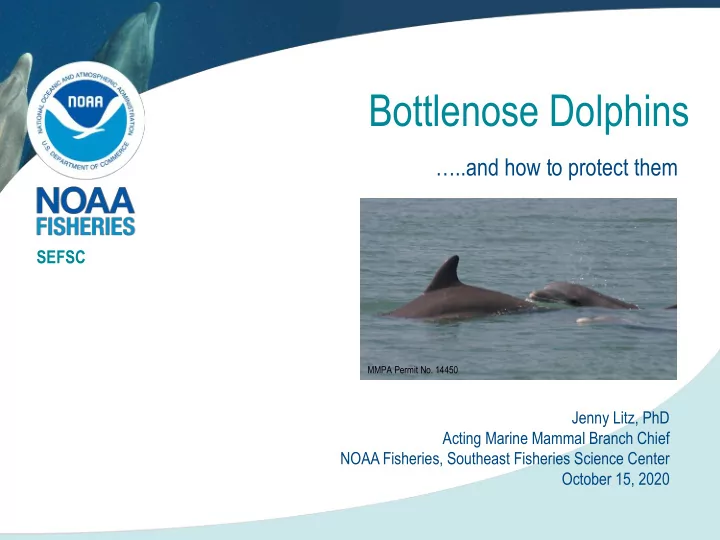
Bottlenose Dolphins

…..and how to protect them

SEFSC

Jenny Litz, PhD Acting Marine Mammal Branch Chief NOAA Fisheries, Southeast Fisheries Science Center October 15, 2020

MMPA Permit No. 14450
slide-2
SLIDE 2

NOAA, SEFSC, Marine Mammal Program

  • Promote stewardship of MM populations through science-based

conservation and management

  • Research seeks to:
  • Monitor abundance of dolphin and whale populations
  • Delineate population and stock structure (>25 species and >90

stocks)

  • Assess human impacts and determine the status of marine

mammal populations

  • Examine causes of mortalities and perform risk assessments
  • Investigate mitigation measures to protect marine mammals

while minimizing effects on economic activities

U.S. Department of Commerce | National Oceanic and Atmospheric Administration | NOAA Fisheries | Page 2

Sperm whale: SEFSC MMPA Permit GoM Bryde’s whale: SEFSC MMPA Permit North Atlantic Right Whale Pilot whale

slide-3
SLIDE 3

Our toolkit includes:

  • Research cruises for oceanic species
  • Aerial surveys for coastal species
  • Small boat surveys in Bay/sounds/estuaries
  • Passive acoustics
  • Genetics
  • Tagging and biopsy
  • Stranding response

NOAA, SEFSC, Marine Mammal Program

slide-4
SLIDE 4

Biscayne Bay Bottlenose Dolphin Study

  • Comprehensive Photo-ID sampling since 1994
  • Over 400 dolphins in the catalog
  • ~300 seen in recent years (2010-2019)
  • Previous analyses included social structure, genetics for

population structure, and POPs

slide-5
SLIDE 5

Study Area

Northern Biscayne Bay is more extensively developed than southern Biscayne Bay

U.S. Department of Commerce | National Oceanic and Atmospheric Administration | NOAA Fisheries | Page 5

slide-6
SLIDE 6

How Photo-ID works

U.S. Department of Commerce | National Oceanic and Atmospheric Administration | NOAA Fisheries | Page 6

  • Appropriate research permits to photograph dolphins,

procedures to limit harassment

  • Thousands of photographs and data are collected in the field
slide-7
SLIDE 7

How Photo-ID works

U.S. Department of Commerce | National Oceanic and Atmospheric Administration | NOAA Fisheries | Page 7

  • Photos are sorted,

matched and cataloged

  • Survey, sighting and

animal data is entered into an archival database

Chop dorsal fin Trailing edge notches Dorsal fin tip missing, trailing edge notches Trailing edge notches Distinctive scratches or scars Leading edge notch

MMPA Permit No. 14450 MMPA Permit No. 14450 MMPA Permit No. 14450

slide-8
SLIDE 8

Biscayne Bay Sighting Histories

U.S. Department of Commerce | National Oceanic and Atmospheric Administration | National Marine Fisheries Service | Page 8

#008 1994 #008 2015

Dolphin #008 – first sighted in 1990 Has been sighted 94 times, with at least 9 calves and 4 “grand-calves” identified so far. Primarily seen in the northern half of the Bay.

#213 (3rd calf of #008 with her calf, 2018)

MMPA Permit No. 14450 MMPA Permit No. 14450

slide-9
SLIDE 9

U.S. Department of Commerce | National Oceanic and Atmospheric Administration | NOAA Fisheries | Page 9

Dolphin #072 – first sighted in 1994 Has been sighted 43 times, with at least 5 calves Primarily seen in the southern half of the Bay

Biscayne Bay Sighting Histories

#072 1995 #072 2019 #072 with calf 2016

MMPA Permit No. 14450 MMPA Permit No. 14450

slide-10
SLIDE 10

Persistent Organic Pollutants (POPs)

U.S. Department of Commerce | National Oceanic and Atmospheric Administration | National Marine Fisheries Service

  • Northern BB dolphins have high levels of

PCBs

  • Studies elsewhere link high PCBs in dolphins

to decreased immune function and reduced reproductive success

  • Dolphins are reflective of the bioavailable

contaminants in their ecosystem SPCBs in sediments

(NOAA, NS&T Program, 1999) (Litz et. al. 2007)

SPCBs in 31 male/juv dolphins

MMPA Permit No. 14450

slide-11
SLIDE 11

Stressors – not just Biscayne Bay but everywhere

U.S. Department of Commerce | National Oceanic and Atmospheric Administration | National Marine Fisheries Service

  • Urban development
  • Habitat loss
  • Boat traffic/harassment
  • Noise
  • Contaminants/run-off
  • Fishing gear

entanglement/ingestion

  • Marine debris

entanglement/ingestion

Photo: HSWRI Photo: NOAA Photo: NOAA

slide-12
SLIDE 12

Responsible viewing

Chronic disturbance from vessels and swimmers can cause both short- and long-term impacts to dolphins such as:

  • Injury or death from boat strikes
  • Separation of mom/calf
  • Changes in social structure
  • Abandonment of habitat
  • And more….

https://www.fisheries.noaa.gov/topic/marine-life-viewing-guidelines#guidelines-&-distances

U.S. Department of Commerce | National Oceanic and Atmospheric Administration | National Marine Fisheries Service

slide-13
SLIDE 13

There are many harmful effects of feeding dolphins: increase in fishing gear entanglements and ingestions

Photo: Mote Marine Lab

slide-14
SLIDE 14

Marine Debris – Entanglement and Ingestion

U.S. Department of Commerce | National Oceanic and Atmospheric Administration | NOAA Fisheries | Page 14

Photo credit: Sarasota Dolphin Research Program Photo credit: FMMSN

slide-15
SLIDE 15

15

slide-16
SLIDE 16

How you can help dolphins?

  • 1. Don't feed or attempt to feed wild dolphins!
  • 2. Admire From A Distance! Stay far away!
  • 3. Recycling Fishing Line and Trash!
  • 4. Follow Dolphin Friendly Fishing Tips!
  • 5. Properly dispose of trash & don’t release balloons
  • 6. Report stranded or injured dolphins or whales to:

1-877-WHALE HELP (877-942-5343)

slide-17
SLIDE 17

So you want to be a marine scientist ?

  • Volunteer/internships
  • Work hard – don’t be afraid to do the

boring stuff

  • Study hard – math and science are

important but so are reading and writing

  • Don’t be afraid to follow your dreams but

also be willing to adapt to new

  • pportunities
slide-18
SLIDE 18

While some days look like this….

slide-19
SLIDE 19

Most days look like this….

slide-20
SLIDE 20

Thank you !!