
SLIDE 1
Boys & Girls Clubs: 125 Years of John Gunckels Legacy in Toledo - - PowerPoint PPT Presentation
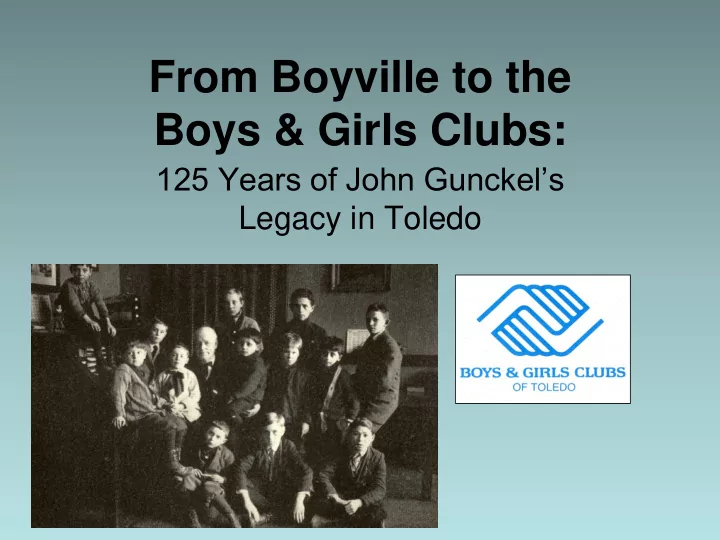
From Boyville to the Boys & Girls Clubs: 125 Years of John Gunckels Legacy in Toledo John Gunckel came to Toledo from Germantown, Ohio, in 1875. He sold real estate for a few years, and then took a job as a ticket agent for the Lake
John Gunckel came to Toledo from Germantown, Ohio, in 1875.
He sold real estate for a few years, and then took a job as a ticket agent for the Lake Shore and Michigan Southern
downtown gave him a window into the lives
selling newspapers every day to survive. “It need not be told that our newsboys, as a general rule, as people have known them, are regarded as a swearing, stealing, lying, dishonest lot of young criminals, and those qualifications are recognized as adjuncts to their business,” Gunckel observed.
Toledo’s industrial base began to expand quickly in the late 19th century, and with this rapid growth came urban problems.
Toledo in the late 19th century was a a difficult place for children. There were few social services, and many children were forced to work to help support their families. Others had no home.
Some boys found work in the glass industry, where they performed the most dangerous and difficult work for low wages. Others hawked newspapers on street corners downtown. With papers selling for as little as a penny, it was demanding work that lasted from sun up to sun down, no matter what the weather.
“Newsies” as they were called, selling their papers in Toledo. Boys working at Libbey Glass, ca. 1890.
In the heyday of the newspaper, the number
Boys were cheaper to hire than grown men, and were paid according to the number of papers they sold, minus any they returned unsold. In some cities, organizations sought to help these
Society opened a Newsboys’ Lodging House for homeless newsboys. Some publishers, fearing strikes by their newsboys could cripple their business, created protective associations to help them. A strike by newsboys in New York in 1899 cost Joseph Pulitzer’s World newspaper over half of its circulation.
Many Toledo newsboys would gather in John Gunckel’s office in the Boody House in the winter. Gunckel sought to help them as well as bring some control to a largely ungovernable group of young men. On December 25, 1892, Gunckel invited 102
the Marine Building on Water Street. “In half an hour the tables were cleared of everything that looked good to eat. Not only were their pockets filled with oranges and apples but their shirt-waists and pant-legs bulged
Gunckel’s account of the first Christmas dinner with the newsboys
After the Christmas party for the newsboys, Gunckel helped them to create an association founded on the ideas of responsibility, self-governance, and the chance at a better life. The Toledo Newsboys Association, which Gunckel called “Boyville” in the book he wrote about it in 1905, was governed by
according to laws written by the members.
The Boyville membership card read:
“_____ is an active member for life of the Boyville Newsboys Association. He does not approve of swearing, lying, stealing, gambling, drinking intoxicating liquors, or smoking cigarettes, and is entitled to all the benefits of said association, and the respect and esteem of the public.” Gunckel was appointed president of the organization by the boys. He gave up his job at the railroad to devote his life to helping the boys and promoting the club to a national audience.
In 1908, John Gunckel started a campaign to raise $100,000 to build a Newboys’ Building downtown. The building, on Superior Street, was dedicated In 1911. It provided a home for association activities.
Groundbreaking ceremony for the Newsboys’ Building. The Newsboys Association Building on Superior. The library in the Newsboys’ Building.
Under Gunckel’s leadership, the association flourished.
The Newsboys’ Band was organized, and in 1905, it played at the inauguration of President Theodore
“immensely pleased with the newsboys, and could not say enough about the remarkable appearance they made.”
A newsboys’ baseball game, ca.1915.
A Sunday lecture series brought cultural enlightenment to the members. Sports were also important.
Because of his book Boyville and lectures he gave around the country, John Gunckel and the Toledo Newsboys Association gained national attention.
Similar organizations were created in other cities. In 1904, with the endorsement of the National Association
Newsboys Association was founded at the St. Louis World’s Fair. Gunckel was named president of the national group.
Gunckel’s health began to fade, and he passed away on August 16, 1915, 11 years to the day from when the National Newsboys Association was
Newsboys’ Building for his memorial. Two years later, a pyramid constructed of 30,000 stones contributed by school children marked his grave in Woodlawn Cemetery.
Gunckel’s funeral procession
Gunckel’s grave in Woodlawn Cemetery
Tributes to John Gunckel came in from the famous and the not-so-famous around the country.
“In the passing from this life of John E. Gunckel, this country, aye, the world, has lost one of the greatest toilers in the cause of humanity.” “Of the service which Gunckel performed directly for the newsboys and thus indirectly for the community and the nation, words seem all too inadequate.” “He was one of those rare noblemen of God whose every word and deed reflected the human kindness which illuminated his soul. His work among the newsboys of Toledo and the whole country constitutes an imperishable monument to his life and character.” “The newsboys of this country have lost their greatest and best friend.”
Gunckel was succeeded by J. D. Robinson, president Of Libbey Glass.
Programs expanded to include vocational training in carpentry, drawing, printing, and journalism.
After Robinson’s death in 1929, he was succeeded by Will Gunckel, and then by Robinson’s son, Joseph.
In 1936, Robinson founded Camp Big Silver in Pinckney, Michigan.
Scenes from Camp Big Silver
In 1942, the Toledo Newsboys Association became affiliated with the Boys Clubs of America.
Membership expanded beyond newsboys to include any Toledo boy who wanted to join.
Throughout the years, the Christmas party started by Gunckel back in 1892 continued to be an important yearly event anticipated by the members.
The number of boys using the downtown club in the 1950s continued to expand to the point that the building could no longer accommodate all of the members.
With a a $75,000 gift from Libbey- Owens-Ford, and a $250,000 capital campaign, the Boys Club expanded to the east side in 1961. In 1967, the clubs expanded to a facility in the south side, and in the 1970s, moved the primary site to Monroe and Detroit to better serve the population.
In June 1982, the Boys Clubs began to offer activities for girls one day a week. Over 3000 girls
in 1985 provided funds for building renovations to incorporate girls full time.
The Boys & Girls Clubs
In 1989, the family of Sam Carson, long time president of the Toledo Boys Club, created a college scholarship that provides one Boys & Girls Clubs member each year the opportunity to attend a school of their choice. To date, 36 members have been awarded the scholarship.
Sam Carson, addressing the Boys Club members.
Lisa Brzuchalski Brooker, first Carson Scholar, 1989. Recent Carson Scholars.
In 2003, Mieasha Hicks was named National Youth of the Year, representing the Boys & Girls Clubs movement across the country.
Today, the Boys & Girls Clubs provide programming at four facilities located in North Toledo, South Toledo, East Toledo, and near the downtown
Today, the mission of the Boys & Girls Clubs of Toledo reflects the same values and goals of those first articulated by John Gunckel at that Christmas party in 1892.
The activities are still building-based, although today those buildings include public schools. Those who participate are still “members,” and proudly show off their membership cards. Children are still treated with respect and dignity, and they still have the right to make their own choice—with adult supervision and guidance. And still today, the impact of the clubs is felt throughout the city. By helping children, the clubs are helping the community and shaping our future.
John Gunckel, Boyville, 1905