Breaking the Cycle of Unintended Pregnancy in Postpartum and - - PowerPoint PPT Presentation

breaking the cycle of unintended pregnancy in postpartum
SMART_READER_LITE
LIVE PREVIEW

Breaking the Cycle of Unintended Pregnancy in Postpartum and - - PowerPoint PPT Presentation

Breaking the Cycle of Unintended Pregnancy in Postpartum and Postabortion Women Carolyn Curtis, CNM, MSN, FACNM Office of Population & Reproductive Health US Agency for International Development 30 th Triennial Congress of the International


slide-1
SLIDE 1

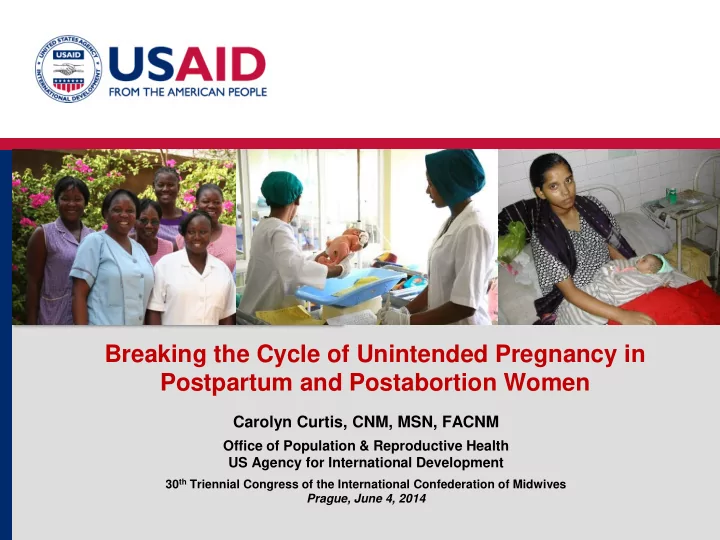
Breaking the Cycle of Unintended Pregnancy in Postpartum and Postabortion Women

Carolyn Curtis, CNM, MSN, FACNM

Office of Population & Reproductive Health US Agency for International Development

30th Triennial Congress of the International Confederation of Midwives Prague, June 4, 2014

slide-2
SLIDE 2

Overview

  • Barriers
  • Postpartum Women
  • Postabortion Women
  • How to overcome “missed opportunities”
slide-3
SLIDE 3

Where births

  • ccur

Exaggerated provider concerns

(re STI, PID, infertility, expulsion)

Poor CPI Provider bias Lack of knowledge re: return to fertility Lack of skills Myths and misperceptions Structure of services Inappropriate eligibility criteria

Barriers

Stigma

Source: RESPOND Project, 2012.

↑ ↑ Access ↑ ↑ Quality of services ↑ ↑ Choice and use ↓ ↓ Rapid repeat pregnancy ↓ ↓ Abortion

Outcomes when barriers are overcome:

Barriers to FP services for postpartum and postabortion (PAC) clients

slide-4
SLIDE 4

Ten Essential Elements

  • f Successful FP Programs

Selected, High-Impact Practices (HIPs)

1. Supportive Policies 2. Evidence Based Programming 3. Strong Leadership and Good Management 4. Effective Communication Strategies 5. Contraceptive Security 6. High Performing Staff 7. Client-Centered Care 8. Easy Access To Services 9. Affordable Services

  • 10. Appropriate Integration of Services

Source: Population Reports 2008, JHU.

  • Community-based services &

task-shifting / task-sharing

  • Postpartum FP
  • Postabortion FP (PAC)
  • Mobile outreach services

Family planning programs: What has worked?

slide-5
SLIDE 5

Who are the women?

1 in 4 women in developing countries have an unmet need for FP = 222 MILLION women with unmet need! Each year:

  • 210 million pregnancies
  • 80 million unintended

pregnancies

  • 44 million abortions
  • 31 million stillbirths
  • Approximately 130 million

births = 130 million postpartum women

slide-6
SLIDE 6

Source: Ross and Winfrey “Contraceptive use, Intention to use, and unmet need during the extended postpartum period, Intl FP Perspectives, 2001. Analysis of DHS data from 27 countries

Reproductive intentions of postpartum women – 12 months following a birth

5% 95% 30% 65% 0% 20% 40% 60% 80% 100% Want to give birth in 2 years Want to space

  • r limit

Using FP method Not using a method

slide-7
SLIDE 7

65 74 52 62 54 29 18 44 32 42 5 8 4 4 3

10 20 30 40 50 60 70 80 90 100

Global Sub-Saharan Africa Middle East Asia Latin America

% Unmet Need % Using Method - Modern & Traditional % Desiring birth within 2 years

Unmet need, contraceptive use & reproductive intention in women 0-12 months postpartum

Source: Ross, J, Winfrey, W, Contraceptive Use, Intention to Use and Unmet Need During the Extended Postpartum Period, International Family Planning Perspectives, 2001 27(1) 20-27.

slide-8
SLIDE 8

Postpartum FP use and method mix among women giving birth in previous 12 months

92 87 87 83 78 77 77 76 62 10 20 30 40 50 60 70 80 90 100

Permanent method LARCs Short-acting resupply Traditional method Not using Source: RESPOND Project, secondary analysis of respective DHS, 2010.

slide-9
SLIDE 9

Number of countries with regulations allowing midwives to provide family planning

70 65 10 20 30 40 50 60 70 80 Injectables Implants IUD

Type of Contraceptive

2014 State of the World Midwifery Report

Implants not included on questionnaire

slide-10
SLIDE 10
  • 26% of the world’s 7 billion people are aged 10-24
  • FP demand in young and unmarried women is high, but access is

constrained:

  • 50-80% demand among married women age 15-24; 20-40% unmet need
  • ~ 90% of unmarried women 15-24 in all regions of the world do not want

to become pregnant, but their unmet need is very high, approaching 50% in some sub-Saharan African countries

  • Complications of unsafe abortion are a main cause of death in 15-19

year-old women in low-resource countries

  • A considerable problem in the U.S. too:

The American College of Obstetricians and Gynecologists recommends that its members “encourage adolescents age 15-19 to consider implants and IUDs as the best reversible methods for preventing unintended pregnancy, rapid repeat pregnancy, and abortion in young women.”

  • -ACOG Committee Opinion #539, Obstet. Gynecol., 2012; 120(4):983-988

PAC FP: background

slide-11
SLIDE 11

32% 77% 60% 20% 20 40 60 80 100

Using FP before pregnancy (method failure) Desire to space or limit next pregnancy Desired a FP method before leaving facility Left facility with FP method

Source: Situation Analyses in Haiti, Dominican Republic, & Nicaragua. Population Council, 2008

PAC FP: How we fail women

slide-12
SLIDE 12

Impact of decentralizing PAC services to lower-level fixed sites

PAC Clients, 21 Districts in Tanzania (October 1, 2007 - September 30, 2010)

Results:

  • Decentralized

PAC services in 21 districts

  • 293 health care

workers trained

  • FP counseling

and services in 224 sites

12,106 14,737 17,262 5,000 10,000 15,000 20,000

Accepted Counseled on FP PAC Clients

Number of PAC clients

Source: ACQUIRE Tanzania Project

slide-13
SLIDE 13

Joint Statements

by:

  • FIGO
  • ICM
  • ICN
  • DFID
  • Gates
  • White Ribbon

Alliance

  • Others

to advance postpartum and postabortion FP

slide-14
SLIDE 14

What is needed to ensure “No missed opportunity”? National Level

  • Ensure contraceptive supply
  • Make FP & LA/PMs available

and at reduced cost or free

  • Support proven policy

changes for midlevel providers

  • Include FP in pre-service

curricula & certifying exams

  • Change in the WHO MEC

for postpartum women

Facility Level

  • Ensure the latest WHO FP

service delivery guidelines are in place – and model following them in practice

  • Reorganize services to

ensure FP services at same location (PP, PAC, EMOC).

  • Become a visible “champion”

in your facility for increasing FP availability and access.

slide-15
SLIDE 15

Thank You!!!

Photo credits: Slide 1 (left to right), A. Jackson/EngenderHealth; A. Fiorente/EngenderHealth; C. Svingen/EngenderHealth. Slide 5 (top to bottom), M. Tuschman/EngenderHealth; C. Svingen/EngenderHealth; M. Tuschman/EngenderHealth; E. Uphoff/EngenderHealth.