
SLIDE 1
Nutrition
BREASTFEEDING
ONE.be
0 - 18 months +
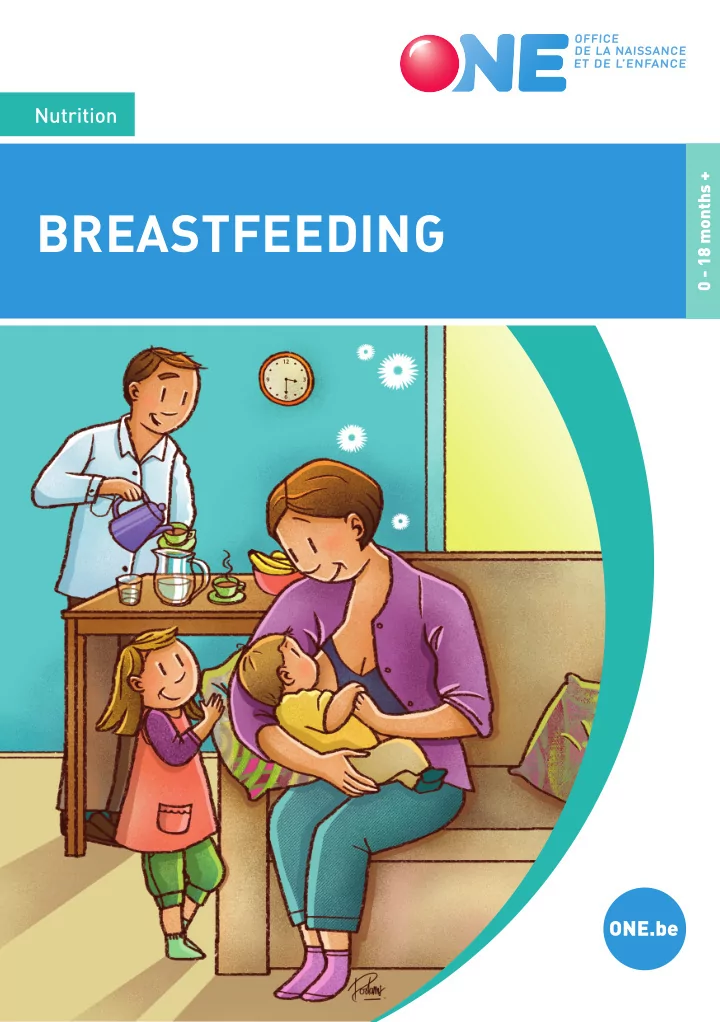
BREASTFEEDING ONE.be CONTENTS The benefjts of breastfeeding / / / - - PDF document
Nutrition 0 - 18 months + BREASTFEEDING ONE.be CONTENTS The benefjts of breastfeeding / / / / / / / / / / / / / / / / / / / / / / / / / / / / / / / / / / / / / / / / / / / / / / / / / / / / /
Nutrition
ONE.be
0 - 18 months +
The benefjts of breastfeeding / / / / / / / / / / / / / / / / / / / / / / / / / / / / / / / / / / / / / / / / / / / / / / / / / / / / / / / / / / / / / / / / / / / / / / / /3 Beginning to breastfeed / / / / / / / / / / / / / / / / / / / / / / / / / / / / / / / / / / / / / / / / / / / / / / / / / / / / / 4 Signs that your baby is hungry / / / / / / / / / / / / / / / / / / / / / / / / / / / / / / / / / / / / / / / / / / / / / / / 5 How to know if your baby is getting enough milk / / / / / / / / / / / / / / / / / / / / / / / / / / / / / / / / 5 How to position yourself for breastfeeding / / / / / / / / / / / / / / / / / / / / / / / / / / / / / / / / / / / / / 6 The family’s role in breastfeeding / / / / / / / / / / / / / / / / / / / / / / / / / / / / / / / / / / / / / / / / / / / / / 8 Breastfeeding and going back to work / / / / / / / / / / / / / / / / / / / / / / / / / / / / / / / / / / / / / / / / / 9 Should your baby drink water? / / / / / / / / / / / / / / / / / / / / / / / / / / / / / / / / / / / / / / / / / / / / / / 10 How to pump breast milk / / / / / / / / / / / / / / / / / / / / / / / / / / / / / / / / / / / / / / / / / / / / / / / / / / / 11 How to store breast milk / / / / / / / / / / / / / / / / / / / / / / / / / / / / / / / / / / / / / / / / / / / / / / / / / / / 12 How to prepare stored breast milk / / / / / / / / / / / / / / / / / / / / / / / / / / / / / / / / / / / / / / / / / / / 13 Cleaning and sterilising your breast pump equipment / / / / / / / / / / / / / / / / / / / / / / / / / / / 14 How to stop breastfeeding / / / / / / / / / / / / / / / / / / / / / / / / / / / / / / / / / / / / / / / / / / / / / / / / / / 15 True/false / / / / / / / / / / / / / / / / / / / / / / / / / / / / / / / / / / / / / / / / / / / / / / / / / / / / / / / / / / / / / / / 16 Are you experiencing breast pain? / / / / / / / / / / / / / / / / / / / / / / / / / / / / / / / / / / / / / / / / / / / 18
CONTENTS
BREASTFEEDING
3
Nutrition
0 - 18 months +
WHAT IS ALWAYS PREPARED, FREE AND ENVIRONMENTALLY FRIENDLY? BREAST MILK!
But that is not all / Breast milk will evolve according to the age and the needs of your baby / It is always adapted and rich enough for his needs /
THE BENEFITS OF BREASTFEEDING
FOR THE BABY
Breastfeeding reduces the risks of:
FOR THE MOTHER
Breastfeeding promotes:
These benefjts become more considerable the longer breastfee- ding is continued / Babies should ideally be breastfed ex- clusively for 6 months / After 6 months they can continue to be breastfed while beginning to eat solid foods (fruits, vegetables…) / Breastfeeding may be continued until the age of 2 years, if not more /*
*Source: World Health Organization
BREASTFEEDING
Nutrition
0 - 18 months +
4 4
BEGINNING TO BREASTFEED
During pregnancy, your breasts naturally prepare themselves for breastfeeding so that they are ready to produce milk after you give birth / Breastfeeding will be stimulated du- ring the fjrst few hours after birth by your baby’s frequent feedings / In the beginning, breastfeed your baby every time he wakes up / Let your baby feed without a schedule. Do not limit the number or length of feedings, both day and night. If you wish to give a dummy to your baby, it is preferable to wait until breastfeeding is well established / Your baby’s need to feed stimulates your breast milk production / The sucking techniques for breastfeeding and dummies are different / Your baby may confuse the two and risks breastfeeding poorly /
6 to 12 feedings every 24 hours
It is important to never go below 5 feedings every 24 hours / During the fjrst weeks, and even the fjrst months, the number of feedings will vary according to the needs of your baby / Have confjdence that your baby knows what he needs! At times, your baby may need more milk and will want to feed more often / Conti- nue to respond to his needs /
BREASTFEEDING
5
Nutrition
0 - 18 months +
SIGNS THAT YOUR BABY IS HUNGRY
If your baby feeds enough, He will have at least 5 full nappies every 24 hours / During the fjrst 3 or 4 weeks, he will have at least one stools that is loose, abundant or yel- low every day / After 1 month your baby may have periods without stools (2 or 3 days) / His mouth is open, searching for your breast / His mouth makes small noises / Your baby wakes up He moves his feet and put his hands in his mouth / Trust your baby, he will show signs of being ready to feed before beginning to cry / Observe these signs.
HOW TO KNOW IF YOUR BABY IS GETTING ENOUGH MILK
At the end of a feeding, your baby will let go of your breast and appear satisfjed / He will be energetic and gain weight /
BREASTFEEDING
Nutrition
0 - 18 months +
6 6
HOW TO POSITION YOURSELF FOR BREASTFEEDING
Position yourself comfortably Your baby’s head in line with his body: the ear, shoulder and hip should be in line / Your baby should not have to turn his head to feed / His head and neck lightly supported Your baby’s stomach against yours His bottom lip turned outwards / His chin against your breast / His mouth open, covering the entire nipple and a part of the areola /
BREASTFEEDING
7
Nutrition
0 - 18 months +
SUGGESTED BREASTFEEDING POSITIONS
You can reduce the risk of cracked nipples by occasionally changing positions and alternating breasts while breastfeeding / You can breastfeed wherever you want! If you feel uncomfortable breastfeeding in public, using a scarf or a cardigan can help breastfeed discreetly /
BREASTFEEDING
Nutrition
0 - 18 months +
8 8
THE FAMILY’S ROLE IN BREASTFEEDING
The support of your partner and the people close to you is a great asset for successful breastfeeding / Do not hesitate to ask them for help with daily tasks / Time spent breastfeeding is very important for the mother-baby relationship / The father-baby relationship may be nurtured through other shared moments: cuddling, chan- ging the baby’s diaper, bath time, going for a walk… When a baby arrives in your family, you will receive plenty of advice / Choose the advice best suited to your situation and HAVE CONFIDENCE IN YOURSELF / If you have questions, doubts or concerns, there are professionals (social-medi- cal workers, midwives, lactation consultants, paediatricians…) and breastfeeding support organisations available to help you /
BREASTFEEDING
9
Nutrition
0 - 18 months +
You are about to go back to work and also have to think about breastfeeding / Your baby can receive your breast milk at day-care / During your maternity leave, you can start to make a stock of freshly pumped milk / Be- fore your baby begins day-care, do not hesitate to ask professional advice: is it possible to breastfeed at the day-care? How will the milk be given (bottle, cup…)? What is the best way to prepare your baby for this transition? Find out about the possibilities to pump and store breast milk at your workplace / 2 to 3 feedings per day are necessary to main- tain your breast milk production / Depending on the age of your baby, the number may be higher /
BREASTFEEDING AND GOING BACK TO WORK
Do not hesitate to feed your baby more regularly during days of leave from work to stimulate your milk production /
BREASTFEEDING
Nutrition
0 - 18 months +
10 10
SHOULD YOUR BABY DRINK WATER?
It is not necessary to give your baby water because your breast milk will quench his thirst / In case of fever or warm temperatures, do not hesitate to feed your baby more often when he asks for it /
BREASTFEEDING
11
Nutrition
0 - 18 months +
HOW TO PUMP BREAST MILK
Before beginning to pump breast milk, wash your hands carefully with soap / There are two methods for pumping breast milk:
MANUAL EXPRESSION
This technique involves using your thumb and index fjnger to lightly massage the breast around the areola, stimulating milk expression / Ask a professional for advice on the best techniques / The milk should be collected in a clean and sterile container (glass, cup or feeding bottle) placed under the breast / Manual expression is the technique closest to your baby’s sucking and can allow the most effjcient production of milk / There are two types of breast pump: manual and electric / Both types of pump have breast shields that mimic the suc- king action of a baby, stimulating milk production / The manual pump is operated by hand and is recommended for occasional use / The electric pump is either battery or mains operated / Elec- tric pumps can be rented or bought through your health insu- rance or at a pharmacy / Refer to your pump’s instruction manual for operating ins- tructions /
USING A BREAST PUMP
BREASTFEEDING
Nutrition
0 - 18 months +
12 12
HOW TO STORE BREAST MILK
Pumped breast milk should be stored in a closed sterile container or in a sterile breast milk storage bag, which can be found in baby stores or pharmacies / Storage guidelines:
Glass bottle Sterile storage bag Sterile container Freeze the milk in small portions so that you can easily reheat the right amount for your baby / Using a covered ice cube tray is a convenient way to freeze small quantities / They should then be stored in a freezer safe container / Transport pumped breast milk in an insulated bag with ice packs to keep it cold / Upon arrival, place the milk in a refrigerator or a freezer / Write the date you pumped the breast milk on the container or storage bag /
BREASTFEEDING
13
Nutrition
0 - 18 months +
Breast milk should be heated to maximum 37°C / Frozen milk should be thawed in the refrigera- tor, in a water bath or in a bottle warmer / Gently swirl the container so that the breast milk is all the same temperature / The use of microwaves is discouraged be- cause they may destroy the living cells found in breast milk /
OR
HOW TO PREPARE STORED BREAST MILK
Pumped breast milk can be given to your baby in a cup, by the spoonful, or in a bottle /
OR
Breast milk should not be refrozen after having been thawed or reheated / Any pumped milk not fjnished during the feeding should be discarded after 1 hour /
BREASTFEEDING
Nutrition
0 - 18 months +
14 14
CLEANING AND STERILISING YOUR BREAST PUMP EQUIPMENT
Your baby is still fragile as his immune system is not fully developed / It is therefore important to clean and sterilise the equipment after each use / 1 - CLEANING Before sterilising the equipment used to pump breast milk, it should be cleaned carefully / Take apart and rinse each piece of equipment / Clean with the help of a baby bottle brush, hot water and dish soap / Rinse all the equipment / 2 - STERILISING In a pot of boiling water: Submerge the equipment for 20 minutes / Teats should be boiled for at least 10 minutes / Using an electric or microwave sterilizer: consult the instruction manual / Cold sterilisation This method uses sterilising tablets sold in pharmacies / To prepare a disinfecting water bath, dissolve one tablet in 5 litres of cold water / Submerge the bottle and pump equip- ment for 15 minutes / Remove the equipment from the water bath without rinsing / 3 - TIDYING UP Let the equipment dry on a clean towel / Place the closed breast pump bottle in a clean cupboard or in the refrigerator /
10 min. 20 min. BREASTFEEDING
15
Nutrition
0 - 18 months +
HOW TO STOP BREASTFEEDING
Weaning is most comfortable for you and your baby if it is done progressively / You can start by replacing a feeding with appropriate food (infant formula or solid meals) / Allow your baby a few days to get used to this change / Do the same for an additional feeding / Your baby will begin to breastfeed less frequently and you will progressively pro- duce less milk / Between feedings, you can relieve your breasts by pumping milk / EXAMPLE WEANING ROUTINE Phase Phase 1
* Phase 2
* Phase 3
*
*
4
*
*
your mind and return to breastfeeding / * Fruits and vegetables should be introduced according to your baby’s development / Consult our brochure about baby food diversifjcation / Each phase can last for one or several days /
BREASTFEEDING
Nutrition
0 - 18 months +
16
TRUE/FALSE
I am expecting twins and will not be able to produce enough breast milk It is entirely possible to breastfeed twins / Repeatedly feeding the two babies will stimulate the production of enough milk to fulfjl their needs / You can feed your two babies either at the same time or separately / With time, you will discover which feeding positions are most comfortable for you / A professional can also provide you with advice / My baby may be born prematurely, so I shouldn’t breastfeed It is possible to breastfeed a premature baby / In fact, considering the benefjts of breast milk for the baby, it is strongly recommended / You can consult a professional about potential arrangements to ensure that breast- feeding goes as smoothly as possible / Mon bébé est né prématurément, puis-je l’allaiter Even while breastfeeding, contraception is necessary Breastfeeding is not an effective contraceptive / If you do not desire another pregnan- cy, choose an appropriate contraceptive method / Breastfeeding may provide contraceptive effects if, and only if, the following four conditions are fulfjlled:
Mon bébé est né prématurément, puis-je l’allaiter My baby was born by Caesarean section, so breastfeeding is inadvisable A Caesarean section, planned or emergency, does not prevent breastfeeding / Pain killers generally do not cause problems for breastfeeding / Medical staff can help you fjnd comfortable feeding positions /
BREASTFEEDING
17
Nutrition
0 - 18 months +
My baby may refuse to breastfeed If your baby refuses to breastfeed, it is his way of saying that something is not right / Your baby won’t refuse to breastfeed for no reason / Potential reasons for your baby’s attitude:
feeding techniques / This refusal to feed may last several days, depending on the cause / Rest assured that it is almost always possible to lead your baby to resume breastfeeding / If I use a nipple shield while breastfeeding, I risk producing less milk Like a dummy or a baby bottle, a nipple shield may confuse your baby because the sucking technique is different from feeding straight from the breast / When you go back to feeding your baby directly from your breast, you may therefore experience certain diffjculties / If a nipple shield is proved necessary, it should ideally only be used as a temporary solution / My breast milk may change colour The nutritional composition of your breast milk can affect its colour / The fjrst milk you produce after your baby’s birth is called colostrum and can take a variety of colours / Milk produced later may appear translucent and sometimes almost blue / Regardless of its colour, your milk is always adapted to the needs of your baby / My breasts are too small to breastfeed The quantity of milk produced is not linked to the size of your breasts / Smaller breasts will produce suffjcient quantities of milk to feed your baby /
BREASTFEEDING
Nutrition
0 - 18 months +
18
ARE YOU EXPERIENCING BREAST PAIN?
SORE AND PAINFUL NIPPLES During the fjrst days of breastfeeding, you may experience soreness or pain in your nipples / This hypersensitivity is entirely normal / It is most noticeable during the fjrst 3 days but will usually ease after 8 to 10 days / The reasons for this soreness are partly hormonal but may also be accentuated by other factors, for example if your baby latches onto your breast improperly / If the pain becomes intense and persistent, consult a health profes- sional / MILK FLOW The expression “milk fmow” may give an inaccurate idea of what is happening / In fact, milk does not “fmow” up into the breasts / If your breasts are swollen, tender and painful, it is due to increased blood circulation to the breasts, which is important for the beginning of milk production / This phenomenon of breast congestion appears approximately 3 days after birth, sometimes later / Your body temperature may also increase slightly / CRACKED NIPPLES Small cracks may appear on your nipples during the fjrst few days of breastfeeding / They can be painful and may become infected / To limit their appearance, be careful to position your baby correctly while breastfeeding / Avoid stretching your breast to free your baby’s nose and do not draw your baby away from your breast too abruptly / Applying breast milk
BREASTFEEDING
19
Nutrition
0 - 18 months +
ENGORGEMENT Breast engorgement is a painful tension in one or both of your breasts / They may become unusually warm, tender and painful / Engorgement may make breastfeeding more diffj- cult, can hamper milk fmow and may be combined with other symptoms (shivers, aches, fever…) / These sensations may appear at any point while breastfeeding but particularly when fee- dings are too short, too few or too spread out / To ease the tension in your breasts, do not hesitate to feed your baby more frequently / Other methods of relieving this tension are to massage your areolas and to take hot showers, facilitating milk fmow / MASTITIS Mastitis is an infmammation of the breast which can potentially lead to infections / Mastitis generally affects only one of your breasts at a time / A part of your breast becomes red, warm and painful / These local symptoms may also be accompanied by others, such as a fever, shivers, aches or fatigue / It is essential that the mother gets plenty of rest / If you are experiencing mastitis, the general advice is the same as that for breast en- gorgement / Your baby should feed regularly, particularly from the affected breast / If the situation does not improve within 12 to 36 hours, consult a doctor to determine whether treatment is necessary (painkillers, antibiotics) / The ONE consultation teams are available to accompany you during your pe- riod of breastfeeding. Do not hesitate to consult our other brochures as well.
D/2014/74 /80/57
Chaussée de Charleroi 95 - 1060 Bruxelles Tél / : +32 (0)2 542 12 11 / Fax : +32 (0)2 542 12 51 info@one /be - ONE /be
ONE.be
EDITEUR RESPONSABLE Benoît PARMENTIER
RÉALISATION ONE
Avec le soutien de la Fédération Wallonie-Bruxelles et de la Loterie Nationale Certaines illustrations sont reprises de «Des images pour accompagner les parents au quotidien» réalisé en collaboration avec la coopérative Cera DOCBR0300
0 years 1 year 2 years 3 years 4 years 5 years 6 years 7 years 8 years 9 years 10 years 11 years 12 years 13 years 14 years 15 years