Brexit by Numbers Joe Twyman, YouGov Head of Political & - - PowerPoint PPT Presentation

brexit by numbers joe twyman yougov head of political
SMART_READER_LITE
LIVE PREVIEW

Brexit by Numbers Joe Twyman, YouGov Head of Political & - - PowerPoint PPT Presentation

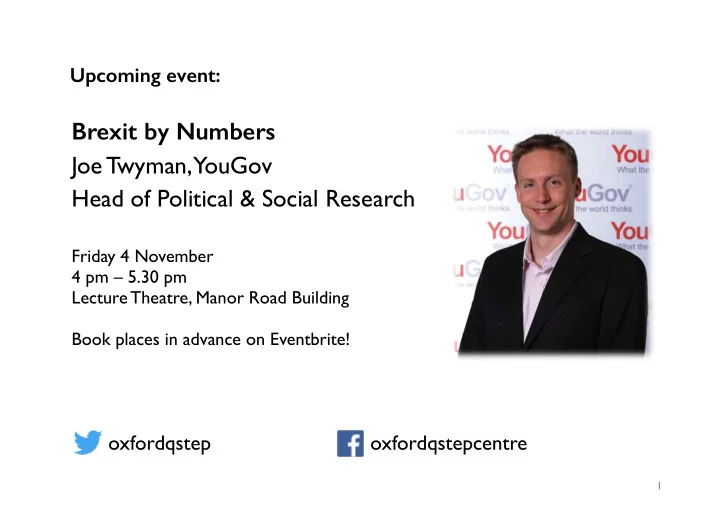
Upcoming event: Brexit by Numbers Joe Twyman, YouGov Head of Political & Social Research Friday 4 November 4 pm 5.30 pm Lecture Theatre, Manor Road Building Book places in advance on Eventbrite! oxfordqstep oxfordqstepcentre 1


slide-1
SLIDE 1

1

Brexit by Numbers Joe Twyman, YouGov Head of Political & Social Research

Friday 4 November 4 pm – 5.30 pm Lecture Theatre, Manor Road Building Book places in advance on Eventbrite!

  • xfordqstep
  • xfordqstepcentre

Upcoming event:

slide-2
SLIDE 2

Control for: determinants of X that might also affect Y! And: determinants of Y that are in any way related to X! Noting that: the impact of X on Y might be conditional on some value of Zb!

Observational studies!

a! b!

slide-3
SLIDE 3

Lab 3: Analysis of Experimental Data

Political Analysis 2: Week 4

2

slide-4
SLIDE 4

Experiments in a nutshell!

  • Many units in a study group.!
  • Some are randomly assigned to control.!
  • Others are randomly assigned to treatment.!
  • We compare sample averages of the control

group and the treatment group after the treatment has occurred. !

  • But the thinking behind this is quite subtle…!
slide-5
SLIDE 5

The Neyman Model

Figure 5.1 (p113) from Dunning, T. (2012)!

Think about potential outcomes…!

slide-6
SLIDE 6

Getting to counterfactual thinking…!

  • Unit causal effect = ???!

– A unit’s potential outcome if treated minus its potential outcome if untreated (control)..???! – Not all units will respond the same. ! – Holland (1986): “the fundamental problem of causal inference”.!

  • Without factual and factual to compare, we

settle for factual and counterfactual. !

slide-7
SLIDE 7

Why difference of means?!

  • Average causal affect

Average causal affect = the difference between the average outcome if all units in the study were assigned to treatment and the average outcome if all units in the study were assigned to control.!

  • Mean of a random sample = an unbiased

estimator of the population mean.!

  • Thus, the mean outcome of treatment group = an

unbiased estimator for the mean of the potential

  • utcomes under treatment.!
  • An unbiased estimator for the average causal

effect = difference of means. !

slide-8
SLIDE 8

Validity!

  • Internal?!

– Fully randomised?! – SUTVA (the stable unit-treatment value assumption)!

  • External?!

– Can we reasonably extrapolate to other contexts?!

slide-9
SLIDE 9

3

“Prior to the August 2006 primary election in Michigan, approximately 80,000 households were sent one of four mailings encouraging them to vote.” (33)

slide-10
SLIDE 10

Theory

(GGL 2008)

  • Utility (happiness) citizens receive from performing their

civic duty is key to predicting turnout

  • à Intrinsic benefits. Satisfaction from behaving in

accordance with norm (voting).

  • à Extrinsic incentives. Social pressure to comply.
slide-11
SLIDE 11

Research Design

(GGL 2008)

  • 180,002 households in Michigan (United States) drawn

as a (random?) sample of all households in the state.

  • 20,000 HH each in four different treatment groups (and a

further 100K HH in control group)

  • 1. “Civic Duty” mailing
  • 2. “Hawthorne” mailing
  • 3. “Self” mailing
  • 4. “Neighbors” mailing
slide-12
SLIDE 12

4

slide-13
SLIDE 13

5

slide-14
SLIDE 14

6

slide-15
SLIDE 15

7

slide-16
SLIDE 16

8

slide-17
SLIDE 17

If you want more…!

  • IR:!

– Hyde, Susan D. "Experiments in International Relations: Lab, Survey, and Field." Annual Review of Political Science 18 (2015): 403-424.! – Hafner-Burton, Emilie M., Brad L. LeVeck, and David G. Victor. "How Activists Perceive the Utility of International Law." The Journal of Politics 78, No. 1 (2016): 167-180.!

  • Comp Gov: !

– Gonzalez Ocantos .E. et al. (2012) ‘Vote Buying and Social! Desirability Bias: Experimental Evidence from Nicaragua’, AmericanJournal of Political Science, 56(1), 202-217 Data: http://www.chadkiewietdejonge.com/research/!

  • Pol Soc:!

– Bansak et al. (2016). "How economic, humanitarian, and religious concerns shape European attitudes toward asylum seekers". Science, 354(6309), 217-222. !