Brexit xit: : Implicatio ations ns for rea eal l estate - - PDF document

brexit xit implicatio ations ns for rea eal l estate
SMART_READER_LITE
LIVE PREVIEW

Brexit xit: : Implicatio ations ns for rea eal l estate - - PDF document

Brexit xit: : Implicatio ations ns for rea eal l estate Downward revision of UK economic growth expectations Markets are trying to digest the political and economic ramifications of the surprise result of the UK referendum on EU membership.


slide-1
SLIDE 1

Markets are trying to digest the political and economic ramifications of the surprise result of the UK referendum on EU membership. The vote to leave was arguably one of the UK’s most important political decisions of the past 60 years, and will have deep and profound political and economic implications. The negative impact on equity markets and sterling was immediate, as was the change in the UK’s political

  • leadership. Markets remain volatile given the uncertainty over the potential timing and terms of a managed UK

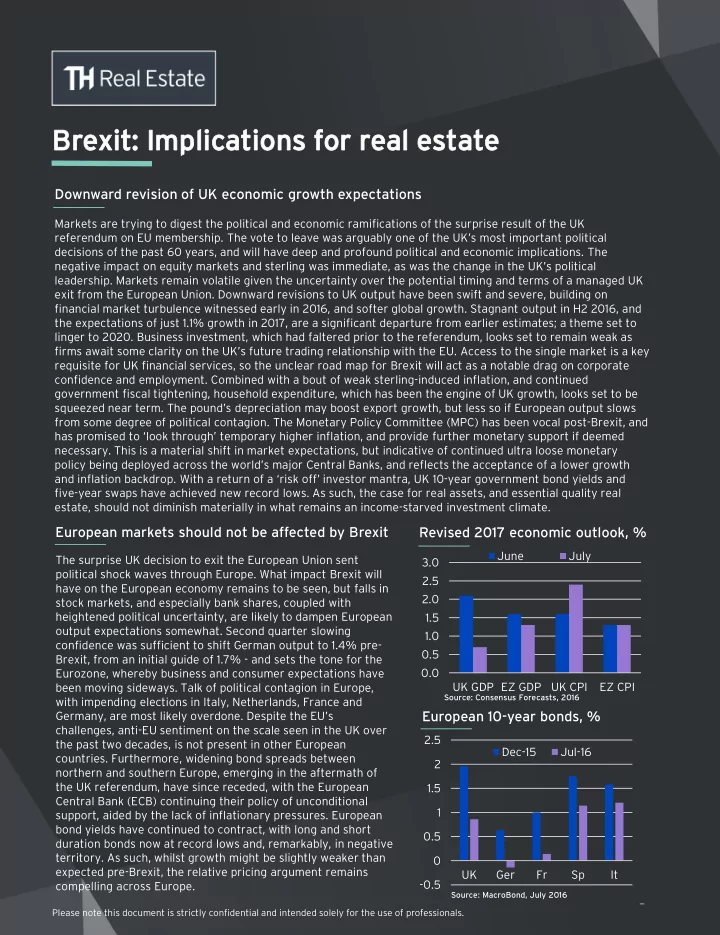
exit from the European Union. Downward revisions to UK output have been swift and severe, building on financial market turbulence witnessed early in 2016, and softer global growth. Stagnant output in H2 2016, and the expectations of just 1.1% growth in 2017, are a significant departure from earlier estimates; a theme set to linger to 2020. Business investment, which had faltered prior to the referendum, looks set to remain weak as firms await some clarity on the UK’s future trading relationship with the EU. Access to the single market is a key requisite for UK financial services, so the unclear road map for Brexit will act as a notable drag on corporate confidence and employment. Combined with a bout of weak sterling-induced inflation, and continued government fiscal tightening, household expenditure, which has been the engine of UK growth, looks set to be squeezed near term. The pound’s depreciation may boost export growth, but less so if European output slows from some degree of political contagion. The Monetary Policy Committee (MPC) has been vocal post-Brexit, and has promised to ‘look through’ temporary higher inflation, and provide further monetary support if deemed

  • necessary. This is a material shift in market expectations, but indicative of continued ultra loose monetary

policy being deployed across the world’s major Central Banks, and reflects the acceptance of a lower growth and inflation backdrop. With a return of a ‘risk off’ investor mantra, UK 10-year government bond yields and five-year swaps have achieved new record lows. As such, the case for real assets, and essential quality real estate, should not diminish materially in what remains an income-starved investment climate.

Brexit xit: : Implicatio ations ns for rea eal l estate

European markets should not be affected by Brexit

Please note this document is strictly confidential and intended solely for the use of professionals.

The surprise UK decision to exit the European Union sent political shock waves through Europe. What impact Brexit will have on the European economy remains to be seen, but falls in stock markets, and especially bank shares, coupled with heightened political uncertainty, are likely to dampen European

  • utput expectations somewhat. Second quarter slowing

confidence was sufficient to shift German output to 1.4% pre- Brexit, from an initial guide of 1.7% - and sets the tone for the Eurozone, whereby business and consumer expectations have been moving sideways. Talk of political contagion in Europe, with impending elections in Italy, Netherlands, France and Germany, are most likely overdone. Despite the EU’s challenges, anti-EU sentiment on the scale seen in the UK over the past two decades, is not present in other European

  • countries. Furthermore, widening bond spreads between

northern and southern Europe, emerging in the aftermath of the UK referendum, have since receded, with the European Central Bank (ECB) continuing their policy of unconditional support, aided by the lack of inflationary pressures. European bond yields have continued to contract, with long and short duration bonds now at record lows and, remarkably, in negative

  • territory. As such, whilst growth might be slightly weaker than

expected pre-Brexit, the relative pricing argument remains compelling across Europe.

Downward revision of UK economic growth expectations

0.0 0.5 1.0 1.5 2.0 2.5 3.0 UK GDP EZ GDP UK CPI EZ CPI June July

Revised 2017 economic outlook, %

  • 0.5

0.5 1 1.5 2 2.5 UK Ger Fr Sp It Dec-15 Jul-16

European 10-year bonds, %

Source: Consensus Forecasts, 2016 Source: MacroBond, July 2016

slide-2
SLIDE 2

H1 2016 recorded a marked slowdown in investment and occupier demand, linked to economic and political uncertainties and concerns relating to historically keen real estate pricing. Changes to real estate taxation in the Chancellor’s March budget, which eroded 1% of capital values, also dampened investor activity given the higher all-in transaction costs. Brexit and the associated volatility in financial markets, slump in business confidence, and heightened liquidity needs, has magnified property market pricing uncertainty. The immediate sell-off of UK REITs and the subsequent suspension of a number of open-ended property investment funds, under pressure from growing redemptions, has led to a significant change in valuation assumptions for H2 2016. Although this is not envisaged to be as damaging as the listed sector, pricing will suffer. Deciphering what is a liquidity-driven sale and managed asset disposal is pivotal in forming a market forecast, as any market correction will not be uniform, differing in magnitude, timing and meaning for all sectors and markets. This is not 2008, and whilst there will be some short-term market volatility, much lower leverage and the number of well-capitalised domestic and overseas buyers of UK property, aided by sterling's weakness, should provide a floor for

  • valuations. Notable downward revisions to economic growth and market confidence will have detrimental

consequences on property investment flows, occupier demand and ultimately pricing – but by how much is greatly debated. However, real estate still offers very favourable yields compared to other asset classes, and thus strong defensive income assets are likely to outperform. The IPD initial yield of 5%, as of Q2 2016, still

  • ffers a premium against a UK 10-year bond yield of 0.9%, whilst five-year swaps have fallen to 0.6%.

50 100 150 200 250 300 20 40 60 80 100 Q2 07 Q1 08 Q4 08 Q3 09 Q2 10 Q1 11 Q4 11 Q3 12 Q2 13 Q1 14 Q4 14 Q3 15 Q2 16 Quarter Total lhs 12mth Rolling

Occupier markets: Three-speed Europe UK market correction amidst occupier and investment uncertainty European CRE investment, €bn

European real estate investment volumes edged up in Q2 2016, although this is more a reflection of a precipitous decline in the first quarter. Rolling annual volumes were nevertheless lower for a second consecutive quarter, suggesting the market peaked in

  • 2015. Despite economic unease, prime property yields

remain either stable or under downward pressure across the EU-27, reflecting even lower sovereign bond yields. Attention should now focus on the occupier outlook, which pre-Brexit had been in recovery mode. Effects on

  • ccupiers will vary across regions and across sectors,

but the most likely scenario is marginally slower growth. A three-speed Europe is emerging. Core European markets (Germany, France, Sweden and Austria) will see their advanced recovery continue, potentially at a more modest pace. The second-speed countries are the southern recovery markets of Spain, Portugal and Italy, which are at a point in the cycle where real rental growth is starting to pick up. The largest risk here is currently the Italian banking system. The third-speed is the UK market, with a short-term, bleak economic outlook. Take-up and investment volumes, as witnessed in H1 2016, have been slowing and will stay restricted whilst EU negotiations take place. Paris, Frankfurt, Dublin, Luxembourg, Stockholm and Berlin have been touted as potentially absorbing some UK Brexit-related company relocations, and could profit in the medium to long term. Presently, however,

  • ccupiers are adopting a ‘wait-and-see’ approach, with

any significant occupier decisions relating to the UK being postponed until uncertainties about the future of legal operating environments are more clear.

Source: CBRE July 2016

35 40 45 50 55 60 65 Jun-04 Jun-05 Jun-06 Jun-07 Jun-08 Jun-09 Jun-10 Jun-11 Jun-12 Jun-13 Jun-14 Jun-15 Jun-16 Bus Activity Job hiring

London surveys, 50 = stable

Source: CBI/PWC Financial Services Survey

slide-3
SLIDE 3

Market inertia across Europe expected – medium and long-term outlook unchanged

At this historic juncture, it is difficult to quantify near-term UK real estate performance. There is little real evidence to date to confirm a valuation adjustment, but market uncertainty will reflect an added risk-premium for perceived riskier assets in non-core locations, Scotland and Central London offices - a sector prone to greater pricing volatility and where investors are deliberating the City’s financial clout within or outside the single market. Whilst we appreciate that the EU referendum has raised the possibility of a second future Scottish UK referendum, it is believed to be remote given the economic uncertainty linked to oil’s re-pricing and unanswered questions surrounding both currency and monetary policy powers. In contrast to the broad market that is likely to undergo a pricing correction in H2 2016, prime, defensive assets may benefit from increased investor interest, especially from overseas investors benefitting from sterling’s weakness, in what is likely to prove an even lower global growth, inflation and bond yield environment. As such, given the number and fire-power of real estate investors reviewing the UK market, it is difficult to gauge the window of

  • pportunity created by Brexit. Investment sentiment will depend on how far or swift prices adjust, and the

economic context. Investors can take comfort from the knowledge that the UK is an innovative, open and flexible economy; but an unwillingness by domestic and overseas businesses to make long-term capital commitments to the UK will have a detrimental impact on occupier demand. One can assume lending terms, whether for non-core assets or development, will become more stringent, but overall investor insecurities should fade as headlines around retail fund suspensions quieten and valuations stabilise.

Headwinds, but market speculation to create opportunities in the UK Sterling’s decline

In the case that we do see an economic slowdown, we will likely see a return to more defensive, quality assets and a heightened risk premium to certain markets and assets. Capital flows into European real estate in H1 2016 were uniformly lower across all markets and sectors, a product of heightened risk aversion, but also due to a lack of supply in the market. There will be some short-term market volatility until there is greater market clarity, and one can expect a period of market inertia, both from an investor and occupiers’ perspective. It is clear that political and economic reform will remain high on the EU agenda, but one should also remember that Europe is not one homogenous region, and it includes many economies, diversified by strength, maturity, foundations and demographics, at a national, regional and city level. Long-term investors in European real estate need to understand the megatrends that are shaping the industry. Investors should not be overly- focused on real estate market cycles, which could mask the long-term erosion of value in locations that become negatively impacted by demographic trends, technology or environmental changes. Far better to seek selective exposure to those locations and assets that will emerge as winners through structural advancements. 1 1.1 1.2 1.3 1.4 1.5 1.6 Jan-15 Apr-15 Jul-15 Sep-15 Dec-15 Mar-16 Jun-16 USD/EUR USD/GBP

  • 1
  • 0.5

0.5 1 1 2 3 4 5 6 7 8 9 10 11 12 13 14 15 16 Q1 16 Q2 UK EU Core* Europe Periphery*

Risk-off investor sentiment

Source: Pacific Exchange Rate Services, July 2016 Source: PMA *Core: DE/FR/NL; Periphery: ES/IT/PT

slide-4
SLIDE 4

Where are the current opportunities?

The founding principle of our European Cities strategy is to look through market cycles and focus on those European cities where people will want to live and work in the future. All our strategic advice is given at city-level now, targeting ‘winning’ cities - around 40 across Europe - that are productive, affluent, young, environmentally sustainable and, most importantly, growing. These cities will of course have their own market cycles, but over the longer term should account for an increasing share of the region's output, benefit from structural trends and be smart destinations for long-term real estate investment capital.

Chris isti tian an Jans nssen en Head of Debt Andrew w Rich ch European Cities Fund Manager Nick ck Deacon

  • n

Director of Central London Offices

We have already seen clear evidence of adjustments in pricing and sentiment towards the UK real estate sector, and in particular the London office market. However, the fundamentals of the occupier market are still positive with limited ‘ready to occupy’ supply. Capital that can target the market in early to mid- 2017 should see considerably better future performance, enhanced by gearing and by sterling’s devaluation against the euro and US dollar for overseas investors. Although the structural impact of the Brexit vote will chip the long-run competitiveness of the City as a global financial centre, the cyclical opportunity is nevertheless there for the taking for any well- capitalised investor. Against the current uncertain backdrop, investments into real estate debt may provide some stability. Real estate debt investments deliver practically all of their returns through a consistent income stream. They also benefit from the borrowers’ subordinated equity position providing an inherent protective buffer to market value volatility. Real estate debt investments therefore have the potential to deliver a consistent and predictable income return with downside protection. Such resilience and reliability should be helpful and attractive to investors given the expectation of further uncertainty ahead.

slide-5
SLIDE 5
  • Income-focused investor strategies are likely to intensify. Investments should continue to be made on a selective
  • basis. Real estate investors should take comfort in the medium to longer-term outlook given property’s robust,

defensive, income qualities in what is likely to prove a low global growth and inflation environment. Medium-term performance, which will be predominately driven from the strength of real estate’s income profile and quality asset management initiatives, remains compelling, and liquidity will benefit from growing allocations to the sector.

  • Investors should treat investments which rely on the occupier recovery continuing in the short term with more

caution, should downside economic risk materialise and act as a drag on rental growth.

  • If European commercial property yields do rise outside of the UK, the window of opportunity for investors is likely to

be short-lived. In the likely absence of a full blown European crisis and recession, this should be viewed as a buying

  • pportunity rather than a reason to retreat.
  • At this time, investors are encouraged to remain patient, diversified and focused on the long-term major European

cities that are characterised by strong long-term economic and demographic fundamentals.

Market conclusions

Post-Brexit, global investors will be reassessing risk and market opportunities. The economic consequences are yet to be felt, and any implications that emerge from a prolonged negotiation between the UK and the EU will take time to implement and be truly understood. This will play on investors’ minds, although quality income-producing real estate, in stable jurisdictions, should still appeal given global interest rates and financial market turbulences.

  • Most forecasters have downgraded UK and, to a small extent, also Eurozone GDP growth for 2017, which would

negatively impact UK rental growth, and may clip the rental recovery in some non-UK markets. Slower growth in the medium term is quite possible as well. However, this would also imply lower inflation, aside of the UK, and further delay any interest rate normalisation, postponing fears of outward yield shift.

  • The investment market had already slowed pre-Brexit across all sectors and countries. Most likely, the second half of

this year will show limited activity as investors wait to see how financial markets play out, and most importantly to what extent the real economy will be affected. In particular, Southern Europe is likely to have a quiet summer. A temporary softening of yields is not a foregone conclusion, given the wall of money targeted at real estate and an absence of forced sellers. Hence, the valuation correction forecasted in the UK is unlikely to be mirrored across Europe.

  • If uncertainty lingers, investors are more inclined to adopt a risk-off mode. This could mean that assets deemed

riskier face softer pricing, while core assets benefit from even lower yields.

Alice Breheny ny Global l Head of Research ch T: +442037278000 E: alice.breheny@threalestate.com

Contact us

Alic ice Brehen eny Global Head of Research

This document is intended solely for the use of professionals and is not for general public distribution. Any assumptions made or opinions expressed are as of the dates specified or if none at the document date and may change as subsequent conditions vary. In particular, the document has been prepared by reference to current tax and legal considerations that may alter in the future. The document may contain “forward-looking” information or estimates that are not purely historical in nature. Such information may include, among other things, illustrative projections and forecasts. There is no guarantee that any projections or forecasts made will come to pass. International investing involves risks, including risks related to foreign currency, limited liquidity particularly where the underlying asset comprises real estate, less government regulation in some jurisdictions, and the possibility of substantial volatility due to adverse political, economic or other developments. Past performance is no guarantee of future performance. The value of investments and the income from them may go down as well as up and are not guaranteed. Rates of exchange may cause the value of investments to go up or down. Any favourable tax treatment is subject to government legislation and as such may not be maintained. The valuation of property is generally a matter of valuer’s opinion rather than fact. The amount raised when a property is sold may be less than the valuation. Nothing in this document is intended or should be construed as advice. The document is not a recommendation to sell or purchase any investment. It does not form part of any contract for the sale or purchase of any investment. TH Real Estate is a name under which Henderson Real Estate Asset Management Limited provides investment products and services. Issued by Henderson Real Estate Asset Management Limited (reg. no. 2137726), (incorporated and registered in England and Wales with registered office at 201 Bishopsgate, London EC2M 3BN) which is authorised and regulated by the Financial Conduct Authority to provide investment products and services. Telephone calls may be recorded and monitored. COMP201600242

Strategic recommendations

Heightened market uncertainty, negative bond rates and slow growth may drive greater capital into prime assets in core markets across Europe. Given current pricing, understanding those markets that are both defensive and offer long-term out- performance will be key in market cycles that are becoming shorter.

Stefan Wundrak rak Head of European Research ch T: +442037278226 E: stefan.wundrak@threalestate.com Micha hael l Keogh Associa ciate te Director tor of Research ch & Strate tegy T: +442037278160 E: michael.keogh@threalestate.com