Brief History of the Hanford Site Michele S. Gerber, Ph.D. - PowerPoint PPT Presentation
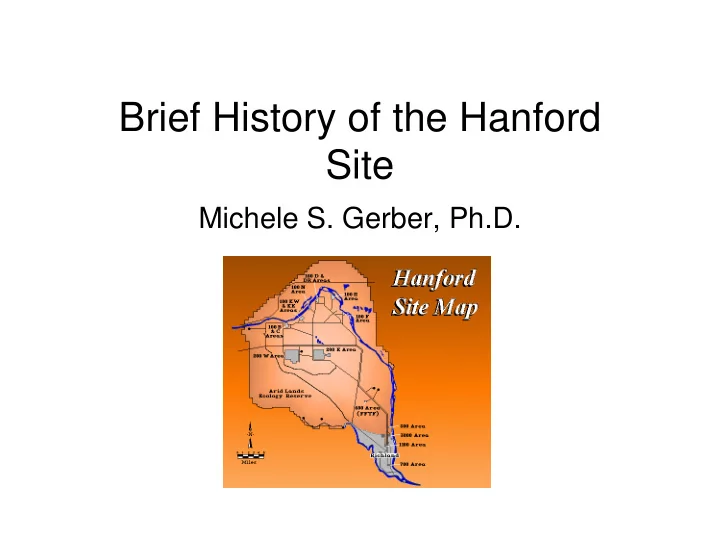
Brief History of the Hanford Site Michele S. Gerber, Ph.D. Founding Acquired February 1943 640 square miles in southeast Washington Conditions perfect for Manhattan Engineer District requirements Construction began March 1943
Brief History of the Hanford Site Michele S. Gerber, Ph.D.
Founding • Acquired February 1943 – 640 square miles in southeast Washington – Conditions perfect for Manhattan Engineer District requirements • Construction began March 1943 – Army Corps of Engineers and DuPont
Original Mission • Produce plutonium for world’s first atomic weapons • Mission succeeded – Trinity bomb test (July 1945) – Nagasaki weapon (August 1945)
World War II Operations • 29 months from beginning of construction to WWII Victory (March 1943-August 1945) • Huge construction and operations accomplishments – Complete fuel fabrication facilities – First three full-size reactors in world – First two full-size radiochemical separations plants – Plutonium isolation facility – 64 single-shell tanks for waste storage – Site infrastructure (i.e.roads, communications, electrical, water) for self-contained operations – Construction camp housing and feeding 51,000 workers – City of Richland built up from capacity for 300 to 17,000 people
The Hanford Process
The Hanford Process, con’t
WWII Tank Farm under construction, 1944
Early Postwar Developments • 1946 – Production lull and period of indecision • Hanford Site employment fell by half (10,000 to 5,000 operations workers) – Atomic Energy Act of 1946: AEC created – Winston Churchill’s Iron Curtain Speech • 1947: AEC ordered huge expansion
First Postwar Expansion • Largest peacetime construction project in American history to that point – Cost more than original Hanford construction – Two more reactors built – Plutonium Finishing Plant – 42 additional waste storage tanks – Expansion of Richland to 23,000 – Construction of trailer/barracks enclave for construction workers
Plutonium Finishing Plant new in 1949
Plutonium “button” or “puck”
Cold War Escalates • 1949 - Soviets explode 1 st atomic bomb – Mao Tse-tung’s Communist Forces victorious over Nationalist forces in China – NATO (North Atlantic Treaty Organization) formed • 1950 – President Truman decides to pursue development of H-bomb – Korean War begins (June) – Communist Chinese enter Korean conflict (December) • 1952 (U.S.) and 1953 (U.S.S.R.) explode hydrogen bombs
Second Postwar Expansion (Korean War Expansion) • REDOX Plant • C Reactor • 2 evaporators for tank waste • 18 additional waste tanks • Major 300 Area laboratories expansion • U Plant activated and UO3 Plant constructed
Hanford’s 2 nd Postwar Expansion: C Reactor under construction, 1951
TX Tank Farm under construction, 1949
Cold War Escalates Further • 1952 – Dwight D. Eisenhower elected president – Policy of massive retaliation • Deterrent value of large defense production facilities • Purposefully leaked information about new facilities • 1955 – Nikita Khrushchev comes to power in Soviet Union
Third Postwar Expansion (Second Korean War Expansion) • President Eisenhower’s Program X – KE and KW Reactors built – PUREX Plant – Plutonium recycle facilities – 21 additional waste tanks
K West Reactor under construction, 1954
Hanford’s Peak Production Years • 1955-1960 – All 8 single-pass reactors undergo “Modifications for Increased Production” – Reactor power levels soar • 1956 – PUREX begins operations – WWII processing plants close – Production capacity quadruples in 4 years – REDOX relegated to “special operations” – PUREX becomes Hanford’s workhorse • 1957 – N Reactor construction authorized in response to Sputnik
President John F. Kennedy dedicates N Reactor 9/23/63
Hanford Cut-Backs 1960s, 1970s • All 8 single-pass reactors close between 1964 and 1971 • N Reactor closes briefly in 1971 – Re-opens for electric power production only • Fabrication work ends at PFP, 1965 • Plutonium Reclamation Facility closes 1978-1984 • PUREX closes 1972-1983
Production Cutbacks: Experiments with Non-Defense Work • PFP’s defense production lines make special oxides for power reactor experiments • Special radioisotopes extracted for NASA and other programs • N Reactor operates for power production only • Fast Flux Test Facility built as largest national experimental facility for power reactor technology • 28 double-shelled waste tanks built
FFTF dedication, 1980
Hanford Production Facilities Reactivated • PUREX retrofitted with multiple environmental upgrades, and oxide conversion facilities • N Reactor re-tooled to produce weapons-grade material • PFP and PRF upgraded; reopen for defense material production 1983 and 1984
Cold War Ends
Solid Waste Trench, Hanford, 1953
K East Reactor basins overflowing, leaking, 1962
Waste Cleanup Project: Largest in the World • Hanford’s Tri-Party Agreement (TPA-Federal Facility Agreement and Consent Order) – U.S. DOE, U.S. EPA, Washington State Department of Ecology – May 1989 – Revised many times; living document • Hanford cleanup funded at nearly $2B per year
First MCO leaves KW Basin 12/07/2000
Vitrification Plant, August 2007
Preserving our History
Recommend
More recommend
Explore More Topics
Stay informed with curated content and fresh updates.