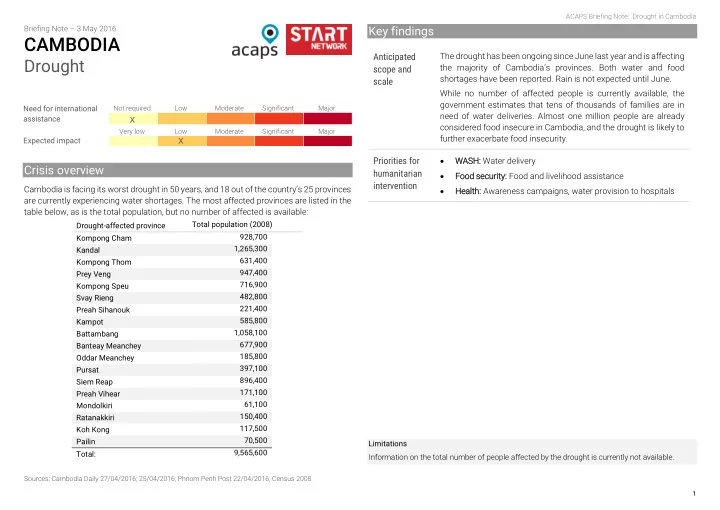
SLIDE 3 ACAPS Briefing Note: Drought in Cambodia 3
Lack of adequate WASH infrastructure
Almost 50% of Cambodia’s rural population does not have access to safe drinking water, with 20% of deaths among children under five caused by waterborne diseases (Water for
Cambodia 2015). Access to latrines and hand-washing facilities is limited in rural areas,
where water from polluted ponds and rivers is a main source of water (UNICEF 2010). Access to safe water in particular in rural areas has been further limited as a result of the drought conditions, and is likely to decline further in coming weeks.
La Niña
La Niña, a weather phenomenon that is forecast to follow this year’s El Niño, is expected to bring heavy rainfall in August and September, which could result in floods in drought- affected areas, where the ground cannot adequately sustain heavy rainfall (Phnom Penh
Post 22/04/2016). Damage to agricultural land caused by floods could result in further food
insecurity, and reduce availability of coping mechanisms.
Key characteristics of Cambodia
Demogra raphic pro rofile: e: Population: 15.6 million. 80% of the population live in rural areas
(World Bank 2015; WFP 31/03/2016).
Povert rty: 19% of the population live below the national poverty line and are unable to meet basic needs (WFP 31/03/2016). Nutri rition: : 32% of children under five suffer from chronic malnutrition. One in ten children under five is acutely malnourished (WFP 31/03/2016; UNICEF 16/09/2015). Health: Maternal mortality: 170 deaths per 100,000 live births. Under-five mortality: 35 deaths/1,000 live births (WFP 31/03/2016). Life expectancy: 68 years (World Bank 2014). WASH SH: 75% of the total population has access to improved water sources, while 42% of the population has access to improved sanitation facilities. In rural areas, 69% of the population has access to improved drinking sources, and 30% has access to improved sanitation facilities (World Bank 2015; CIA World Factbook 2015). Litera racy: Female: 70%; male: 84% (CIA World Factbook 2015).
Response capacity
Local and national response capacity
The government has called on the armed forces, civil servants, and the Cambodian Red Cross to ensure adequate water supplies reach the affected population. 18 provinces are currently receiving emergency water deliveries. Cambodia’s National Centre for Disaster Management is coordinating the response, and authorities have also ordered digging of wells to ease the water shortages (Cambodia Daily 29/04/2016; Bangkok Post 26/04/2016).
International response capacity
Chinese authorities have discharged water from the Jinghong hydropower station in Yunnan province to provide additional water to drought-affected areas in Cambodia
(Cambodia Daily 25/04/2016).
The Humanitarian Response Forum in Cambodia coordinates response between UN agencies and INGOs, and collaborates with the National Centre for Disaster Management
(Humanitarian Response 2016). WFP is present in Cambodia, however funding cuts have
recently reduced operations (WFP 31/03/2016).
Population coping mechanisms
The affected population has resorted to buying water from private vendors, which poses problems for already economically vulnerable families (Cambodia Daily 25/04/2016). In affected provinces, people have reportedly migrated to Thailand to find jobs (Phnom Penh
Post 29/04/2016).
Information gaps and needs
No number of drought-affected people is currently available – the government is reportedly collecting data (Cambodia Daily 25/04/2016). Very little publicly available information on the current situation has been provided by humanitarian organisations in drought-affected provinces – the information in this report is mainly collected from local media sources.
Lessons learned
80% of Cambodia’s population live in rural areas, where the majority rely on rice as their main income and staple food. In the severe drought in 2004, an estimated 82% of the potential rice harvest was lost as a result of the drought (Chhinh 2015). Farmers who are completely dependent on rainfall to water their crops are particularly vulnerable to drought, and measures to secure water supply to these farmers would reduce their vulnerability significantly (Chhinh et al 2014). Cambodia has yet to introduce an early warning system for drought – its implementation would improve preparedness and response planning (Chhinh 2015).