Broadening the Differential: Disclosures Spine and Lower Extremity - - PowerPoint PPT Presentation

broadening the differential disclosures spine and lower
SMART_READER_LITE
LIVE PREVIEW

Broadening the Differential: Disclosures Spine and Lower Extremity - - PowerPoint PPT Presentation

Broadening the Differential: Disclosures Spine and Lower Extremity Injuries in the Young Athlete - Consultant - Orthopediatrics - Committee Member POSNA Dr. Nirav K. Pandya Assistant Professor of Orthopaedic Surgery Director, Pediatric


slide-1
SLIDE 1

1

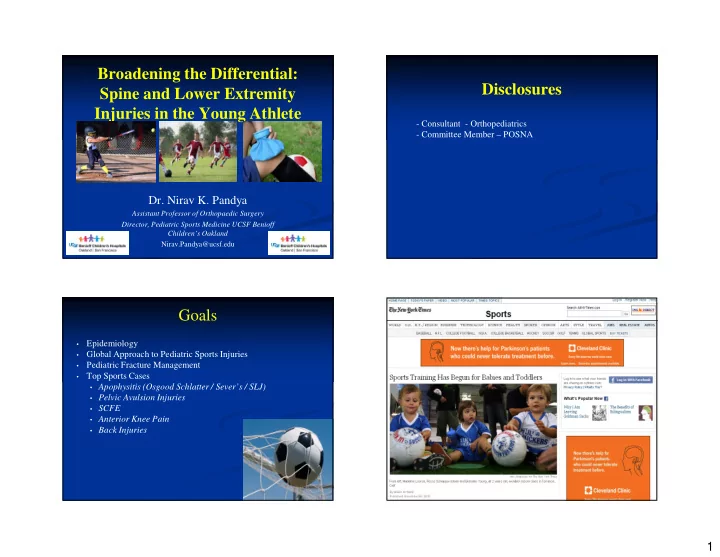
Broadening the Differential: Spine and Lower Extremity Injuries in the Young Athlete

  • Dr. Nirav K. Pandya

Assistant Professor of Orthopaedic Surgery Director, Pediatric Sports Medicine UCSF Benioff Children’s Oakland Nirav.Pandya@ucsf.edu

Disclosures

  • Consultant - Orthopediatrics
  • Committee Member – POSNA

Goals

  • Epidemiology
  • Global Approach to Pediatric Sports Injuries
  • Pediatric Fracture Management
  • Top Sports Cases
  • Apophysitis (Osgood Schlatter / Sever’s / SLJ)
  • Pelvic Avulsion Injuries
  • SCFE
  • Anterior Knee Pain
  • Back Injuries
slide-2
SLIDE 2

2

Why Are Kids Different?

50% of all pediatric athletes will suffer at least 1 significant injury / year!

Key History Questions

  • Insidious and dull vs. sharp and traumatic pain
  • Diffuse vs. localized pain
  • Pain before / after sports vs. during sport
  • Normal gait vs. locking, instability, limping

vs.

slide-3
SLIDE 3

3

Key History Questions

  • Hours / week, miles / week, pitches / week
  • Number of teams (club, school)
  • Shoewear changes / inserts / braces
  • Medications / supplements / alternative tx
  • Prior MSK problems
  • Family history
  • Grades
  • Emotional health

Key Physical Exam Maneuvers

Location of palpable pain will direct you to injury 99% of time!!

Imaging ALL PATIENTS SHOULD GET AN AP AND LATERAL X-RAY OF THE AFFECTED JOINT!!!

  • Ex. 10 y/o soccer player with 6 weeks of anterior

knee pain

slide-4
SLIDE 4

4

Osteosarcoma Pediatric Fractures Pediatric Fractures

  • The vast majority of pediatric sports

injuries still involve ruling out or treating fractures

  • Children can mask fractures very

easily and initial radiographs can be negative

  • Do not feel bad immobilizing a child

if you are not sure

  • Fractures constitute 10 % - 25 % of all pediatric

injuries

  • Risk of fracture from birth to 16 years:
  • Boys: 42%
  • Girls: 27%
slide-5
SLIDE 5

5

Why Are Children’s Fractures Different? Why Are Children’s Fractures Different?

  • Growth Plate (Physis)
  • Periosteum
  • Ligaments
  • Physiology
  • Bone Structure

Bone Anatomy

  • Epiphysis
  • Metaphysis
  • Diaphysis
  • Periosteum
  • Physis

The Physis: The Difference Maker

  • Many childhood fractures involve the physis
  • 20% - 25% of all skeletal injuries
  • CAN disrupt growth of bone
  • Length and /or angulation
  • Injury near but not at the physis can stimulate bone

to grow more

slide-6
SLIDE 6

6

Salter-Harris Classification

  • Classification system to

delineate risk of growth disturbance

  • Higher grade fractures =

increase risk

  • Growth disturbance can

happen with ANY physeal injury

Physeal Injuries: Growth Disturbance

  • Fractures with highest rate of growth disturbance:
  • Distal femur
  • Distal tibia
  • Late reduction of distal radius

50%

25% Children vs. Adults

  • LIGAMENTS:
  • Pediatric ligaments stronger than bone
  • More likely to get avulsion than ligament tear

Children vs. Adults

  • PHYSIOLOGY:
  • More robust blood supply; less chance of non-union
  • Children tend to heal fractures faster than adults
  • Advantage: shorter immobilization times
  • Disadvantage: misaligned fragments become

“solid” sooner

slide-7
SLIDE 7

7

Remodeling Potential Treatment Principles

1. AP and lateral x-rays of fracture site 2. AP and lateral x-ray of joint above / below 3. Kids can have occult injuries 4. If tender around growth plate, assume Salter Harris I

Treatment Principles

What do you do to treat definitively?

Treatment Principles

Kids don’t get stiff!!!

slide-8
SLIDE 8

8

Top Cases Case 1: Apophysitis Case 1: Apophysitis

When growing pains are not growing pains

Case 1: Apophysitis

  • Apophysis = growth

plate where muscle attaches

  • Bone growth >>

muscle growth

  • Apophysitis =

irritation of the apophysis due to tight muscles / overuse

slide-9
SLIDE 9

9

Osgood – Schlatter’s Sinding-Larsen Johansson Syndrome (SLJ) Sever’s Ischial Tuberosity Apophysitis

slide-10
SLIDE 10

10

Iselin’s Disease

  • Between 7 – 12 years of age (sk. immature)
  • Sever’s usually younger
  • OS / SLJ / IT / Iselin’s usually older
  • Soccer and basketball!!
  • Overuse, overuse, overuse
  • Growth spurt, growth spurt, growth spurt
  • Pain over bone prominences NOT tendon

Key H+ P Osgood - Schlatter Sever’s

slide-11
SLIDE 11

11

Osgood - Schlatter / Sever’s : Key H+ P

During growth spurt, bones grow faster than muscle > more tense muscles > more pull on apophysis

  • R.I.C.E
  • Avoid excessive running
  • Stretching / PT
  • Orthosis for flat feet
  • Patellar tendon straps

Osgood - Schlatter Treatment

  • R.I.C.E
  • Avoid excessive running
  • Stretching / PT
  • Heel cups
  • Minimize cleat wear

Sever’s Treatment What To Worry About

slide-12
SLIDE 12

12

Return to Play Case 2: Pelvic Avulsion Fractures Bony Injuries – Avulsion Fx’s Pelvic Anatomy

slide-13
SLIDE 13

13

Pelvic Anatomy

  • Avulsion Fractures
  • Ages 14 - 25
  • “I heard a pop”
  • Sprinters, jumpers, hurdlers, soccer, football
  • Sudden violent muscle contraction
  • Separation in cartilaginous area between apophysis

and bone

Bony Injuries – Avulsion Fx’s

Bony Injuries – Avulsion Fx’s

Prompt diagnosis to avoid chronic pain

Bony Injuries – Avulsion Fx’s

slide-14
SLIDE 14

14

Prompt diagnosis to avoid chronic pain

Bony Injuries – Avulsion Fx’s

  • Treatment
  • Rest and ice
  • Protected weight bearing until pain free
  • Progression to light isometric stretching and full

weight bearing

  • Return to full sports once full strength and pain-

free range of motion is achieved

Bony Injuries – Avulsion Fx’s

Case 3: Slipped Capital Femoral Epiphysis (SCFE) Slipped Capital Femoral Epiphysis (SCFE)

slide-15
SLIDE 15

15

SCFE – Epidemiology

  • Common problem with

serious consequences

  • Annual incidence - 2 to 13

per 100,000

  • Increased risk in certain

groups

  • Male
  • Obese
  • Peripubertal
  • Polynesian

SCFE – Etiology

  • Mechanical insufficiency of the proximal femoral

physis to resist the load across it due to:

  • Endocrine factors
  • Previous radiation therapy
  • Renal osteodystrophy
  • Obesity

SCFE – Etiology

  • Mechanical insufficiency of the proximal femoral

physis to resist the load across it due to:

  • Decreased femoral anteversion
  • Decreased neck-shaft angle
  • Deeper acetabulum
  • Acetabular retroversion

Pathoanatomy

  • Proximal femoral metaphysis impinges

against acetabulum

  • Cartilage + labral damage
  • Posteromedial callus also develops over time
  • Long term risk of FAI and DJD
slide-16
SLIDE 16

16

Pathoanatomy

Why do we care?

AVN and DJD

Presentation and Workup

  • Complaints of groin or thigh pain + / - trauma
  • May or may not be ambulating
  • May complain of knee pain!!
  • AP and frog pelvis x-ray
  • MRI of hip if not sure
slide-17
SLIDE 17

17

Classification

  • Functional
  • Stable: able to bear weight
  • Unstable: unable to bear weight

AVN risk in unstable slips can range from 10% to 60%, and is higher in younger patients with a shorter duration of preceding symptoms

Radiographs Initial Treatment

  • Prevent further slip progression
  • Restore proximal femoral anatomy

Wheelchair and ED

Goals of Treatment

  • Prevent further slip progression
  • Restore proximal femoral anatomy
slide-18
SLIDE 18

18

Treatment Options Return to Activity??

  • 1. Wheelchair / crutches until 6 weeks post-op
  • 2. Full-weightbearing @ post-op week 6
  • 3. Return to sports at 3 months post-op
  • 4. X-Rays every 6 months until 2 years post-op
  • 5. Watch out for FAI

Case 4: Anterior Knee Pain

Irritation Behind Patella

What is PF Syndrome?

slide-19
SLIDE 19

19

Patellofemoral Syndrome: Key H + P

  • No trauma
  • Dull pain around knee cap or “deep inside”
  • “Feels like sandpaper underneath kneecap”
  • Playing sports all the time
  • Stairs and sitting for long time = pain
  • Benign exam
  • Lack flexibility and core strength

Patellofemoral Syndrome

Assess Single Leg Squat Assess Popliteal Angles

slide-20
SLIDE 20

20

Core Stability Imaging

  • AP, lateral, notch, and merchant x-rays (r/o OCD, fractures, etc)
  • MRI only if does not improve with 6 – 12 weeks of PT

Patellofemoral Pain Syndrome

  • Treatment
  • Rest
  • Pharmacologic
  • NSAID’S
  • PT
  • Core / Hip Strengthening
  • Stretching
  • Orthosis
slide-21
SLIDE 21

21

Can I Play Through the Pain?

  • Consequences of Playing:
  • No structural damage but pain

will last longer

  • Minor risk of structural damage
  • Major risk of structural damage

Surgery: Is It Ever Indicated? Case 5: Back Pain Back Pain in Pediatrics

  • Uncommon CC, but common occurrence
  • 7% of 12yo with >1 episode LBP
  • 50% of 18yo F, 50% of 20yo M
  • Most not definitively diagnosed
  • Most benign etiologies
  • ~Half of episodes musculoskeletal (ER)
  • Remember, backpacks <15-20% of weight!
slide-22
SLIDE 22

22

Back Pain in Pediatrics: Differential Diagnosis

Red Flags!

  • Infectious, Neoplastic, Rheumatologic
  • Acute trauma
  • Night pain
  • Worsening pain
  • Systemic symptoms
  • Neuro symptoms
  • Hx CA/TB exposure
  • Severe disability
  • Young age (<4yo)
  • Bowel / bladder

Spondylolysis Spondylolysis

  • Spondylolysis: Defect (separation) in pars

interarticularis

  • Spondylolisthesis: Anterior slippage of vertebral

body over next lowest body

slide-23
SLIDE 23

23

Who Is At Risk?

  • Athletes with repetitive

hyperextension

  • Gymnasts
  • Divers
  • Football offensive linemen
  • Pole vaulters
  • Weight lifters
  • Wrestlers
  • LAXers!

Spondylolysis: H and P

  • Low back pain without radiation
  • Insidious onset
  • Worse with activity
  • Rarely radiating
  • Usually no hx trauma
  • Usually no neuro deficits

Spondylolysis: H and P

  • Pain with hyperextension
  • +/- “Step-off” at L5
  • +/- Facet joint tenderness
  • Hamstring spasm – classic in adolescents!
  • Phalen-Dickson sign
  • hip-flexed, knee-flexed gait

Radiographs: Scottie Dog

slide-24
SLIDE 24

24

Radiographs: Scottie Dog

If not sure, then order CT, MRI, etc

Treatment

  • Depends on SLIPPAGE and SYMPTOMS and

SKELETAL MATURITY

  • Activity restriction
  • NSAIDs
  • Physical therapy
  • Abdominal/back strengthening
  • Hamstring stretching
  • Bracing/Casting
  • Symptomatic / Acute pars fx
  • Surgery

Pediatric Sports Top 10 List

  • 1. Pediatric sports injuries are at an epidemic level
  • 2. Kids have hard time verbalizing and have multiple pressures
  • 3. Location of palpable pain will lead you to injury 99.0% of time
  • 4. Pediatric fractures are most common sports injuries
  • 5. Kids don’t get stiff and heal faster; watch out for growth issues
  • 6. Bony tenderness in athlete = apophysitis
  • 7. Pop and pelvic pain = avulsion fracture
  • 8. Thigh pain = rule out SCFE
  • 9. Look at mechanics and core strength for anterior knee pain

10.Pain with hyperextension = spondy

Thank You