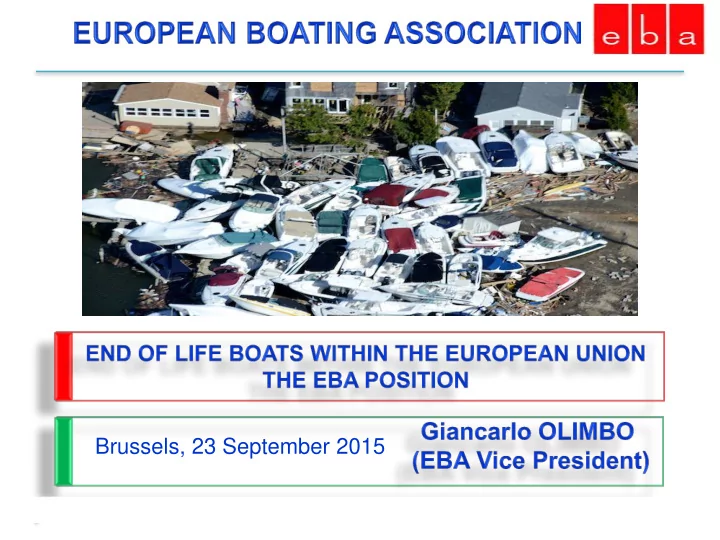
SLIDE 1
1
Brussels, 23 September 2015
SLIDE 2 EXECUTIVE SUMMARY
2
- Fibre Reinforced Plastic (FRP) vessels highly durable and end-
- f-life (EOL) disposal progressively becoming a major issue.
- As regulation restricts the disposal of FRP to landfill, recycling
will become the only realistic option.
- Many projects on boat dismantling and recycling practices :
Increased awareness, but none addressed how disposal to be
financed;
a few suggested costs should fall on the boat owner; not recognized the boatbuilding industry has its part to play and
development of marine products more sustainable throughout their life cycle must be incentivized;
SLIDE 3 EXECUTIVE SUMMARY
3
- In Europe, in spite of advances in waste management, there is a
compelling need for specific and uniform provisions related to management, scrapping and recycling of boats;
- For EBA it’s time marine Industry start developing viable EOL
strategies itself so as :
- boats are designed and manufactured to allow their reuse,
recycling and recovery;
- producers meet a significant part for the costs of the
implementation of these measures.
SLIDE 4 BACKGROUND
4
- On ELB EBA mandated its WG to make inventory of the problem
from a Consumer perspective;
- Findings confirm the problem exists with a rapid growth.
- The estimated normal lifespan for boats in FRP is about 30/40 years.
As the mass production of such hulls started in the early 70ies, the “tsunami” of ELB cases is expected in the next years to come.
SLIDE 5 BACKGROUND
5
- Present disposal methods generally involve chopping up
composite structures, reducing them to fragments for landfill.
- Approach unsustainable in the long run !!
- Countries, as Germany and the Netherlands, have regulations
restricting the disposal of FRP to landfill.
- Recycling will become the only realistic and viable option !!!!
- It meets the legal provisions as set out by EU Waste Directive
2008/98/EC Unlike metal and wooden boats, made of recyclable or naturally degrading materials, fiberglass craft need particular consideration and safe, ecofriendly working practices;
SLIDE 6 LOGISTICS
6
- Recycling of “clean waste material” is already viable;
- Process to facilitate this recycling focused on:
- dismantling (using existing breaker yard facilities);
- separation of different materials (tooling already existing)
- tackling specific impurities like AF paint/asbestos
insulation, etc.
SLIDE 7 The industrial process
7
Today, 1 broad model being developed, based on:
- Creating a local network of professionals to organize boat
collection;
- Assessment of each individual boat;
- De-pollution, dismantling and boat dispatching into gross
waste condition;
- Treatment in industrial waste recycling plants;
- URGENT issue:
The final cost is born by the owners (1300-1500 €/10 m)
SLIDE 8 Boat DIGEST and EBA
8
EBA:
involved in the Boat DIGEST project as Advisory Board member,
providing suggestions and feedback on the deliverables, the vocational education and awareness developed;
disseminated info to its members and discussed the outputs with
them;
recognizes the valuable contribution that Boat DIGEST made in
raising the level of awareness among a number of key sectors;
however, the project hasn’t make an assessment on the possible
financing models for disposing of an old craft:
this
and where costs fall, issues that concern boat
SLIDE 9 Responding to the B.D. Questionnaire
9
DONE : close and continuous contacts with EBI and BD;
- Guidelines for boat owners, with the WG extended comments;
- BD’s aim to promote owners/users liability NOT ENOUGH;
- Stressed EBA stances & perspectives on preventing owners
shouldering associated dismantling/recycling costs;
- EBA-EBI cooperation appropriate to progress common aspects but
also monitor and address the consumers’ concerns;
- For EBI, a new horizon to be explored:
- convenience of a closer cooperation with EBA, as over 10 millions
- f owners/users constitute a "critical mass" with large impact on
the boating policies and their makers;
SLIDE 10
Responding to the BD Questionnaire
10
EBA’s opinion: EBI and EBA to fight the equation “boat owners = wealthy
people” as unrealistic, outdated and contrary to any recreational/economical logic.
Industry develop solutions preventing inadequate costs
for last owner. However, the big question to be answered is:
“ what costs are involved and who will pay for them?”
.
SLIDE 11 WHO WILL PAY?
11
Conventional dismantling a 7 m long boat, including logistics, is
€800, rising to some € 1500 for a 10-12 m craft and € 15,000 for a 15 m vessel. (The escalation is related more to boat volume than to length and to the greater complexity of larger vessels);
Suggested costs could fall on the boat owner, unwilling or unable to
afford such substantial sums, at least within a short time span;
Unlike owners of metal boats, which have significant scrap value in
their recyclable metals, those of reinforced plastic craft cannot rely
- n embodied scrap value to reduce disposal costs;
Risks of abandoned boats, already present, to be enhanced, increasing environmental impact.
SLIDE 12 WHO WILL PAY?
12
For EBA the main problem is:
- this scheme doesn’t recognize the boatbuilding Industry has its
part to play;
- so far little incentive for innovation in green design and
development of new marine products more sustainable throughout their life cycle and during scrapping and recycling; Now time that European policy makers consider the concept of extended producer responsibility (EPR) as the best route to take; In this approach, the Industry itself has the primary responsibility for EOL disposal;
SLIDE 13 WHO WILL PAY?
13
This reflects the fact boat builders and their suppliers are, after all, key stakeholders in the life-cycle process and working towards sustainable production is in their interests; Although EPR is not without its problems:
who ‘inherits’ the responsibility if the original fabricator goes
- ut of business since many boat builders last nowhere near as
long as the composite boats they build, EBA believes the marine Industry must start developing viable EOL strategies itself or risk of solutions imposed by European legislation akin to those that have evolved for the auto trade.
SLIDE 14 OPTIONS ON ELB
14
Different national measures concerning end-of life vehicles should be harmonized to minimize the impact of end-of life boats
- n the environment, thus contributing to the protection,
preservation and improvement of the quality of the environment; A Community-wide framework necessary to ensure coherence between national approaches, particularly with a view to:
- the design of boats for recycling and recovery;
- the requirements for collection and treatment facilities, and
- the attainment of the targets for reuse, recycling and recovery,
taking into account the principle of subsidiarity and the “polluter-pays” principle.
SLIDE 15 OPTIONS ON ELB
15
In line with the Community strategy for waste management:
- the generation of waste must be avoided as much as
possible;
- IAW the fundamental principle, waste should be reused
and recovered, and
- Priority be given to reuse and recycling.
SLIDE 16
OPTIONS ON ELB
16
Member States should take measures to ensure that:
economic operators set up systems for collection, treatment
and recovery of FRP boats no longer fit for use;
last holder and/or owner can deliver the boat to an authorized
treatment facility without any cost as a result of the boat having no or a negative market value;
producers meet a significant part of the costs for the
implementation of these measures; the normal functioning of market forces should not be hindered;
The requirements for dismantling reuse and recycling of ELB
and their components should be integrated in the design and production of new boats;
innovation budget is available to stimulate recycling of GRP
material originating from pleasure craft (the 7^ EAP)
SLIDE 17 17
THE 7th ENVIRONMENT ACTION PROGRAMME (EAP)
- The main objective guiding the European
Environment Policy for the years to come.
- EAP sets out a life “within the planet’s ecological limits, nothing is
wasted, natural resources sustainably managed and low-carbon growth decoupled from resource use, setting the pace for a safe and sustainable global society.”
- Any progress is possible only within an environmental framework;
- EAP identified the objectives for intermediate and final goals.
- It financially supports investments for :
- “the sustainable management and efficient use of resources, including
waste”, and
- “the value of an economy based on products environmentally sound”.
- To this target, then, should also aim ELB!!
SLIDE 18 18
THE 7th ENVIRONMENT ACTION PROGRAMME (EAP)
- Special focus on turning waste into a resource-efficient,
green, and competitive economy and to move towards a better implementation of existing legislation, with more and wiser investment for the EU waste management and recycling sector.
- The programme entered into force in January 2014.
- EU institutions and Member States to ensure it is
implemented and that priority objectives set out are met by 2020.
SLIDE 19
THE EBA WG POSITION
19
Today, in spite of the great advances in waste management in Europe, there is a compelling need for specific, harmonized provisions on management, scrapping and recycling of boats. Similar to the EOL Vehicles, there is now a requirement for harmonized measures on EOL boats that lay down procedures aimed at:
Ensuring boats are designed and manufactured so as to allow
targets for reuse, recycling and recovery to be achieved;
preventing of waste; promoting the reuse, recyclability and recovery; obligating the use of manufacturing processes without
hazardous substances;
improving the environmental performance of all of the
economic operators involved in the life cycle of boats.
SLIDE 20 THE EBA WG POSITION
20
- Work collectively with Industry so as:
The scheme cover boats and end-of life
boats, including their components and materials;
Address
Administrations
the possibility of creating partnerships with builders/dismantlers/recyclers;
- The aim is to:
- stress the chance of significant incomes for reusing products;
- foresee financial support for this activity( i.e. car recycling) both
at national and EU level, IAW the 7^ EAP;
- reduce significantly the current owners’ costs;
- mitigate the ELB impact on the environment;
- preserve boating ecological image/reputation;
Contribute to the long term growth of European boating !!
SLIDE 21 21
OPPORTUNITIES
ELB would lead to the establishment of a “return cycle” that allows to reduce the costs both for management of waste and for the use
- f a secondary raw material, result of a up-cycling process and
cheaper than the materials currently available on the market;
- For the environment & the consumer:
The abandonment of ELB boats creates extensive economic problems related to the management of the generated waste:
- Possible action: Benefiting of a mechanism/scheme which could
encourage, either fiscally or indirectly, the boats disposal at their end life.
SLIDE 22 22
OPPORTUNITIES
The market of raw materials sees an increase of their value that is reflected in an increase of the price of the finished product; Possible action: Stimulate an industrial policy that rewards activities of design and construction aimed at promoting the separation of components for their eco-friendly disposal, with a consequent better and recognized qualification of yards that are distinguished by these characteristics (i.e. progressive number of quality stars
A simpler new procedure for a more eco-friendly recycling of boats at their end-of-life could encourage consumers to purchase new boats: Possible action: The EU Institutions/Governments should encourage fiscally the collection and recycling of boats at the end
etc.)
SLIDE 23 Any Questions?
P