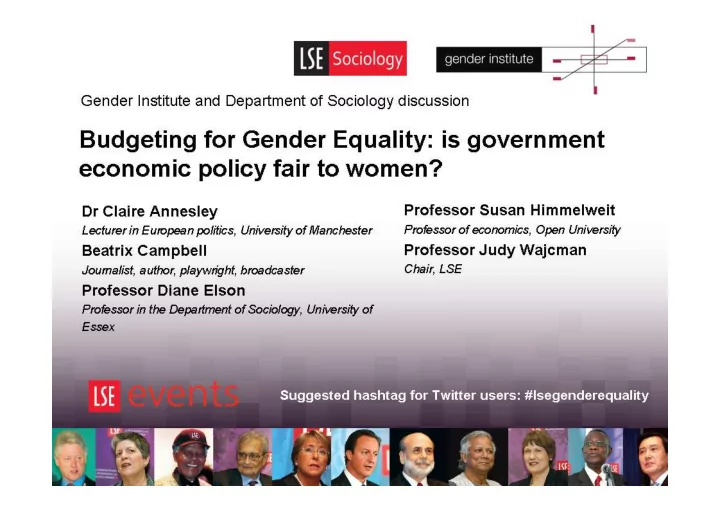
Budgeting for Gender Equality: is government economic policy fair - - PowerPoint PPT Presentation

budgeting for gender equality is government economic
SMART_READER_LITE
LIVE PREVIEW

Budgeting for Gender Equality: is government economic policy fair - - PowerPoint PPT Presentation

Budgeting for Gender Equality: is government economic policy fair to women? Dr Claire Annesley University of Manchester/Womens Budget Group claire.annesley@manchester.ac.uk Foundations for Gender Equality Equal opportunities for quality


slide-1
SLIDE 1
slide-2
SLIDE 2

Budgeting for Gender Equality: is government economic policy fair to women?

Dr Claire Annesley University of Manchester/Women’s Budget Group claire.annesley@manchester.ac.uk

slide-3
SLIDE 3

Foundations for Gender Equality

  • Equal opportunities for quality paid employment
  • Access to adequate independent income for all

women and men

  • Coalition’s measures in June 2010 Budget and

October 2010 Spending Review chip away at these (see: wbg.org.uk)

  • Measures and proposals announced so far in 2011

appear to mark a trend towards economic dependence for women and the return of the Male Breadwinner Model.

  • But there is also potentially some better news.
slide-4
SLIDE 4

Welfare Reform Bill (February)

  • Sets out proposals for Universal Credit: means-tested,

single monthly payment to household intended to increase incentives to get one adult into work and to ‘mimic wages’.

  • Strengthens work incentive for one working adult; but

benefit withdrawal rate will be faster for second earners.

  • Maximum subsidy for childcare costs down from 80 to

70%.

  • Single household payment. Couples can nominate who

the payment should go to; it will only be split in emergencies.

  • Women manage budgets and day to day spending; a

single monthly payment makes it harder to budget on low incomes.

slide-5
SLIDE 5

The Budget (March)

  • Commitments to tax breaks, promoting enterprise and

improving skills. But nothing for women’s employment.

  • Proposed rise of personal allowance to £8,105 in

2012/13 will lift 260,000 people out of tax, 56% of whom are women.

  • But will not benefit those earning below this threshold,

73% of whom are women (LFS 2009-10).

  • Desired job growth in the private sector will not

necessary benefit women: gender pay gap; less compatible with caring responsibilities; attack on regulations.

  • Investment in 50,000 new apprenticeships but no

commitment to gender equality in allocation or

  • quality. Budget’s emphasis strongly on science.
slide-6
SLIDE 6

Pension Green Paper (April)

  • ‘A State Pension for the 21st Century’ (2011 DWP)

sets out plans for reforming current pensions system.

  • One option is for single-tier state pension,

combining BSP and S2P. Set at ‘around £140’ per week; gets rid of means-tested Pensions Credit.

  • Explicit aim to reduce gender inequalities in

pensions (DWP 2011, 22).

  • But: future pensioners only; still based on

contributory principle (rather than citizenship); does not compensate for loss of public services.

slide-7
SLIDE 7

So Far in 2011…

  • No support for women in the shift from public to

private employment opportunities.

  • An explicit acceptance that the Male

Breadwinner Model is ‘justified’ (DWP 2011, 19).

  • Nothing to help people on the lowest incomes,

many of whom are women.

  • Nothing to compensate lone parents and single

pensioners for the loss of services due to October’s public sector spending cuts.

slide-8
SLIDE 8