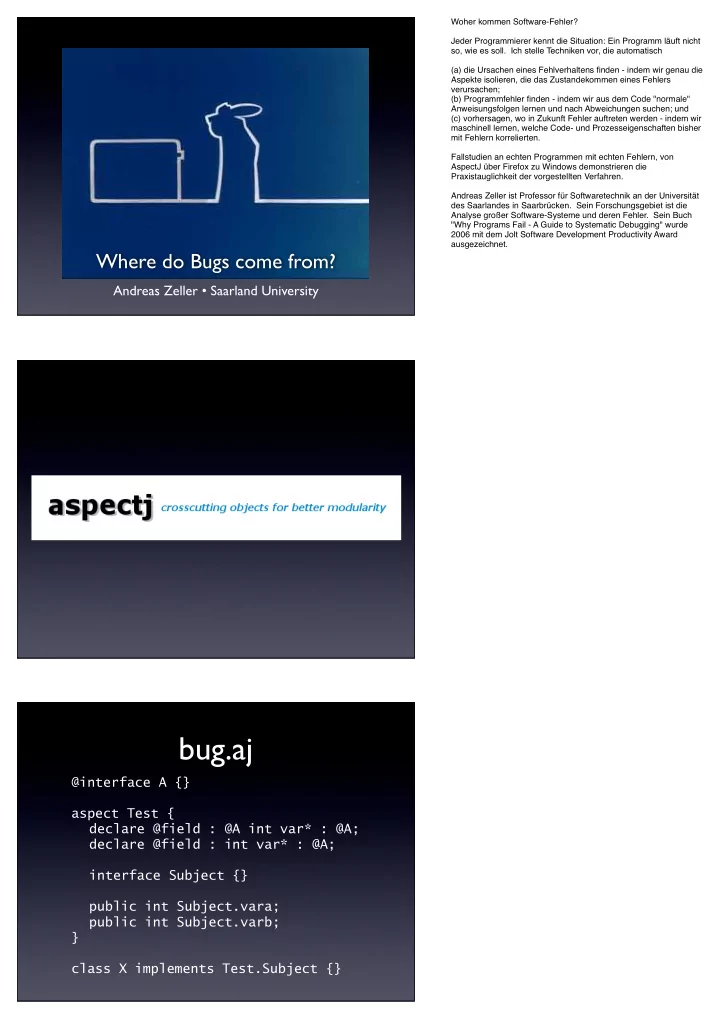
bug.aj @interface A {} aspect Test { declare @field : @A int var* - - PDF document

bug aj
SMART_READER_LITE
LIVE PREVIEW

bug.aj @interface A {} aspect Test { declare @field : @A int var* - - PDF document

Woher kommen Software-Fehler? Jeder Programmierer kennt die Situation: Ein Programm luft nicht so, wie es soll. Ich stelle Techniken vor, die automatisch (a) die Ursachen eines Fehlverhaltens finden - indem wir genau die Aspekte isolieren, die


slide-1
SLIDE 1

Where do Bugs come from?

Andreas Zeller • Saarland University

bug.aj

@interface A {} aspect Test { declare @field : @A int var* : @A; declare @field : int var* : @A; interface Subject {} public int Subject.vara; public int Subject.varb; } class X implements Test.Subject {} Woher kommen Software-Fehler? Jeder Programmierer kennt die Situation: Ein Programm läuft nicht so, wie es soll. Ich stelle Techniken vor, die automatisch (a) die Ursachen eines Fehlverhaltens finden - indem wir genau die Aspekte isolieren, die das Zustandekommen eines Fehlers verursachen; (b) Programmfehler finden - indem wir aus dem Code "normale" Anweisungsfolgen lernen und nach Abweichungen suchen; und (c) vorhersagen, wo in Zukunft Fehler auftreten werden - indem wir maschinell lernen, welche Code- und Prozesseigenschaften bisher mit Fehlern korrelierten. Fallstudien an echten Programmen mit echten Fehlern, von AspectJ über Firefox zu Windows demonstrieren die Praxistauglichkeit der vorgestellten Verfahren. Andreas Zeller ist Professor für Softwaretechnik an der Universität des Saarlandes in Saarbrücken. Sein Forschungsgebiet ist die Analyse großer Software-Systeme und deren Fehler. Sein Buch "Why Programs Fail - A Guide to Systematic Debugging" wurde 2006 mit dem Jolt Software Development Productivity Award ausgezeichnet.
slide-2
SLIDE 2

Diagnosis Detection Prevention

Where do Bugs come from? • Andreas Zeller, Saarland University
slide-3
SLIDE 3

Diagnosis Detection Prevention

Where do Bugs come from? • Andreas Zeller, Saarland University

bug.aj

@interface A {} aspect Test { declare @field : @A int var* : @A; declare @field : int var* : @A; interface Subject {} public int Subject.vara; public int Subject.varb; } class X implements Test.Subject {} java.util.NoSuchElementException at java.util.AbstractList$Itr .next(AbstractList.java:427) at org.aspectj.weaver.bcel.BcelClassWeaver .weaveAtFieldRepeatedly (BcelClassWeaver.java:1016)

ajc Stack Trace

We can fix this by looking at the stack trace.

slide-4
SLIDE 4

weaveAtFieldRepeatedly

for (Iterator iter = itdFields.iterator(); iter.hasNext();) { ... for (Iterator iter2 = worthRetrying.iterator(); iter.hasNext();) { ... } } Lenhof, Hans-Peter,, +49 681 302-64701, lenhof@cs.uni-sb.de Lindig, Christian, +49 681 9358406, +49 681 302 5590, lindig@cs.uni-sb.de Mehlmann, Martin,,, mehlmann@st.cs.uni-sb.de Meyer zu Tittingdorf, Friederike, +49 6894 890035, +49 681 302-58099, meyer@cs.uni-sb.de Mileva, Yana,, +49 681 302-64020, mileva@cs.uni-sb.de Müller-Perich, Elisabeth,, +49 681 302-5070, sekr.techfak@rz.uni-sb.de Nir-Bleimling, Naomi,, +49 68130264011, naomi@wjpserver.cs.uni-sb.de Offergeld, Thilo,, +49 681 302-6594, t.offergeld@univw.uni-sb.de PC, CC 2006,,, cc2006pc@st.cs.uni-sb.de Paul, Wolfgang, +4968171825, +49 6813022436, wjp@cs.uni-sb.de Premraj, Rahul, +44 7796953511, +49 681 302-64013, premraj@cs.uni-sb.de Reindel, Erich, +49 6371 912842, +49 681 302-58091, reindel@cs.uni-sb.de Schuler, David,, +49 681 302-64026, schuler@st.cs.uni-sb.de Schuler, Erika,, +49 6813025069, schuler@tf.uni-sb.de Schäfer, Christa, +49 6897 51165, +49 68130264011, Security, AG,,, security@st.cs.uni-sb.de Seidel, Raimund, +49 6894 383698, +49 681 302-4513, rseidel@cs.uni-sb.de Sekretariat, Sekretariat,, +49 681 302-64011, office@st.cs.uni-sb.de Sliwerski, Jacek, +491741333208,, sliwers@st.cs.uni-sb.de Slusallek, Philipp, +49 6826 1 88 71 32, +49 681 302-3830, slusallek@cs.uni-sb.de Slusallek USA, Philipp, +1 650 391 9186, +1 408 486 2788, slusallek@cs.uni-sb.de Smolka, Gert, +49 681 582770, +49 681 302-5311, smolka@ps.uni-sb.de Software-Evolution, AG,,, softevo@st.cs.uni-sb.de Thiel, Frank,,, hausmeister@cs.uni-sb.de Weiß, Cathrin,,, weiss@st.cs.uni-sb.de Wilhelm, Reinhard,, +49 681 302-4399, wilhelm@cs.uni-sb.de Zeller, Andreas,,, zeller@cs.uni-sb.de Zeller, Andreas, +49 681 3710465, +49 681 302-64011, zeller@cs.uni-sb.de Zimmermann, Tom, +49 851 51542 (Eltern), +1 403 210 9470, zimmerth@cs.uni-sb.de

mozilla.csv

slide-5
SLIDE 5
  • Proceed by binary search. Throw away half

the input and see if the output is still wrong.

  • If not, go back to the previous state and

discard the other half of the input.

Simplifying

mozilla.csv

✘ ✔ ✘ ✔

Lenhof, Hans-Peter,, +49 681 302-64701, lenhof@cs.uni-sb.de Lindig, Christian, +49 681 9378406, +49 681 302 7790, lindig@cs.uni-sb.de Mehlmann, Martin,,, mehlmann@st.cs.uni-sb.de Meyer zu Tittingdorf, Friederike, +49 6894 890037, +49 681 302-78099, meyer@cs.uni-sb.de Mileva, Yana,, +49 681 302-64020, mileva@cs.uni-sb.de Müller-Perich, Elisabeth,, +49 681 302-7070, sekr.techfak@rz.uni-sb.de Nir-Bleimling, Naomi,, +49 68130264011, naomi@wjpserver.cs.uni-sb.de Offergeld, Thilo,, +49 681 302-6794, t.offergeld@univw.uni-sb.de PC, CC 2006,,, cc2006pc@st.cs.uni-sb.de Paul, Wolfgang, +4968171827, +49 6813022436, wjp@cs.uni-sb.de Premraj, Rahul, +44 7796973711, +49 681 302-64013, premraj@cs.uni-sb.de Reindel, Erich, +49 6371 912842, +49 681 302-78091, reindel@cs.uni-sb.de Schuler, David,, +49 681 302-64026, schuler@st.cs.uni-sb.de Schuler, Erika,, +49 6813027069, schuler@tf.uni-sb.de Schäfer, Christa, +49 6897 71167, +49 68130264011, Security, AG,,, security@st.cs.uni-sb.de Seidel, Raimund, +49 6894 383698, +49 681 302-4713, rseidel@cs.uni-sb.de Sekretariat, Sekretariat,, +49 681 302-64011, office@st.cs.uni-sb.de Sliwerski, Jacek, +491741333208,, sliwers@st.cs.uni-sb.de Slusallek, Philipp, +49 6826 1 88 71 32, +49 681 302-3830, slusallek@cs.uni-sb.de Slusallek USA, Philipp, +1 670 391 9186, +1 408 486 2788, slusallek@cs.uni-sb.de Smolka, Gert, +49 681 782770, +49 681 302-7311, smolka@ps.uni-sb.de Software-Evolution, AG,,, softevo@st.cs.uni-sb.de Thiel, Frank,,, hausmeister@cs.uni-sb.de Weiß, Cathrin,,, weiss@st.cs.uni-sb.de Wilhelm, Reinhard,, +49 681 302-4399, wilhelm@cs.uni-sb.de Zeller, Andreas,,, zeller@cs.uni-sb.de Zeller, Andreas, +49 681 3710467, +49 681 302-64011, zeller@cs.uni-sb.de Zimmermann, Tom, +49 871 71742 (Eltern), +1 403 210 9470, zimmerth@cs.uni-sb.de

Failure Cause

Lenhof, Hans-Peter,, +49 681 302-64701, lenhof@cs.uni-sb.de Lindig, Christian, +49 681 9378406, +49 681 302 7790, lindig@cs.uni-sb.de Mehlmann, Martin,,, mehlmann@st.cs.uni-sb.de Meyer zu Tittingdorf, Friederike, +49 6894 890037, +49 681 302-78099, meyer@cs.uni-sb.de Mileva, Yana,, +49 681 302-64020, mileva@cs.uni-sb.de Müller-Perich, Elisabeth,, +49 681 302-7070, sekr.techfak@rz.uni-sb.de Nir-Bleimling, Naomi,, +49 68130264011, naomi@wjpserver.cs.uni-sb.de Offergeld, Thilo,, +49 681 302-6794, t.offergeld@univw.uni-sb.de PC, CC 2006,,, cc2006pc@st.cs.uni-sb.de Paul, Wolfgang, +4968171827, +49 6813022436, wjp@cs.uni-sb.de Premraj, Rahul, +44 7796973711, +49 681 302-64013, premraj@cs.uni-sb.de Reindel, Erich, +49 6371 912842, +49 681 302-78091, reindel@cs.uni-sb.de Schuler, David,, +49 681 302-64026, schuler@st.cs.uni-sb.de Schuler, Erika,, +49 6813027069, schuler@tf.uni-sb.de Schäfer, Christa, +49 6897 71167, +49 68130264011, Security, AG,,, security@st.cs.uni-sb.de Seidel, Raimund, +49 6894 383698, +49 681 302-4713, rseidel@cs.uni-sb.de Sekretariat, Sekretariat,, +49 681 302-64011, office@st.cs.uni-sb.de Sliwerski, Jacek, +491741333208,, sliwers@st.cs.uni-sb.de Slusallek, Philipp, +49 6826 1 88 71 32, +49 681 302-3830, slusallek@cs.uni-sb.de Slusallek USA, Philipp, +1 670 391 9186, +1 408 486 2788, slusallek@cs.uni-sb.de Smolka, Gert, +49 681 782770, +49 681 302-7311, smolka@ps.uni-sb.de Software-Evolution, AG,,, softevo@st.cs.uni-sb.de Thiel, Frank,,, hausmeister@cs.uni-sb.de Weiß, Cathrin,,, weiss@st.cs.uni-sb.de Wilhelm, Reinhard,, +49 681 302-4399, wilhelm@cs.uni-sb.de Zeller, Andreas,,, zeller@cs.uni-sb.de Zeller, Andreas, +49 681 3710467, +49 681 302-64011, zeller@cs.uni-sb.de Zimmermann, Tom, +49 871 71742 (Eltern), +1 403 210 9470, zimmerth@cs.uni-sb.de

Failure Cause

Now, the idea is that we can easily automate the whole process.

slide-6
SLIDE 6

Problem: Simplifying manually is inhuman.

Delta Debugging

Delta Debugging isolates failure causes automatically: Inputs: 1 of 436 Columba contacts Code changes: 1 of 8,721 code changes in GDB Threads: 1 of 3.8 bln thread switches in Scene.java Fully automatic + purely test-based

Problem: Simulating user interaction is cumbersome.

slide-7
SLIDE 7 v: Vector Vector() add() remove() remove()

Isolating Relevant Calls

Step 1: Record add() remove() JINSI Event Log v: Vector

Isolating Relevant Calls

Step 2: Replay JINSI Event Log Vector() add() remove() remove() add() remove()

v: Vector

Isolating Relevant Calls

Step 3: Simplify JINSI Event Log Vector() add() remove() remove() add() remove()

slide-8
SLIDE 8

Isolating Relevant Calls

Step 4: Create Unit Test JINSI

Text

testVector() { Vector v = new Vector(); v.remove(obj); }

Columba ContactModel

c: ContactModel ContactModel() setSortString() setNickName() setFamilyName() setFormattedName() setGivenName() and 18732 more…

ContactModel() getPreferredEmail() c: ContactModel ↯

Columba ContactModel

slide-9
SLIDE 9

Unit Test

testContactModel() { ContactModel c = new ContactModel(); String s = c.getPreferredEmail(); }

getPreferredEmail

public String getPreferredEmail() { Iterator it = getEmailIterator(); // get first item IEmailModel model = (IEmailModel) it.next(); // backwards compatiblity // -> its not possible anymore to create a // contact model without email address if (model == null) return null; return model.getAddress(); }

Delta Debugging

Delta Debugging isolates failure causes automatically: Inputs: 1 of 436 Columba contacts Code changes: 1 of 8,721 code changes in GDB Threads: 1 of 3.8 bln thread switches in Scene.java Fully automatic + purely test-based Calls: 2 of 18738 method calls

slide-10
SLIDE 10 ZELLER

FAIL

A Guide to Systematic Debugging ANDREAS ZELLER

WHY PROGRAMS FAIL

A Guide to Systematic Debugging

WHY

PROGRAMS

“The definitive book on debugging” – WALTER F. TICHY TU Karlsruhe #1 in Software Engineering Books Algorithms Books Software Design Books

Diagnosis Detection Prevention

Where do Bugs come from? • Andreas Zeller, Saarland University

And if you need such a toolbox, I have written all these techniques down in a textbook.

slide-11
SLIDE 11

Diagnosis Detection Prevention

Where do Bugs come from? • Andreas Zeller, Saarland University
  • Invalid iterator usage:

hasNext() should precede next()

  • hasNext() is operational precondition
AspectJ Columba

Problem: Specifying preconditions is hard work.

Kann man spezifizieren – eleganter ist aber das Extrahieren aus Code

slide-12
SLIDE 12

OP-Miner

Program iter.hasNext () iter.next () Usage Models hasNext ≺ next hasNext ≺ hasNext next ≺ hasNext next ≺ next Temporal Properties hasNext ≺ next hasNext ≺ hasNext Patterns hasNext ≺ next hasNext ≺ hasNext hasNext ≺ next hasNext ≺ hasNext

✓ ✗

Anomalies

OP-Miner

Program iter.hasNext () iter.next () Usage Models hasNext ≺ next hasNext ≺ hasNext next ≺ hasNext next ≺ next Temporal Properties hasNext ≺ next hasNext ≺ hasNext Patterns hasNext ≺ next hasNext ≺ hasNext hasNext ≺ next hasNext ≺ hasNext

✓ ✗

Anomalies

Method Models

public Stack createStack () { Random r = new Random (); int n = r.nextInt (); Stack s = new Stack (); int i = 0; while (i < n) { s.push (rand (r)); i++; } s.push (-1); return s; }
slide-13
SLIDE 13

Method Models

public Stack createStack () { Random r = new Random (); int n = r.nextInt (); Stack s = new Stack (); int i = 0; while (i < n) { s.push (rand (r)); i++; } s.push (-1); return s; } Random r = new Random ();

Method Models

public Stack createStack () { Random r = new Random (); int n = r.nextInt (); Stack s = new Stack (); int i = 0; while (i < n) { s.push (rand (r)); i++; } s.push (-1); return s; } Random r = new Random (); int n = r.nextInt (); Stack s = new Stack (); int i = 0; Random r = new Random (); int n = r.nextInt (); Stack s = new Stack (); int i = 0; i < n i++; s.push (rand (r));

Method Models

public Stack createStack () { Random r = new Random (); int n = r.nextInt (); Stack s = new Stack (); int i = 0; while (i < n) { s.push (rand (r)); i++; } s.push (-1); return s; }
slide-14
SLIDE 14 Random r = new Random (); int n = r.nextInt (); Stack s = new Stack (); int i = 0; i < n i < n i++; s.push (-1); s.push (rand (r));

Method Models

public Stack createStack () { Random r = new Random (); int n = r.nextInt (); Stack s = new Stack (); int i = 0; while (i < n) { s.push (rand (r)); i++; } s.push (-1); return s; } Random r = new Random (); int n = r.nextInt (); Stack s = new Stack (); int i = 0; i < n i < n i++; s.push (-1); s.push (rand (r));

Method Models

public Stack createStack () { Random r = new Random (); int n = r.nextInt (); Stack s = new Stack (); int i = 0; while (i < n) { s.push (rand (r)); i++; } s.push (-1); return s; } Random r = new Random (); int n = r.nextInt (); Stack s = new Stack (); int i = 0; i < n i < n i++; s.push (-1); s.push (rand (r));

Usage Models

slide-15
SLIDE 15 Stack s = new Stack (); s.push (-1); s.push (rand (r));

Usage Models Usage Models

s.<init>() s.push (_) s.push (_) Random r = new Random (); int n = r.nextInt (); Stack s = new Stack (); int i = 0; i < n i < n i++; s.push (-1); s.push (rand (r));

Usage Models

slide-16
SLIDE 16 Random r = new Random (); int n = r.nextInt (); s.push (rand (r));

Usage Models Usage Models

r.<init> () r.nextInt () Utils.rand (r)

OP-Miner

Program iter.hasNext () iter.next () Usage Models hasNext ≺ next hasNext ≺ hasNext next ≺ hasNext next ≺ next Temporal Properties hasNext ≺ next hasNext ≺ hasNext Patterns hasNext ≺ next hasNext ≺ hasNext hasNext ≺ next hasNext ≺ hasNext

✓ ✗

Anomalies
slide-17
SLIDE 17

OP-Miner

Program iter.hasNext () iter.next () Usage Models hasNext ≺ next hasNext ≺ hasNext next ≺ hasNext next ≺ next Temporal Properties hasNext ≺ next hasNext ≺ hasNext Patterns hasNext ≺ next hasNext ≺ hasNext hasNext ≺ next hasNext ≺ hasNext

✓ ✗

Anomalies

Discovering Anomalies

  • pen()
hello() parse() get() Temporal Properties Methods start ≺ stop lock ≺ unlock eof ≺ close

A Defect

for (Iterator iter = itdFields.iterator(); iter.hasNext();) { ... for (Iterator iter2 = worthRetrying.iterator(); iter.hasNext();) { ... } }

should be iter2

This would be a pattern, if it were not for the missing element

slide-18
SLIDE 18

Another Defect

public void visitNEWARRAY (NEWARRAY o) { byte t = o.getTypecode (); if (!((t == Constants.T_BOOLEAN) || (t == Constants.T_CHAR) || ... (t == Constants.T_LONG))) { constraintViolated (o, "(...) '+t+' (...)"); } }

should be double quotes

Name internalNewName (String[] identifiers) ... for (int i = 1; i < count; i++) { SimpleName name = new SimpleName(this); name.internalSetIdentifier(identifiers[i]); ... } ... }

A False Positive

should stay as is

A Code Smell

public String getRetentionPolicy () { ... for (Iterator it = ...; it.hasNext();) { ... = it.next(); ... return retentionPolicy; } ... }

should be fixed

On encountering a wrong typecode, \<visitNEWARRAY() > should report the typecode to the

  • user. However,

it fails to do so, as it uses \<'+t+'> instead of \<"+t +"> when In 48 cases: argument comes from String() constructor;

  • nly in 3 cases:

from array Hint → if fixed, would improve program Code smell → does not result in errors, but may cause maintainability problems Defects → reported & verified

slide-19
SLIDE 19

AspectJ

16 42 242 Defects Code smells False positives

More Results

# Violations Program Total Investigated # Defects # Code smells # False positives Efficiency A-R 0.8.2 25 25 2 13 10 60% A T 6.0.16 55 55 9 46 16% AUML 0.24 305 28 12 16 43% AJ 1.5.3 300 300 16 42 242 19% A 2.5.0.0 315 85 1 26 58 32% C 1.2 57 57 4 15 38 33% E 4.2 11 11 4 7 36% 1,068 562 23 121 417 26%

OP-Miner

OP-Miner learns operational preconditions – i.e., how to typically construct arguments learns from normal usage – for specific projects or across projects Fully automatic Found dozens of verified defects

1 out of 5 is a defect or code smell 2.5 minutes per violation – one new defect after 10 minutes Defects → reported & confirmed All in all, 1 out of 4 violations is a problem Lots of subtle defects in production code Unclear whether these would be found by other means

slide-20
SLIDE 20

Diagnosis Detection Prevention

Where do Bugs come from? • Andreas Zeller, Saarland University

Diagnosis Detection Prevention

Where do Bugs come from? • Andreas Zeller, Saarland University

ProgramBugs sind eingereicht und bestätigt

slide-21
SLIDE 21

Problem: How can we learn from our mistakes?

Bugs Versions

Such software archives are being used in practice all the time. If you file a bug, for instance, the report is stored in a bug database, and the resulting fix is stored in the version archive.

slide-22
SLIDE 22 Bugs Versions

Map bugs to code

Bugs in AspectJ Firefox Vulnerabilities

Where do these bugs come from?

These databases can then be mined to extract interesting

  • information. From bugs and

changes, for instance, we can tell how many bugs were fixed in a particular location.

slide-23
SLIDE 23

Is it the Developers?

Does experience matter? Bug density correlates with experience!

Is it History?

I found lots of bugs here. Will there be more? Yes! (But where did these come from?)

How about metrics?

Do code metrics correlate with bug density?

Sometimes!

slide-24
SLIDE 24
  • Uh. Coverage?

Does test coverage correlate with bug density? Yes – the more coverage, the more bugs!

Ah! Language features?

Are gotos harmful?

No correlation!

  • Ok. Problem Domain?

Which tokens do matter?

import • extends

  • implements
slide-25
SLIDE 25 nsIPrivateDOMEvent.h nsReadableUtils.h

✘ ✘ ✘ ✘ ✘ ✘ ✘ ✘ ✘ ✘ ✘ ✘ ✘ ✘ ✘ ✘ ✘ ✘ ✘

Prediction Component Fact 1 nsDOMClassInfo 3 2 SGridRowLayout 95 3 xpcprivate 6 4 jsxml 2 5 nsGenericHTMLElement 8 6 jsgc 3 7 nsISEnvironment 12 8 jsfun 1 9 nsHTMLLabelElement 18 10 nsHttpTransaction 35
  • Know where the bugs are
  • Calibrate bug prediction
  • Know where the next bugs will be
  • Fully automatic
slide-26
SLIDE 26 Bugs Versions
  • contain full record of project history
  • maintained via programming environments
  • automatic maintenance and access
  • freely accessible in open source projects

Software Archives

Bugs Versions Effort Navigation Chats e-mail Models Specs Code Traces Profile Tests Bugs Versions Effort Navigation Chats e-mail Models Specs Code Traces Profile Tests

This was just a simple example. So, the most important aspect that software archives give you is

  • automation. They are maintained

automatically (“The data comes to you”), and they can be evaluated automatically (“Instantaneous results”). For researchers, there are plenty

  • pen source archives available,

allowing us to test, compare, and evaluate our tools.

Tools can only work together if they draw

  • n difgerent artefacts

What are we working

  • n in SE - we are

constantly producing and analyzing artefacts: code, specs, etc.

Combining these sources will allow us to get this “waterfall effect” – that is, being submerged by data; having more data than we could possibly digest.

slide-27
SLIDE 27

Obtaining Data

The dirty story about this data is that it is frequently collected manually. In fact, the company phone book is among the most important tools of an empirical software engineering

  • researchers. One would phone one

developer after the other, and question them – say, “what was your effort”, or “how often did you test module ʻfooʼ?”, and tick in the appropriate form. In

  • ther words, data is scarce, and as it is

being collected from humans after the fact, is prone to errors, and prone to bias. Combining these sources will allow us to get this “waterfall effect” – that is, being submerged by data; having more data than we could possibly digest.

slide-28
SLIDE 28

Studies

Rosenberg, L. and Hyatt, L. “Developing An Effective Metrics Program” European Space Agency Software Assurance Symposium, Netherlands, March, 1996

Make this Actionable!

Letʼs now talk about results. What should our tools do? Should they come up with nice reports, and curves like this one?

slide-29
SLIDE 29

Diagnosis Detection Prevention

Where do Bugs come from? • Andreas Zeller, Saarland University

Diagnosis Detection Prevention

Where do Bugs come from? • Andreas Zeller, Saarland University ZELLER

FAIL

A Guide to Systematic Debugging ANDREAS ZELLER WHY PROGRAMS FAIL WHY PROGRAMS