Building Collaborative Academic-Practice Research Teams Lory Lory - - PDF document

building collaborative academic practice research teams
SMART_READER_LITE
LIVE PREVIEW

Building Collaborative Academic-Practice Research Teams Lory Lory - - PDF document

APNA 29th Annual Conference Session 2034.1: October 29, 2015 Building Collaborative Academic-Practice Research Teams Lory Lory Clukey Clukey, PhD, PhD, PsyD PsyD, RN, CNS RN, CNS The speaker has no conflicts of interest to disclose.


slide-1
SLIDE 1

APNA 29th Annual Conference Session 2034.1: October 29, 2015 Clukey 1

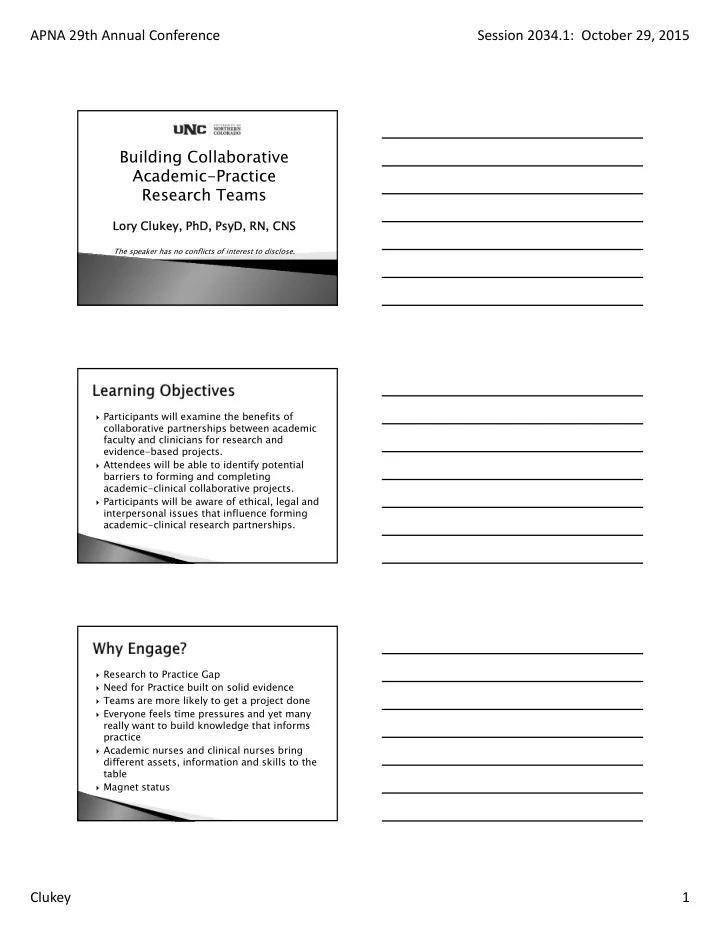
Building Collaborative Academic-Practice Research Teams

Lory Lory Clukey Clukey, PhD, PhD, PsyD PsyD, RN, CNS RN, CNS

The speaker has no conflicts of interest to disclose.

 Participants will examine the benefits of

collaborative partnerships between academic faculty and clinicians for research and evidence-based projects.

 Attendees will be able to identify potential

barriers to forming and completing academic-clinical collaborative projects.

 Participants will be aware of ethical, legal and

interpersonal issues that influence forming academic-clinical research partnerships.

 Research to Practice Gap  Need for Practice built on solid evidence  Teams are more likely to get a project done  Everyone feels time pressures and yet many

really want to build knowledge that informs practice

 Academic nurses and clinical nurses bring

different assets, information and skills to the table

 Magnet status

slide-2
SLIDE 2

APNA 29th Annual Conference Session 2034.1: October 29, 2015 Clukey 2

 Many minds are better than 1 mind  Different disciplines bring different

perspectives…interesting and enriching

 Professional development  Burn out prevention  Learning  Visibility and prestige  Relationships  Personal satisfaction  Type of project being formed:

  • Human Subject Research,
  • Evidence Based Project,
  • Quality Improvement Project

 Need for IRB approval  Need for business and legal expertise and

highest level of administration support

  • Product production

 Software, instrument development, program

 Interagency agreement

  • Different organizational purposes
  • Different structures
  • Different culture
  • Different languages

 Need for formalized contract…even among

friends

 Ethical and Legal considerations  Financial Issues

  • Costs & profits
  • Marketing & representation
slide-3
SLIDE 3

APNA 29th Annual Conference Session 2034.1: October 29, 2015 Clukey 3

 Collectively develop a plan for:

  • Purpose
  • Conduct
  • Workload distribution (roles & responsibilities)
  • Timeline(s)
  • Resource distribution (payment)
  • Data ownership (intellectual property)
  • Product ownership (financial compensation)
  • Patents
  • Time limit for contractual agreement

 Difficult process  Big problem = mismatched expectations  Need precise delineation of:

  • responsibilities for each person involved
  • administrative support
  • time commitments (projected then add some)
  • payment
  • expected outcome(s) or products

 Don’t leave anything assumed – THIS IS

ESSENTIAL!!!

 Put EVERYTHING in writing – even with friends  Each stakeholder shares perspectives,

expectations, concerns

 Requires a willingness to negotiate,

compromise, communicate clearly & directly

 Consensus needed  Need organizational approval  Need legal representation and approval  Consider cost and benefits that might not be

very obvious (prestige, visibility, reputation)

slide-4
SLIDE 4

APNA 29th Annual Conference Session 2034.1: October 29, 2015 Clukey 4

 Different organizational

  • Purpose
  • Structure
  • Goals
  • Culture
  • Expectations
  • Reward systems
  • Legal regulations
  • Economic incentives
  • Academic and Healthcare Businesses are different

animals

 Pressure for public institutions to generate

new funding sources => expanding patents; stronger intellectual property protection; protecting inventions (genetic; software)

 Changing regulations regarding “technology

transfer offices”

 Competition for limited resources  Unclear legal regulations  Communication, communication,

communication…

 Enhanced job satisfaction => retention  Clinical: targeted patient population; physical

resources (labs, equiptment); expertise in disease management; most knowledgeable of clinical problems (set research priorities); feasibility of interventions; clinical testing

 Academic: experts in research design, theory

testing; data collection, management, stats & analysis; funding, grant writing, publication; research laboratories, libraries

slide-5
SLIDE 5

APNA 29th Annual Conference Session 2034.1: October 29, 2015 Clukey 5

Bleich, M. R., Hewlett, P. O., Miller, K. L., Bender, K. (2004). Beyond tradition: Synergizing intellectual and material capital to forge the new academic-service partnership. Journal of Professional Nursing, 20(5), 285-294.

Blumenthal, D., & Meyer, G. S. (1996). Academic health centers in a changing environment. Health Affairs, 15(2), 200-215.

Cervantes, M. (2015). Academic Patenting: How universities and public research organizations are using their intellectual properto to boost research and spur innovative start-ups. World Intellectual Property Organization. Retrieved from: http://www.wipo.int/sme/en/documents/academic_patenting.html

Centrella-Nigro, A. M., Faber, K., Wiklinski, B., Bognar, L., Flynn, D. L., LaForgia, M. (2015). Effective collaboration among magnet hospitals: A win-win for nurses and institutions. American Journal of Nursing, 115(7), 50-54.

Edward, K. (2015). A model for increasing appreciation, accessibility and application of research in nursing. Journal of Professional Nursing, 31(2), 119-123.

Foote, J. M., Conley, V., Williams, J. K., McCarthy, A. M., Countryman, M. (2015). Academic and institutional review board collaboration to ensure ethical conduct of doctor of nursing practice

  • projects. Journal of Nursing Education, 54(7), 373-377.

Hulcombe, J., Sturgess, J., Souvlis, T., Fitzgerald, C. (2014). An approach to building research capacity for health practitioners in a public health environment: An organizational perspective. Australian Health Review, 38, 252-258.

Krumm, S. & Mock, V. (2005). Maximizing clinical-academic partnerships in studies of symptom management: Examples of success. Advanced Studies in Nursing, 3(5), 164-169.

Overholser, J. C. (2014). Protesting the decline while predicting the demise of clinical psychology: Can we avoid a total collapse? Journal of Contemporary Psychotherapy, 44, 273- 281.