Bulk observables vs. hard probes bulk high- p T probes Only few - - PowerPoint PPT Presentation

bulk observables vs hard probes
SMART_READER_LITE
LIVE PREVIEW

Bulk observables vs. hard probes bulk high- p T probes Only few - - PowerPoint PPT Presentation

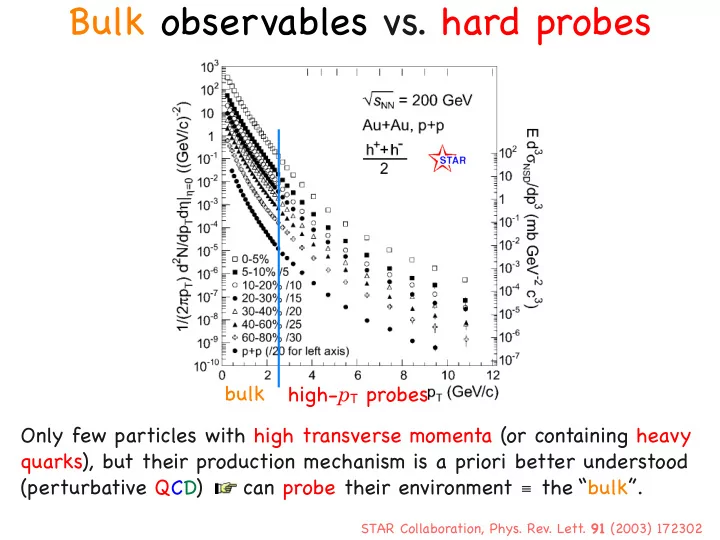
Bulk observables vs. hard probes bulk high- p T probes Only few particles with high transverse momenta (or containing heavy quarks), but their production mechanism is a priori better understood (perturbative QCD) can probe their environment


slide-1
SLIDE 1

bulk high-pT probes

Bulk observables vs. hard probes

Only few particles with high transverse momenta (or containing heavy quarks), but their production mechanism is a priori better understood (perturbative QCD) can probe their environment ≡ the “bulk”.

STAR Collaboration, Phys. Rev. Lett. 91 (2003) 172302

slide-2
SLIDE 2

Lclassical = −1 4F A

µνF µν A +

  • flavors

¯ qa(iD − m)abqb F A

µν = ∂µAA ν − ∂νAA µ − gf ABCAB µ AC ν

(Dµ)ab = ∂µδab + ig(tCAA

µ )ab

QCD Lagrangian

[tA, tB] = if ABCtC a, b = 1 … Nc = 3; A, B, C = 1 … Nc

  • 1

= 8 Effective coupling:

2

αs ≡ g2 4π

slide-3
SLIDE 3

Running of αs

plot from Bethke, Prog. Part. Nucl. Phys. 58 (2007) 351

Q2 ∂αs ∂Q2 = β(αs) ≡ −bα2

s

  • 1 + b′αs + b′′α2

s + O(α3 s)

  • b = 11CA − 2Nf

12π

  • ≡ β0

slide-4
SLIDE 4

Jets in heavy-ion collisions

[…] …

slide-5
SLIDE 5

Jets in heavy-ion collisions

[…] …

(unfortunately, effect overestimated by a factor ≈100)

slide-6
SLIDE 6

Time evolution of a heavy-ion collision

space time

slide-7
SLIDE 7

Time evolution of a heavy-ion collision

hard scatterings

space time

γ QQ – hard parton

slide-8
SLIDE 8

e x p a n s i

  • n

Time evolution of a heavy-ion collision

hard scatterings

space time

γ μ± e± Quark-Gluon Plasma few fm/ - c QQ –

slide-9
SLIDE 9

e x p a n s i

  • n

Time evolution of a heavy-ion collision

hard scatterings

space time

γ μ± e± Quark-Gluon Plasma few fm/ - c jet hadronization p K Λ π J/ψ,Υ? QQ –

slide-10
SLIDE 10

e x p a n s i

  • n

Time evolution of a heavy-ion collision

stolen from Steffen Bass & John Harris

hard scatterings

space time

γ μ± e± Quark-Gluon Plasma few fm/ - c jet hadronization p K Λ π J/ψ,Υ? freeze-out QQ –

slide-11
SLIDE 11

“Jet quenching”: basic picture

A fast parton propagating through a dense medium will “lose” part of its energy. The resulting jet of hadrons (if any!) is distorted: “quenching”. in vacuum in medium

slide-12
SLIDE 12

Hadrons at large pT at RHIC

Nuclear modification factor

(=1 if AA collision is a superposition of independent NN collisions )

*

* up to isospin corrections…

√s

NN

In central Au+Au collisions at = 200 GeV , one misses 80% of the high-transverse-momentum hadrons! uncertainty Rh

AB ≡

1 N AB

coll dNh

AB

dpT dy dNh

pp

dpT dy

N AB

coll

PHENIX Coll., Phys. Rev. Lett. 101 (2008) 232301

slide-13
SLIDE 13

Hadrons at large pT at RHIC

Nuclear modification factor

(=1 if AA collision is a superposition of independent NN collisions )

*

* up to isospin corrections…

√s

NN

In central Au+Au collisions at = 200 GeV , one misses 80% of the high-transverse-momentum hadrons! uncertainty uncertainty on pp-normalization Rh

AB ≡

1 N AB

coll dNh

AB

dpT dy dNh

pp

dpT dy

N AB

coll

PHENIX Coll., Phys. Rev. Lett. 101 (2008) 232301

slide-14
SLIDE 14

Photons should not dissipate energy like colored particles : RAA≈1

*

* yet photon production is modified: Bremsstrahlung, photons from parton fragmentation…

Hadrons at large pT at RHIC

slide-15
SLIDE 15

Photons should not dissipate energy like colored particles : RAA≈1

*

* yet photon production is modified: Bremsstrahlung, photons from parton fragmentation…

computations of are not off by a factor 5! Ncoll

Hadrons at large pT at RHIC

slide-16
SLIDE 16

Photons should not dissipate energy like colored particles : RAA≈1

*

* yet photon production is modified: Bremsstrahlung, photons from parton fragmentation…

deviation from 1 not unexpected (isospin…) computations of are not off by a factor 5! Ncoll

Hadrons at large pT at RHIC

slide-17
SLIDE 17

Photons should not dissipate energy like colored particles : RAA≈1

*

* yet photon production is modified: Bremsstrahlung, photons from parton fragmentation…

deviation from 1 not unexpected (isospin…) embarrassingly close to the pion value? computations of are not off by a factor 5! Ncoll

Hadrons at large pT at RHIC

slide-18
SLIDE 18

≡ 1 Ncoll

d2NAA dPT dy d2Npp dPT dy

RAA less quenching more quenching

PHENIX Coll., Phys. Rev. Lett. 101 (2008) 232301

Hadrons at large pT at RHIC

slide-19
SLIDE 19

PHENIX Coll., Phys. Rev. Lett. 101 (2008) 232301

The scaled yield of high-pT hadrons decreases with growing centrality: increasing quenching

Hadrons at large pT at RHIC

slide-20
SLIDE 20

Hadrons at large pT at RHIC

taken from A.Sickles’ talk at QM’09

slide-21
SLIDE 21

Hadrons at large pT at RHIC

“Azimuthal correlation” between a “trigger” particle (4 < pT,trig < 6 GeV /c) and “associated” particles (2 < pT < pT,trig).

slide-22
SLIDE 22

In central collisions, the “back jet” (= peak at 180° from the trigger particle) disappears.

Hadrons at large pT at RHIC

“Azimuthal correlation” between a “trigger” particle (4 < pT,trig < 6 GeV /c) and “associated” particles (2 < pT < pT,trig).

slide-23
SLIDE 23

Hadrons at large pT at RHIC

STAR Coll., Phys. Rev. Lett. 91 (2003) 072304

Trigger particle: 4 < pT,trig < 6 GeV /c; associated particles: 2 < pT < pT,trig.

slide-24
SLIDE 24

Hadrons at large pT at RHIC

STAR Coll., Phys. Rev. Lett. 97 (2006) 162301

The “back jet” reappears when one changes the momentum cuts...

slide-25
SLIDE 25

Hadrons at large pT at RHIC

STAR Coll., Phys. Rev. Lett. 97 (2006) 162301

Trigger particle: 8 < pT,trig < 15 GeV /c. The “back jet” reappears when one changes the momentum cuts...

slide-26
SLIDE 26

pictures taken from T.Ullrich’ s student lecture at QM’09

Jets?

UA2, ca.1982 DELPHI, 1991

slide-27
SLIDE 27

pictures taken from T.Ullrich’ s student lecture at QM’09

Jets?

CDF D0, ca.2003

slide-28
SLIDE 28

Observing jets in heavy-ion collisions

Needle in a haystack… About 8000 hadrons in a central Au+Au collision at = 200 GeV: √s

NN

slide-29
SLIDE 29

≃ 22 GeV /c η φ

pT per grid cell (GeV /c)

Jets in Au-Au collisions at RHIC

Audaces fortuna juvat… very preliminary “results”

talks by J.Putschke & S.Salur @ Hard Probes 2008

slide-30
SLIDE 30

Jets in Au-Au collisions at RHIC

Audaces fortuna juvat… very preliminary “results”

talks by J.Putschke & S.Salur @ Hard Probes 2008

≃ 22 GeV /c η φ

pT per grid cell (GeV /c)

≃ 47 GeV /c η φ

pT per grid cell (GeV /c)

(with cone or kT reconstruction algorithms)