
SLIDE 1
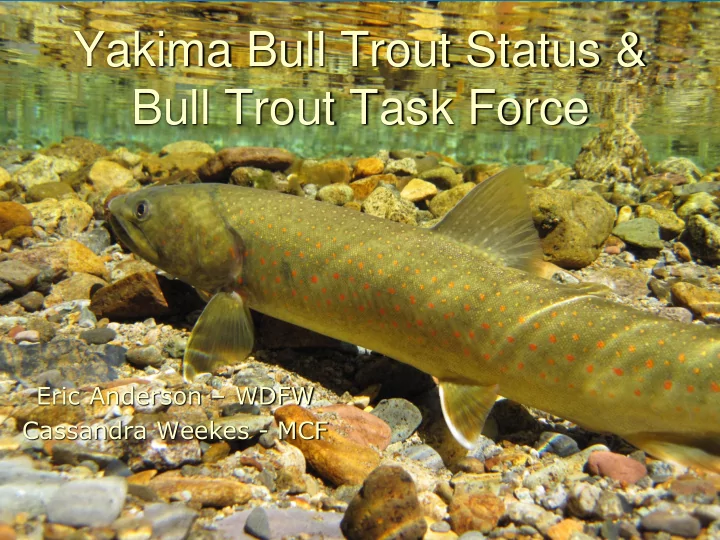
Yakima Bull Trout Status & Bull Trout Task Force
Eric Anderson – WDFW Cassandra Weekes - MCF
Bull Trout Task Force Eric Anderson WDFW Cassandra Weekes - MCF - - PowerPoint PPT Presentation
Yakima Bull Trout Status & Bull Trout Task Force Eric Anderson WDFW Cassandra Weekes - MCF Geographic Recovery Unit Area Yakima Core Area - 15 local populations (12 gen. distinct) Ahtanum, N.F Tieton, S.F Tieton, Indian, Rattlesnake,
Eric Anderson – WDFW Cassandra Weekes - MCF
Yakima Core Area - 15 local populations (12 gen. distinct)
American, Crow, Deep/Up. Bumping (1), N.F. Teanaway, Kachess, Box, Gold, Cle Elum, Waptus, U. Yakima.
30 - 40 redds (Amer. & Rattle); 20 redds (N.F.Tieton)
climate change.
15 local populations: 9 adfluvial 4 fluvial 2 resident (semi-isolated) 7 U. Yakima (3 ext.) 8 Naches/Ahtanum Redd count: 0 -- 202 (10 yr. avg.)
(6), American (40)
SF Tieton (202), NF Tieton (20)
years, functionally extirpated
Deep Creek
Emergency Actions
– Box Canyon temporary flume – Fish salvage
Population specific projects
– Gold Creek, Upper Kachess River, Box Canyon Creek, North Fork Tieton
Yakima Basin
– Integrated Plan – Bull Trout Enhancement Package – Bull Trout Working Group – Bull Trout Action Plan – Bull Trout Task Force
Rangewide
– USFWS Bull Trout Recovery Plan – Bull Trout Vulnerability Analysis – Environmental DNA (eDNA) sampling
Authors: Yuki Reiss (formerly YBFWRB) Jeff Thomas (USFWS) Eric Anderson (WDFW) Jim Cummins (retired, WDFW) A locally developed, up-to- date summary of bull trout populations in the Yakima Basin. In 2016 the Bull Trout Working Group is reviewing and updating the actions in the BTAP, in addition to identifying the each action’s status, next steps, link to
Found online at:
www.ybfwrb.org
On-the-ground crew working to mitigate recreational
Education & outreach Recreation dam removal Monitoring Assistance with research projects
Over 6,000 people have been directly educated about bull trout!
Bull Trout (Protected)
Brook Trout (Not Native, Not Protected)
with a blue halo
Bull trout are a native species of char, meaning they have a dark body and light spots. Bull trout require cold, clean water. The presence of bull trout is a sign of a healthy river system. Bull trout are found in cold water lakes and rivers in the Yakima Basin. Bull trout are federally listed as Threatened under the Endangered Species Act and must be released immediately.
What Are Bull Trout? No Black On The Fin, Put It Back In!
Anglers should be aware that non-native brook trout have similar characteristics to bull trout, which are protected under the Endangered Species Act and may not be
Anglers who catch a bull trout must release the fish unharmed without removing it from the water. Sacrifice your hook and not the fish – please cut your line if the fish swallows the hook.
Photos taken by William Meyer, WDFW.
Bull trout Brook trout
Recreation dam on Rattlesnake Creek
Recreation dam on the SF Ahtanum Creek
Before After Over 280 recreation dams removed!
Monitor passage conditions in 13 locations Maintain 12 temperature loggers Conduct redd and snorkel surveys Perform exploratory surveys
In 2016 exploratory surveys are tentatively planned Also potential to collect eDNA samples in the Yakima Basin
Acknowledgements Jeff Thomas - USFWS Pat Monk - USFWS Robert Randall - USFWS Judy Neibauer - USFWS Gary Torretta - USFS Paul James - CWU Ashton Bunce - CWU Tim Ressigue - YN Jeff Trammell - YN William Meyer - WDFW Scott Kline – WDFW John Easterbrooks – WDFW Josh Rogala – WDFW Jon Kohr - WDFW Alex Conley – YBFWRB David Child - DC Consulting … and more!