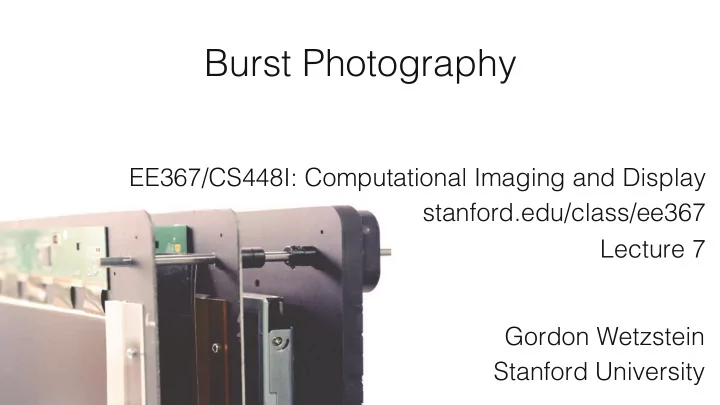
Burst Photography ! EE367/CS448I: Computational Imaging and Display ! - - PowerPoint PPT Presentation
Burst Photography ! EE367/CS448I: Computational Imaging and Display ! stanford.edu/class/ee367 ! Lecture 7 ! Gordon Wetzstein ! Stanford University ! Motivation ! wikipedia ! exposure sequence ! -4 stops ! Motivation ! wikipedia ! exposure sequence
Motivation!
exposure sequence!
wikipedia!
- 4 stops!
Motivation!
exposure sequence!
wikipedia!
- 2 stops!
Motivation!
exposure sequence!
wikipedia! 2 stops!
wikipedia! 4 stops!
Motivation!
wikipedia! HDR! contrast reduction (scaling)!
wikipedia! HDR! local tone mapping!
Computational Photography - Overview
Debevec & Malik, 1997
- high dynamic range
- super-resolution
- burst photography
- focal stack
- aperture stack
- confocal stereo
- blurry/noisy
- flash/no flash
- multi-flash
High Dynamic Range Imaging!
- !
dynamic range: ratio between brightest and darkest value!
- !
quantization within that range is equally important ! ! from 8 bits (256 values) to 32 bits floating point!
- riginal photo!
motion blurred photo! simulation from HDR! simulation from LDR!
Debevec & Malik, 1997!
HDRI – Overview
- estimate camera response curve
- capture multiple low dynamic range (LDR) exposures
- fuse LDR images into 32 bit HDR image
- possibly convert to absolute radiance (global scaling)
- application specific use:
- image-based rendering lighting
- tone mapping
- …
HDRI – Estimating the Response Curve
- not required when working with linear RAW images
- easiest option: use calibration chart
HDRI – Estimating the Response Curve!
- !
not required when working with linear RAW images !
- !
easiest option: use calibration chart!
pixel value! 128! 255! 64! 196! known reflectance! 1
linear RAW!
HDRI – Estimating the Response Curve!
- !
not required when working with linear RAW images !
- !
easiest option: use calibration chart!
pixel value! 128! 255! 64! 196! known reflectance! 1
e.g. JPEG!
HDRI – Linearizing LDR Exposures!
- !
capture exposure, apply lookup table!
pixel value! 128! 255! 64! 196! relative radiance! 1
e.g. JPEG!
I Ilin = f !1 I
( )
f !1 "
( )
HDRI – Merging LDR Exposures
- Image from Debevec & Malik, 1997
- start with LDR image sequence Ii (only exposure time ti changes)
- individual exposure is: , f is camera response function
Ii = f tiX
( )
HDRI – Merging LDR Exposures
- Image from Debevec & Malik, 1997
- undo the camera response:
e.g. gamma function
Ilini = f −1 Ii
( )
f I
( ) = I1/γ
→ f −1 I
( ) = I γ
HDRI – Merging LDR Exposures!
- !
compute a weight (confidence) that a pixel is well-exposed ! ! (close to) saturated pixel = not confident, pixel in center of dynamic range = confident!! !
wij = exp !4 Ilinij ! 0.5
( )
2
0.52 " # $ $ % & ' '
- r mean pixel value,!
e.g. 127.5 if I in [0, 255]!
HDRI – Merging LDR Exposures
wij = exp −4 Ilinij − 0.5
( )
2
0.52 ⎛ ⎝ ⎜ ⎜ ⎞ ⎠ ⎟ ⎟
- compute per-color-channel-per-LDR-pixel weights
HDRI – Merging LDR Exposures
- define least-squares objective function in log-space à perceptually
linear:
- equate gradient to zero:
- gives:
minimize O=
X
wi log Ilini
( )− log tiX
( )
( )
i
∑
2
∂O ∂log X
( ) = 2
wi log Ilini
( )− log ti
( )− log X
( )
( )
i
∑
= 0 X
! = exp
wi log Ilini
( )− log ti
( )
( )
i
∑
wi
i
∑
⎛ ⎝ ⎜ ⎜ ⎞ ⎠ ⎟ ⎟
HDRI – Merging LDR Exposures!
- !
define least-squares objective function in log-space ! perceptually linear:!
- !
equate gradient to zero:!
- !
gives:!
minimize O=
X
wi log Ilini
( )! log tiX
( )
( )
i
"
2
!O !log X
( ) = 2
wi log Ilini
( )" log ti
( )" log X
( )
( )
i
#
= 0 X
! = exp
wi log Ilini
( )! log ti
( )
( )
i
"
wi
i
"
# $ % % & ' ( (
HDRI – Relative v Absolute Radiance!
- !
LDR to HDR only gives relative radiance (HW4!)!
- !
scale by reference radiance to get absolute!
! Image from Debevec & Malik, 1997!
- !
text!
Image-based Lighting with Light Probes!
Paul Debevec!
- !
single light probe covers light incident from (almost) entire hemisphere!!
Image-based Lighting with Light Probes!
Paul Debevec, Renderign with Natural Light! SIGGRAPH Electronic Theater 1998!
Image Based Lighting!
HDRI – Tone Mapping
- how to display a high dynamic range image on an LDR display?
- tone mapping: fit into luminance range of display (or 0-255), while
preserving image details
- HW4
HDRI – Tone Mapping
[Durand and Dorsey, 2002]
- sun overexposed
- foreground too dark
HDRI – Global Tone Mapping
[Durand and Dorsey, 2002]
- gamma correction:
- colors are washed out
I = I γ
HDRI – Global Tone Mapping
[Durand and Dorsey, 2002]
- gamma in intensity
- nly!
- intensity details lost
HDRI – Gradient-domain Tone Mapping!
- !
compute gradients, scale them, integrate (Poisson eq.) !
[Fattal et al., 2002]!
HDR image (scaled)!
HDRI – Gradient-domain Tone Mapping!
- !
compute gradients, scale them, integrate (Poisson eq.) !
[Fattal et al., 2002]!
HDR image (scaled)! gradients!
HDRI – Gradient-domain Tone Mapping!
tone mapped result! gradient attenuation map!
[Fattal et al., 2002]!
Fast! Bilateral ! Filter!
HDRI – Tone Mapping with Bilateral Filter!
Detail! Color! Intensity! Large scale (base layer)! Reduce! contrast! Detail! Large scale! Color! Preserve!! Input HDR image! Output! [Durand and Dorsey, 2002]!
HDRI – Tone Mapping with Bilateral Filter!
[Durand and Dorsey, 2002]!
Gradient-space [Fattal et al.]! Bilateral [Durand et al.]!
- !
difference is not too big!
HDRI – Tone Mapping with Bilateral Filter!
[Durand and Dorsey, 2002]!
Gradient-space [Fattal et al.]! Bilateral [Durand et al.]!
- !
bilateral “looks” a bit better!
- !
no ground truth ! it’s up to the user!
HW4, Q1 & Q2
- Q1: HDR image fusion (from series of different LDR exposures)
- Q2: tone-map HDR image with
- global gamma correction on all color channels
- global gamma correction on intensity channel
- local tone mapping with bilateral filter
Burst Photography - Overview!
- !
basic idea: capture and merge bursts of photos (2 or more):!
- !
multiple exposures: HDR but also deblurring …!
- !
multiple shifted low-res images: super-resolution!
- !
focal stack!
- !
aperture stack!
- !
noisy + blurry: denoising + deblurring!
- !
flash / no flash!
- !
multi-flash!
- multiple exposures: HDR but also deblurring …
Pixel Super-Resolution
- increase “pixel count”, not related to diffraction limit
- idea: capture multiple low-res (LR) images and fuse them into a single
super-resolved (SR) image
Super-Resolution
[Ben-Ezra et al., 2004]
Pixel Super-Resolution!
light l16!
light l16!
Pixel Super-Resolution!
- !
LR must be sub-pixel shifted!
I1 I2 ISR I1 I2 ! " # # $ % & & = A1 A2 ! " # # $ % & & ISR
stacked, measured! LR images!
b A
!
downsampling &! phase shift!
!
Pixel Super-Resolution!
I1 I2 ISR = ISR b A !
- !
example for 1D scanline!
Pixel Super-Resolution
- in general: system is well-conditioned for non-integer pixel shifts and
super-resolution factors of 2-3x (don’t necessarily need priors)
- HW 4, Q3: solve (large-scale) pixel super-resolution with gradient
descent to
minimize
ISR
1 2 AISR − b 2
2
HW4 – Q3!
- !
gradient descent:!
- !
use matrix-free functions to implement matrix-vector multiplications!! !
x = x !"AT Ax ! b
( ) = x !"ATr
Ax() is already implemented, generate your
- wn 4 low-res images, then
implement Atx() and solve!
ISR I1 ISR I2
SR
ISR I4
SR
ISR I3
SR
Overview of Other Techniques
Focal Stack!
focal stack! contributions! find highest gradient! all-in-focus image!
- !
implemented in a range of products… !
wikipedia!
Aperture Stack
- what changes? exposure and depth of field – extract HDR & depth!
[Hasinoff and Kutulakos 2007] f/2 f/4 f/8 refocus front refocus rear layered depth map
Confocal Stereo!
- !
idea: intensity of in-focus point remains constant for varying aperture!
[Hasinoff and Kutulakos, 2006]!
Confocal Stereo!
- !
capture aperture and focal stack!
- !
for each pixel: find focus setting where aperture stack is most invariant!
aperture !" focus f " ( aperture !i , focus fj )!
[Hasinoff and Kutulakos, 2006]!
Confocal Stereo!
aperture !" focus f "
[Hasinoff and Kutulakos, 2006]!
photograph! estimated depth map!
Low-res High-res Image Pair – Motion Deblurring!
Deblurred image! Blurred image! Tripod image (Ground Truth) ! slow, high-res camera! fast, low-res camera!
- !
secondary, fast, noisy, low-res camera for motion PSF! estimation!
estimated motion blur!
[Ben-Ezra and Nayar, 2003]!
Blurry / Noisy Image Pair – Motion Deblurring
- same idea, but take two images with same camera
- super short, high ISO noisy exposure for motion PSF estimation
- longer exposure with camera shake à deblur
[Yuan et al., 2007]
Blurry / Noisy Image Pair – Motion Deblurring!
[Yuan et al., 2007]!
iteratively motion PSFs!
Flash / No-flash Image Pair!
with flash: not noisy! without flash: noisy, but nice colors! combined!
[Pettschnigg et al., 2004]!
Flash / No-flash Image Pair!
no flash! extract details ! (e.g. bilateral filter)!
[Pettschnigg et al., 2004]!
flash! denoised w/! bilateral filter!
Multi-flash Photography!
[Raskar et al., 2004]!
Multi-flash Photography!
[Raskar et al., 2004]!
Multi-flash Photography!
[Raskar et al., 2004]!
Multi-flash Photography!
?!
[Raskar et al., 2004]!
Multi-flash Photography!
Canny Intensity ! Edge Detection! Multi-Flash! Photo! Multi-Flash ! Overlay!
[Raskar et al., 2004]!
Multi-flash Photography!
[Raskar et al., 2004]!
Multi-flash Photography!
[Raskar et al., 2004]!
Multi-flash Photography!
[Raskar et al., 2004]!
Multi-flash Photography!
[Raskar et al., 2004]!
Multi-flash Photography!
[Raskar et al., 2004]!
Multi-flash Photography!
[Raskar et al., 2004]!
Multi-flash Photography!
Multi-Flash! Canny!
[Raskar et al., 2004]!
Computational Photography - Overview
Debevec & Malik, 1997
- high dynamic range
- super-resolution
- focal stack
- aperture stack
- confocal stereo
- blurry/noisy
- flash/no flash
- multi-flash
à capture and fuse multiple images
Next: Light Field Photography!
- !
integral imaging!
- !
plenoptic 1.0 v 2.0!
- !
acquisition!
- !
sequential!
- !
multiplexing!
- !
camera array!
- !
refocus!
- !
Fourier slice theorem!
References and Further Reading
HDR
- Mann, Picard “On Being ‘Undigital’ with Digital Cameras: Extending Dynamic Range by Combining Differently Exposed Pictures”, IS&T 1995
- Debevec, Malik, “Recovering High Dynamic Range Radiance Maps from Photographs”, SIGGRAPH 1997
Debevec, Malik, “Recovering High Dynamic Range Radiance Maps from Photographs”, SIGGRAPH 1997
- Robertson, Borman, Stevenson, “Estimation-Theoretic approach to Dynamic Range Improvement Using Multiple Exposures”, Journal of Electronic Imaging 2003
- Mitsunaga, Nayar, “Radiometric self Calibration”, CVPR 1999
- Reinhard, Ward, Pattanaik, Debevec (2005). High dynamic range imaging: acquisition, display, and image-based lighting. Elsevier/Morgan Kaufmann
- Fattal, Lischinski, Werman, “Gradient Domain High Dynamic Range Compression”, ACM SIGGRAPH 2002
- Durand, Dorsey, “Fast Bilateral Filtering for the Display of High Dynamic Range Images”, ACM SIGGRAPH 2002
Durand, Dorsey, “Fast Bilateral Filtering for the Display of High Dynamic Range Images”, ACM SIGGRAPH 2002 Super-resolution
- Baker, Kanade, Limits on super-resolution and how to break them“ IEEE Transactions on Pattern Analysis and Machine Intelligence 24(9), 1167–1183 (2002)
- Ben-Ezra, Lin, Wilburn, Zhang,, “Penrose pixels for super-resolution” EEE Transactions on Pattern Analysis and Machine Intelligence 33(7), 1370–1383 (2011)
- Ben-Ezra, Zomet, Nayar, “Jitter Camera: High Resolution Video from a Low Resolution Detector”, CVPR 2004
Ben-Ezra, Zomet, Nayar, “Jitter Camera: High Resolution Video from a Low Resolution Detector”, CVPR 2004
- Ben-Ezra, Zomet, Nayar, “Video super-resolution using controlled subpixel detector shifts” IEEE Trans. PAMI27(6), 977–987 (2005)
- Elad, Feuer, “Restoration of single super-resolution image from several blurred, noisy and down-sampled measured images” IEEE Trans. Im. Proc. 6(12), (1997)
Other
- Ben-Ezra and Nayar, "Motion Deblurring using Hybrid Imaging”, CVPR 2003
- Yuan, Sun, Quan, Shum, “Image Deblurring with Blurred/Noisy Image Pairs”, ACM SIGGRAPH 2007
- Hasinoff, Kutulakos, “Confocal Stereo”, ECCV 2006
- Hasinoff, Kutulakos, “A Layer-Based Restoration Framework for Variable-Aperture Photography”, ICCV 2007
- Raskar, Tan, Feris, Yu, Turk, “Non-photorealistic Camera: Depth Edge Detection and Stylized Rendering using Multi-Flash Imaging”, ACM SIGGRAPH 2004
- Pettschnigg, Agrawala, Hoppe, Szeliski, Cohen, Toyama, “Digital Photography with Flash and No-Flash Image Pairs”, ACM SIGGRAPH 2004
- Eisemann, Durand, “Flash Photography Enhancement via Intrinsic Relighting”, ACM SIGGRAPH 2004