But y ou can't c hec k the FD ! in AB C these - - PDF document

but y ou can t c hec k the fd in ab c these relations 1
SMART_READER_LITE
LIVE PREVIEW

But y ou can't c hec k the FD ! in AB C these - - PDF document

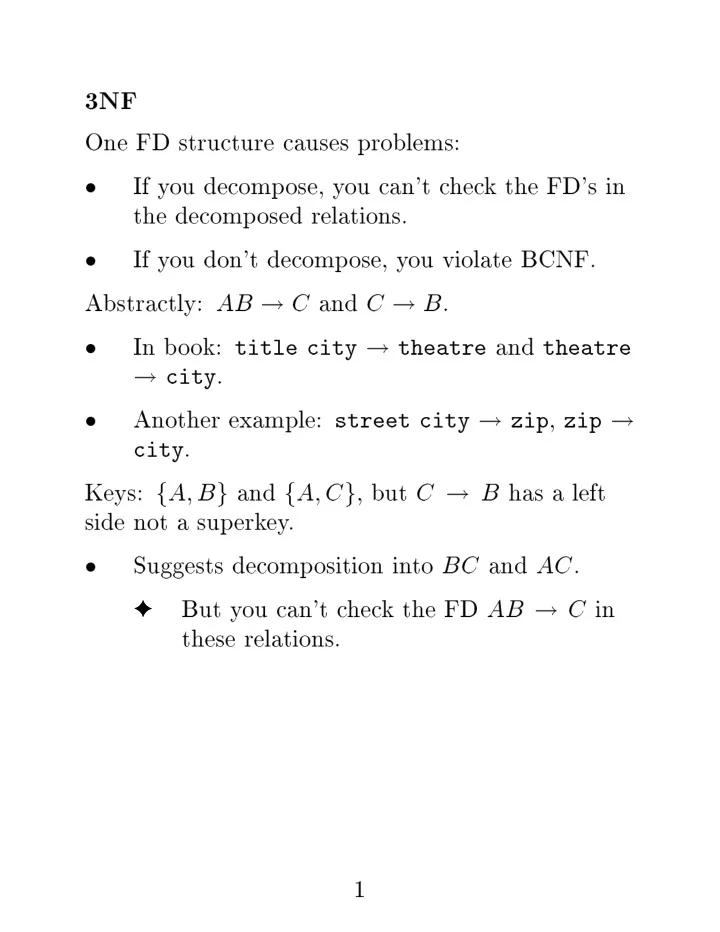
3NF One FD structure causes problems: If y ou decomp ose, y ou can't c hec k the FD's in the decomp osed relations. If y ou don't decomp ose, y ou violate BCNF. Abstractly: ! and ! . AB C C B


slide-1
SLIDE 1 3NF One FD structure causes problems:
  • If
y
  • u
decomp
  • se,
y
  • u
can't c hec k the FD's in the decomp
  • sed
relations.
  • If
y
  • u
don't decomp
  • se,
y
  • u
violate BCNF. Abstractly: AB ! C and C ! B .
  • In
b
  • k:
title city ! theatre and theatre ! city.
  • Another
example: street city ! zip, zip ! city. Keys: fA; B g and fA; C g, but C ! B has a left side not a sup erk ey .
  • Suggests
decomp
  • sition
in to B C and AC .

But y
  • u
can't c hec k the FD AB ! C in these relations. 1
slide-2
SLIDE 2 Example A = street, B = city, C = zip. street zip 545 T ec h Sq. 02138 545 T ec h Sq. 02139 cit y zip Cam bridge 02138 Cam bridge 02139 Join: cit y street zip Cam bridge 545 T ec h Sq. 02138 Cam bridge 545 T ec h Sq. 02139 2
slide-3
SLIDE 3 \Elegan t" W
  • rk
around Dene the problem a w a y .
  • A
relation R is in 3NF i for ev ery non trivial FD X ! A, either: 1. X is a sup erk ey ,
  • r
2. A is prime = mem b er
  • f
at least
  • ne
k ey .
  • Th
us, the canonical problem go es a w a y: y
  • u
don't ha v e to decomp
  • se
b ecause all attributes are prime and therefore no 3NF violati
  • ns
can
  • ccur.
3
slide-4
SLIDE 4 T aking Adv an tage
  • f
3NF Theorem: F
  • r
an y relation R and set
  • f
FD's F , w e can nd a decomp
  • sition
  • f
R in to 3NF relations, suc h that if the decomp
  • sed
relations satisfy their pro jected dep endencies from F , then their join will satisfy F itself.
  • In
fact, with some more eort, w e can guaran tee that the decomp
  • sition
is also \lossless"; i.e., the join
  • f
the pro jections
  • f
R
  • n
to the decomp
  • sed
relations is alw a ys R itself, just as for the BCNF decomp
  • sition.
  • But
what w e giv e up is absolute absence
  • f
redundancy due to FD's.
  • The
\ob vious" approac h
  • f
doing a BCNF decomp
  • sition,
but stopping when a relation sc hema is in 3NF, do esn't alw a ys w
  • rk
| it migh t still allo w some FD's to get lost. 4
slide-5
SLIDE 5 Roadmap 1. Study minimal sets
  • f
FD's: needed for the decomp
  • sitions.

Requires study
  • f
when t w
  • sets
  • f
FD's are e quivalent, in the sense that they are satised b y exactly the same relation instances. 2. Giv e the algorithm for constructing a decomp
  • sition
in to 3NF sc hemas that preserv es all FD's.

Called the synthesis algorithm. 3. Sho w ho w to mo dify this construction to guaran tee losslessness. 5
slide-6
SLIDE 6 3NF Syn thesis Algorithm Roughly , w e create for eac h FD in F a relation con taining
  • nly
its attributes.
  • But:
w e need rst to mak e F minimal in the sense that: a) No FD can b e eliminated from F . b) No attribute can b e eliminated from a left side
  • f
an FD
  • f
F .
  • Note
that minimal sets
  • f
FD's are not necessarily unique. Equiv alen t Sets
  • f
FD's FD sets are e quivalent if they eac h deriv e the
  • ther,
i.e., if they allo w the same set
  • f
relation instances.
  • F
  • r
eac h
  • f
(a) and (b) in the denition
  • f
\minimalit y ," w e mean \without making a set
  • f
FD's inequiv al en t to F ." 6
slide-7
SLIDE 7 T esting Equiv alence X 1 ! A1 Y 1 ! B 1 X 2 ! A2 Y 2 ! B 2
  • X
n ! An Y m ! B m
  • F
  • r
eac h i, Y i ! B i m ust follo w from the set
  • n
the left.

i.e, (Y i) + m ust con tain B i, when closure is computed using the FD's
  • n
the left.
  • Also,
eac h X i ! Ai m ust follo w from the set
  • n
the righ t.
  • Imp
  • rtan
t sp ecial case: no need to c hec k an FD that app ears in b
  • th
sets. 7
slide-8
SLIDE 8 Example Supp
  • se
F has A ! B , B ! C , and AC ! D .
  • F
is not minimal.
  • F
1 with A ! B , B ! C , and A ! D is minimal.

Note that from F w e can infer A ! D , and from F 1 w e can infer AC ! D .
  • F
2 consisting
  • f
A ! B , B ! C and C ! D is not equiv al en t to F .

Note y
  • u
cannot infer C ! D from F . 8
slide-9
SLIDE 9 A Dep endency-Preserving Decomp
  • sition
1. Minimize the giv en set
  • f
dep endencies. 2. Create a relation with sc hema X Y for eac h FD X ! Y . 3. Eliminate a relation sc hema that is a subset
  • f
another. 4. Add in a relation sc hema with all attributes that are not part
  • f
any FD. 9
slide-10
SLIDE 10 Example
  • Start
with R = AB C D and F consisting
  • f
A ! B , B ! C , and AC ! D .
  • F
1 with A ! B , B ! C , and A ! D is a minimal equiv alen t.
  • With
F 1 as
  • ur
minimal set
  • f
FD's, w e get database sc hema AB , B C , and AD , whic h is sucien t to c hec k F 1 and therefore F . 10
slide-11
SLIDE 11 Dep endency Preserv ation with Losslessness Same as for just dep endency preserv ation, but add in a relation sc hema consisting
  • f
a k ey for R . Example In ab
  • v
e example, A is a k ey for R , so w e should add A as a relation sc hema. Ho w ev er, A is a subset
  • f
AB , and so nothing is needed; the
  • riginal
database sc hema fAB ; B C ; AD g is lossless. Not Co v ered
  • Wh
y basing the decomp
  • sition
  • n
a minimal equiv ale n t set
  • f
FD's guaran tees 3NF.
  • Wh
y the k ey + FD's syn thesis approac h guaran tees losslessness. 11
slide-12
SLIDE 12 Multiv alued Dep endencies Consider the relation Drinkers(name, addr, phone, beersLiked), with the FD name ! addr. That is, drink ers can ha v e sev eral phones and lik e sev eral b eers. T ypical relation: name addr phone b eersLik ed jo e a p1 b1 jo e a p1 b2 jo e a p1 b3 jo e a p2 b1 jo e a p2 b2 jo e a p2 b3
  • Key
= fname, phone, beersLikedg.
  • BCNF
violati
  • n:
name ! addr. Decomp
  • se
in to D1(name, addr), D2(name, phone, beersLiked).

Both are in BCNF. 12
slide-13
SLIDE 13
  • But
lo
  • k
at D 2: name phone b eersLik ed jo e p1 b1 jo e p1 b2 jo e p1 b3 jo e p2 b1 jo e p2 b2 jo e p2 b3
  • The
phones and b eers are eac h rep eated.

If Jo e had n phones and lik ed m b eers, there w
  • uld
b e nm tuples for Jo e, when max(n; m) should b e enough. 13
slide-14
SLIDE 14 Multiv alued Dep endencies The multivalue d dep endency X ! ! Y holds in a relation R if whenev er w e ha v e t w
  • tuples
  • f
R that agree in all the attributes
  • f
X , then w e can sw ap their Y comp
  • nen
ts and get t w
  • new
tuples that are also in R . X Y
  • thers
14
slide-15
SLIDE 15 Example In Drinkers, w e ha v e MVD name ! ! phone. F
  • r
example: name addr phone b eersLik ed jo e a p1 b1 jo e a p2 b2 with phone comp
  • nen
ts sw app ed yields: name addr phone b eersLik ed jo e a p1 b2 jo e a p2 b1 whic h are also tuples
  • f
the relation.
  • Note:
w e m ust c hec k this condition for al l pairs
  • f
tuples that agree
  • n
name, not just
  • ne
pair. 15
slide-16
SLIDE 16 MVD Rules 1. Ev ery FD is an MVD.

Because if X ! Y , then sw apping Y 's do esn't create new tuples.

Example, in Drinkers: name ! ! addr. 2. Complementation: if X ! ! Y , then X ! ! Z , where Z is all attributes not in X
  • r
Y .

Example: since name ! ! phone holds in Drinkers, so do es name ! ! addr beersLiked. 16
slide-17
SLIDE 17 Splitting Do esn't Hold Sometimes y
  • u
need to ha v e sev eral attributes
  • n
the left
  • f
an MVD. F
  • r
example: Drinkers(name, areaCode, phone, beersLiked, beerManf) name areaCo de phone BeersLik ed b eerManf Jo e 650 555-1111 Bud A.B. Jo e 650 555-1111 Wic k edAle P ete's Jo e 415 555-9999 Bud A.B. Jo e 415 555-9999 Wic k edAle P ete's
  • name
! ! areaCode phone holds, but neither name ! ! areaCode nor name ! ! phone do. 17
slide-18
SLIDE 18 4NF Eliminate redundancy due to m ultiplicati v e eect
  • f
MVD's.
  • Roughly:
treat MVD's as FD's for decomp
  • sition,
but not for nding k eys.
  • F
  • rmally:
R is in F
  • urth
Normal F
  • rm
if whenev er MVD X ! ! Y is nontrivial (Y is not a subset
  • f
X , and X [ Y is not all attributes), then X is a sup erk ey .

Remem b er, X ! Y implies X ! ! Y , so 4NF is more stringen t than BCNF.
  • Decomp
  • se
R , using 4NF violati
  • n
X ! ! Y , in to X Y and X [ (R
  • Y
). R X Y 18
slide-19
SLIDE 19 Example Drinkers(name, addr, areaCode, phone, beersLiked, beerManf)
  • FD:
name ! addr
  • Non
trivial MVD's: name ! ! areaCode phone and name ! ! beersLiked beerManf.
  • Only
k ey: fname, areaCode, phone, beersLiked, beerManfg
  • All
three dep endencies violate 4NF.
  • Successiv
e decomp
  • sition
yields 4NF relations: D1(name, addr) D2(name, areaCode, phone) D3(name, beersLiked, beerManf) 19