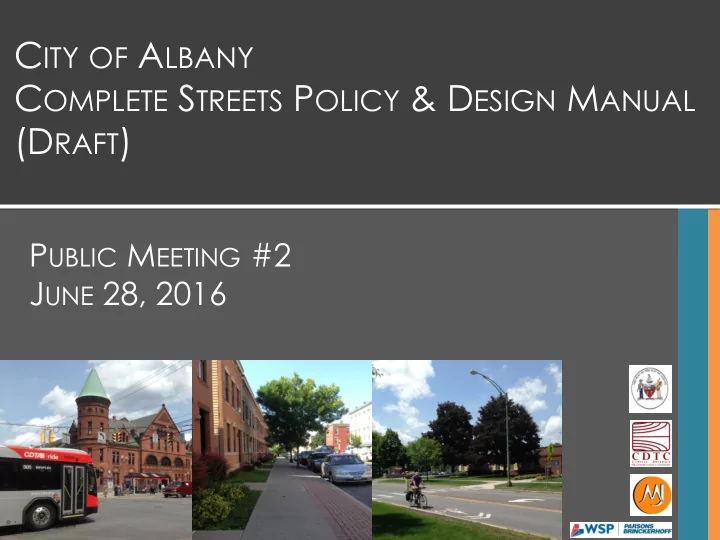
C ITY OF A LBANY C OMPLETE S TREETS P OLICY & D ESIGN M ANUAL (D - - PowerPoint PPT Presentation

c ity of a lbany
SMART_READER_LITE
LIVE PREVIEW

C ITY OF A LBANY C OMPLETE S TREETS P OLICY & D ESIGN M ANUAL (D - - PowerPoint PPT Presentation

C ITY OF A LBANY C OMPLETE S TREETS P OLICY & D ESIGN M ANUAL (D RAFT ) P UBLIC M EETING #2 J UNE 28, 2016 A GENDA 1. Welcome and Project Team 2. Project Overview 3. Project Tasks 4. Draft Manual Overview 5. Next Steps P ROJECT T EAM


slide-1
SLIDE 1

CITY OF ALBANY COMPLETE STREETS POLICY & DESIGN MANUAL (DRAFT)

PUBLIC MEETING #2 JUNE 28, 2016

slide-2
SLIDE 2

AGENDA

  • 1. Welcome and Project Team
  • 2. Project Overview
  • 3. Project Tasks
  • 4. Draft Manual Overview
  • 5. Next Steps
slide-3
SLIDE 3

PROJECT TEAM

  • City of Albany
  • Capital District Transportation Committee (CDTC)
  • Planning Advisory Committee (PAC)
  • CDTA
  • CDRPC
  • Planning Office
  • Sustainability Office
  • Fire Department
  • Traffic Engineering
  • Engineering
  • Water & Water Supply
  • Central BID
  • Accessibility Representatives
  • Forester
  • Bicycling Advocates
slide-4
SLIDE 4

CONSULTANT TEAM

Project Manager Jaclyn Hakes, AICP (MJ) Planning Services

Kristen Gaynor (MJ) Ame Bucher (MJ) Stephen Chiaramonte, AICP/PP (WSP|PB) Frederick Frank, LEED AP BD+C (WSP|PB)

Landscape Architecture

Christopher Riale, AICP (WSP|PB) Pippa Brashear (WSP|PB)

Managing Partner Michael D. Panichelli, PE (MJ) Transportation and Traffic Engineering

Eric Williams, PE (MJ) Theodore Orosz, AICP CTP (WSP|PB) Chad Schneider (MJ) Lisa Wallin, PE (MJ)

Existing Conditions Inventory

Michael Pianka, GISP (MJ) Michael Koterba (MJ) Devon Hinds (MJ)

slide-5
SLIDE 5

PROJECT OVERVIEW

slide-6
SLIDE 6

PROJECT OVERVIEW

  • Objective: Implement the adopted Complete Streets

Ordinance No. 2.11.13

  • Ordinance requires the needs of all users be

considered in any future street construction, reconstruction or resurfacing project

  • Directs City departments to develop complete

street guidelines addressing

  • Typologies
  • Design guidance
  • Implementation
slide-7
SLIDE 7

PROJECT OVERVIEW

  • “Complete street design features are roadway design features that

accommodate and facilitate convenient access and mobility by all users, including current and projected users, particularly pedestrians, bicyclists and individuals of all ages and abilities”

  • Features may include, but not be limited to:
  • Sidewalks
  • Paved shoulders suitable for use by bicyclists
  • Lane striping
  • Bicycle lanes and bicycle parking/storage
  • Share-the-road signage
  • Street and sidewalk lighting
  • Crosswalks or median refuges
  • Road diets
  • Pedestrian control signalization
  • Bus pullouts / pedestrian access to bus stops
  • Raised crosswalks and ramps
  • Traffic-calming measures
slide-8
SLIDE 8

PROJECT OVERVIEW

  • Support CDTC’s New Visions linking land use /

transportation

  • Coordination with ReZone Albany
  • Consideration of Albany 2030 Comprehensive Plan
  • 2009 Bicycle Master Plan
  • CDTA BRT studies
  • Other relevant plans and studies
slide-9
SLIDE 9

PROJECT TASKS

slide-10
SLIDE 10

PROJECT TASKS

Task 1: Project Coordination / Initiation Meeting Task 2: Existing Conditions Inventory Task 3: Public Workshop #1 Task 4: Draft Complete Streets Policy and Design Manual

Task 5: Public Workshop #2

Task 6: Development of Final Plan

  • 6 PAC meetings
  • 8 Working Group meetings
  • 2 Public Meetings
  • Complete Streets Walking Audit of key neighborhoods
  • Mobile Mapping to gather existing conditions
slide-11
SLIDE 11

DRAFT POLICY & DESIGN MANUAL

slide-12
SLIDE 12

HOW DOES THE MANUAL WORK?

  • Key Points:
  • Implementation will occur incrementally as part of regular

maintenance and/or street improvement projects

  • Use of manual will vary based on project type and sponsor
  • Manual should be referenced at beginning of project design
  • Coordination among city departments critical
  • General steps: (Ch. 3 outlines specific steps in process)

1. Identify applicable land use/street typology (Ch. 2) 2. Determine project type and sponsor (Ch. 3) 3. Select appropriate checklist (Ch. 3) 4. Select specific treatments based on technical guidance and site opportunities/constraints (Ch. 4, 5 and 6)

slide-13
SLIDE 13

POLICY & DESIGN MANUAL OUTLINE

  • Executive Summary
  • Chapter 1: Introduction
  • Chapter 2: Land Use/Street Typologies
  • Chapter 3: Process and Implementation
  • Chapter 4: Trending City-wide Design Considerations
  • Chapter 5: Streetscapes, Sidewalks, and Streets
  • Chapter 6: Intersections
slide-14
SLIDE 14

EXECUTIVE SUMMARY

slide-15
SLIDE 15

EXECUTIVE SUMMARY

  • What are complete streets?
  • Initiative
  • Engagement
  • Guiding Principles
  • Design Guidelines
  • Implementation
  • Coordination
slide-16
SLIDE 16

CHAPTER 1: INTRODUCTION

slide-17
SLIDE 17

CHAPTER 1: INTRODUCTION

  • Purpose
  • Implement the adopted City of Albany Complete Streets

Ordinance No. 2.11.13

  • Evolution of a Transportation Network
  • Historic transportation patterns illustrate how choices and

policies related to transportation can directly impact growth and accessibility

slide-18
SLIDE 18

CHAPTER 1: INTRODUCTION

  • Compliance
  • Establishes a course of action to accomplish goals related

to transportation

  • Understanding Existing Conditions
  • Review of adopted City and community plans
  • Walking audits
  • Mobile LIDAR Mapping
  • Review of City standard details
slide-19
SLIDE 19

CHAPTER 1: INTRODUCTION

  • Vision/Goals

 Can be utilized on a regular basis  Easy to apply – realistic and usable process  Assist during planning and implementation  Serve a range of project types  Establish and extend a safe and efficient transportation network  Improve accessibility for people of all ages and abilities

slide-20
SLIDE 20

CHAPTER 1: INTRODUCTION

  • Guiding Principles

 Accessibility

Ability to move from one location to another with ease regardless of age or ability

 Connectivity

Ability to connect modes of transportation as well as neighborhoods, major destinations, and nodes of activity

 Safety

Includes providing a safer environment for all users regardless of transportation

 Placemaking

Involves creating a livable, walkable, vibrant community by incorporating elements that enhance the quality of life

slide-21
SLIDE 21

CHAPTER 1: INTRODUCTION

  • Roles and Responsibilities
  • Tool to be utilized by the City when projects are proposed
  • May be utilized by municipal departments when

collaborating with NYSDOT, Albany County, and other agencies

  • Manual Organization
  • Description of each of the manual chapters
  • Application of the Manual
  • Demonstrates how each chapter works with one another
  • Legal Resources
  • NYSDOT, NYSDEC, AASHTO, NACTO, FHWA, MUTCD
slide-22
SLIDE 22

CHAPTER 2: LAND USE/STREET TYPOLOGIES

slide-23
SLIDE 23

CHAPTER 2: LAND USE/STREET TYPOLOGIES

  • 6 land use/street typologies
  • Descriptions with photos
  • Example complete street elements
  • Typical users
  • Existing characteristics table
slide-24
SLIDE 24

CHAPTER 2: LAND USE/STREET TYPOLOGIES

  • Downtown
  • High density commercial, office, civic,

and multi-family residential uses

  • Multiple modes of transportation
  • Neighborhood Mixed Use
  • Moderate density residential and

community supported commercial areas

  • Functions as transition between

Downtown and Neighborhood Residential

  • Neighborhood Residential
  • Often found adjacent to

Neighborhood Mixed Use streets and Community Commercial Streets

  • Primarily walking, biking, and vehicular
slide-25
SLIDE 25

CHAPTER 2: LAND USE/STREET TYPOLOGIES

  • Community Mixed Use
  • Transition between Neighborhood

Mixed Use or Neighborhood Residential streets and Community Commercial streets

  • Mix of standalone commercial or
  • ffice buildings, smaller scale

commercial plazas, single family housing and multi-family housing

  • Community Commercial
  • Moderate to low density commercial

uses of a larger scale

  • Provide ease access to necessary

commercial establishments and services

  • Industrial
  • Support industrial, commercial,

wholesale, construction, and service uses

slide-26
SLIDE 26

CHAPTER 2: LAND USE/STREET TYPOLOGIES

Land Use/Street Typology Functional Classification Modal Hierarchy Example Elements Existing Building Setback Range (feet)a Existing ROW Width Range (feet)b Existing Pavement Width Range (feet)c

Downtown Principal Arterial Minor Arterial Local Road Pedestrian Bicyclist Transit User Motorist Sidewalks, Crosswalks, Curb Ramps Bike Racks, Shared Lanes Bus Shelters, Bus Bulbs Marked Lanes, On-Street Parking 48 - 152 23 - 90 Neighborhood Mixed Use Principal Arterial Minor Arterial Major Collector Pedestrian Bicyclist Motorist Transit User Pedestrian Crossing Signals, Sidewalks, Benches Bike Racks, Bike Lanes, Signage Marked Lanes, On-Street Parking Bus Shelters, Bus Bulbs 0 - 20 76 - 102 45 - 59 Neighborhood Residential Minor Arterial Major Collector Local Road Pedestrian Bicyclist Motorist Pedestrian-scaled Lighting, Sidewalks, Curb Ramps Share the Road Signage Minimal Obstructions, On-street Parking 20 - 25 37 - 50 18 - 28 Community Mixed Use Principal Arterial Minor Arterial Major Collector Motorist Transit User Pedestrian Bicyclist Designated Turning Lanes, On-Street Parking Bus Shelters, Bus Bulbs Sidewalks, Crosswalks, Curb Ramps Bike Racks 0 - 20 98 - 103 52 - 58 Community Commercial Principal Arterial Minor Arterial Major Collector Motorist Transit User Pedestrian Bicyclist Designated Turning Lanes Bus Shelters, Curb Extensions Pedestrian-scaled Lighting, Sidewalks, Curb Ramps Shared Lanes, Bike Racks 0 - 40 98 - 104 60 - 70 Industrial Major Collector Local Road Motorist Transit User Bicyclist Pedestrian Dedicated Turn Lanes Bus Shelters Shared Lanes Sidewalks, Crosswalks, Curb Ramps 0 - 20 41 - 85 23 - 34

a The building setback ranges are front setback minimums. These ranges are estimated and do not reflect specific requirements of the City of Albany zoning ordinance. b The ROW width ranges reflect estimated field observations from roadways. c The pavement width ranges reflect estimated field observations from roadways.
slide-27
SLIDE 27

CHAPTER 3: PROCESS AND IMPLEMENTATION

slide-28
SLIDE 28

CHAPTER 3: PROCESS AND IMPLEMENTATION

  • Overview
  • Implementation is a multifaceted process that includes

planning, design, construction, and maintenance

  • Coordination
  • Coordination among City departments and applicable

agencies is required to ensure that opportunities for project implementation are achieved

  • Funding
  • Important component for implementation
  • Funding opportunities pursued with City’s capital budget

and beyond, such as grants

  • May also explore non-traditional funding such as NYSDEC

and NYSERDA grants

slide-29
SLIDE 29

CHAPTER 3: PROCESS AND IMPLEMENTATION

  • Evaluation

Process

  • City Sponsored
  • Privately

Sponsored

  • Maintenance
slide-30
SLIDE 30

CHAPTER 3: PROCESS AND IMPLEMENTATION

  • Evaluation Process
  • Process is not always linear
  • Steps may occur concurrently or

be revisited

  • Emergency projects are not

subject to the complete streets evaluation process

  • Flow charts are being further

developed to assist with evaluations

slide-31
SLIDE 31

CHAPTER 3: PROCESS AND IMPLEMENTATION

  • Complete Streets Review Checklists
  • 2 checklists – project dependent
  • Form A: Reconstruction and Construction Projects
  • Form B: Maintenance Projects
  • Both checklists require and encourage projects occurring

within the City of Albany to consider incorporating complete street elements

  • Checklists are currently being reviewed and further

developed

slide-32
SLIDE 32

CHAPTER 3: PROCESS AND IMPLEMENTATION

  • Form A:

Reconstruction and Construction Projects Checklist

slide-33
SLIDE 33

CHAPTER 3: PROCESS AND IMPLEMENTATION

  • Form B:

Maintenance Project Checklist

slide-34
SLIDE 34

CHAPTER 3: PROCESS AND IMPLEMENTATION

  • Measuring Success
  • Measure and monitor implementation in order to understand the

progress and future direction of complete streets within the City

slide-35
SLIDE 35

CHAPTER 4: TRENDING CITY-WIDE DESIGN CONSIDERATIONS

slide-36
SLIDE 36

CHAPTER 4: TRENDING CITY-WIDE DESIGN CONSIDERATIONS

  • Overview
  • Considerations represent general concepts, policies, and

programs

  • Applicable guiding principle icons applied to each

consideration

  • Bicycling
  • Bike Share Programs
  • On-Street Bicycle Parking
  • Transit
  • Enhanced Transit
  • Shared Transit-Bicycle Lanes
slide-37
SLIDE 37

CHAPTER 4: TRENDING CITY-WIDE DESIGN CONSIDERATIONS

  • Fundamental
  • Emergency Vehicles
  • Loading Zones/Delivery Vehicles
  • Smart Technology
  • Stormwater/Green Infrastructure
  • Streets Meeting Public Places
  • Non-Standard Street Widths
  • Future
  • Autonomous Vehicles
  • Electric Bicycles
  • Electric Vehicle Charging Stations
  • Maintenance
  • Essential as infrastructure ages and is used more frequently
slide-38
SLIDE 38

CHAPTER 5: STREETSCAPES, SIDEWALKS,

AND STREETS

slide-39
SLIDE 39

CHAPTER 5: DESIGN GUIDELINES FOR STREETSCAPES, SIDEWALKS, AND STREETS

  • Overview
  • Chapter serves as a toolbox for complete streets
  • Allows designers to choose the elements that best fit
  • Based on complete street aspirations
  • Streetscapes and Sidewalks
  • Design Guidelines
  • Streetscape and Sidewalk Elements
  • Streetscape and Sidewalk Cross Sections
  • Streets
  • Design Guidelines
  • Street Elements
  • Streets Sample Cross Sections – wide and narrow ROW
slide-40
SLIDE 40

CHAPTER 5: DESIGN GUIDELINES FOR STREETSCAPES, SIDEWALKS, AND STREETS

  • Streetscapes and Sidewalks
  • All elements contributing to the appearance and function
  • f a given street or corridor
  • Design Guidelines
  • Preferred zone range measurements have been identified
  • Building Use Zone
  • Pedestrian Zone
  • Buffer Zone
  • Curb Zone
  • Streetscape and Sidewalk Elements
  • Benches, Bike Racks, Bus Shelters, Sidewalks, Street Trees
  • Guiding principles identified for each element
slide-41
SLIDE 41

CHAPTER 5: DESIGN GUIDELINES FOR STREETSCAPES, SIDEWALKS, AND STREETS

Street Typology Building Use Zone (ft) a Pedestrian Zone (ft) b Buffer Zone (ft) c Total Width (ft) d Downtown 4 – 8 8 – 12 4 – 6 16 – 26 Neighborhood Mixed Use 2 – 6 6 – 10 4 – 6 12 – 22 Neighborhood Residential 2 – 6 5 – 6 2 – 6 9 – 18 Community Mixed Use 2 – 6 6 – 10 4 – 6 12 – 22 Community Commercial 2 – 6 6 – 10 4 – 6 12 – 22 Industrial 0 – 10 5 – 6 4 – 6 9 – 12

a The industry standard width of 2 ft has been adopted as the preferred minimum between the effective sidewalk width and the face of buildings or other obstacles. b The industry standard width of 5 ft has been adopted by NYSDOT as a minimum to allow use by users of all abilities. The minimum clear width per ADAAG is 4 ft with a minimum 5 ft x 5 ft area to allow for disabled users to pass at

a reasonable distance (200 ft per NYSDOT standards). In commercial areas with high pedestrian volume, widths up to 12 ft should be considered with typical widths ranging from 8 ft to 12 ft. The exact width will depend on pedestrian volumes. These standards should also be applicable where there are no buffer zones.

c The buffer zone width is calculated for required snow storage capacity and is based on the pavement width from the centerline of the roadway to the edge of the curb (L) (Snow Storage = 0.5*L). This calculation is in Chapter 5,

Section 3.2.11.1 of the NYSDOT Highway Design Manual. For areas where bus shelters are provided, a width of at least 7 ft is required for a standard CDTA shelter, while BRT shelters require at least 12 ft for a 10 ft shelter.

d Curb widths must also be considered in total width calculations. Per the City of Albany Code, Section 323-18, a stone curb is to be 4 inches. Per NYSDOT, stone curbs are to be 5 inches.
slide-42
SLIDE 42
  • Streetscape and Sidewalk Cross Sections
  • Samples cross sections provided for each land use/street typology
  • Descriptions of each zone provided for each of the land use/street

typology

CHAPTER 5: DESIGN GUIDELINES FOR STREETSCAPES, SIDEWALKS, AND STREETS

Downtown Streetscape and Sidewalk Sample

slide-43
SLIDE 43

CHAPTER 5: DESIGN GUIDELINES FOR STREETSCAPES, SIDEWALKS, AND STREETS

  • Streets
  • All elements contributing to or within the travelway
  • Design Guidelines
  • Preferred zone range measurements have been identified
  • Transit Lane
  • Turn Lane
  • Travel Lane
  • Bicycle Lane
  • Parking Lane
  • Street Elements
  • Crosswalks, Curb Ramps, Driveways, Lane Striping
  • Guiding principles identified for each element
  • Travelway Elements
  • Bike Boulevards, Enhanced Transit Lanes, Medians
slide-44
SLIDE 44

CHAPTER 5: DESIGN GUIDELINES FOR STREETSCAPES, SIDEWALKS, AND STREETS

Street Typology FHWA Functional Classification a Transit Lane (ft) b Travel Lane (ft) c Turn Lane (ft) d Bicycle Lane (ft) e Parking Lane (ft) f

Downtown Principal Arterial / Minor Arterial / Local Road 11 – 14 10 – 12 10 – 12 5 – 7 7 – 8 Neighborhood Mixed Use Principal Arterial / Minor Arterial / Major Collector 11 – 14 10 – 12 10 – 12 5 – 7 7 – 8 Neighborhood Residential Minor Arterial / Major Collector / Local Road N / A 9 – 12 9 – 12 5 – 7 7 – 8 Community Mixed Use Principal Arterial / Minor Arterial / Major Collector 11 – 14 10 – 12 10 – 12 5 – 7 7 – 8 Community Commercial Principal Arterial / Minor Arterial / Major Collector 11 – 14 10 – 12 10 – 12 5 – 7 7 – 8 Industrial Major Collector / Local Road 11 – 14 9 – 12 9 – 12 5 – 7 7 – 8

a Principal Arterials serve major centers of metropolitan areas, provide a high degree of mobility, providing access to abutting land uses. Minor Arterials serve geographic areas that are smaller than

Principal Arterials, while offering connectivity to the higher Arterial system. Major Collectors serve a critical role in the roadway network by gathering traffic from Local Roads and funneling them to the Arterial network. Local Roads provide direct access to adjacent land, while providing access to higher systems and carrying no through traffic.

b A minimum lane width of 11 feet is required for CDTA buses. However, a lane width may be as wide as 14 feet to accommodate shared use. It is recommended that lanes do not exceed 14 feet in order to

discourage unsafe passing movements.

c Travel lane widths may vary due to traffic speed, traffic type, pavement constraints and/or right-of-way constraints. Projects located on NYSDOT Designated Qualifying Highways require a minimum

lane width of 12 feet. Projects located on Designated Access Highways require a minimum lane width of 10 feet. All routes located within one mile of Qualifying Highways require a minimum travel lane width of 10 feet.

d Turn lane widths may vary due to traffic speed, traffic type, pavement constraints and/or right-of-way constraints. Projects located on NYSDOT Designated Qualifying Highways require a minimum lane

width of 12 feet. Projects located on Designated Access Highways require a minimum lane width of 10 feet. All routes located within one mile of Qualifying Highways require a minimum travel lane width

  • f 10 feet.
e Bicycle lane widths, as recommended by the AASHTO’s 2012 Guide for Development of Bicycle Facilities 4th Edition and the City of Albany Bicycle Master Plan, should be at least 5 feet. AASHTO

guidelines also recommend that a bicycle lane should be 7 feet wide when adjacent to an 8 foot wide or less parking lane typical of high rates of turnover. In areas with high bicycle volumes, no on-street parking, and high vehicle speeds and volumes, lane widths are recommended to be between 6 feet and 8 feet. The wider lane creates more room for potential avoidance maneuvers.

f Parking lane widths may vary due to potential future uses, such as becoming a travel or turn lane. According to Chapter 2 of the NYSDOT Highway Design Manual, the minimum parking lane width is 7

feet which is typically seen along residential corridors.

  • Table of Recommended Lane Dimensions
slide-45
SLIDE 45

CHAPTER 5: DESIGN GUIDELINES FOR STREETSCAPES, SIDEWALKS, AND STREETS

Complete Street Elements Downtown Neighborhood Mixed Use Neighborhood Residential Community Mixed Use Community Commercial Industrial Wide Narrow Wide Narrow Wide Narrow Wide Narrow Wide Narrow Wide Narrow 2-Lane Travelway

  • 3-Lane Travelway
  • 4-Lane Travelway
  • 5-Lane Travelway
  • Bicycle Boulevard
  • Buffered Bicycle Lane
  • Buffered Bicycle Lane – Curbside of

On-Street Parking

  • Contra-Flow Bicycle Lanes
  • Dedicated Transit Lane
  • Enhanced Transit Lanea
  • Median
  • Median Cycle Track
  • One-Way Protected Bicycle Lane
  • One-Way Separated Bicycle Path
  • One-Way Street
  • On-Street Parking (1-Way Street)
  • On-Street Parking (2-Way Street)
  • Shared Transit/Bicycle Lane
  • Shared Use Lane
  • Striped Bicycle Lane
  • Two-Way Protected Bicycle Lane
  • Two-Way Separated Bicycle Path
  • a As BRT routes continue to be developed throughout the City, there is a great chance for enhanced transit to appear in land use/street typologies not selected.
  • Travelway Elements by Land Use/Street Typology
slide-46
SLIDE 46

CHAPTER 5: DESIGN GUIDELINES FOR STREETSCAPES, SIDEWALKS, AND STREETS

  • Street Sample Cross Sections
  • Two sample cross sections provided for each land

use/street typology

  • Wide ROW
  • Narrow ROW
  • Travelway elements vary within each cross section and

land use/street typology to demonstrate a variety of design options

  • Cross sections are samples are not a representation of any

specific street within the City

slide-47
SLIDE 47

CHAPTER 5: DESIGN GUIDELINES FOR STREETSCAPES, SIDEWALKS, AND STREETS

Downtown Sample: Wide Right-of-Way Street

slide-48
SLIDE 48

CHAPTER 5: DESIGN GUIDELINES FOR STREETSCAPES, SIDEWALKS, AND STREETS

Downtown Sample: Narrow Right-of-Way Street

slide-49
SLIDE 49

CHAPTER 5: DESIGN GUIDELINES FOR STREETSCAPES, SIDEWALKS, AND STREETS

  • Modal Hierarchy
  • Used to make well-

prioritized design and

  • peration decisions
  • Limited ROW
  • Table used for guidance
  • Width may be sacrificed

to serve another zone if a zone is identified as a low priority

  • Width may not be

sacrificed is a zone is identified as a high priority

Functional Classification Building Use Zone Pedestrian Zone Buffer Zone Transit Lane Travel/Turn Lane Median Zone Bicycle Zone Parking Zone

DOWNTOWN Principal Arterial Minor Arterial Local Road NEIGHBORHOOD MIXED USE Principal Arterial Minor Arterial Major Collector NEIGHBORHOOD RESIDENTIAL Minor Arterial Major Collector Local Road COMMUNITY MIXED USE Minor Arterial Major Collector Local Road COMMUNITY COMMERCIAL Minor Arterial Major Collector INDUSTRIAL Major Collector Local Road

slide-50
SLIDE 50

CHAPTER 6: INTERSECTIONS

slide-51
SLIDE 51

CHAPTER 6: DESIGN GUIDELINES FOR INTERSECTIONS

  • Overview
  • Challenging aspect of complete street implementation due

to range of complexity

  • Intersections introduce conflicts amongst various

transportation modes

  • User Experience
  • Pedestrians
  • Bicyclists
  • Transit Riders
  • Motorists
  • Design Criteria and Principles
  • Sample Plan View Illustrations
slide-52
SLIDE 52

CHAPTER 6: DESIGN GUIDELINES FOR INTERSECTIONS

  • Pedestrian Experience
  • Environment that is safe, comfortable, and accommodating
  • Highly visible and navigable by all pedestrians
  • Bicyclist Experience
  • Not only a lifestyle amenity, but a lifestyle necessity
  • Bicycle treatments at intersections have potential to create the

most apprehension pertaining to comfort level

  • Transit Rider Experience
  • Benefit from transit priority treatments and amenities
  • Motorist Experience
  • Significant factors include physical, operational, and control

characteristics

slide-53
SLIDE 53

CHAPTER 6: DESIGN GUIDELINES FOR INTERSECTIONS

Intersection Sample – Focus on Transit and Bicycling Elements

slide-54
SLIDE 54

CHAPTER 6: DESIGN GUIDELINES FOR INTERSECTIONS

Intersection Sample – Focus on Bicycling Elements

slide-55
SLIDE 55

CHAPTER 6: DESIGN GUIDELINES FOR INTERSECTIONS

Intersection Sample – Focus on Transit Elements

slide-56
SLIDE 56

HOW DOES THE MANUAL WORK?

  • Key Points:
  • Implementation will occur incrementally as part of regular

maintenance and/or street improvement projects

  • Use of manual will vary based on project type and sponsor
  • Manual should be referenced at beginning of project design
  • Coordination among city departments critical
  • General steps: (Ch. 3 outlines specific steps in process)

1. Identify applicable land use/street typology (Ch. 2) 2. Determine project type and sponsor (Ch. 3) 3. Select appropriate checklist (Ch. 3) 4. Select specific treatments based on technical guidance and site opportunities/constraints (Ch. 4, 5 and 6)

slide-57
SLIDE 57

NEXT STEPS

slide-58
SLIDE 58

NEXT STEPS

  • Consider Comments from Public Meeting
  • Written comments accepted through 7/27
  • Gather process input from City
  • Develop Final Design Manual
  • Final Documents placed on Project website

For more information go to: http://www.albany2030.org/complete-streets

slide-59
SLIDE 59

THANK YOU