C++ tutorial private and protected inheritance? Assume youve seen - - PDF document

c tutorial private and protected inheritance
SMART_READER_LITE
LIVE PREVIEW

C++ tutorial private and protected inheritance? Assume youve seen - - PDF document

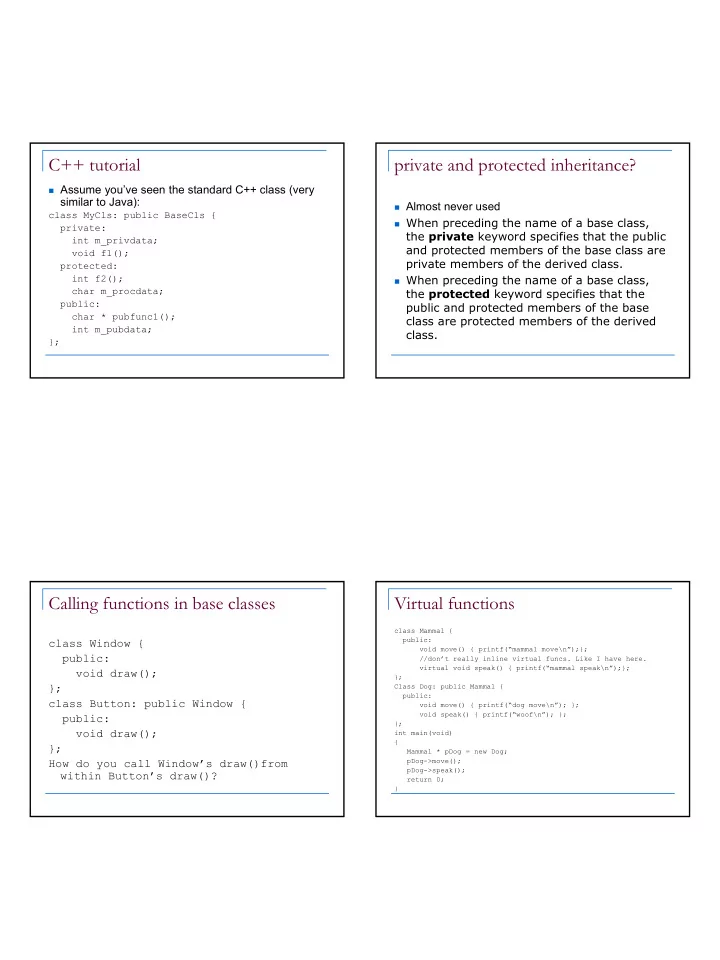
C++ tutorial private and protected inheritance? Assume youve seen the standard C++ class (very similar to Java): Almost never used class MyCls: public BaseCls { When preceding the name of a base class, private: the private keyword


slide-1
SLIDE 1

1

C++ tutorial

Assume you’ve seen the standard C++ class (very

similar to Java):

class MyCls: public BaseCls { private: int m_privdata; void f1(); protected: int f2(); char m_procdata; public: char * pubfunc1(); int m_pubdata; };

private and protected inheritance?

Almost never used When preceding the name of a base class,

the private keyword specifies that the public and protected members of the base class are private members of the derived class.

When preceding the name of a base class,

the protected keyword specifies that the public and protected members of the base class are protected members of the derived class.

Calling functions in base classes

class Window { public: void draw(); }; class Button: public Window { public: void draw(); }; How do you call Window’s draw()from within Button’s draw()?

Virtual functions

class Mammal { public: void move() { printf(“mammal move\n”);}; //don’t really inline virtual funcs. Like I have here. virtual void speak() { printf(“mammal speak\n”);}; }; Class Dog: public Mammal { public: void move() { printf(“dog move\n”); }; void speak() { printf(“woof\n”); }; }; int main(void) { Mammal * pDog = new Dog; pDog->move(); pDog->speak(); return 0; }

slide-2
SLIDE 2

2

How virtual functions (roughly) work

When a virtual function is created, the compiler

builds a virtual function table – has pointer to each virtual function

One virtual function table per type Each instance of a class has virtual table pointers

(vptr) that point to the vtable

The vptr is adjusted in the constructors to point to

the “correct” function

Small overhead associated with virtual functions.

Destructors should always be virtual:

class A { public: ~A() {}; void func(); }; class B: public A { private: char * data; public: ~B() { if(data) free(data); }; }; void main(void) { A * a = new B; delete a; //oops... ~B() not called!! }

Pure virtual functions

class Mammal { public: virtual void speak()=0; };

Speak is a pure virtual function Can’t instantiate a class with pure virtuals Derived classes must implement the pure

virtual function or else it can’t be instantiated.

The static keyword in classes

In C++, when modifying a data member in a

class declaration, the static keyword specifies that one copy of the member is shared by all the instances of the class. When modifying a member function in a class declaration, the static keyword specifies that the function accesses only static members.

static member functions may be called

without an instance

static data needs to be delcared in the

implementation like a global.

slide-3
SLIDE 3

3

Concurrency

Haviland – Ch. 8.3.3

Concurrency

The two key concepts driving computer systems and

applications are

communication: the conveying of information from one

entity to another

concurrency: the sharing of resources in the same time

frame

Concurrency can exist in a single processor as well

as in a multiprocessor system

Managing concurrency is difficult, as execution

behaviour is not always reproducible.

Concurrency Example

Program a:

#!/usr/bin/sh count=1 while [ $count -le 20 ] do echo -n “a” count=`expr $count + 1` done

Program b

#!/usr/bin/sh count=1 while [ $count -le 20 ] do echo -n “b” count=`expr $count + 1` done

When run sequentially (a; b) output is sequential. When run concurrently (a&; b&) output is

interspersed and different from run to run.

Race conditions

A race condition occurs when multiple processes

are trying to do something with shared data and the final outcome depends on the order in which the processes run.

E.g., If any code after a fork depends on whether

the parent or child runs first.

A parent process can call wait() to wait for

termination (may block)

A child process can wait for parent to terminate by

polling (wasteful)

Standard solution is to use signals.

slide-4
SLIDE 4

4

Example 1

Process A x = get(count) write(x + 1) Process B y = get(count) write(y + 1) x = 1 y = 2

1 2 3

The value of count is what we expect.

Count

write(2) write(3)

Example 2

Process A x = get(count) write(x + 1) Process B y = get(count) write(y + 1) x = 1 y = 1

1 2 3

write(2) write(2) y = 2 write(3)

2

Not what we wanted!

Count

Example: Race Conditions

#!/bin/sh c=1 while [ $c –le 10 ] do sd=`cat sharedData` sd=`expr $sd + 1` echo $sd > sharedData c=`expr $c + 1` echo d = $sd done #file sharedData must exist and hold #one integer

Try running several instances of this

Producer/Consumer Problem

Simple example: who | wc –l Both the writing process (who) and the

reading process (wc) of a pipeline execute concurrently.

A pipe is usually implemented as an internal

OS buffer.

It is a resource that is concurrently accessed

by the reader and the writer, so it must be managed carefully.

slide-5
SLIDE 5

5

Producer/Consumer

consumer should be blocked when buffer is empty producer should be blocked when buffer is full producer and consumer should run independently

as far as buffer capacity and contents permit

producer and consumer should never be updating

the buffer at the same instant (otherwise data integrity cannot be guaranteed)

producer/consumer is a harder problem if there are

more than one consumer and/or more than one producer.

Protecting shared resources

Programs that manage shared resources

must protect the integrity of the shared resources.

Operations that modify the shared resource

are called critical sections.

Critical section must be executed in a

mutually exclusive manner.

Semaphores are commonly used to protect

critical sections.

Semaphores

Code that modifies shared data usually has

the following parts:

Entry section: The code that requests permission

to modify the shared data.

Critical Section: The code that modifies the

shared variable.

Exit Section: The code that releases access to

the shared data.

Remainder: The remaining code.

Critical Sections

Problem: How to execute critical sections in a fair,

symmetric manner?

Solutions must satisfy the following:

Mutual Exclusion: At most one process is in its critical

section at a time.

Progress: If no process is executing its critical section a

process that wants to enter can get in

Bounded Waiting: No process is postponed indefinitely.

An atomic operation is an operation that, once

started, completes in a logical indivisible way. Most solutions to the critical section problem rely on the existence of atomic operations.

slide-6
SLIDE 6

6

General structure

// process i do { critical section remainder section } while(1); entry section exit section // process i do { critical section remainder section } while(1); while(turn != i); turn = j;

Problems? strict alternation (violates progress rule)

Flawed Solution 1 Flawed Solution 2

boolean flag[2]; do { critical section remainder section } while(1); flag[i] = true; while(flag[ j ]); flag[i] = false;

Problems? mutual exclusion not

satisfied

Consider: t0: P0 sets flag[0] to true t1: P1 sets flag[1] to true Now both are looping

forever.

A correct solution

do{ critical section remainder section } while(1);

flag[0] and flag[1] could

both be true, but turn can have only one value. Thus only one process can enter critical section

progress is preserved

because process i can

  • nly be spinning in the

loop if turn == j and flag[j] == true. When process j exits the critical section, it will set flag[j] to false.

flag[i] = true; turn = j; while(flag[ j] && turn == j); flag[i] = false;

Problems with the software solution

The biggest problem with the software

solution to the critical section problem is that a process waiting to get into the critical region is busy-waiting.

A solution is to take advantage of atomic

hardware instructions and use them to build up more general synchronization mechanisms like semaphores.

slide-7
SLIDE 7

7

Semaphores

A semaphore is an integer variable with two

atomic operations: acquire and release.

acquire also called wait, down, P, and lock release also called signal, up, V, and unlock

A process that executes an acquire on a

semaphore variable S, cannot proceed until S is positive. It then decrements S.

The release operation increments the value

  • f the semaphore variable.

Flawed implementation of semaphores

void acquire(int *s) { while(*s <= 0); (*s)--; } void release(int *s) { (*s)++; }

Problems:

busy-waiting is inefficient does not guarantee bounded waiting ++ and -- operations are not necessarily atomic

Unix (System V) semaphores

The following pseudo-code protects a critical

section:

acquire(&s); /* critical section */ release( &s ); /* remainder section */

What happens if S is initially 0? or 8? We will use System V semaphores to

implement acquire and release.

Unix System V Semaphores

Semaphore structures are created and stored

in the OS kernel, so unrelated processes can use them.

A semaphore created and associated with a

key, similar to a file handle.

One System V semaphore is actually an

array of semaphores. (We will only use one element of the array in discussions in this class.)

slide-8
SLIDE 8

8

Semaphores

Three operations on a semaphore

semget – create or gain access to a semaphore semctl – get or set the value of a semaphore,

change permissions, or remove a semaphore.

semop – perform semaphore operation

Initializing Semaphores

semget() initializes or gains access to a semaphore

int semget(key_t key, int nsems, int semflg);

key – access value associated with the semaphore

ID

nsems – number of elements in a semaphore array semflg – access permission and creation control

flags

returns the semaphore ID

What’s a key?

Keys are used to identify IPC (inter-process

communication) objects

IPC objects vary: message queues, shared

memory, semaphores

Like a file name, but simpler – just a number Can just pick one, but note keys can conflict! To get a unique key, use:

key_t ftok(const char *path,int id)

More about the semflg

Contains the usual octal permissions Two additional flags are of relevance:

IPC_CREAT – create the IPC object if it doesn’t

already exist

IPC_EXCL – fail if the IPC object already exists

(returns –1), sets errno to EEXIST

Combine everything with bitwise OR

slide-9
SLIDE 9

9

Controlling Semaphores

semctl() changes permission and other

characteristics of a semaphore set. int semctl(int semid, int semnum, int cmd, union semnum arg);

must be called with a valid semid. semnum selects a semaphore from an array by its

index

cmd is one of a number flags to specify an opertion union semun arg is optional depending on the

  • peration. If required the type must be explicitly

declared by the user program.

semctl() operations

union semun { int val; struct semid_ds * stat; unsigned short * array; }; GETVAL – return the value of a single semphore SETVAL – set value of a single semaphore (arg is

taken as arg.val, an int)

GETPID – return the PID of the process that

performed the last operation on the semaphore

GETNCNT – return the number of processes waiting

for the semaphore to go to positive.

IPC_STAT, IPC_SET – retrieves/sets info in stat IPC_RMID – remove the specified semaphore set.

Code thus far…

int initsem(key_t semkey) { int status=0, semid; if((semid = semget(semkey,1,0600|IPC_CREAT|IPC_EXCL))==-1) { if(errno==EEXIST) semid=semget(semkey,1,0); } else { semun arg; arg.val=1; //the initial value of the semaphore status = semctl(semid,0,SETVAL,arg); if(status==-1) { //handle error... } } return semid; }

Semaphore Operations

int semop(int semid, struct sembuf *sops, size_t nsops);

semid is the semaphore ID returned by semget() sops is a pointer to an array of structures containing

information about a semaphore operation:

struct sembuf { ushort_t sem_num; /*semaphore number */ short sem_op; /* semaphore operation */ short sem_flg; /* operation flags */ };

nsops specifies the length of the array The array of operations execute atomically

slide-10
SLIDE 10

10

semop()

The operation to be performed is determined

by the value of sem_op(int sembuf):

sembuf.sem_op > 0 – increment semaphore

by sembuf.sem_op immediately

sembuf.sem_op = 0 – wait for the semaphore

to reach 0

sembuf.sem_op < 0 to be discussed next

semop() (cont’d)

Control flags:

IPC_NOWAIT –makes the function return without changing the semaphore if the

  • peration cannot be performed.

SEM_UNDO – Allows operation to be undone when process exits.

semop()

sembuf.sem_op < 0 – decrement semaphore

by ABS(sembuf.sem_op)

An attempt to set a semaphore to a value less than

zero fails or blocks depending on whether IPC_NOWAIT is in effect.

Pseudo code:

if(semval >= ABS(sem_op)) { semval= semval – ABS(sem_op) } else{ if(IPC_NOWAIT set) return –1 else wait until semval >= ABS(sem_op) and decrment }

lock()

int lock(int semid) { struct sembuf p_buf; p_buf.sem_num = 0; p_buf.sem_op = -1; p_buf.sem_flg = SEM_UNDO; return !(semop(semid,&p_buf,1)==-1); }

slide-11
SLIDE 11

11

Cleaning up

Semaphores are a system-wide resource You must delete semaphores when done with

them

semctl() function and IPC_RMID ipcs and ipcrm programs