Calif ifornia Gra rape & Tre ree Fru ruit League To fulfill - - PowerPoint PPT Presentation

calif ifornia gra rape tre ree fru ruit league
SMART_READER_LITE
LIVE PREVIEW

Calif ifornia Gra rape & Tre ree Fru ruit League To fulfill - - PowerPoint PPT Presentation

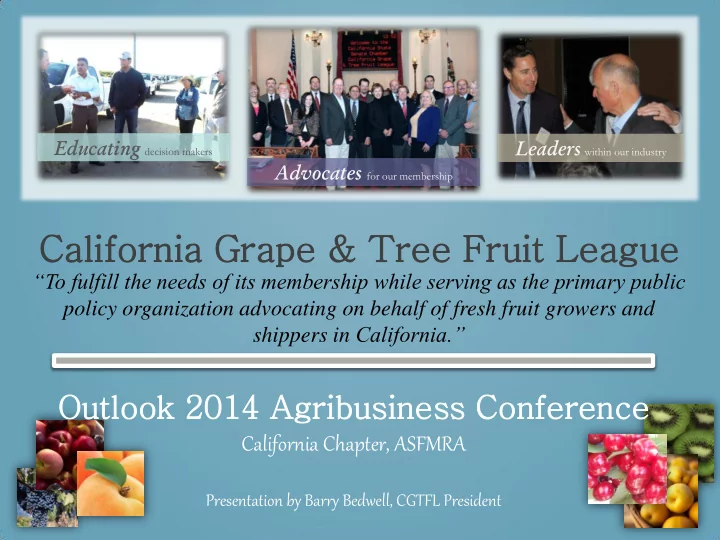
Educating decision makers Leaders within our industry Advocates for our membership Calif ifornia Gra rape & Tre ree Fru ruit League To fulfill the needs of its membership while serving as the primary public policy organization


slide-1
SLIDE 1

Educating decision makers Advocates for our membership Leaders within our industry

Calif ifornia Gra rape & Tre ree Fru ruit League

“To fulfill the needs of its membership while serving as the primary public policy organization advocating on behalf of fresh fruit growers and shippers in California.”

Outlo look 2014 Agrib ibusiness Confe ference

California Chapter, ASFMRA

Presentation by Barry Bedwell, CGTFL President

slide-2
SLIDE 2
  • Origins dating back to

1921; Growers & Shippers Protective League and Table Grape Growers & Shippers Association

  • Voluntary, non-profit

representing about 85%, by volume, fresh table grapes, tree fruit and berries

Background of the League

slide-3
SLIDE 3
  • Membership ranges

from Coachella Valley to Lake County

  • Primary public policy

advocate in Sacramento & DC

  • Different from

mandatory commissions Background of the League

slide-4
SLIDE 4

PPN Acreage

20,000 40,000 60,000 80,000 100,000 120,000 2006 2007 2008 2009 2010 2011 Est. 2012 Est. 2013

Bearing Acreage

Bearing Acreage

Acres

slide-5
SLIDE 5

California PPN Production

10 20 30 40 50 60 70 2006 2007 2008 2009 2010 2011 Est. 2012 Est. 2013

Box units (in millions)

slide-6
SLIDE 6

PPN Crop Value

$500.0 $510.0 $520.0 $530.0 $540.0 $550.0 $560.0 $570.0 $580.0 $590.0 $600.0 2006 2007 2008 2009 2010 2011 Est. 2012 Est. 2013

Value (in millions)

slide-7
SLIDE 7

California PPN Exports

2 4 6 8 10 12 14 16 2007 2008 2009 2010 2011

  • Est. 2012 Est. 2013

Million Box Units

slide-8
SLIDE 8

PPN Top 11 Export Markets

2 4 6 8 2007 2008 2009 2010 2011 2012 2013

25-pound box equivalents In Millions

slide-9
SLIDE 9
  • California’s fresh peach, plum and nectarine acreage continues to

decrease, although at a slightly slower rate, as growers move primarily to nut and citrus crops.

  • The number of independent PPN growers continues to decrease

with current estimates between 200 to 250 as compared to over 700 ten years ago.

  • The number of PPN shippers and marketers also continues to

decrease with approximately 12 shippers accounting for more than 80% of the market.

  • Last year’s (2013) production was higher than originally expected

but was comparable to 2012 where smaller sizes and lower grades were shipped.

  • Preliminary expectations are for PPN production to be in the mid

to high forties. This level is seen as an amount that will be effectively marketed.

  • Outlook in the near term is one of improved stability.

PPN Outlook & Summary

slide-10
SLIDE 10

CA Table Grape Acreage

20,000 40,000 60,000 80,000 100,000 120,000 2006 2007 2008 2009 2010 2011 2012 Bearing Acreage Thompson Seedless Acreage*

Acres

slide-11
SLIDE 11

CA Table Grape Production

20 40 60 80 100 120 140 2006 2007 2008 2009 2010 2011 2012 Est 2013

Box units (in millions)

slide-12
SLIDE 12

Weighted Average Box Price

$0.00 $2.00 $4.00 $6.00 $8.00 $10.00 $12.00 $14.00 $16.00 $18.00 2006 2007 2008 2009 2010 2011 2012 Est. 2013

slide-13
SLIDE 13

CA Table Grapes Crop Value

Value (in billions)

$0.0 $0.2 $0.4 $0.6 $0.8 $1.0 $1.2 $1.4 $1.6 $1.8 2005 2006 2007 2008 2009 2010 2011 2012 Est. 2013

slide-14
SLIDE 14

CA Table Grape Exports

5 10 15 20 25 30 35 40 2006 2007 2008 2009 2010 2011 2012 Est. 2013

Million Box Units

Excludes Canada

slide-15
SLIDE 15

CA Table Grape Top 10 Export Markets

2 4 6 8 2009 2010 2011 2012

19- pound box equivalents In Millions

slide-16
SLIDE 16

US Consumption of Imported Table Grapes By Origin

Chile 65% Mexico 26% Peru 7% Brazil 1% Other 1%

slide-17
SLIDE 17

Top 15 Table Grape Varieties By Volume-Box Units

Variety 2012 1 Crimson Seedless 17,865,835 2 Flame Seedless 14,202,971 3 Red Globe 11,126, 289 4 Scarlet Royal 8,672,565 5 Thompson Seedless 7,363,707 6 Autumn King 6,959,913 7 Sugraone 5,887,121 8 Autumn Royal 5,229,995 9 Princess 4,845,529 10 Blanc Seedless 3,339,711 11 90-3618 1,843,146 12 C51-63 1,760,476 13 Summer Royal 1,324,911 14 Sugrathirteen 1,278,836 15 Sheegene-4 967,607

slide-18
SLIDE 18
  • California’s table grape crop value, in spite of a box price decline in

2013, fell only slightly in 2013 due to record crop levels.

  • We continue to have a limited number of growers (approximately

464) and marketers.

  • Acreage of table grapes in California has remained relatively stable in

recent years but reported acreage statistics are somewhat suspect.

  • The industry is continuing to develop new varieties in response to

changing consumer preferences and production challenges.

  • The industry has now successfully marketed two crops in a row over

100 million boxes.

  • Outlook in the near term remains very optimistic with a continued

trend toward newer and proprietary varieties.

Table Grape Outlook Summary

slide-19
SLIDE 19

Top CGTFL Priorities 2014 Description 2013

1 Immigration Reform/Enforcement/E-Verify 1 2 Labor Laws & Regulations/OSHA/ALRA/SB 126 2 3 Water Supply Issues 4 4 Health Care Mandates/ACA 5 5 Labor Costs/Minimum Wage Increase 3 6 Invasive Pests Issues/Quarantine Costs & Impacts 6 7 Water Quality Regulations (Nitrogen, Salts) 10 8 Workers’ Compensation Costs 7 9 Food Safety Modernization Act (FSMA) 8 10 Air Quality Regulations/Fees/Costs 9

slide-20
SLIDE 20
  • #10: Air Quality

– The continued costs of compliance.

Truck rule as an example.

  • #9: Food Safety Modernization Act

– The need to be commodity specific and risk

based.

  • #8: Worker’s Comp Costs

– Increasing costs due to trial attorney’s and

the need for tort reform.

  • #7: Water Quality Regulations

– Who will fairly pay for the cleanup?

Main Points: #10 thru #7

slide-21
SLIDE 21
  • #6: Invasive Species

The need for resources. HLB as an example.

  • #5: Labor Costs

The incremental impact of minimum wage increases on the price of food.

  • #4: Health Care Mandates (ACA)

A great example of unintended consequences.

  • #3: Water Supply Issues

Will the drought cause production and price fluctuations? The potential for groundwater

  • management. Will a bond pass?

Main Points: #6 thru #3

slide-22
SLIDE 22

California Labor Laws & The Agricultural Labor Relations Act (ALRA)

  • History of the ALRA

– The role of Governor Brown.

  • Structure

– Board and General Counsel.

  • Where We Are Now

– Legislative progress over the last forty years and the catch 22

for unions

– The need for a genuine voice for agricultural employees.

Main Points: #2 CA Labor Laws & ALRA

slide-23
SLIDE 23

Other Complicated Legislative Factors Senate Bill 126

  • Background of SB 126

– SB 126 implementation near the top of list of

concerns

– Authored by Senate President Pro Tem

Darrell Steinberg (D-Sacramento) but written by Governor Brown

– First rejected by UFW who preferred Card

Check but later embraced

  • Where Are We Now?

– Where will the bar be set on employer

misconduct?

Main Points: #2 Senate Bill 126

slide-24
SLIDE 24
  • Background

Authored by Senator Pro-Tem Steinberg

Would create a pathway to perpetual mandatory mediation (where currently only the initial contract is so subject). Could create a scenario whereby current employees would never cast a secret ballot.

Provides that an action to enforce an order of the ALRB with reference to the mandatory mediation decision of the Board may be filed within 60 days whether or not the

  • ther party is seeking judicial review of the order

Would also increase the evidentiary threshold for the court to grant a stay of the Board's order and would require the court to make written findings supporting any order granting a stay of the order during the pendency of the appeal.

Senate Bill 25

slide-25
SLIDE 25

The Need For Immigration Reform

  • Farm Bureau Survey

– A 2012 survey by the California Farm Bureau found that 71 percent of tree

fruit growers, and nearly 80 percent of raisin and berry growers, were unable to find an adequate number of employees.

  • Ongoing Problem

– In 2008, Texas A&M reported that 77 percent of vegetable farmers reported

scaling back operations.

– The problem exists for all facets of agriculture, beyond just fruits, vegetables

and nuts. A separate Texas A&M study in 2012 focused on dairy.

  • Causes For Shortage

– The shortage of farm workers has several causes, including the reverse

migration of workers from the U.S. to Mexico, historic levels of immigration enforcement and mandatory E-Verify.

Main Points: #1 Immigration Reform

slide-26
SLIDE 26
  • Groups Involved With Immigration Reform

Agricultural Coalition For Immigration Reform (ACIR)

National Council of Agricultural Employers (ACAE)

Agricultural Workforce Coalition (AWC) Partnership For A New American Economy (PNAE)

United Farm Workers (UFW)

Groups Involved With Immigration Reform

slide-27
SLIDE 27
  • Title I: Blue Card Program for

Experienced Farm Workers

To be eligible for a green card the workers must have:

  • Performed at least five years of agricultural employment

for at least 100 work days per year during the upcoming 8-year period; or

  • Performed at least three years of agricultural

employment for at least 150 workdays per year during the upcoming five-year period.

  • Title II: Agricultural Worker

Program – Future Guest Workers

Cap, Wages, Housing, Transportation, Recruitment, Attestation , Dispute Resolution, Equal Treatment

Senate Proposal For Immigration Reform

slide-28
SLIDE 28
  • Republican Majority. The Hastert Rule. 142 out of

232 less than 10 %.

  • The reality of a changing electorate versus the Tea

Party.

Challenges in House of Representatives

  • 2012 Election

In 2012, Republicans were expected to maintain majority in House, but lost some

  • seats. The Senate was expected to go

Republican as of 33 seats up 23 are D and 10

  • R. In reality 2012 was a disaster for

Republicans.

slide-29
SLIDE 29

2012 California Congressional Elections Not North vs. South

but

Coastal vs. Interior

38 Democrats 15 Republicans

slide-30
SLIDE 30
  • Border security and interior enforcement must

come first

  • Implement entry/exit visa tracking system
  • Employment

verification and workplace enforcement

  • Reform to the legal immigration system
  • Youth (Dreamers)
  • Individuals living outside of the rule of law

– No special path to citizenship – Background checks – Pay fine and back taxes – Learn English and civics – No access to public assistance

Republican Principles for Immigration Reform

slide-31
SLIDE 31
  • The window of opportunity for immigration reform

looks to be between May and July. Remember it is an election year.

  • Politics

are situational. Never let emotions, particularly past events, get in the way

  • f

accomplishing current goals.

  • In a state like California, the messenger is as important

as the message. Your voice and input as a constituent is always more powerful than the paid representatives.

  • Ultimately the consumer is the final decision maker.

They will decide if California agriculture remains truly sustainable.

Take Away Messages

slide-32
SLIDE 32

Thank you for your tim time & a atte ttention!

Barry Bedwell (559) 226-6330 – bbedwell@cgtfl.com