CALIFORNIA RADIOACTIVE MATERIALS MANAGEMENT FORUM Keith E. - - PDF document

california radioactive materials management forum
SMART_READER_LITE
LIVE PREVIEW

CALIFORNIA RADIOACTIVE MATERIALS MANAGEMENT FORUM Keith E. - - PDF document

CALIFORNIA RADIOACTIVE MATERIALS MANAGEMENT FORUM Keith E. Asmussen, Ph.D., CHAIR Dir., Licensing, Safety & Nuclear Compliance General Atomics Post Office Box 85608 San Diego, CA 92186-5608 (858) 455-2823, Fax (858) 455-2822 TECHNICAL


slide-1
SLIDE 1

CALIFORNIA RADIOACTIVE MATERIALS MANAGEMENT FORUM

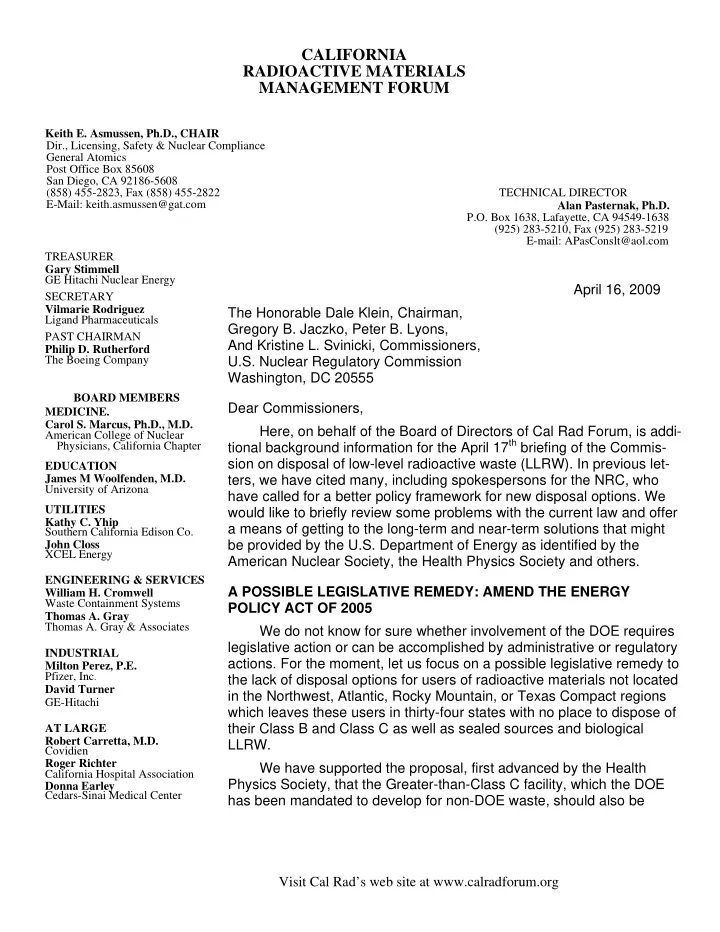
April 16, 2009 The Honorable Dale Klein, Chairman, Gregory B. Jaczko, Peter B. Lyons, And Kristine L. Svinicki, Commissioners, U.S. Nuclear Regulatory Commission Washington, DC 20555 Dear Commissioners, Here, on behalf of the Board of Directors of Cal Rad Forum, is addi- tional background information for the April 17th briefing of the Commis- sion on disposal of low-level radioactive waste (LLRW). In previous let- ters, we have cited many, including spokespersons for the NRC, who have called for a better policy framework for new disposal options. We would like to briefly review some problems with the current law and offer a means of getting to the long-term and near-term solutions that might be provided by the U.S. Department of Energy as identified by the American Nuclear Society, the Health Physics Society and others. A POSSIBLE LEGISLATIVE REMEDY: AMEND THE ENERGY POLICY ACT OF 2005 We do not know for sure whether involvement of the DOE requires legislative action or can be accomplished by administrative or regulatory

  • actions. For the moment, let us focus on a possible legislative remedy to

the lack of disposal options for users of radioactive materials not located in the Northwest, Atlantic, Rocky Mountain, or Texas Compact regions which leaves these users in thirty-four states with no place to dispose of their Class B and Class C as well as sealed sources and biological LLRW. We have supported the proposal, first advanced by the Health Physics Society, that the Greater-than-Class C facility, which the DOE has been mandated to develop for non-DOE waste, should also be Keith E. Asmussen, Ph.D., CHAIR

Dir., Licensing, Safety & Nuclear Compliance General Atomics Post Office Box 85608 San Diego, CA 92186-5608 (858) 455-2823, Fax (858) 455-2822 E-Mail: keith.asmussen@gat.com TREASURER Gary Stimmell GE Hitachi Nuclear Energy SECRETARY Vilmarie Rodriguez Ligand Pharmaceuticals PAST CHAIRMAN Philip D. Rutherford The Boeing Company BOARD MEMBERS MEDICINE. Carol S. Marcus, Ph.D., M.D. American College of Nuclear Physicians, California Chapter EDUCATION James M Woolfenden, M.D. University of Arizona UTILITIES Kathy C. Yhip Southern California Edison Co. John Closs XCEL Energy ENGINEERING & SERVICES William H. Cromwell Waste Containment Systems Thomas A. Gray Thomas A. Gray & Associates INDUSTRIAL Milton Perez, P.E. Pfizer, Inc. David Turner GE-Hitachi AT LARGE Robert Carretta, M.D. Covidien Roger Richter California Hospital Association Donna Earley Cedars-Sinai Medical Center

TECHNICAL DIRECTOR

Alan Pasternak, Ph.D. P.O. Box 1638, Lafayette, CA 94549-1638 (925) 283-5210, Fax (925) 283-5219 E-mail: APasConslt@aol.com

Visit Cal Rad’s web site at www.calradforum.org

slide-2
SLIDE 2

Members of the U.S. Nuclear Regulatory Commission Page 2 April 16, 2009 Washington, DC available to dispose of non-DOE Class B and C and possibly other wastes which have no disposal access. We have also proposed that, in the interim, existing DOE disposal facilities be made available for disposal of non-DOE waste. The simplest and most direct means of achieving theses goals by legislation would be to amend the Energy Policy Act of 2005 (EPACT), rather than the Low-Level Waste Policy Act of 1980 (amended in 1985). Enclosed is Section 631 of the EPACT with proposed amendments in red. I would appreciate hearing any comments on this approach. ADDITIONAL CONSIDERATIONS AND PROBLEMS

λ The Low-Level Waste Policy Act in force now is not the same law enacted by Con-

gress in 1980 (amended in 1985), because the courts have struck-down the “Take Title” provision. The Act as passed included both a carrot and a stick to encourage de- velopment of new LLRW disposal facilities: The carrot was the ability of compacts to limit disposal access to member states of the compact, the stick was the requirement that any state that failed to provide access to a disposal facility for users of radioactive materials in its state would be required to take title and possession of the waste gen-

  • erated. Without the “Take Title” provision, much of the incentive for states to under-

take the difficult and often politically unpopular task of developing a disposal facility is gone.

λ There has been interest by NRC staff in pursuing “blending” of wastes, combining

Class B and C LLRW, perhaps with Class A waste, so that the final mixture of waste is Class A. The objective is clearly to make the Class B and C wastes eligible for dis- posal at the Clive, Utah facility. Clive accepts Class A LLRW, and is currently avail- able to the thirty-four states without access to B and C disposal, but does not accept Class B or C waste (or sealed sources or biological wastes). However, officials from the State of Utah have made it clear that this approach will fail. Utah considers that LLRW carries the same classification as when it was generated. Utah has not adopted 10 CFR 61.58 which allows an alternate means of waste classification nor was Utah required to do so as part of the NRC compatibility determinations. If you have any questions or comments about the information in this or previous letters, please call me at (925) 283-5210 or send me an email at APasConslt@aol.com. Sincerely, Alan Pasternak Encl.: Proposed amendments to Sect. 631

  • f the Energy Policy Act of 2005

cc: NRC Staff Cal Rad Forum Board of Directors

slide-3
SLIDE 3

O:\END\EPAC306.xml (file 7 of 19) S.L.C. 597

1

  • SEC. 631. SAFE DISPOSAL OF GREATER-THAN-CLASS C AND SOME CLASS A

2

AND CLASS B RADIOACTIVE WASTE.

3 (a) RESPONSIBILITY FOR ACTIVITIES TO PROVIDE 4 STORAGE FACILITY.—The Secretary shall provide to Con- 5 gress official notification of the final designation of an en- 6 tity within the Department to have the responsibility of 7 completing activities needed to provide a facility for safely 8 disposing of all greater-than-Class C low-level radioactive 9 waste and Class B and Class C radioactive waste that has no other disposal

  • utlet.

10 (b) REPORTS AND PLANS.— 11 (1) REPORT ON PERMANENT DISPOSAL FACIL- 12 ITY.— 13 (A) PLAN REGARDING COST AND SCHED- 14 ULE FOR COMPLETION OF EIS AND ROD.— Not 15 later than 1 year after the date of enactment of 16 this Act, the Secretary, in consultation with 17 Congress, shall submit to Congress a report 18 containing an estimate of the cost and a pro- 19 posed schedule to complete an environmental 20 impact statement and record of decision for a

July 27, 2005

slide-4
SLIDE 4

O:\END\EPAC306.xml (file 7 of 19) S.L.C.

598 1 permanent disposal facility for greater-than- 2 Class C radioactive waste and for Class B and Class C radioactive waste that has no other disposal outlet. The report shall also identify disposal options at existing DOE disposal facilities, including facilities designated for disposal of federal wastes, for Class B and Class C radioactive waste lacking other disposal options prior to

  • peration of the Greater-than-Class C disposal facility described in Section (a).

3

(B) ANALYSIS OF ALTERNATIVES.—Before

4

the Secretary makes a final decision on the dis-

5

posal alternative or alternatives to be imple-

6

mented, the Secretaryt shall—

7

(i) submit to Congress a report that

8

describes all alternatives under consider-

9

ation, including all information required in

10

the comprehensive report making rec-

11

  • mmendations for ensuring the safe dis-

12

posal of all greater-than-Class C low-level

13

radioactive waste that was submitted by

14

the Secretary to Congress in February

15

1987 and Class B and Class C low-level radioactive waste that has no other disposal outlet; and

16

(ii) await action by Congress.

17 (2) SHORT-TERM PLAN FOR RECOVERY AND

18 STORAGE.—

slide-5
SLIDE 5

19 (A) IN GENERAL.—Not later than 180 20 days after the date of enactment of this Act, 21 the Secretary shall submit to Congress a plan

July 27, 2005

O:\END\EPAC306.xml (file 7 of 19) S.L.C.

599 1 to ensure the continued recovery and storage of 2 greater-than-Class C low-level radioactive sealed 3 sources that pose a security threat until a per- 4 manent disposal facility is available. 5 (B) CONTENTS.—The plan shall address 6 estimated cost, resource, and facility needs.