Can account of Fermi motion describe the EMC effect? A ( , p t ) d - - PowerPoint PPT Presentation

can account of fermi motion describe the emc effect
SMART_READER_LITE
LIVE PREVIEW

Can account of Fermi motion describe the EMC effect? A ( , p t ) d - - PowerPoint PPT Presentation

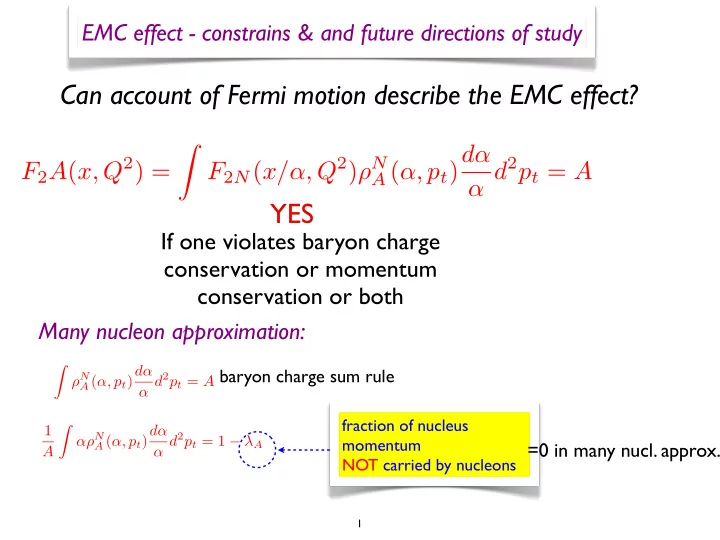
EMC effect - constrains & and future directions of study Can account of Fermi motion describe the EMC effect? A ( , p t ) d Z F 2 N ( x/ , Q 2 ) N F 2 A ( x, Q 2 ) = d 2 p t = A YES If one violates baryon charge conservation


slide-1
SLIDE 1

Can account of Fermi motion describe the EMC effect? YES

If one violates baryon charge conservation or momentum conservation or both Many nucleon approximation:

Z ρN

A (α, pt)dα

α d2pt = A baryon charge sum rule

fraction of nucleus momentum NOT carried by nucleons

1 A Z αρN

A (α, pt)dα

α d2pt = 1 − λA

1

=0 in many nucl. approx.

EMC effect - constrains & and future directions of study

F2A(x, Q2) = Z F2N(x/α, Q2)ρN

A (α, pt)dα

α d2pt = A

slide-2
SLIDE 2

Generic models of the EMC effect

RA(x, Q2) = 1 − λAnx 1 − x

extra pions - λπ ~ 4% -actually for fitting Jlab and SLAC data ~ 6% + enhancement from scattering off pion field with απ~ 0.15

6 quark configurations in nuclei with P6q~ 20-30%

◉ ◉ ◉

Mini delocalization (color screening model) - small swelling - enhancement of deformation at large x due to suppression of small size configurations in bound nucleons + valence quark antishadowing with effect roughly ∝ !knucl2

Nucleon swelling - radius of the nucleus is 20--15% larger in nuclei. Color is significantly delocalized in nuclei

Larger size →fewer fast quarks - possible mechanism: gluon radiation starting at lower Q2

(1/A)F2A(x, Q2) = F2D(x, Q2ξA(Q2))/2

2

slide-3
SLIDE 3

Drell-Yan experiments: Q2 = 15 GeV2

A-dependence of antiquark distribution, data are from FNAL nuclear Drell-Yan experiment, curves - pQCD analysis of Frankfurt, Liuti, MS 90. Similar conclusions by Eskola et al 93-07 data analyses

vs Prediction

¯ qCa(x)/¯ qN = 1.1 ÷ 1.2| x=0.05÷0.1

x

VOLUME 65, NUMBER 14

PHYSICAL REVIEW LETTERS

1 OCTOBER 1990

we find

that

the difference

Rs(x, Q ) —

I=S~(x,Q )/

AS~(x, Q ) —

1, evaluated

at x =0.05, increases

by a

factor of 2 as Q

varies between Q =3 and 25 GeV . In

particular,

if

we

use

the

QCD

aligned-jet

model

(QAJM) of Refs. 4 and 5 (which

is a QCD extension of

the

well-known

parton logic of Bjorken)

to calculate

Rs(x, Q ), we

find,

in the case of

Ca, Rg(x=0.04,

Q =3 GeV ) =0.9 and Rs(x=0.04, Q =25 GeV )

=0.97.

The

last number

is in

good agreement

with

Drell-Yan data (see Fig. 2). Thus,

we conclude

that

the

small shadowing

for S~ observed

in Ref. 3 for

x=0.04

and

Q

& 16 GeV2

corresponds

to a

much

larger shadowing for Q =Qo. Shadowing

in the sea-quark

distribution

at x =0.04

[Rs(x=0.04, Q =3 GeV ) =0.9), combined

with

the experimental

data

for

F2 (x,Q )/AF2 (x,Q )

at the

same

value of x [F2 (x,Q )/AFi (x,Q ) & I], unambi- guously implies an enhancement

  • f the valence

quarks,

i.e., Rv(x, Q ):

V~(x, Q )/AV~(x, Q ) & 1. For

Ca,

Rv(x =0.04-0.1,

Q

3

GeV )= 1.1,

whereas

for

infinite

nuclear

matter,

we find Rv(x =0.04-0.1, Q =3

GeV )~ 1.2. By applying

the baryon-charge

sum rule

[Eq. (2)], we conclude

that

experimental

data

require the presence

  • f shadowing

for valence

quarks

at small

values

  • f x [i.e., Rv(x, Q ) & 1 for x,h &0.01-0.03].

Moreover, the

amount

  • f shadowing

for Rv(x, Q ) is

about the same (somewhat

larger)

as the shadowing for the sea-quark

channel

(see Fig. 3). The overall

change

  • f the momentum

carried

by valence and sea quarks

at

Q'= I GeV' is

yv(Qo) =1.3%, )s(Qo) = — 4.6%.

To summarize,

the present data are consistent

with the

parton-fusion

scenario 6rst suggested

in Ref. 7: All par-

ton distributions

are shadowed at small x, while at larger

x, only

valence-quark

and gluon

distributions

are en- hanced. At the same time, other scenarios

inspired by

the now popular

(see, e.g., Ref. 8) idea of parton

fusion,

which

assume

that the

momentum

fraction carried

by

sea quarks

in a nucleus

remains

the same as in a free nu- cleon,

are

hardly

consistent

with

deep-inelastic

and

Drell- Yan data.

Let us brieAy

consider dynamical ideas that

may be

consistent

with

the emerging picture

  • f the

small-x

(x ~ 0.1) parton

structure

  • f nuclei.

In the nucleus

rest frame the x =0.1 region corresponds

to a possibility

for

the virtual photon

to interact

with

two nucleons

which

are at distances of about

I fm [cf. Eq. (I)]. But at these

distances quark

and gluon

distributions

  • f different

nu- cleons may overlap.

So, in analogy

with the pion model

  • f the European

Muon Collaboration

effect, the natural

interpretation

  • f the observed

enhancement

  • f gluon

and valence-quark distributions is that intermediate-range in- ternucleon

forces are a result of interchange

  • f quarks

and gluons. Within such a model, screening of the color

charge

  • f quarks

and gluons

would

prevent

any

sig- nificant enhancement

  • f the meson

field in nuclei.

Such

a picture of internucleon

forces does not necessarily con- tradict

the experience of nuclear physics. Really,

in the

low-energy

processes

where

quark

and gluon

degrees of freedom cannot be

excited,

the exchange

  • f quarks

(gluons) between

nucleons

is

equivalent,

within

the

dispersion

representation

  • ver

the momentum

transfer,

to the exchange

  • f a group of a few mesons.

Another

  • 1. 10I—

. 00

CL

  • 0. 90

0, 80

1.30 1.20

Ca/D

  • FIG. 2. Ratio R =(2/A)ug(x, g')/uD(x, g') plotted

vs x,

for diff'erent

values of Q . Notations

as in Fig. 1. Experimen-

tal data from Ref. 3.

1 0

FIG. 3.

Ratios

R(x,gj) (2/3)F" (x,gf)/FP(x, g$)

(dashed

line),

R=Rv(x, gS) -(2/A) Vq(x, gf)/Vo(x, QS)

(solid

line),

and R—

=Rs(x,g/) =(2/A)S~(x, g/)/SD(x, g/)

(dot-dashed line)

in

Ca.

All curves have been obtained

at

Q) =2 GeV . The Iow-x behavior (x ~ x,h) corresponds

to the predictions

  • f the QA3M of Refs. 4 and 5; the antishadowing

pattern

(i.e.,

a

10/o

enhancement

in

the valence channel whereas

no enhancement

in the sea, leading

to a less than 5%

increase of F~q at x =0.1-0.2) has been evaluated

within

the present approach

by requiring

that

sum

rules (2) and (3) are

satisfied. Experimental

data are from Ref.

1 (diamonds)

and

  • Ref. 3 (squares),

the latter representing the sea-quark

ratio Rg

(cf. Fig. 2). The theoretical

curves are located below the data

at small x, due to the

high

experimental

values of g~: (g )

=14.5 GeV~ in Ref.

1 and (Q ) =16 GeV2 in Ref. 3, respec-

tively.

1727

meson model expectation Q2 = 2 GeV2

¯ qCa/¯ qN ≈ 0.97

¯ qCa/¯ qN

¯ qCa(x)/¯ qN = 1.1 ÷ 1.2| x=0.05÷0.1

3

1989
slide-4
SLIDE 4

Structure of 2N correlations - probability ~ 20% for A>12 → dominant but not the only term in kinetic energy

90% pn + 10% pp< 10% exotics⇒probability of exotics < 2%

Combined analysis of (e,e’) and knockout data

Analysis of (e,e’) SLAC data at x=1 -- tests Q2 dependence of the nucleon form factor for nucleon momenta kN < 150 MeV/c and Q2 > 1 GeV2 :

rbound

N

/rfree

N

< 1.036

Analysis of elastic pA scattering

— 1~

~ 0.04.

This inequality is relevant for

Similar conclusions from combined analysis of (e,e’p) and (e,e’) JLab data

Problem for the nucleon swelling models of the EMC effect with 20% swelling

4

slide-5
SLIDE 5

Thou shalt not introduce dynamic pions into nuclei Remember baryon conservation law Honour momentum conservation law Thou shalt not introduce large deformations of low momentum nucleons

However large admixture of nonnucleonic degrees of freedom (20-- 30 %) strange but was not initially ruled out.

Qualitative change due to direct observation of short-range NN correlations at JLab and BNL

First five commandments Honour existence of large predominantly nucleonic short-range correlations

Thou shalt not introduce large exotic component in nuclei

  • 20 % 6q, Δ’s

5

slide-6
SLIDE 6

6

Theory of the leading twist shadowing based on the Gribov unitarity relations and QCD factorization theorem for hard

  • diffraction. Predictions for LHC, EIC,...

2

Im − Re

2 2

Im + Re

2

H H j j p p p p γ∗ γ∗ H H γ∗ γ∗ j j Α Α P P P P Hard diffraction

  • ff parton "j"

Leading twist contribution structure function fj (x,Q2) to the nuclear shadowing for

N1 N2 A−2

Physics Reports 512 (2012) 255–393

  • L. Frankfurt a, V. Guzey b,∗, M. Strikman c

Leading twist nuclear shadowing phenomena in hard processes with nuclei

y

  • 1

1 2 3 4

/ dy [mb]

coh

σ d

1 2 3 4 5 6 7 8 9 10

CMS ALICE AB-MSTW08 AB-HKN07 STARLIGHT GSZ-LTA AB-EPS09 AB-EPS08

CMS Preliminary = 2.76 TeV

NN

s ψ Pb+Pb+J/ → Pb+Pb

  • 1

b µ = 159

int

L

χ

x=10-3

Cross section of coherent J/ψ production in γ+Α →J/ψ +Α ultraperipheral collisions. Yellow band is our prediction - large (~ 0.6 ) gluon shadowing is observed

y

Thou shalt take into account leading twist shadowing andrelated leading twist antishadowing

slide-7
SLIDE 7

Two minor effects to be included in a precision analysis of the EMC ratio requires a) correction for the definition of x= AQ2/2q0mA b) 1% of heavy nucleus LC momentum carried by Weizs ̈acker-William photons

slide-8
SLIDE 8

Very few models of the EMC effect survive when constraints due to the observations of the SRC are included & lack of enhancement of antiquarks and Q2 dependence of the quasielastic (e,e’) at x=1 It appears that essentially one generic scenario survives - strong deformation of rare configurations in bound nucleons increasing with nucleon momentum and with most of the effect due to the SRCs .

8

slide-9
SLIDE 9

Dynamical model - color screening model of the EMC effect

(b) Nucleon in a quark-gluon configurations of a size << average size

(PLC) should interact weaker than in average configuration. Already application of the variational principle indicates that probability of such configurations in bound nucleons is suppressed by factor

Combination of two ideas:

(a) Quarks in nucleon with x>0.5 --0.6 belong to small size configurations with strongly suppressed pion field.

prediction for pA with trigger - confirmed by pA LHC and BNL DAu studies of large x jet produciton.

9

In color screening model modification of average properties is < 2- 3 %.

(FS 83-85)

δ(p,Eexc) = ✓ 1− p2

int −m2

2∆E ◆−2

effect

ΔE~ 0.5 GeV

slide-10
SLIDE 10

Dependence of suppression we find for small virtualities: 1-c(p2int-m2)

seems to be very general for the modification of the nucleon properties. Indeed, consider analytic continuation of the scattering amplitude to p2int-m2=0. In this point modification should vanish. Our quantum mechanical treatment of 85 automatically took this into account.

This generalization of initial formula allows a more accurate study of the A-dependence of the EMC effect.

10

Our dynamical model for dependence of bound nucleon pdf on virtuality - explains why effect is large for large x and practically absent for x~ 0.2 (average configurations V(conf) ~ <V>).

28

0.0 0.2 0.4 0.6 0.8 1.0 x 0.80 0.85 0.90 0.95 1.00 1.05 1.10 1.15 1.20 REMC

Unmodified Color screening

Simple parametrization of suppression: no suppression x≤ 0.45, by factor δA(k) for x ≥0.65, and linear interpolation in between

Fe , Q2=10 GeV2

Freese, Sargsian, MS 14

slide-11
SLIDE 11

interesting to measure tagged structure functions where modification is expected to increase quadratically with tagged nucleon momentum. It is applicable for searches of the form factor modification in (e,e’N). If an effect is observed at say100 MeV/c - go to 200 MeV/c and see whether the effect would increase by a factor of ~3-4.

1 − F bound

2N

(x/α, Q2)/F2N(x/α, Q2) = f(x/α, Q2)(m2 − p2

int)

Here α is the light cone fraction of interacting nucleon Tagging of proton and neutron in e+D→e+ backward N +X (lab frame).

αspect = (2 − α) = (EN − p3N)/(mD/2)

11

γ D p

A>2 -- two step contributions, motion of the pair. mask effect. In neutrino scattering BEBC tried to remove two step processes to see better 2N SRC “Doppler” shift

Collider kinematics -- nucleons with pN>pD/2

“Gold plated test” (FS85) (Silver?)

slide-12
SLIDE 12

12

Experimental challenges ❖

Jlab Q range - separate LT and HT (50 :50 ) contribution to the EMC effect at Jlab. Precision relative normalization to study scaling of F2A(x) / FD(x) -1 = f(A) φ(x) and precision of f(A) ~ a2-1

feasible: Freese, Sargsian, MS

COMPASS DIS --- improve old DIS data which have errors ~50% for x=0.6

❖ Superfast (x> 1) quarks Jlab: Study of Q2 dependence, trying to reach

LT regime for x~ 1 at Q2 ~ 15 GeV2

x~1 LHC dijet production in pPb ❖ EIC --- x~0.1: u-, d- quarks, gluons

F2A(x = 1)/F2D(x = 1) > a2(A)

Direct searches for exotics - isobars,...

slide-13
SLIDE 13

13

Large angle processes like γ+A --> N π + (A-1)

In color transparency regime - breaking of factorization due to suppression of small size configurations in bound nucleons. -- by factor

δ(p,Eexc) = ✓ 1− p2

int −m2

2∆E ◆−2