Can environmentally-friendly farming also be productive? James - - PowerPoint PPT Presentation

can environmentally friendly farming also be productive
SMART_READER_LITE
LIVE PREVIEW

Can environmentally-friendly farming also be productive? James - - PowerPoint PPT Presentation

Can environmentally-friendly farming also be productive? James Bullock NERC Centre for Ecology and Hydrology jmbul@ceh.ac.uk Agri-environment schemes Implemented in the EU through the CAP (but also elsewhere in the World) Targeted


slide-1
SLIDE 1

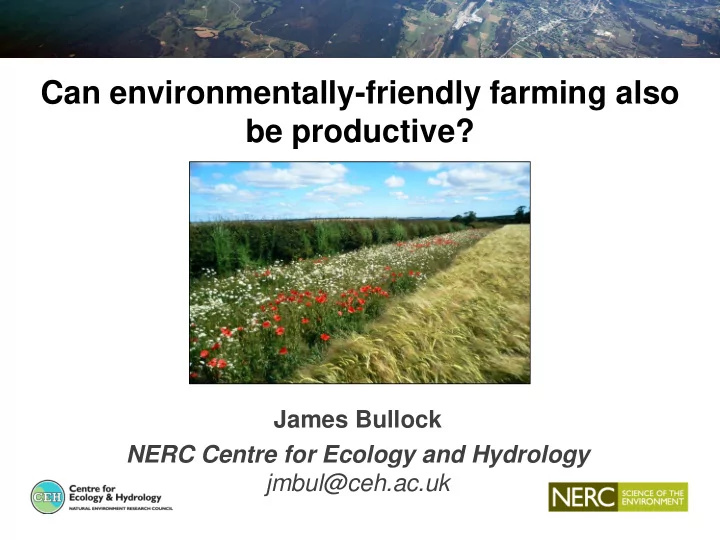
Can environmentally-friendly farming also be productive?

James Bullock NERC Centre for Ecology and Hydrology jmbul@ceh.ac.uk

slide-2
SLIDE 2

Agri-environment schemes

  • Implemented in the EU through the CAP (but also

elsewhere in the World)

  • Targeted primarily at wildlife, but also other

environmental benefits – reducing pollution, storing carbon, increasing soil health, etc

  • Budget in the EU ca €2.5bn per year
  • Payments compensate farmers for “profit foregone”
slide-3
SLIDE 3

Agri-environment schemes do work

Arable plant survey (20-km) Bumblebee survey (10-km) Bird - assemblage studies

# # # # # #

# # # # # # # #

100 200 50 Kilometers

0.00 0.05 0.10 0.15 0.20 0.25 0.30 0.35 0.40 0.0 0.5 1.0 1.5 2.0 2.5 3.0 3.5 4.0 0.0 0.2 0.4 0.6 0.8 1.0 1.2 1.4 1.6 1.8 5 10 15 20 25 30 35

Control General Evidence Control General Evidence Control vs. General Evidence vs. General Evidence vs. Control

a) Plants b) Bumblebees c) Birds

Common species Rare species

  • 1.0

0.0 1.0 2.0 3.0 4.0 5.0

  • No. common species
  • No. rare species
  • No. common species
  • No. rare species

Hedges’ d

  • Although they need to be well designed
slide-4
SLIDE 4

But are AES simply a cost to productive farming?

  • Encouraging wild bees as crop pollinators?

y = -1.8621x + 558.56 R² = 0.202 200 400 600 800 1000 1200 50 100 150 200 250 Pollinator density (indi. ha-1) Distance from field boundary (m)

slide-5
SLIDE 5

Worldwide – wild pollinators enhance crop fruit set

  • Wild insects more important for crops than honeybees

Change in fruit set compared to no insect pollinators

slide-6
SLIDE 6

But are AES simply a cost to productive farming?

  • Encouraging natural pest control?

Number of adult aphids

slide-7
SLIDE 7

Might AES enhance crop yields?

  • Studies of blueberries in the US & of mangoes in S.

Africa show wildflower patches increase pollination and fruit yield

slide-8
SLIDE 8

The Hillesden Project

  • Quantify effects of agri-environmental measures on

biodiversity, beneficial species & crop yield

  • 1000ha commercial arable farm
  • Three treatments applied to 50-60ha patches:
  • Cross Compliance (0% land removed)
  • Typical Entry Level AES (1% land removed for

two wildlife habitats)

  • Entry Level Extra AES (6% land removed for six

habitats)

  • Habitat location in awkward/low yielding margins

/corners

slide-9
SLIDE 9

Block 1 Block 2 Block 3 Block 4 Block 5

Design

slide-10
SLIDE 10

Hillesden: monitoring

  • 10 years of monitoring
  • Crop yield & inputs
  • Beneficial species associated with

crop production (pollinators, pest control)

  • Declining farmland species (e.g.

birds, butterflies)

slide-11
SLIDE 11

0.90 0.95 1.00 1.05 1.10 1.15

Cross Compliance ELS ELS Extra Yield as Ratio of Regional average

0.90 0.95 1.00 1.05

Cross Compliance ELS ELS Extra Yield as Ratio of Regional average

Whole field

a) Cropped area b) Whole field

Effects on yield (6yrs): all crops (wheat, OSR, beans)

slide-12
SLIDE 12

0.40 0.50 0.60 0.70 0.80 0.90 1.00 1.10

Cross Compliance ELS ELS Extra Yield deficit as ratio of national average

Beans - cropped area

Effects on yield: Beans

a) Cropped area

0.40 0.50 0.60 0.70 0.80 0.90 1.00

Cross Compliance ELS ELS Extra Yield deficit as ratio of national average

b) Whole field

slide-13
SLIDE 13

a) Cropped area b) Whole field

Effects on yield: Wheat

slide-14
SLIDE 14

0.8 0.9 1 1.1 1.2 2006 2007 2008 2009 2010 2011

Yield deficit as ratio of Regional/National average

Whole field

Cross Compliance ELS ELS Extra

Yield trend with time

0.8 0.9 1 1.1 1.2 1.3 1.4 2006 2007 2008 2009 2010 2011

Yield as Ratio of Regional/National average

Cropped area

Cross Compliance ELS ELS Extra

a) Cropped area b) Whole field

slide-15
SLIDE 15

Using AES more broadly for sustainable farming?

B L O C K 2

11a 10 9 7 6 5 4 3a 3 2 1 11b 11c 13 14

A41 Grass Corral Cranwell Speeds Great Speeds Cow House Browns

130 260 65 Meters

Waddesdon Estate Expermintal Layout ENHANCEMENTS

Treatments

Control Enhanced

Enhanced Options

OptDesc

Ditch EF2/HF2 Bird EF22 EF4/HF4 EJ9 EK2/3 Early Annuals Fences HF1/HK8 HF10 Sandwich HF10 Shop Window HF10 Wildflower Hedge Leave Existing Other PC Racehorse Paddock

BLOCK 2

Disc Feed Slot

Wildflower strips for crop pollinators & pest control Legumes into grassland/ arable reversion for carbon capture and decreased flooding/erosion Cover crop, buffer strips & sediment ponds for water quality Wildflowers, rare plants, birds for cultural value

slide-16
SLIDE 16
  • Sustainable Intensification Research Platform
  • A multi-partner research project funded by Defra to investigate approaches to

more sustainable farming.

  • 3 projects:
  • SIP 1 Integrated Farm Management for improved economic,

environmental and social performance

  • SIP 2 Opportunities and risks for farming and the environment at a

landscape scale

  • SIP 3 A scoping study on the influence of external drivers and actors on

the sustainability and productivity of English and Welsh farming

  • Platform aims to develop more integrated and collaborative ways of funding,

conducting and applying agricultural research around sustainable intensification.

slide-17
SLIDE 17

Farmers have a very important role

  • Farmers with longer and more intense experience in

AES produce better quality margins

  • And so they have more birds, bees & butterflies

Improving agri-environment schemes

The FarmCat project