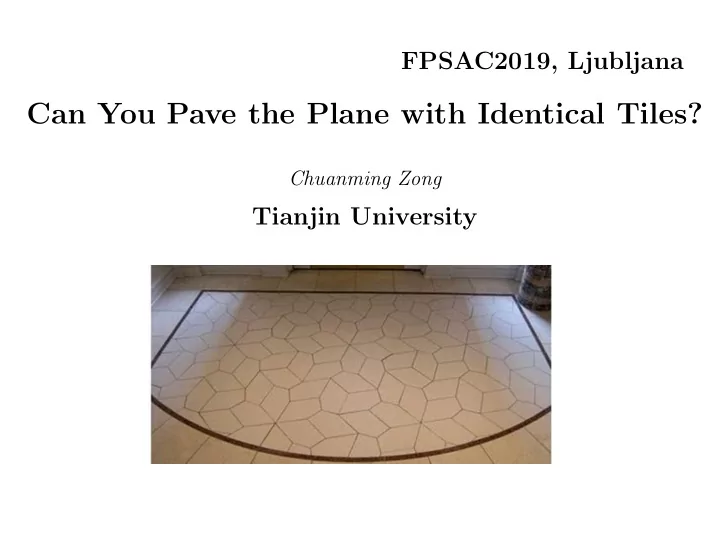
Can You Pave the Plane with Identical Tiles? Chuanming Zong Tianjin - - PowerPoint PPT Presentation

can you pave the plane with identical tiles
SMART_READER_LITE
LIVE PREVIEW

Can You Pave the Plane with Identical Tiles? Chuanming Zong Tianjin - - PowerPoint PPT Presentation

FPSAC2019, Ljubljana Can You Pave the Plane with Identical Tiles? Chuanming Zong Tianjin University 1 What kind of polygons can tile the whole plane? 2 Tiling is one of the ancient subjects in mathematics. Early studies can be traced back to


slide-1
SLIDE 1

FPSAC2019, Ljubljana

Can You Pave the Plane with Identical Tiles?

Chuanming Zong

Tianjin University

slide-2
SLIDE 2

1

What kind of polygons can tile the whole plane?

slide-3
SLIDE 3

2

Tiling is one of the ancient subjects in mathematics. Early studies can be traced back to Aristotle and Archimedes. There are thousands of papers about tilings. However, solutions to some fundamental problems are still missing. Aristotle, 384 BC – 322 BC Archimedes, 287 BC – 212 BC

slide-4
SLIDE 4

3

Convex Bodies and Lattices

Convex Body: In the n-dimensional Euclidean space En, we say a set K is convex if all the segments connecting two points of the set belong to the

  • set. In other words,

λx + (1 − λ)y ∈ K holds whenever both x and y belong to K and 0 ≤ λ ≤ 1. We call K an n-dimensional convex body if it is convex, full-dimensional and compact.

x y

slide-5
SLIDE 5

4

Lattice: If v1, v2, . . ., vn are n independent vectors in En, we call Λ = { n ∑

i=1

zivi, zi ∈ Z } an n-dimensional lattice.

v1 v2

slide-6
SLIDE 6

5

Lattice Tilings, Fedorov’s Discovery A family F of compact subsets of En with non-empty interiors is a tiling of En if their union is En and any two distinct sets have disjoint interiors. The sets are called tiles. To avoid complexity and confusion, in this talk we only deal with the tilings by identical convex polygon tiles. In particular, we call it a congruent tiling if all the tiles are congruent to each others, call it a translative tiling if all the tiles are translates of each others, and call it a lattice tiling if it is a translative tiling and all the translative vectors together is a lattice.

slide-7
SLIDE 7

6

Theorem 1 (Fedorov, 1885). A convex domain can form a lattice tiling of E2 if and only if it is a parallelogram or a centrally symmetric hexagon; a convex body can form a lattice tiling in E3 if and only if it is a parallelotope, a hexagonal prism, a rhombic dodecahedron, an elongated

  • ctahedron or a truncated octahedron.

H

  • p1

p2 Figure 3.1 2p1 2p2

  • Remark. Of course, we can treat a parallelogram as a special centrally

symmetric hexagon. Therefore, essentially there is only one type of convex polygons which can produce lattice tilings in the plane.

slide-8
SLIDE 8

7

Hilbert’s Problem and Bieberbach’s Question Clearly, a lattice is an additive group in the space, and a lattice tile is a fundamental region of the group of motions. In 1900, Hilbert proposed a list of mathematical problems in his ICM lecture in Paris. As a generalized inverse of Fedorov’s discovery, he proposed the following problem as a part of his 18th problem: A fundamental region of each group of motions, together with the con- gruent regions arising from the group, evidently fills up space completely. The question arises: whether polyhedra also exist which do not appear as fundamental regions of groups of motions, by means of which neverthe- less by a suitable juxtaposition of congruent copies a complete filling up

  • f all space is possible.
slide-9
SLIDE 9

8

Hilbert proposed his problem in the space, perhaps he believed that there is no such domain in the plane. When Reinhardt started his Doctoral thesis at Frankfurt am Main in 1910s, Bieberbach suggested him to determine all the convex domains which can form congruent tilings in the plane and so that to verify that Hilbert’s problem indeed has positive answer in the plane. Problem 1. To determine all the two-dimensional convex tiles.

  • Remark. In 1954, Venkov proved that if an n-dimensional convex body can

produce a translative tiling, then it is a parallelohedron. However, to classify all of the parallelohedra is a very challenging job and our knowledge about it is limited to dimensions five or less.

slide-10
SLIDE 10

9

Classification of the Two-dimensional Tiles It can be easily shown that a convex tile must be a polytope. Then, by Euler’s formula it can be shown that the number of the edges of a two-dimensional convex tile is at most six. Apparently, two identical triangles can make a parallelogram and two identical quadrilaterals can make a centrally symmetric hexagon. Thus, by Fedorov’s theorem, identical triangles or quadrilaterals can always tile the plane nicely.

Figure 3.2

slide-11
SLIDE 11

10

Then, Bieberbach’s problem can be reformulated as: What kind of convex pentagons or hexagons can tile the plane? For the hexagon case, in 1918 Reinhardt claimed the following solution. Theorem 2. A convex hexagon can tile the whole plane if and only if it is one of the following three types:

a d α β γ a d c e α β δ a b c d e f α γ ǫ a = d α + β + γ = 2π a = d c = e α + β + δ = 2π a = b c = d e = f α = γ = ǫ = 2π/3 Figure 3.3

slide-12
SLIDE 12

11

The story of hunting the pentagon tiles is very dramatic! In 1918, Reinhardt discovered five types of pentagon tiles and believed that the list was complete. Half a century later, Kershner discovered three new types of pentagon tiles and claimed the completeness of the extended list. Unfortunately, six types

  • f new two-dimensional convex tiles were discovered in 1970s and 1980s by

James, Rice and Stein, respectively. However, this is still not the end of the

  • story. In 2017, Mann, Mcloud-Mann and Derau reported another one!!!

Theorem 3. A convex pentagon can tile the whole plane if it belongs to

  • ne of the following fifteen types:

α β γ α + β + γ = 2π a d α β δ a = d α + β + δ = 2π b c e a d α γ δ a = b d = c + e α = γ = δ = 2π/3

  • K. Reinhardt
  • K. Reinhardt
  • K. Reinhardt
slide-13
SLIDE 13

12 a b c d α γ a b c d α γ a = b c = d α = γ = π/2 a = b c = d α = γ/2 = π/3 a b c d e α γ ǫ a = b = e c = d α = 2γ γ + ǫ = π

  • K. Reinhardt
  • K. Reinhardt

R.B. Kershner a b c d α β γ δ a = b = c = d α + 2δ = 2π 2β + γ = 2π a b c d α β γ δ a = b = c = d 2α + β = 2π γ + 2δ = 2π a b c d β γ ǫ δ a = b = c = d β + 2ǫ = 2π γ + 2δ = 2π R.B. Kershner R.B. Kershner

  • M. Rice

a b d e α β γ δ ǫ a = e = b + d ǫ = π/2 2β − δ = π 2γ + δ = 2π α + δ = π a c d e α β γ δ ǫ 2a + c = d = e α = π/2 γ + ǫ = π 2β + γ = 2π a c d e α β γ δ ǫ 2a = c + e = d α = π/2 γ + ǫ = π 2β + γ = 2π

  • R. James
  • M. Rice
  • M. Rice
slide-14
SLIDE 14

13

a c d e α β γ δ ǫ a b c d e α β γ δ ǫ c = d 2c = e β = ǫ = π − δ/2 α = γ = π/2 α = π/2 2β + γ = 2π 2a = 2c = d γ + ǫ = π α + β + δ = 2π Figure 3.4

  • M. Rice
  • R. Stein

A B C D E a b c d e A = 60◦ B = 135◦ C = 105◦ D = 90◦ E = 150◦ a = 1 b = 1/2 d = 1/2 e = 1/2 c = 1/ √ 2( √ 3 − 1) Mann, Mcloud-Mann and Derau

slide-15
SLIDE 15

14

  • Remark. In fact, the pentagons of type six (discovered by Kershner) are

counterexamples to Hilbert’s problems in the plane, although Kershner him- self did not realize this fact.

  • Remark. The Mathematical Association of America paved a lobby floor in

Washington D. C. with one of Rice’s tiles.

slide-16
SLIDE 16

15

Theorem 4 (Rao, 2017). The list in Theorem 3 is complete. Proof Idea. First, by studying the angle condition, a computer algorithm reduces to 371 possible types of pentagons tiles. Then, checking them further by computer and eliminating the impossible cases.

  • Remark. Rao’s paper has not published yet. Some experts are still checking

his proof.

slide-17
SLIDE 17

16

Multiple Tilings Assume that F = {K1, K2, K3, . . .} is a family of convex bodies in En and k is a positive integer. We call F a k-fold tiling of En if every point x ∈ En belongs to at least k of these convex bodies and every point x ∈ En belongs to at most k of the int(Ki). In other words, a k-fold tiling of En is both a k-fold packing and a k-fold covering in En. In particular, we call a k-fold tiling of En a k-fold congruent tiling, a k-fold translative tiling, or a k-fold lattice tiling if all Ki are congruent to K1, all Ki are translates of K1, or all Ki are translates of K1 and the translative vectors form a lattice in En, respectively. In these particular cases, we call K1 a k-fold congruent tile, a k-fold translative tile or a k-fold lattice tile, respectively.

slide-18
SLIDE 18

17

Furtw¨ angler (1936) and Robinson (1979) first studied multiple lattice tilings by cubes. It was proved by Bolle, Gravin, Robins and Shiryaev that a transla- tive k-tile must be centrally symmetric with centrally symmetric facets. Let P denote an n-dimensional centrally symmetric convex polytope, let τ(P) denote the smallest integer k such that P is a translative k-tile, and let τ ∗(P) denote the smallest integer k such that P is a lattice k-tile. For convenience, we define τ(P) = ∞ if P can not form translative tiling of any multiplicity. Clearly, for every convex polytope we have τ(P) ≤ τ ∗(P). Problem 2. When D runs over all convex polygons, can τ ∗(D) (or τ(D)) take every positive integer ? Problem 3. Is τ(D) always identical with τ ∗(D)?

slide-19
SLIDE 19

18

Multiple Lattice Tilings In 1994, Bolle studied the two-dimensional lattice multiple tilings. He proved the following criterion: Lemma 1. A convex polygon is a k-fold lattice tile for a lattice Λ and some positive integer k if and only if the following conditions are satis- fied:

  • It is centrally symmetric.
  • When it is centered at the origin, in the relative interior of each

edge G there is a point of 1

2Λ.

  • If the midpoint of G is not in 1

2Λ, then G is a lattice vector of Λ.

slide-20
SLIDE 20

19

In 2013, Gravin, Robins and Shiryaev discovered the following example. Example 1. Let Λ denote the two- dimensional integer lattice Z2 and let D8 denote the polygon with vertices v1 = (1

2, −3 2), v2 = (3 2, −1 2), v3 =

(3

2, 1 2), v4 = (1 2, 3 2), v5 = −v1, v6 =

−v2, v7 = −v3 and v8 = −v4. Then D8 + Λ is a seven-fold lattice tiling of

  • E2. Consequently, we have

τ ∗(D8) ≤ 7.

slide-21
SLIDE 21

20

In 2017, Yang and Zong proved the following theorem: Theorem 5 (Yang and Zong). If D is a two-dimensional convex do- main which is neither a parallelogram nor a centrally symmetric hexagon, then we have τ ∗(D) ≥ 5, where the equality holds at some particular decagons. Remark. The lower bound follows easily from the known results about multiple packings. However, the equal- ity example is unexpected.

v1 v2 v3 v4 v5 v6 v7 v8 v9 v10

slide-22
SLIDE 22

21

Even more unexpected, by studying lattice polygons, all the five-fold lattice tiles can be nicely characterized. They are two classes of octagons and one class of decagons, besides parallelograms and centrally symmetric hexagons. Theorem 6 (Zong). A convex domain can form a five-fold lattice tiling

  • f the Euclidean plane if and only if it is a parallelogram, a centrally

symmetric hexagon, under a suitable affine linear transformation, a cen- trally symmetric octagon with vertices v1 = (−α, −3

2), v2 = (1 − α, −3 2),

v3 = (1 + α, −1

2), v4 = (1 − α, 1 2), v5 = −v1, v6 = −v2, v7 = −v3

and v8 = −v4, where 0 < α <

1 4, or with vertices v1 = (β, −2),

v2 = (1 + β, −2), v3 = (1 − β, 0), v4 = (β, 1), v5 = −v1, v6 = −v2, v7 = −v3, v8 = −v4, where 1

4 < β < 1 3, or a centrally symmetric decagon

with u1 = (0, 1), u2 = (1, 1), u3 = (3

2, 1 2), u4 = (3 2, 0), u5 = (1, −1 2),

u6 = −u1, u7 = −u2, u8 = −u3, u9 = −u4 and u10 = −u5 as the middle points of its edges.

slide-23
SLIDE 23

22 v1 v2 v3 v5 v4 v6 v7 v8 D8(α) v1 v2 v3 v4 v5 v6 v7 v8 D8(β) v1 v2 v3 v4 v5 v6 v7 v8 v9 v10

slide-24
SLIDE 24

23

Multiple Translative Tilings By introducing and studying adjacent wheels, in 2017 Yang and Zong were able to generalize the results of previous section to the translative case. Let Xv denote the subset of X consisting of all points xi such that v ∈ ∂(P2m) + xi. Since P2m + X is a multiple tiling, the set Xv can be divided into disjoint subsets Xv

1 , Xv 2 , . . . , Xv t such that the translates in P2m + Xv j can be re-

enumerated as P2m + xj

1, P2m + xj 2, . . ., P2m + xj sj satisfying the following

conditions:

  • 1. v ∈ ∂(P2m) + xj

i holds for all i = 1, 2, . . . , sj.

slide-25
SLIDE 25

24

2. Let ∠j

i denote the

inner angle of P2m + xj

i

at v with two half-line edges Lj

i,1 and Lj i,2 such

that Lj

i,1, xj i − v and

Lj

i,2 are in clock order.

Then, the inner angles join properly as Lj

i,2 = Lj i+1,1

holds for all i = 1, 2, . . . , sj, where Lj

sj+1,1 =

Lj

1,1.

v v∗

1

v∗

2

v∗

3

v∗

4

P8 + x1 P8 + x2 P8 + x3 P8 + x4 P8 + x5 P8 + x6 P8 + x7 P8 + x8 v∗

5

v∗

6

v∗

7

v∗

8

slide-26
SLIDE 26

25

For convenience, we call such a sequence P2m +xj

1, P2m +xj 2, . . ., P2m +xj sj

an adjacent wheel at v. It is easy to see that

sj

i=1

∠j

i = 2wj · π

hold for positive integers wj. Then we define ϕ(v) =

t

j=1

wj = 1 2π

t

j=1 sj

i=1

∠j

i

and φ(v) = ♯ {xi : xi ∈ X, v ∈ int(P2m) + xi} . Clearly, if P2m + X is a τ(P2m)-fold translative tiling of E2, then τ(P2m) = φ(v) + ϕ(v) (2) holds for all v ∈ V + X. By detailed analysis based on (2), Yang and Zong

  • btained the following results.
slide-27
SLIDE 27

26

Theorem 7 (Yang and Zong). If D is a two-dimensional convex do- main which is neither a parallelogram nor a centrally symmetric hexagon, then we have τ(D) ≥ 5, where the equality holds if D is some particular centrally symmetric oc- tagon or some particular centrally symmetric decagon.

v1 v2 v3 v4 v5 v6 v7 v8 v9 v10

slide-28
SLIDE 28

27

Theorem 8 (Yang and Zong). A convex domain can form a five-fold translative tiling of the Euclidean plane if and only if it is a parallelogram, a centrally symmetric hexagon, under a suitable affine linear transfor- mation, a centrally symmetric octagon with vertices v1 = (3

2 − 5α 4 , −2

) , v2 = ( −1

2 − 5α 4 , −2

) , v3 = (α

4 − 3 2, 0

) , v4 = (α

4 − 3 2, 1

) , v5 = −v1, v6 = −v2, v7 = −v3 and v8 = −v4, where 0 < α < 2

3, or with ver-

tices v1 = (2 − β, −3), v2 = (−β, −3), v3 = (−2, −1), v4 = (−2, 1), v5 = −v1, v6 = −v2, v7 = −v3 and v8 = −v4, where 0 < β ≤ 1, or a centrally symmetric decagon with u1 = (0, 1), u2 = (1, 1), u3 = (3

2, 1 2),

u4 = (3

2, 0), u5 = (1, −1 2), u6 = −u1, u7 = −u2, u8 = −u3, u9 = −u4 and

u10 = −u5 as the middle points of its edges.

  • Remark. In fact, it can be easily verified that every two-dimensional five-

fold translative tile is a five-fold lattice tile.

slide-29
SLIDE 29

28 v1 v2 v3 v5 v4 v6 v7 v8 D8(α) v1 v2 v3 v4 v5 v6 v7 v8 D8(β) v1 v2 v3 v4 v5 v6 v7 v8 v9 v10

slide-30
SLIDE 30

29

References

  • M. Rao, Exhaustive search of convex pentagons which tile the plane,

arXiv:1708.00274.

  • Q. Yang and C. Zong, Multiple lattice tilings in Euclidean spaces, Cana-

dian Math. Bull., in press.

  • Q. Yang and C. Zong, Multiple translative tilings in Euclidean spaces,

arXiv:1711.02514.

  • C. Zong, Characterization of the two-dimensional five-fold lattice tile,

arXiv:1712.01122.

  • C. Zong, Can you pave the plane nicely with identical tiles, arXiv:1803.

06610.

Thank you very much!