Carbon NanoBuds (CNB) Synthesis, Structure and Thin Film Device - - PowerPoint PPT Presentation

carbon nanobuds cnb synthesis structure and thin film
SMART_READER_LITE
LIVE PREVIEW

Carbon NanoBuds (CNB) Synthesis, Structure and Thin Film Device - - PowerPoint PPT Presentation

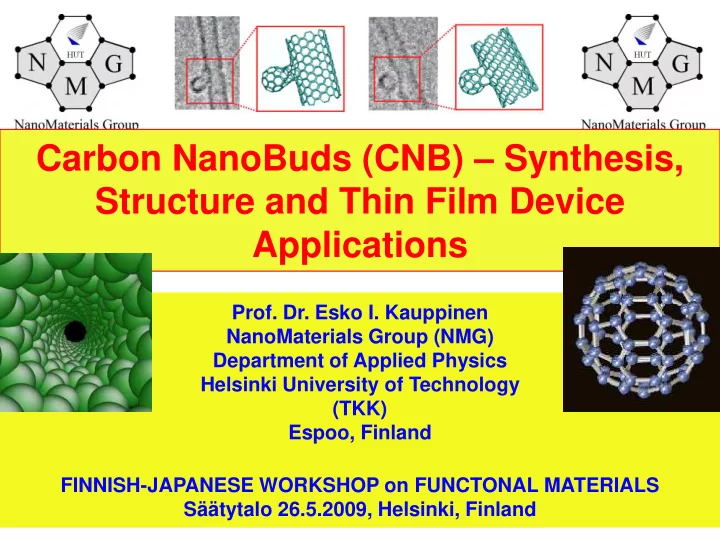
Carbon NanoBuds (CNB) Synthesis, Structure and Thin Film Device Applications Prof. Dr. Esko I. Kauppinen NanoMaterials Group (NMG) Department of Applied Physics Helsinki University of Technology (TKK) Espoo, Finland FINNISH-JAPANESE


slide-1
SLIDE 1
  • Prof. Dr. Esko I. Kauppinen

NanoMaterials Group (NMG) Department of Applied Physics Helsinki University of Technology (TKK) Espoo, Finland FINNISH-JAPANESE WORKSHOP on FUNCTONAL MATERIALS Säätytalo 26.5.2009, Helsinki, Finland

Carbon NanoBuds (CNB) – Synthesis, Structure and Thin Film Device Applications

slide-2
SLIDE 2

Nan anoM

  • Mat

ater erial als (Nan anoM

  • Mat

at) Gro roup up

Department artment of Applied plied Physics ics and Center er for New Material ials Hels lsinki inki Univers ersity ty of Technology

  • logy (TKK)

1). Synthesis of carbon nanotubes and nanobuds

2). Synthesis of multicomponent nano- and microparticles for drug and gene delivery 3). Structural characterization of nanotubes and nanoparticles by electron microscopy 4). Generation of novel 2-D and 3-d nanotube, nanobud and polymer/protein structures for transparent electronics and energy applications 5). MD and DFT

Nanobud Carbon nanotube

http://www.fyslab.hut.fi/nanomat

slide-3
SLIDE 3

NanoMaterials Group, Helsinki University of Technology

  • Dept. of Applied Physics & Center for New Materials

http://www.fyslab.hut.fi/nanomat/

Acknowledgement for Funding * Academy of Finland * EU FP6 & FP7 * TEKES FinNano Program

  • Dr. Albert G. Nasibulin
  • Dr. Hua Jiang
  • Dr. Janne Raula
  • Dr. David P. Brown

CEO, Canatu Oy

  • Mrs. Jing Tian
  • Ms. Marina Zavodchikova

TKK 100th Anniv. Fund Also: Antti Kaskela, Toma Susi NEDO

slide-4
SLIDE 4
  • Personnel

– 1 prof. and 5 post-docs – 10 graduate and 7 undergraduate students

  • Doctoral level expertise

– Carbon nanotubes, nanobuds, metal oxide nanowires (Albert G. Nasibulin - phys.chem) – Drug, polymer, peptide and protein chemistry, nanoparticle synthesis and CNT & CNB surface functionalisation (Janne Raula – polymer mat.) – Transmission electron microscopy of nanomaterials (Hua Jiang - physics) – Electrochemistry with carbon nanomaterials – FC&SC (Virginia Ruiz – phys. chem) – Molecular dynamics and DFT (Markus Kaukonen - physics)

  • External Funding

– More than 1 000 k€/year – EU: BNC Tubes – Strep 2007-2010 3 500 k€; NanoTox – SSA – Academy of Finland (e.g. NanoDuraMEA), TEKES, companies – CNB-E 2008-2012 MIDE/TKK 100 Years Anniversary Research Program

slide-5
SLIDE 5

Acknowledgements for Collaboration –

  • Prof. Yutka Phno, Nagoya U.
  • Prof. Florian Banhart, U. Strasbourg

Brad Aitchison, Jussi Sarkkinen, Canatu Oy

  • Dr. Peter V. Pikhitsa and Prof. Mansoo Choi

National CRI Center for Nano Particle Control, Institute of Advanced Machinery and Design, Seoul National University, Korea

  • Dr. Abdou Hassanien and Dr. Günther Lientschnig

AIST, Tsukuba, Japan

  • Dr. Giulio Lolli and Prof. Daniel E. Resasco

Chemical Biological and Materials Engineering, University of Oklahoma, USA

  • Dr. Arkady V. Krasheninnikov and Prof. Risto Nieminen

Laboratory of Physics, Helsinki University of Technology, Finland

  • Prof. David Tománek

Physics and Astronomy Department, Michigan State University, USA
slide-6
SLIDE 6

Known forms of Carbon Nanomaterials

Carbon Nanotube (SWCNT): Roll of carbon sheet one atomic layer thick = Graphene NanoRibbons (GNR) 1 000 000 times thinner than paper

(10,10) armchair tube METALLIC (10,5) helical (chiral) tube SEMICONDUCTING

Rolling in different directions makes different kinds of tubes

By Prof. Shigeo Maruyama, Tokyo Universssity, Japan

slide-7
SLIDE 7

CNTN -Materials for Flexible Electronics

Mobility Year

CNTN FET

According to Prof. G. Gruner, UCLA,USA

slide-8
SLIDE 8

Properties of Carbon Nanotubes

  • Better conductor than copper
  • Better transistor material than silicon
  • Conduct heat twice as efficiently as diamond
  • Field emit 500 times as efficiently as molybdenum
  • Thermally stable up to 1500 oC while polymers

degrade below 150 oC

  • Half as dense as aluminum
  • 25 times stronger than steel
  • Very inert and difficult to integrate into

composite materials and to incorporate into electronics manufacturing

slide-9
SLIDE 9

Three allotropic modifications of carbon: diamond, graphite, and fullerene structures (fullerenes and CNTs). ?

?

PEAPOD

Graphene

slide-10
SLIDE 10

CNB- Carbon NanoBudTM

New Carbon NanoMaterial

NanobudTM combines Carbon Nanotubes and Fullerenes in Single Structure with Covalent Bonding

Nasibulin & Kauppinen et al. Nature Nanotechnology, 2(3) 156 March 2007

slide-11
SLIDE 11

Content of the Talk

  • CNB’s (Carbon NanoBuds = C60+SWCNT) –

floating CVD synthesis, structure and properties

  • Novel Dry Thin Film Device Manufacturing Method
  • Field Electron Emission of CNB vs SWCNT films
  • Transparent flexible electrode and TFT
  • Preliminary results on nanocarbon PEMFC

applications

slide-12
SLIDE 12

Mechanism of CNB Formation from CO with Fe Cluster Catalyst

CO CO

. . . . . . . . . .

CO

.

CO CO

Particle saturation by C

  • REACTIONS: 2CO=C+CO2 AND H2+CO=C+H2O
  • C RELEASE ON SURFACE
  • C DISSOLUTION

CO. . CO

Formation of graphene layer

  • HEXAGON AND PENTAGON FORMATION

CO

.

CNT nucleation

  • HEPTAGON FORMATION

Steady-state growth of CNT

  • C INCORPORATION INTO GRAPHENE LAYER
  • REACTIONS OF CARBON RELEASE AND ETCHING:

FE particle formation

  • VAPOUR NUCLEATION
  • CONDENSATION
  • CLUSTER COAGULATION

H2/N2

. . . . . . . . . . . . . . . . . . . . . . . . . . . . . . . . . . . . . Fe(g) H2

End of CNT growth

  • CARBON DISPROPRTIONATION

IS PROHIBITED (t > 900 °C)

HEATING ZONE TEMPERATURE HIGH ZONE

CO

.

CO

.

CO

.

400 °C 900 °C CO2 reaction with amorphous carbon: C+CO2 = 2CO

CO

.

CO

.

CO2 C

  • REACTIONS ON

REACTOR WALLS:

2CO=C+CO2

H2+CO=C+H2O

  • CO2 AND H2O

RELEASE

. .

CO2

H

2O

. .

2CO<=>C+CO2 AND H2+CO<=>C+H2O

. .

H2 H2

. .

H2 H2 H2 H

2O

CO2

Bundling α NCNT

2 α NCat 2

CO

CO

2

H O

2

H O

2

CO CO

slide-13
SLIDE 13

HWG method Ferrocene-based method

Synthesis of NanoBuds (CNB) – add CO2 or H2O

slide-14
SLIDE 14

Lab scale (7) and pilot scale (1) reactors for CNT&CNB synthesis and in-situ thin film-based device manufacturing Flow reactors (3) for nanoparticle synthesis

Lab scale reactors Pilot scale reactor

slide-15
SLIDE 15

CNB formation mechanisms – Fullerenes nucleate from the graphene at the cluster surface

Fullerens attached to graphene at Fe cluster surface

slide-16
SLIDE 16

TEM of CNB Fe Catalyst via PVD Carbon from ethanol

10 nm 10 nm 10 nm 10 nm

slide-17
SLIDE 17

Conclusion: nothing happened with fullerenes, they were not dissolved – stronger than Van der Waals bonding

TEM observation of the sample after washing in toluene and decaline

10 nm 10 nm

5 n m 5 n m

toluene decaline

slide-18
SLIDE 18

Controll of Fullerene density on CNB’s via H2O

1 n m 1 n m

1 n m 1 n m 1 n m 1 n m 1 n m 1 n m 1 n m 1 n m 1 n m 1 n m 1 n m 1 n m 1 n m 1 n m

increase H2O concentration  increase H2O concentration 

slide-19
SLIDE 19

50 40 30 20 10 200 400 600 800 1000 1200

particles CNTs and fullerenes position in reactor, cm Temperature, °C

CO CO 100 cm3 /min 300 cm3 /min

water cooling circulation ferrocene cartridge

dilutor

N2 12 L/min

Filter

water

FT-IR/ ESP CO2 or N2 0 - 20 cm3/min

10 nm 10 nm 0.2 µm 0.2 µm 0.2 µm 0.2 µm

A.G.Nasibulin & E.I.Kauppinen et al, Chem.Phys.Lett, 446(2007), 109-114.

885 ºC 945 ºC

2 nm

Synthesis of Carbon NanoBuds

slide-20
SLIDE 20

NanoBudsTM on FEI Titan TEM at 80kV with image Cs-corrector - Movie

Image :B.Freitag FEI; samples : Prof. Kauppinen Helsinki, Finnland

Individual Fullerene Cluster

  • f

Fullerenes Fullerenes are NOT removed by electron beam

slide-21
SLIDE 21

Number size distribution of NanoBudTM fullerenes measured from HR-TEM images

0.00 0.05 0.10 0.15 0.20 0.25 0.30 0.41 0.43 0.45 0.47 0.50 0.52 0.55 0.58 0.60 0.63 0.67 0.70 0.73 0.77 0.81 0.85 0.89 0.93 0.98 1.03 0.39 0.41 0.43 0.45 0.47 0.50 0.52 0.55 0.58 0.60 0.63 0.67 0.70 0.73 0.77 0.81 0.85 0.89 0.93 0.98

Diameter of fullerenes (nm) Frequency

C60 C42 C20 C34 C86

slide-22
SLIDE 22

Comparison of ultraviolet-visible absorption spectra of CNB’s, C70 and C60 standards

200 300 400 500 600 0.0 0.5 1.0 1.5 2.0 2.5 3.0 3.5 4.0

700 800 900 1000 1100

in hexane: in toluene: C60 C60 C70 C70 FFCNTs FFCNTs

Absorbance (au) Wavelength (nm) SWCNT absortion bands:

Fullerene absortion bands:

slide-23
SLIDE 23

Raman spectra of NanoBuds carried out by using red (633 nm), green (514 nm), and blue (488 nm) lasers.

200 400 600 800 1000 1200 1400 1600 1800 0.0 5.0x10

3

1.0x10

4

1.5x10

4

2.0x10

4

Intensity (au) Raman shift (cm

  • 1)
slide-24
SLIDE 24

Bonding scenarios of fullerenes on nanotubes based on DFT calculations

Calculations By Arkady Krasheninnikov, TKK

slide-25
SLIDE 25

Nasibulin & Kauppinen et al. Nature Nanotechnology, 2(3) 156 March 2007

LT UHV STM: Chemisorbed Fullerene on Nanotube Lattice

Peaks in the LDOS are due to nanobuds, cannot be assigned to physisorbed fullerenes

Nanometer Range Controll for DOS !

Ambient STM

slide-26
SLIDE 26

Calculations by Arkady Krasheninnikov, TKK

Experiment

This suggests that chemically attached fullerene via 2+2 cycloaddition is energetically favorable

slide-27
SLIDE 27

. . CNT

Aerosol

Synthesis Process

Control of Material Direct Manufacture

Deposition Process

Dry, direct deposition method for Integrated Component Manufacturing

Products

slide-28
SLIDE 28

Traditional CNT film processes are complex

Increases cost and may deteriorate performance

Dirty raw bundled CNTs as powder

Collect CNT powder

“Clean” bundled damaged CNTs in liquid

Acid purify & sonicate Produce CNT powder

Dirty raw bundled CNTs aerosol or on substrate Surfactant coated unbundled damaged CNTs in liquid

Surfactant treat & centrifuge

“Clean” unbundled functionalized damaged CNTs on substrate

Chemically purify, functionalize & dry

Surfactant coated unbundled damaged CNTs

  • n substrate

Filter, spray or spin coat and dry

slide-29
SLIDE 29

Experimental set up: Ferrocene Reactor

CO CO 100 cm3 /min 300 cm3 /min

furnace

ESP

water cooling circulation ferrocene cartridge

dilutor

N2 12 L/min

Filter FT-IR

Moisala, Nasibulin, Brown, Jiang, Khriachtchev, Kauppinen, (2006) Chem. Eng. Sci. 61, 4393.

Ferrocene: Fe(C5H5)2 Catalyst precursor:

CO + CO = C(s) + CO2

Fe

Carbon source:

6 24 35 85 100 500 2930

slide-30
SLIDE 30

Large Reactor Small Reactor

Flow rate 0.3 liters/min Reactor Tube Diameter Inner 2.5 cm Lentgh 50 cm Flow rate 10-100 x Small Reactor

slide-31
SLIDE 31

SEM images demonstrating CNT film densification by ethanol

(b)

as deposited CNT film after treatment with ethanol

Nasibulin, Ollikainen, Kauppinen et al. Chem. Engin. J. (2008) 136, 409.

slide-32
SLIDE 32

Cold field emission properties of as-deposited CNB films on Au substrate: comparison with SWCNTs

0.0 0.5 1.0 1.5 2.0 2.5 100 200 300 400 500 600 700

0.0 0.5 1.0 1.5 2.0 2.5 1 2 3 4

SWNTs NanoBuds (H2O: 65 ppm) NanoBuds (H2O: 100 ppm) NanoBuds (H2O: 150 ppm)

Current density ( A/cm

2)

Field strength (V/ m)

ACCVD; Tanamura et al., APL (2006)- SWCNT grown on glass

slide-33
SLIDE 33
  • Large reactor
slide-34
SLIDE 34

Large reactor tubes - HRTEM at 385C

slide-35
SLIDE 35

Maria A1 Ethanol treatment heating 485C

Large reactor tubes - HRTEM at 485C

slide-36
SLIDE 36

Large reactor tubes - HRTEM at 485C

slide-37
SLIDE 37

Dry deposition of CNT networks for TF-FETs

Teflon Metal

Schematic of an ESP substrate size is up to 12х12mm

substrate holder 12х12mm

Metal

T.J. Krinke et al., Aerosol Science 33, 2002

Condensation particle counter (CPC)

slide-38
SLIDE 38

CNT networks with various densities

1 2 3 4 5 1 2 3 4 5 2 4 6 8 10 12 1 2 3 4 5 2 4 6 8 10 12

Estimated average density [CNT bundles/um

2]

Deposition time [min]

SiO2 SiO2 Cr SiO2 ρcalc.~12 CNT bundles/µm2 ρcalc.~5 CNT bundles/µm2 ρcalc.~2,5 CNT bundles/µm2 ρcalc.~1 CNT bundles/µm2 Cr SiO2 ρcalc.~8 CNT bundles/µm2 SiO2 Cr AZ

. calc

t C Q S

ρ-estimated average density (CNTs/µm2); t-time of collection; C-particle concentration by CPC (CNTs/cm3); Q- particle flow (cm3/min); S-substrate area (µm2).

slide-39
SLIDE 39

SWCNTN FETs on Si and Kapton substrates –

  • n/off`= 105, mobility = 5 cm2/(V*s) on Si (L=W=50 µm)
  • n/off`= 105, mobility = 1cm2/(V*s) on polymer (L=150 µm, W=200 µm)
slide-40
SLIDE 40

THANKS TO YOU FOR YOUR ATTENTION !