
SLIDE 1
Care Coordination for the Burmese Population
Burmese Care Coordination | DiversityRx 2013 Conference | March 11 - 14, 2013
Marjeta Daja and Mina Kini. Diversity and Inclusion
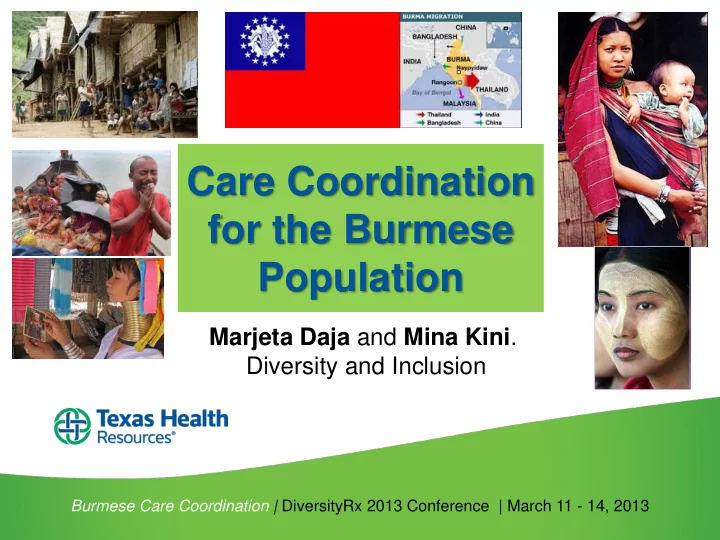
Care Coordination for the Burmese Population Marjeta Daja and Mina - - PowerPoint PPT Presentation
Care Coordination for the Burmese Population Marjeta Daja and Mina Kini . Diversity and Inclusion Burmese Care Coordination | DiversityRx 2013 Conference | March 11 - 14, 2013 Discussion Focus: Project Texas Health Description
Burmese Care Coordination | DiversityRx 2013 Conference | March 11 - 14, 2013
Marjeta Daja and Mina Kini. Diversity and Inclusion
Resources as the system of care
Values
Community in Dallas
Organizational Context
Objectives and Outcomes
Care for Burmese Patients
Project Description
Advancing the Strategy
Outcomes
Today’s Journey – 30 minutes
1000 2000 3000 4000 5000 6000 7000 2007 2008 2009 2010 2011 2012 TOTAL Series1 668 854 1,541 1,373 1,140 1,153 6729
Burmese Arrival Data/ Dallas Fort Worth Areas
Burma is located in South-East ASIA
USA
REFUGEES - Different ethnicities: language, culture, experiences
Kachin Chin Karen Mon Kayah
Started with Language Issues
interpreter
dialect
seek understanding
Other Related Issues
Understanding the Western Medicine model and care expectations
processes
Barriers to Care
Image Source: Texas Health Resources 2012 Multicultural Calendar
Resources as the system of care
Values
Community in Dallas
Organizational Context
Objectives and Outcomes
Care for Burmese Patients
Project Description
Advancing the Strategy
Outcomes
Today’s Journey – 30 minutes
Project Sponsor : Dale Leach, Mina Kini (THR) EE Leader: Jazz Patterson, Clint Abernathy Nursing: Debra DuBois, Erin Smith, Melissa Morton, Shanna Brown Kendra Henderson, Molly Montgomery, Julie Anderson, Patti Marks, Chris Brooks, Krisi Ingram, Jean Tan, Rosa Belgard, Kelli Raibick, Shawna Gonzalez, Myesha Bryant WHC, ED, L&D, OB/GYN, Post Partum, Nursery/NICU, Pedi Clinic, Education Operations: Teresa Cannon (ITS), Marjeta Daja (THR),John Engelhard (Pastoral Care), Nancy Hetherington (Admissions), Ruby Manuel (Patient Services), Sandra Pinkerton (THRE), Elsa Phelan (Community Health) Community Members: Luke Saw, Wilma Montz, Kari Brasselero, Julie
Access to Care Getting Treatment (In Patient) Discharge & Prevention
Problem Identification Team & Stakeholder Identification Team Charter & Objectives Definition Key Focus Areas
Issues Articulated: Interpretation Needs & Cultural Issues Using Patient/Family Journey Flow: – Clinical, Operations & Community Partners
CAP approaches
Throughput Analysis
Clinical Area Needs MULTIDISCIPLINARY WORK -TEAM
manner
Perot Center
Patient Arrives at the WHC or Physicians Office Patient Calls WHC or Physicians Off. For an Appt. Patient Care Given Patient Returns for F/U Patient Presents at L & D Admitting Patient Registers and is Directed to Location of Delivery Patient Fills Out Consent Forms and Gets Initial Teaching Patient Receives Care from L & D Patient(s) Transported and Admitted to New Area Patient Gets Initial Teaching Patient Receives Care Patient Receives Care Teaching Patient Receives Discharge Teaching Patient Arrives at Emergency Room
Patient Arrives at the WHC or Physicians Office Patient Calls WHC or Physicians
Appt. Staff Gives Literacy Test Staff Informs Depts of Patient Status (L& D, NICU, PP, Gyn, High Risk, Special Care, Newborn) Patient Care Given Patient Tour Scheduled Patient Returns for F/U and goes on Tour Staff Uses Check Sheet to Document Understanding Patient Presents at L & D Admitting Patient Registers and is Directed to Location of Delivery Patient Fills Out Consent Forms and Gets Initial Teaching Patient Receives Care from L & D Patient(s) Transported and Admitted to New Area Patient Gets Initial Teaching Patient Receives Care Patient Receives Care Teaching Patient Receives Discharge Teaching Staff Uses Check Sheet to Document Understanding Patient Arrives at Emergency Room Patient Education Graphics/ Interpretation No Planned Change Department Coordinat. ER Path Only
Interpretation Services Education Graphical & Instruction Tools Community Outreach Care Coordination Team
Top2 Language Line Groups
Minutes WHC – L&D – Newborn Nursery – Post Partum – Pedi Clinic - Pharmacy
Sheets – Bilingual Translated Forms
Cultural Intelligence - For Healthcare Providers to provide Culturally Competent Care
Literacy & Patient Materials
Explanation & Accuracy of Technical
methods of graphical representation
I Speak Card
Partnership with Community Organizations resettling refugees Exploratory Care Models: Care Navigation Partnership for Action Research
Organization
Patient Information Tool – Patient History for WHC
ED and Inpatient documentation of Primary Language and Interpreter needed, can be found in the Professional Exchange Report.
Care Connect Standardization
Translation and Interpreter Services SharePoint Site @ THD
Resources as the system of care
Values
Community in Dallas
Organizational Context
Objectives and Outcomes
Care for Burmese Patients
Project Description
Advancing the Strategy
Outcomes
Today’s Journey – 30 minutes
Patient Tours
Interpretation
Clinical Outcome Interpreting Encounters Cultural & Emerging Needs
Diversity Consultant
Director Diversity and Inclusion Texas Health Resources www.texashealth.org/diversityandinclusion