Carnegie Mellon Univ. Dept. of Computer Science 15-415/615 - DB - - PDF document

carnegie mellon univ dept of computer science 15 415 615
SMART_READER_LITE
LIVE PREVIEW

Carnegie Mellon Univ. Dept. of Computer Science 15-415/615 - DB - - PDF document

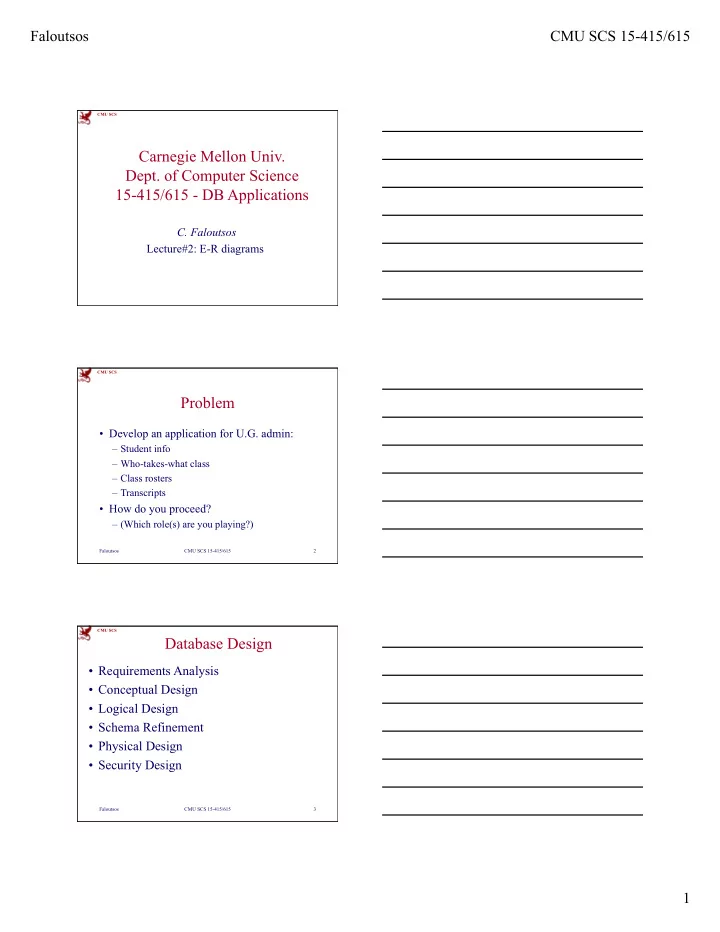
Faloutsos CMU SCS 15-415/615 CMU SCS Carnegie Mellon Univ. Dept. of Computer Science 15-415/615 - DB Applications C. Faloutsos Lecture#2: E-R diagrams CMU SCS Problem Develop an application for U.G. admin: Student info


slide-1
SLIDE 1

Faloutsos CMU SCS 15-415/615 1

CMU SCS

Carnegie Mellon Univ.

  • Dept. of Computer Science

15-415/615 - DB Applications

  • C. Faloutsos

Lecture#2: E-R diagrams

CMU SCS

Problem

  • Develop an application for U.G. admin:

– Student info – Who-takes-what class – Class rosters – Transcripts

  • How do you proceed?

– (Which role(s) are you playing?)

Faloutsos CMU SCS 15-415/615 2

CMU SCS

Faloutsos CMU SCS 15-415/615 3

Database Design

  • Requirements Analysis
  • Conceptual Design
  • Logical Design
  • Schema Refinement
  • Physical Design
  • Security Design
slide-2
SLIDE 2

Faloutsos CMU SCS 15-415/615 2

CMU SCS

Faloutsos CMU SCS 15-415/615 4

Database Design

  • Requirements Analysis
  • Conceptual Design
  • Logical Design
  • Schema Refinement
  • Physical Design
  • Security Design

user’s needs high level (ER) Tables Normalization Indices etc Access controls

CMU SCS

Faloutsos CMU SCS 15-415/615 5

Overview

  • concepts

– Entities – Relationships – Attributes – Specialization/Generalization – Aggregation – ER modeling questions

CMU SCS

Faloutsos CMU SCS 15-415/615 6

Tools

Entities (‘entity sets’) Relationships (‘rel. sets’) and mapping constraints attributes

N M P

slide-3
SLIDE 3

Faloutsos CMU SCS 15-415/615 3

CMU SCS

Faloutsos CMU SCS 15-415/615 7

Example

Students, taking courses, offered by instructors; a course may have multiple sections; one instructor per section nouns -> entity sets verbs -> relationship sets

CMU SCS

Faloutsos CMU SCS 15-415/615 8

STUDENT name ssn ... INSTRUCTOR issn primary key = unique identifier -> underline

CMU SCS

Faloutsos CMU SCS 15-415/615 9

STUDENT name ssn ... COURSE c-id c-name but: sections of course (with different instructors)? INSTRUCTOR issn

slide-4
SLIDE 4

Faloutsos CMU SCS 15-415/615 4

CMU SCS

Faloutsos CMU SCS 15-415/615 10

COURSE c-id INSTRUCTOR issn STUDENT ssn SECTION s-id but: s-id is not unique... (see later)

CMU SCS

Faloutsos CMU SCS 15-415/615 11

COURSE c-id INSTRUCTOR issn STUDENT ssn SECTION s-id Q: how to record that students take courses?

CMU SCS

Faloutsos CMU SCS 15-415/615 12

COURSE c-id INSTRUCTOR issn STUDENT ssn SECTION s-id takes N M

slide-5
SLIDE 5

Faloutsos CMU SCS 15-415/615 5

CMU SCS

Faloutsos CMU SCS 15-415/615 13

COURSE c-id INSTRUCTOR STUDENT SECTION s-id takes N M N 1 teaches

CMU SCS

Faloutsos CMU SCS 15-415/615 14

COURSE c-id INSTRUCTOR STUDENT SECTION s-id takes N M N 1 teaches has N 1

CMU SCS

Faloutsos CMU SCS 15-415/615 15

Cardinalities

  • 1 to 1 (example?)
  • 1 to N
  • N to M

1 1 1 N N M

slide-6
SLIDE 6

Faloutsos CMU SCS 15-415/615 6

CMU SCS

Faloutsos CMU SCS 15-415/615 16

Cardinalities

1 1 1 N N M

COUNTRY

CAPITAL PERSON STUDENT SECTION has CAR

  • wns

takes

CMU SCS

Faloutsos CMU SCS 15-415/615 17

Cardinalities

PERSON STUDENT SECTION CAR

  • wns

takes

Book’s notation:

COUNTRY

has CAPITAL

CMU SCS

Faloutsos CMU SCS 15-415/615 18

Cardinalities

1 1 1 N N M PERSON STUDENT SECTION CAR

  • wns

takes

Book’s notation vs 1 to N notation

CAPITAL

COUNTRY

has

slide-7
SLIDE 7

Faloutsos CMU SCS 15-415/615 7

CMU SCS

Faloutsos CMU SCS 15-415/615 19

‘Total/partial’ participation

1:1 1:1 ?:1 ?:N ?:N ?:M PERSON STUDENT SECTION CAR

  • wns

takes total, total ?? ??

COUNTRY

has CAPITAL

CMU SCS

Faloutsos CMU SCS 15-415/615 20

‘Total/partial’ participation

1:1 1:1 1:1 0:N ?:N ?:M PERSON STUDENT SECTION CAR

  • wns

takes total, total ?? partial, total

COUNTRY

has CAPITAL

CMU SCS

Faloutsos CMU SCS 15-415/615 21

‘Total/partial’ participation

1:1 1:1 1:1 0:N 1:N 0:M PERSON STUDENT SECTION CAR

  • wns

takes total, total partial, total partial, total

COUNTRY

has CAPITAL

slide-8
SLIDE 8

Faloutsos CMU SCS 15-415/615 8

CMU SCS

Faloutsos CMU SCS 15-415/615 22

Weak entities

  • ‘section’ has no unique-id of its own!(?)

COURSE c-id SECTION s-id has N 1

CMU SCS

Faloutsos CMU SCS 15-415/615 23

Weak entities

  • ‘weak’ entities: if they need to borrow a unique id

from a ‘strong entity - thick box.

  • ‘c-id’ + ‘s-id’: unique id for SECTION
  • partial key (eg., ‘s-id’) - dashed-underline
  • identifying relationship (eg., ‘has’)

COURSE c-id SECTION s-id has N 1

CMU SCS

Faloutsos CMU SCS 15-415/615 24

More details

  • self-relationships - example?
slide-9
SLIDE 9

Faloutsos CMU SCS 15-415/615 9

CMU SCS

Faloutsos CMU SCS 15-415/615 25

More details

  • self-relationships - example?

EMPLOYEE manages 1 N

CMU SCS

Faloutsos CMU SCS 15-415/615 26

More details

  • 3-way and k-way relationships?

CMU SCS

Faloutsos CMU SCS 15-415/615 27

More details

  • 3-way and k-way relationships? Rare, but

possible:

EMPLOYEE uses PROJECT TOOL N M P

slide-10
SLIDE 10

Faloutsos CMU SCS 15-415/615 10

CMU SCS

Faloutsos CMU SCS 15-415/615 28

Overview

  • concepts

– Entities – Relationships – Attributes – Specialization/Generalization – Aggregation – ER modeling questions

CMU SCS

Faloutsos CMU SCS 15-415/615 29

More details - attributes

  • key (or primary key): unique identifier
  • underlined, in the ER diagram
  • [not in textbook - FYI:

– multivalued or set-valued attributes (eg., ‘dependents’ for EMPLOYEE) – derived attributes (eg., 15% tip) ]

CMU SCS

Faloutsos CMU SCS 15-415/615 30

Overview

  • concepts

– Entities – Relationships – Attributes – Specialization/Generalization – Aggregation – ER modeling questions

slide-11
SLIDE 11

Faloutsos CMU SCS 15-415/615 11

CMU SCS

Faloutsos CMU SCS 15-415/615 31

Specialization

  • eg., students: part

time (#credit- hours) and full time (major)

STUDENT name ssn PT-STUDENT #credits FT-STUDENT major IS-A

CMU SCS

Faloutsos CMU SCS 15-415/615 32

Observations

  • Generalization: exact reverse of

‘specialization’

  • attribute inheritance
  • could have many levels of an IS-A

hierarchy

CMU SCS

Faloutsos CMU SCS 15-415/615 33

More details

  • Overlap constraints
  • Covering constraints

A B C

slide-12
SLIDE 12

Faloutsos CMU SCS 15-415/615 12

CMU SCS

Faloutsos CMU SCS 15-415/615 34

More details

  • Overlap constraints

– can an entity belong to both ‘B’ and ‘C’?

  • Covering constraints

– can an ‘A’ entity belong to neither ‘B’ nor ‘C’?

A B C

CMU SCS

Faloutsos CMU SCS 15-415/615 35

More details

  • Overlap constraints -

examples?

A B C

CMU SCS

Faloutsos CMU SCS 15-415/615 36

More details

  • Covering constraints -

examples?

A B C

slide-13
SLIDE 13

Faloutsos CMU SCS 15-415/615 13

CMU SCS

Faloutsos CMU SCS 15-415/615 37

Overview

  • concepts

– Entities – Relationships – Attributes – Specialization/Generalization – Aggregation – ER modeling questions

CMU SCS

Faloutsos CMU SCS 15-415/615 38

Aggregation

CPU HD

  • computer model (w/ CPU and HD)
  • and Maker (eg., Dell, HP)

N M MAKER ?

CMU SCS

Faloutsos CMU SCS 15-415/615 39

Aggregation

  • treat a relationship as an entity
  • used to express a relationship among

relationships

CPU HD N M MAKER

slide-14
SLIDE 14

Faloutsos CMU SCS 15-415/615 14

CMU SCS

Faloutsos CMU SCS 15-415/615 40

Overview

  • concepts

– Entities – Relationships – Attributes – Specialization/Generalization – Aggregation – ER modeling questions

CMU SCS

Faloutsos CMU SCS 15-415/615 41

Conceptual design

  • Entity vs attribute
  • Entity vs relationship
  • Binary or ternary relationships?
  • Aggregation?

CMU SCS

Faloutsos CMU SCS 15-415/615 42

Entity vs. attribute

  • Entity EMPLOYEE (w/ emp#, name,

job_code, ...)

  • Q: How about ‘spouse’ - entity or attribute?
  • Q: How about ‘dependents’?
slide-15
SLIDE 15

Faloutsos CMU SCS 15-415/615 15

CMU SCS

Faloutsos CMU SCS 15-415/615 43

Entity vs. attribute

  • Entity EMPLOYEE (w/ emp#, name,

job_code, ...)

  • Q: How about ‘spouse’ - entity or attribute?
  • A: probably, ‘attribute’ is enough
  • Q: How about ‘dependents’?
  • A: Entity - we may have many dependents

CMU SCS

Faloutsos CMU SCS 15-415/615 44

Entity vs. Relationship

STUDENT SECTION takes N M STUDENT SECTION TAKES 1 N 1 N OR

CMU SCS

Faloutsos CMU SCS 15-415/615 45

Binary vs Ternary Relationships

  • usually, binary relationships are ‘cleaner’:
slide-16
SLIDE 16

Faloutsos CMU SCS 15-415/615 16

CMU SCS

Faloutsos CMU SCS 15-415/615 46

Binary vs. Ternary Relationships

If each policy is

  • wned by just 1

employee:

Policies policyid cost age pname Dependents Covers name Employees ssn lot

CMU SCS

Faloutsos CMU SCS 15-415/615 47

Binary vs. Ternary Relationships

If each policy is

  • wned by just 1

employee:

Bad design

Policies policyid cost age pname Dependents Covers name Employees ssn lot

CMU SCS

Faloutsos CMU SCS 15-415/615 48

Binary vs. Ternary Relationships

If each policy is

  • wned by just 1

employee:

Bad design

Policies policyid cost age pname Dependents Covers name Employees ssn lot

Key constraint on

Policies would mean policy can only cover 1 dependent!

slide-17
SLIDE 17

Faloutsos CMU SCS 15-415/615 17

CMU SCS

Faloutsos CMU SCS 15-415/615 49

Binary vs. Ternary Relationships

If each policy is

  • wned by just 1

employee:

Bad design

Beneficiary age pname Dependents policyid cost Policies Purchaser name Employees ssn lot

Better design What are the additional constraints in the 2nd diagram?

Policies policyid cost age pname Dependents Covers name Employees ssn lot

Key constraint on

Policies would mean policy can only cover 1 dependent!

CMU SCS

Faloutsos CMU SCS 15-415/615 50

Binary vs Ternary Rel.

  • But sometimes ternary rel. can not be

replaced by a set of binary rel’s:

CMU SCS

Faloutsos CMU SCS 15-415/615 51

Binary vs. Ternary Relationships (Contd.)

Suppliers qty Departments Contract Parts Suppliers Departments deals-with Parts can-supply

VS. why is it bad?

slide-18
SLIDE 18

Faloutsos CMU SCS 15-415/615 18

CMU SCS

Faloutsos CMU SCS 15-415/615 52

Binary vs. Ternary Relationships (Contd.)

– S “can-supply” P, D “needs” P, and D “deals-with” S does not imply that D has agreed to buy P from S. – How do we record qty?

Suppliers qty Departments Contract Parts Suppliers Departments deals-with Parts can-supply

VS.

CMU SCS

Faloutsos CMU SCS 15-415/615 53

Binary vs. Ternary Relationships (Contd.)

Suppliers qty Departments Contract Parts Suppliers qty Departments Contract Parts

Not in textbook: in practice, often:

CMU SCS

Faloutsos CMU SCS 15-415/615 54

Binary vs. Ternary Relationships (Contd.)

Suppliers qty Departments Contract Parts c-id

Not in textbook: in practice, often:

slide-19
SLIDE 19

Faloutsos CMU SCS 15-415/615 19

CMU SCS

Faloutsos CMU SCS 15-415/615 55

Binary vs. Ternary Relationships (Contd.)

Suppliers qty Departments Contract Parts c-id

Not in textbook: in practice, often: N M 1 N 1 N

CMU SCS

Faloutsos CMU SCS 15-415/615 56

Ternary vs. aggregation

  • use aggregation, if we want to attach a

relationship to a relationship

  • (see book for example)
  • (in practice, again we create a unique-id and

resort to binary relationships)

CMU SCS

Ternary vs. aggregation

  • How would you handle this case?

Faloutsos CMU SCS 15-415/615 57

CPU HD N M MAKER

slide-20
SLIDE 20

Faloutsos CMU SCS 15-415/615 20

CMU SCS

Ternary vs. aggregation

  • How would you handle this case?

Faloutsos CMU SCS 15-415/615 58

CPU HD MAKER

  • COMP. MODEL

CMU SCS

Ternary vs. aggregation

  • How would you handle this case?

Faloutsos CMU SCS 15-415/615 59

CPU HD ? ? MAKER

  • COMP. MODEL

? ?

CMU SCS

Ternary vs. aggregation

  • How would you handle this case?

Faloutsos CMU SCS 15-415/615 60

CPU HD N M MAKER

  • COMP. MODEL

N M HAS_CPU

slide-21
SLIDE 21

Faloutsos CMU SCS 15-415/615 21

CMU SCS

Faloutsos CMU SCS 15-415/615 61

Summary

  • E-R Diagrams: a powerful, user-friendly

tool for data modeling:

– Entities (strong, weak) – Attributes (primary keys, discriminators, derived, multivalued) – Relationships (1:1, 1:N, N:M; multi-way) – Generalization/Specialization; Aggregation

CMU SCS

Faloutsos CMU SCS 15-415/615 62

Summary

  • E-R Diagrams: a powerful, user-friendly

tool for data modeling:

– Entities (strong, weak) – Attributes (primary keys, discriminators, derived, multivalued) – Relationships (1:1, 1:N, N:M; multi-way) – Generalization/Specialization; Aggregation

POPULAR

CMU SCS

Faloutsos CMU SCS 15-415/615 63

Summary - cont’d

(strong) entity set weak entity set relationship set identifying rel. set for weak entity attribute primary key A partial key A

slide-22
SLIDE 22

Faloutsos CMU SCS 15-415/615 22

CMU SCS

Faloutsos CMU SCS 15-415/615 64

Summary - cont’d

cardinalities N M cardinalities with limits l:h l’:h’ cardinalities partial/total (not in textbook - FYI)

CMU SCS

Faloutsos CMU SCS 15-415/615 65

Summary - cont’d

IS-A aggregation