Case Presentation Case Presentation 79 year old gentleman underwent - - PDF document

case presentation case presentation
SMART_READER_LITE
LIVE PREVIEW

Case Presentation Case Presentation 79 year old gentleman underwent - - PDF document

Case Presentation Case Presentation 79 year old gentleman underwent CABG 10 years ago: SVG to the LAD, SVG to the obtuse Coronary Artery Disease Coronary Artery Disease marginal branch, and SVG to the ramus intermedius vessel John A Larry


slide-1
SLIDE 1

1

Coronary Artery Disease Coronary Artery Disease

John A Larry MD John A. Larry, MD

Associate Professor, Clinical Internal Medicine Director of Cardiac Rehabilitation Section Chief, OSU East Cardiovascular Medicine The Ohio State University

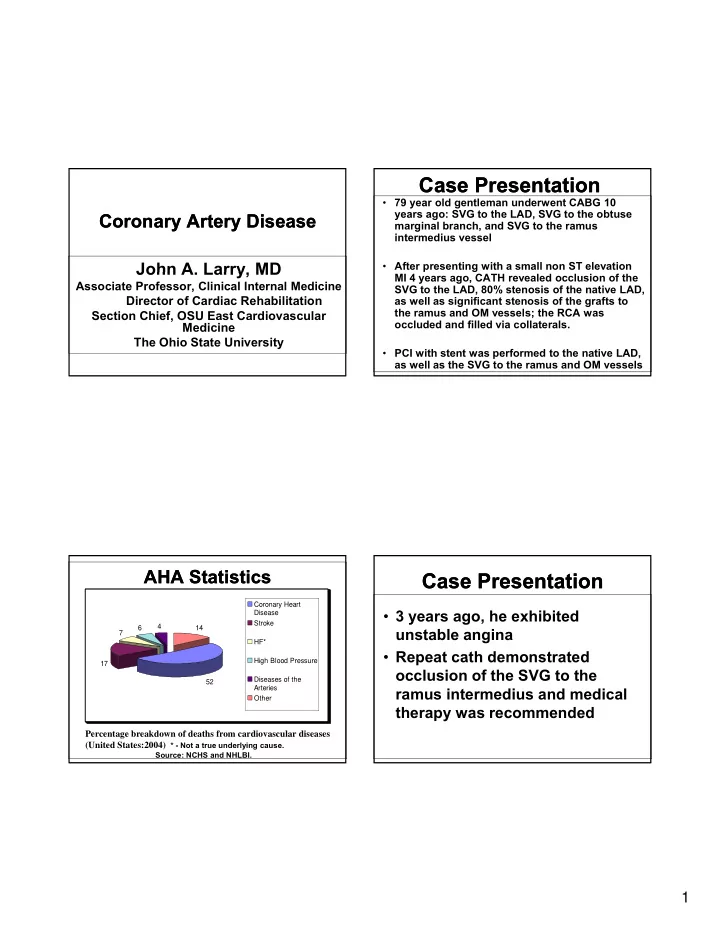
7 6 4 14 Coronary Heart Disease Stroke HF* Hi h Bl d P

AHA Statistics AHA Statistics

Percentage breakdown of deaths from cardiovascular diseases (United States:2004) * - Not a true underlying cause.

Source: NCHS and NHLBI.

52 17 High Blood Pressure Diseases of the Arteries Other

Case Presentation Case Presentation

  • 79 year old gentleman underwent CABG 10

years ago: SVG to the LAD, SVG to the obtuse marginal branch, and SVG to the ramus intermedius vessel

  • After presenting with a small non ST elevation

MI 4 years ago, CATH revealed occlusion of the SVG to the LAD, 80% stenosis of the native LAD, as well as significant stenosis of the grafts to the ramus and OM vessels; the RCA was

  • ccluded and filled via collaterals.
  • PCI with stent was performed to the native LAD,

as well as the SVG to the ramus and OM vessels

Case Presentation Case Presentation

  • 3 years ago, he exhibited

unstable angina

  • Repeat cath demonstrated

Repeat cath demonstrated

  • cclusion of the SVG to the

ramus intermedius and medical therapy was recommended

slide-2
SLIDE 2

2

Case Presentation Case Presentation

  • He had been doing well, exercising at a

very modest pace 3x a week.

  • 4-5 days prior to office visit, he noted

substernal chest tightness without exertional provocation radiation or exertional provocation, radiation, or associated symptoms, lasting 5-10 minutes, resolved with a single NTG on 2

  • ccasions. Since that time, he walked

some, up to 10 minutes at a slow pace without symptoms, and he has exhibited no recurrent chest pain.

Case Presentation Case Presentation

  • Current medications include

– ASA – Clopidogrel 75 mg daily – Metoprolol XL 25 mg daily – Isosorbide120 mg daily – Simvastatin 80 mg daily – Lisinopril 10 mg daily – SL NTG

Case Presentation Case Presentation

  • Exam

– Pulse 56, BP 138/60 right, 134/60 left,

  • resp. rate 16

– JVP is normal. No carotid bruits are present present – Lungs are clear to auscultation and percussion – PMI is nondisplaced. S1 and S2 are

  • normal. A grade 1 systolic ejection

murmur is noted. No gallops or rubs present

Case Presentation Case Presentation

  • Exam

– Abdomen is soft and nontender, with no organomegaly, aneurysm or bruits – Extremities free of edema, distal l l bl pulses are palpable.

slide-3
SLIDE 3

3 Diagnostic studies for evaluation of ischemic heart disease Diagnostic studies for evaluation of ischemic heart disease

  • Stress EKG
  • Stress ECHO (treadmill or

pharmacologic) St l (t d ill

  • Stress nuclear (treadmill or

pharmacologic)

  • Adenosine/dobutamine MRI
  • Coronary CT angiography
  • Cardiac catheterization with coronary

angiography

100 – 80 –

ty of CAD (%) (+) ST

tic, no risk factors mptomatic, HBP, ↑ chol, D.M. 55 y/o M, typical chest pain

Use of Baves theorem to calculate the probability of coronary artery disease Use of Baves theorem to calculate the probability of coronary artery disease

60 – 40 – 20 – 0 – 20 40 60 80 100

Post-test Probabilit Pre-test (Clinical) Probability of CAD (%) (+) ST (-) ST

JACC 1989; 13: 1653

45 y/o M, asymptomat 45 y/o M, asy

(-) Exercise ECG (+) Exercise ECG

Prognostic Information in Exercise Treadmill Testing Prognostic Information in Exercise Treadmill Testing

  • Abnormal BP response
  • Abnormal Chronotropic Response
  • Impairment in Heart Rate Recovery

E i D ti

  • Exercise Duration
  • Magnitude and Duration of ST Segment

Depression

  • Duke Treadmill Score (Mark, et al Annals Int Med 1987)

Exercise time on Bruce protocol (mins)- 5x maximum ST depression (mm) -4x anginal index (0-no angina, 1 mild angina, 2-limiting angina)

slide-4
SLIDE 4

4 Prognostic Data in Stress Testing Prognostic Data in Stress Testing

  • Circulation. 1998;98:1622-1630

High Risk Features in Stress/Dobutamine Echo High Risk Features in Stress/Dobutamine Echo

  • New or worsening wall motion

abnormalities in multiple coronary territories territories

  • Peak wall motion score index >1.7
  • Drop in LVEF

Adverse Prognostic Features in Treadmill/Pharmacologic Nuclear Imaging Adverse Prognostic Features in Treadmill/Pharmacologic Nuclear Imaging

  • Multiple reversible perfusion defects in 2
  • r more coronary territories
  • Quantitatively large myocardial perfusion

defects

  • Transient ischemic dilation of the LV
  • Lung uptake

Case Presentation Case Presentation

  • Pharmacologic nuclear study
  • rdered

– His typical walking speed limited – HR independent study – Both issues raised concern a treadmill study would not be adequate

slide-5
SLIDE 5

5

Case Presentation Case Presentation

  • Pharmacologic nuclear study ordered

– Previous revascularization – By appropriateness criteria published by the ACC/AHA imaging study by the ACC/AHA, imaging study considered appropriate – As an aside, pharmacologic nuclear study is preferred in patients with LBBB or ventricular paced rhythm

Case Presentation Case Presentation

Pharmacologic nuclear study findings: Large, moderate to severe reversible perfusion defect in the inferoapical, entire lateral/inferolateral and basal and mid anterior/anterolateral walls, concerning for ischemia concerning for ischemia. No scintigraphic evidence of prior injury. He was referred for left heart catheterization with coronary and graft angiography.

Coronary Artery Disease Coronary Artery Disease

Richard J. Gumina, MD, PhD

Associate Professor, Cardiovascular Medicine Director, Interventional Cardiovascular Research The Ohio State University

Coronary Angiogram Video 1 Coronary Angiogram Video 1

slide-6
SLIDE 6

6

Coronary Angiogram Video 2 Coronary Angiogram Video 2 Coronary Angiogram Video 3 Coronary Angiogram Video 3 Revascularization Options Revascularization Options

  • Indications for PCI
  • Indications for Coronary Artery
  • Indications for Coronary Artery

Bypass Graft Surgery

  • Hybrid Revascularization Trial

ACCF/SCAI/STS/AATS/AHA/ASNC 2009 Appropriateness Criteria for Coronary Revascularization A Report by the American College of Cardiology Foundation Appropriateness Criteria Task Force, Society for Cardiovascular Angiography and Interventions, Society of Thoracic Surgeons, American Association for Thoracic Surgery, American Heart Association, and the American Society of Nuclear Cardiology Endorsed by the American Society of Echocardiography, the Heart Failure Society of America, and the Society of Cardiovascular Computed Tomography

Revascularization Options

Appropriateness Criteria

Revascularization Options

Appropriateness Criteria

February 2009 180 clinical scenarios Appropriateness of revascularization and appropriateness of PCI or CABG individually as the primary mode of revascularization

Patel, M. R. et al. J Am Coll Cardiol 2009;53:530-553

Manesh R. Patel, MD, Chair, Coronary Revascularization Writing Group, Gregory J. Dehmer, MD, FACC, FACP, FSCAI, FAHA, Coronary Revascularization Writing Group, John W. Hirshfeld, MD, Coronary Revascularization Writing Group , Peter K. Smith, MD, FACC, Coronary Revascularization Writing Group and John A. Spertus, MD, MPH, FACC, Coronary Revascularization

slide-7
SLIDE 7

7

Appropriateness Criteria: Low-Risk Appropriateness Criteria: Low-Risk

  • Low-risk treadmill score (≥ 5)
  • Normal or small myocardial perfusion

defect at rest or with stress defect at rest or with stress

  • Normal stress echocardiographic wall

motion or no change of limited resting wall motion abnormalities during stress

Appropriateness Criteria: Intermediate Risk Appropriateness Criteria: Intermediate Risk

  • Mild/moderate resting left ventricular

dysfunction (LVEF 35-49%)

  • Intermediate-risk treadmill score (-11 to +5)
  • Stress induced moderate perfusion defect
  • Stress-induced moderate perfusion defect

without LV dilation or increased lung uptake (thallium-201)

  • Limited stress echocardiographic ischemia

with a wall motion abnormality only at higher doses of dobutamine involving ≤ 2 segments

Appropriateness Criteria: High Risk Appropriateness Criteria: High Risk

  • Severe resting left ventricular dysfunction

(LVEF < 35%)

  • High-risk treadmill score (≤ or equal to 11)
  • Severe exercise left ventricular

dysfunction (exercise LVEF < 35%)

  • Stress-induced multiple perfusion defect

(particularly if anterior)

  • Stress-induced multiple perfusion defects
  • f moderate size

Appropriateness Criteria: High Risk Appropriateness Criteria: High Risk

  • Large, fixed perfusion defect with LV

dilation or increased lung uptake (thallium-201)

  • Echocardiographic wall motion

abnormality involving > 2segments developing with low dose dobutamine or at low heart rate (< 120)

  • Stress echocardiographic evidence of

extensive ischemia

slide-8
SLIDE 8

8

Appropriateness Ratings by Risk Findings

  • n Noninvasive Imaging Study and

Symptoms Appropriateness Ratings by Risk Findings

  • n Noninvasive Imaging Study and

Symptoms Symptoms

Asymptomatic to CCS Class IV

Medical therapy

Minimal to maximal

Cornary anatomy

Chronic total occlusion 1 vessel 1-2 Vessel without Proximal LAD 1 Vessel disease 2 Vessel Disease 3 Vessel Disease

2-vessel CAD with proximal LAD stenosis 3-vessel CAD Isolated Left Main Disease Left Main disease and additional CAD CABG No diabetes Normal LVEF A A A A

Method of Revascularization of Advanced Method of Revascularization of Advanced Coronary Artery Disease Coronary Artery Disease

Modified from Patel, M. R. et al. J Am Coll Cardiol 2009;53:530-553

Diabetes A A A A Depressed LVEF A A A A PCI No diabetes Normal LVEF A U I I Diabetes A U I I Depressed LVEF A U I I

CABG indicates coronary artery bypass grafting; LAD, left anterior descending artery; LVEF, left ventricular ejection fraction; and PCI, percutaneous coronary intervention

2-vessel CAD with proximal LAD stenosis 3-vessel CAD Isolated Left Main Disease Left Main disease and additional CAD CABG No diabetes Normal LVEF A A A A

Syntax

Method of Revascularization of Advanced Method of Revascularization of Advanced Coronary Artery Disease Coronary Artery Disease

Modified from Patel, M. R. et al. J Am Coll Cardiol 2009;53:530-553

Diabetes A A A A Depressed LVEF A A A A PCI No diabetes Normal LVEF A U I I Diabetes A U I I Depressed LVEF A U I I

Syntax

CABG indicates coronary artery bypass grafting; LAD, left anterior descending artery; LVEF, left ventricular ejection fraction; and PCI, percutaneous coronary intervention

Original Article Percutaneous Coronary Intervention versus Coronary-Artery Bypass Grafting for Severe Coronary Artery Disease

Patrick W. Serruys, M.D., Ph.D., Marie-Claude Morice, M.D., A. Pieter Kappetein, M.D., Ph.D., Antonio Colombo, M.D., David R. Holmes, M.D., Michael J. Mack, M.D., Elisabeth Ståhle, M.D., Ted

  • E. Feldman, M.D., Marcel van den Brand, M.D., Eric J. Bass, B.A., Nic Van Dyck, R.N., Katrin

Leadley, M.D., Keith D. Dawkins, M.D., and Friedrich W. Mohr, M.D., Ph.D. for the SYNTAX Investigators N Engl J Med 2009; 360:961-972. March 5, 2009

  • Goal: To compare the safety and efficacy of CABG v. PCI

Syntax Trial Syntax Trial

with TAXUS DES in patients with 3 vessel disease or left main disease, who were eligible for either procedure.

  • Hypothesis: DES-PCI would be non-inferior to CABG in

the management of patients with 3VD and/or LM.

  • All patients in PCI arm received TAXUS DES.

1800 pts randomised (897 CABG, 903 PCI)

Serruys PW et al. N Engl J Med 2009;360:961-972.

slide-9
SLIDE 9

9

e Rate (%) 20

13.5 17.8 12.4 P=0.002 P=0.99 p<0.001

Rates of Outcomes among the Study Rates of Outcomes among the Study Patients, According to Treatment Patients, According to Treatment Group at 12 months Group at 12 months

Modified from Serruys PW et al. N Engl J Med 2009;360:961-972.

Cumulative 10

Death from Any Cause Death from Any Cause, Stroke, or MI Repeat Revascularization Major Adverse Cardiac or Cerebrovascular Event

4.4 3.5 7.7 7.6 5.9 p=0.37

PCI CABG

Rates of Major Adverse Cardiac or Rates of Major Adverse Cardiac or Cerebrovascular Cerebrovascular Events among the Study Patients, According to Events among the Study Patients, According to Treatment Group and SYNTAX Score Category. Treatment Group and SYNTAX Score Category.

High SYNTAX scores

(≥33, indicating the most complex disease)

(%) 30

p<0.001 23.4 Modified from Serruys PW et al. N Engl J Med 2009;360:961-972.

Cumulative Rate 20 10

10.9

“Redo” CABG Surgery “Redo” CABG Surgery -

  • considerations

considerations

Reoperative coronary artery bypass procedures: risk factors for early mortality and late survival

J.T. Christenson*, M. Schmuziger, F. Simonet The Cardio6ascular Surgery Unit, Hoˆpital de la Tour, 1. a6. J.-D. Maillard, CH-1217 Meyrin-Gene6a, Switzerland E J l f C di th i S 11 (1997) 129 133 European Journal of Cardio-thoracic Surgery 11 (1997) 129–133 REDO CABG (n=594) Primary CABG (n=3148) Risk Factor REDO CABG (n=594) Primary CABG (n=3148)

P Odds P Odds Emergent operation <0.001 2.12 0.001 1.92 Urgent operation 0.008 1.86

  • CCS class 3 and 4

0.005 1.96 0.006 1.67

Independent rick factors for mortality. Multivariate logistic regression analysis

“Redo” CABG Surgery “Redo” CABG Surgery -

  • considerations

considerations

LVEF <40% 0.011 1.62 0.022 1.28 Multifocal vascular disease 0.007 1.77 0.014 1.73 Preoprerative renal insufficiency 0.012 1.48

  • IDDM

0.029 1.12

  • Age >65 years

0.028 1.13 0.011 1.08 Interval from primary CABG >1 year 0.012 1.81 Modified from: European Journal of Cardio-thoracic Surgery 11 (1997) 129–133

slide-10
SLIDE 10

10

Simultaneous Hybrid Revascularization Versus Off-Pump Coronary Artery Bypass for Multivessel Coronary Artery Disease

Hybrid Approach Hybrid Approach

Coronary Artery Disease

Shengshou Hu, MD,* Qi Li, MD,* Peixian Gao, MD,* Hui Xiong, MD, Zhe Zheng, MD, Lihuan Li, MD, Bo Xu, MD, and Runlin Gao, MD Departments of Surgery, Anesthesiology, and Cardiology, and Research Center for Cardiovascular Regenerative Medicine, Ministry of Health of China, Cardiovascular Institute and Fuwai Hospital, Beijing, China

The Annals of Thoracic Surgery Volume 91, Issue 2, February 2011, Pages 432-438

Complication Hybrid (n = 104)

  • No. (%)

OPCAB (n = 104)

  • No. (%)

p Value MACCE 1 (1.0%) 10 (9.6%) 0.03 Death 1 (1.0%) 0.50 Myocardial infarction 1.00

Hybrid Approach Hybrid Approach

Neurologic event 5 (4.8%) 0.07 Repeat revascularization 1 (1.0%) 3 (2.9%) 0.34 Readmittance 9 (8.7%) 26 (25.0%) 0.001 Survival 104 (100%) 103 (99.0%) 0.50

MACCE = major adverse cardiac or cerebrovascular events; OPCAB = off-pump coronary artery bypass grafting. Modified from: The Annals of Thoracic Surgery Volume 91, Issue 2, February 2011, Pages 432-438

  • Underwent Redo-CABG
  • Free RIMA to the left anterior

Our Patient Our Patient

descending artery

Coronary Artery Disease Coronary Artery Disease

John A Larry MD John A. Larry, MD

Associate Professor, Clinical Internal Medicine Director of Cardiac Rehabilitation Section Chief, OSU East Cardiovascular Medicine The Ohio State University

slide-11
SLIDE 11

11

Importance of Dual Antiplatelet Therapy Post Drug Eluting Stent Implantation Importance of Dual Antiplatelet Therapy Post Drug Eluting Stent Implantation

  • AHA/ACC/SCAI/ACS/ADA Science

Advisory 2007

  • Because premature discontinuation of

dual antiplatelet therapy greatly dual antiplatelet therapy greatly increases the risk of stent thrombosis, myocardial infarction, and death

  • Dual antiplatelet therapy should be

continued uninterrupted for one year post implantation of a drug eluting stent

slide-12
SLIDE 12

12

Blood Pressure Control Blood Pressure Control

  • Goal is less than 140/90 or
  • Less than 130/80 in patients with

diabetes or chronic kidney disease y

  • Initially, utilize B-blockers and ACE

inhibitors and add additional therapy as needed

slide-13
SLIDE 13

13

Lipid management goals Lipid management goals

  • Current secondary prevention

recommendations for lipid management recommend:

  • LDL goal < 100, reasonable target of 70

/dL mg/dL

  • Non HDL < 30 points above the LDL target
  • There may be need to consider additional

therapy beyond statin agents to achieve NCEP goals

Circulation 2006;113;2363-2372

OSUMC Comprehensive Lipid Management Clinic OSUMC Comprehensive Lipid Management Clinic

  • Patients that may benefit

Difficulty achieving NCEP lipid goals, intolerance to therapy, low HDL, elevated TG

  • Appointments/Referrals
  • (614) 293-ROSS (7677)
  • Offices located at Ross ACC, OSU

East, Gahanna and Stoneridge (Dublin)

Vaccination Vaccination

  • Patient with CAD should receive

appropriate vaccination for appropriate vaccination for influenza

Smoking Cessation Smoking Cessation

  • Ask about tobacco use status at every visit. I (B)
  • Advise every tobacco user to quit. I (B)
  • Assess the tobacco user’s willingness to quit. I

(B) ( )

  • Assist by counseling and developing a plan for
  • quitting. I (B)
  • Arrange follow-up, referral to special programs,
  • r pharmacotherapy I (B)
  • Urge avoidance of exposure to environmental

tobacco smoke at work and home. I (B)

slide-14
SLIDE 14

14

Cardiac Rehab Programs Cardiac Rehab Programs

  • Indications for Cardiac Rehab

– Angina with documented evidence of myocardial ischemia within 6 mos. – MI within 12 months – PCI within 6 mos. – CABG within 6 mos. – Valve replacement/repair within 6 mos. – Heart transplant within 12 mos

  • OSU Heart Center at Morehouse 293-6937
  • OSU East 257-3974

Effects of Cardiac Rehabilitation Effects of Cardiac Rehabilitation

Outcome Mean 95% conf. intervals p-value

  • Total Mortality* -20% (-7 to -32%) p=.005
  • Cardiac Mortality* -26% (-10 to -29%) p=.002

Nonfatal MI 21% ( 43 to 9%) p= 15

  • Nonfatal MI
  • 21% (-43 to 9%) p=.15
  • CABG
  • 13% (-35 to 16%) p=.4
  • PCI -19% (-51 to 34%) p=.4

Taylor, et al Am J of Medicine 2004; 116:682-97

20 30 g/d Fiber 50%–60% of total calories Carbohydrate (esp. complex carbs) 25%–35% of total calories Total fat Up to 20% of total calories Monounsaturated fat Up to 10% of total calories Polyunsaturated fat <7% of total calories Saturated fat* Recommended Intake Nutrient

ATP III Dietary Recommendations ATP III Dietary Recommendations

*Trans fatty acids also raise LDL-C and should be kept at a low intake Note: Regarding total calories, balance energy intake and expenditure to maintain desirable body weight.

<200 mg/d Cholesterol ~15% of total calories Protein 20–30 g/d Fiber

Expert Panel on Detection, Evaluation, and Treatment of High Blood Cholesterol in Adults. JAMA 2001;285:2486-97 ATP=Adult Treatment Panel

Chest Pain Clinic Chest Pain Clinic

366-1279