case Statement Nesting if past two levels is error prone and - - PowerPoint PPT Presentation

case statement
SMART_READER_LITE
LIVE PREVIEW

case Statement Nesting if past two levels is error prone and - - PowerPoint PPT Presentation

case Statement Nesting if past two levels is error prone and possibly inefficient. case excels when many tests are performed on the same expression. case works well for muxes, decoders, and next state logic. SVerilog case has implied


slide-1
SLIDE 1

case Statement

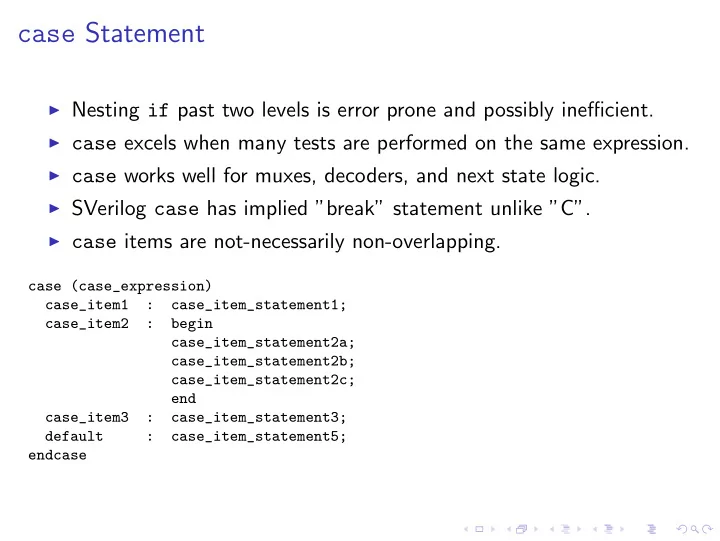
◮ Nesting if past two levels is error prone and possibly inefficient. ◮ case excels when many tests are performed on the same expression. ◮ case works well for muxes, decoders, and next state logic. ◮ SVerilog case has implied ”break” statement unlike ”C”. ◮ case items are not-necessarily non-overlapping. case (case_expression) case_item1 : case_item_statement1; case_item2 : begin case_item_statement2a; case_item_statement2b; case_item_statement2c; end case_item3 : case_item_statement3; default : case_item_statement5; endcase

slide-2
SLIDE 2

case Statement

//8-wide, 4:1 multiplexer module case1 ( input [7:0] a_in, b_in, c_in, d_in, input [1:0] sel,

  • utput logic [7:0] d_out);

always_comb case (sel) 2’b00 : d_out = a_in; 2’b01 : d_out = b_in; 2’b10 : d_out = c_in; 2’b11 : d_out = d_in; endcase endmodule

U34 U32 U30 U28 U26 U24 U22 U36 U29 U27 U25 U23 U39 U41 U38 U40 U42 U37 U35 U33 U31

slide-3
SLIDE 3

case Statement

Is the simulation correct? What do we do with the ”X”?

//8-wide, 4:1 multiplexer module case1 ( input [7:0] a_in, b_in, c_in, d_in, input [1:0] sel,

  • utput logic [7:0] d_out);

always_comb case (sel) 2’b00 : d_out = a_in; 2’b01 : d_out = b_in; 2’b10 : d_out = c_in; 2’b11 : d_out = d_in; endcase endmodule 10 20 30 40 1 2 3 X 10 20 30 40 /case1/a_in 10 /case1/b_in 20 /case1/c_in 30 /case1/d_in 40 /case1/sel 0 1 2 3 X /case1/d_out 10 20 30 40

slide-4
SLIDE 4

case Statement

We can use a default to propagate the ”X”. What does this do for us?

module case1 ( input [7:0] a_in, b_in, c_in, d_in, input [1:0] sel,

  • utput logic [7:0] d_out);

always_comb case (sel) 2’b00 : d_out = a_in; 2’b01 : d_out = b_in; 2’b10 : d_out = c_in; 2’b11 : d_out = d_in; default : d_out = 8’bx; endcase endmodule 10 20 30 40 1 2 3 X 10 20 30 40 xx /case1/a_in 10 /case1/b_in 20 /case1/c_in 30 /case1/d_in 40 /case1/sel 0 1 2 3 X /case1/d_out 10 20 30 40 xx

slide-5
SLIDE 5

case Statement - Incomplete case

//incomplete case, 8-wide, 3:1 mux module case2 ( input [7:0] a_in, b_in, c_in, input [1:0] sel,

  • utput logic [7:0] d_out);

always_comb case (sel) 2’b00 : d_out = a_in; 2’b01 : d_out = b_in; 2’b10 : d_out = c_in; endcase endmodule

U19 U20 U21 U17 U22 U15 U18 U23 ...g[5] ...g[0] U25 ...g[4] U27 ...g[3] U16 U24 ...g[7] ...g[2] U26 ...g[6] ...g[1]

Inferred memory devices in process in routine case2 line 6 in file ’case2.sv’. =========================================================================== | Register Name | Type | Width | Bus | MB | AR | AS | SR | SS | ST | =========================================================================== | d_out_reg | Latch | 8 | Y | N | N | N | - | - | - | =========================================================================== Warning: Netlist for always_comb block contains a latch. (ELAB-974) Presto compilation completed successfully.

slide-6
SLIDE 6

case Statement

//incomplete case statement //with default case_item module case2 ( input [7:0] a_in, b_in, c_in, input [1:0] sel,

  • utput logic [7:0] d_out);

always_comb case (sel) 2’b00 : d_out = a_in; 2’b01 : d_out = b_in; 2’b10 : d_out = c_in; default : d_out = 8’bx; endcase endmodule

U15 U11 U16 U12 U13 U14 U17 U10 U18 a_in[2] c_in[6] a_in[1] a_in[0] c_in[7] n3 b_in[3] b_in[4] b_in[2] b_in[5] b_in[1] b_in[6] sel[0] b_in[0] b_in[7] sel[1] a_in[7] c_in[0] c_in[1] a_in[6] c_in[2] a_in[5] c_in[3] a_in[4] c_in[4] a_in[3] c_in[5] c_in[7:0] d_out[7:0] b_in[7:0] sel[1:0] a_in[7:0] c_in[7:0] sel[1:0] a_in[7:0] b_in[7:0] d_out[7:0]

Does RTL and gate simulation differ when sel = 2’b11? What does synthesis do with the 8’bx?

slide-7
SLIDE 7

case Statement - unique and priority to the Rescue

◮ SystemVerilog introduced two case and if statement modifiers

◮ priority ◮ unique

◮ Both give information to synthesis to aid optimization. ◮ Both are assertions (simulation error reporting mechanisms) ◮ Both imply that there is a case item for all the possible legal values

that case expression might assume.

slide-8
SLIDE 8

case Statement - unique and priority

Unique Case

◮ Unique is an assertion which implies:

◮ All possible values of case expression are in the case items ◮ At simulation run time, a match must be found in case items ◮ At run time, only one match will be found in case items

◮ Unique guides synthesis

◮ It indicates that no priority logic is necessary ◮ This produces parallel decoding which may be smaller/faster

◮ Unique usage

◮ Use when each case item is unique and only one match should

  • ccur.

◮ Using a ”default” case item removes the testing for non-existent

matches, but the uniqueness test remains.

slide-9
SLIDE 9

case Statement - unique and priority

Priority Case

◮ Priority is an assertion which implies:

◮ All possible values for case expression are in case items

◮ Priority guides synthesis

◮ It indicates that all other testable conditions are don’t cares and may

be used to simplify logic

◮ This produces logic which is possibly smaller/faster

◮ Priority usage

◮ Use to explicitly say that priority is important even though the Verilog

case statement is a priority statement.

◮ Using a ”default” case item will cause priority requirement to be

dropped since all cases are available to be matched.

◮ Use of a ”default” also indicates that more than one match in

case item is OK.

◮ Priority is a bad name. Case is already a priority structure.

slide-10
SLIDE 10

case Statement

//incomplete case statement //with systemverilog priority modifier module case2 ( input [7:0] a_in, b_in, c_in, input [1:0] sel,

  • utput logic [7:0] d_out);

always_comb priority case (sel) 2’b00 : d_out = a_in; 2’b01 : d_out = b_in; 2’b10 : d_out = c_in; endcase endmodule

U17 U11 U12 U14 U13 U15 U16 U10 U18 c_in[2] b_in[1] c_in[3] b_in[0] c_in[4] c_in[5] a_in[7] c_in[6] a_in[6] c_in[7] a_in[5] a_in[4] a_in[3] a_in[2] a_in[1] a_in[0] b_in[4] b_in[5] b_in[6] sel[0] b_in[7] n3 sel[1] c_in[0] b_in[3] c_in[1] b_in[2] a_in[7:0] c_in[7:0] d_out[7:0] b_in[7:0] sel[1:0] b_in[7:0] c_in[7:0] sel[1:0] a_in[7:0] d_out[7:0]

Synthesis reminds us of the implicit claims made by priority:

Warning: case2.sv:7: Case statement marked priority does not cover all possible conditions. (VER-504)

slide-11
SLIDE 11

case Statement

System Verilog priority Modifier

◮ OK, so now what happens now when sel is 2’b11 ? ◮ RTL Simulator issues a run-time warning. ◮ Go back, fix the RTL error that caused the disallowed case to occur. ◮ After fixing, the RTL and gate simulation will match.

slide-12
SLIDE 12

case Statement

//incomplete case priority modifier module case2 ( input [7:0] a_in, b_in, c_in, input [1:0] sel,

  • utput logic [7:0] d_out);

always_comb priority case (sel) 2’b00 : d_out = a_in; 2’b01 : d_out = b_in; 2’b10 : d_out = c_in; endcase endmodule

Simulator issues warning at sel==2’11, and with sel==2’1x

** Warning: (vsim-8315) case2.sv(7): No condition is true in the unique/priority if/case statement. ** Warning: (vsim-8315) case2.sv(7): No condition is true in the unique/priority if/case statement.

slide-13
SLIDE 13

casez Statement

◮ casez is a special version of the case expression ◮ Allows don’t care’s in case expression or case item ◮ casez uses ? or Z as don’t care instead of as a logic value ◮ Recommendation: use ”?” as don’t care, not ”Z”. ◮ For example:

◮ case item 2b1? can match the case expressions:

2b10, 2b11, 2b1x, or 2b1z

◮ casez has overlapping case items. If more than one case item

matches a case expression, the first matching case item has priority.

◮ Use caution when using this statement

slide-14
SLIDE 14

casez Statement

This is a interrupt priority encoder. Simultaneous interrupt requests may be asserted, but returns only the highest priority request.

module priority_encoder_casez ( input [7:0] irq, //interrupt requests

  • utput logic [3:0] highest_pri); //encoded highest pritority interrupt

always_comb begin priority casez (irq) 8’b1??????? : highest_pri = 4’h8; //interrupt 8 8’b?1?????? : highest_pri = 4’h7; //interrupt 7 8’b??1????? : highest_pri = 4’h6; //interrupt 6 8’b???1???? : highest_pri = 4’h5; //interrupt 5 8’b????1??? : highest_pri = 4’h4; //interrupt 4 8’b?????1?? : highest_pri = 4’h3; //interrupt 3 8’b??????1? : highest_pri = 4’h2; //interrupt 2 8’b???????1 : highest_pri = 4’h1; //interrupt 1 default : highest_pri = 4’h0; //no interrupts endcase end endmodule

slide-15
SLIDE 15

casex Statement

◮ One more case expression exists: casex. ◮ Can be useful for testbenches. ◮ Current recommendations are to not use it in synthesizible code.