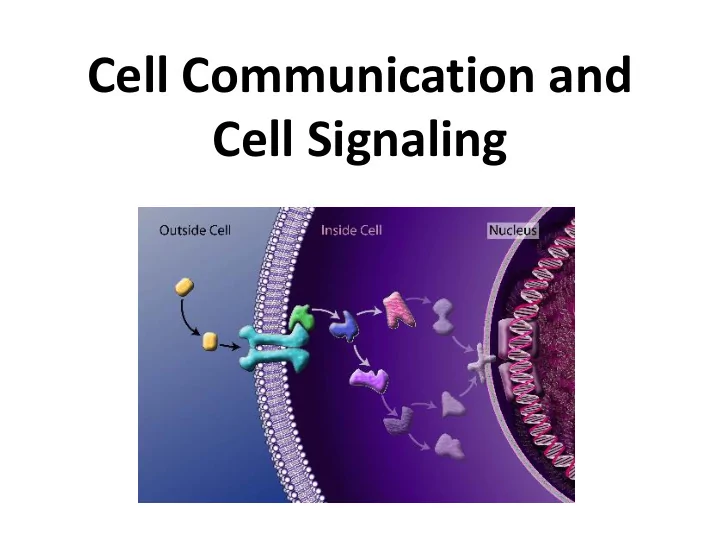
SLIDE 1
Cell Communication and Cell Signaling
SLIDE 2
Why is cell signaling important?
SLIDE 3 Why is cell signaling important?
- Allows cells to communicate and coordinate
functions/activities of the organism
- Usually involves the cell membrane
SLIDE 4 Cell Communication
- Communication involves transduction of
stimulatory or inhibitory signals from other cells, organisms or the environment
- Correct and appropriate signal transduction
pathways are generally under strong selective pressure
SLIDE 5 Single-Celled Organisms
- Signal transduction pathways influence how
the cell responds to its environment
- Example: quorum sensing in bacteria
SLIDE 6 Multicellular Organisms
- Signal transduction pathways coordinate the
activities within individual cells that support the function of the organism as a whole
- Example: Epinephrine stimulation of glycogen
breakdown in mammals
SLIDE 7 Cell Communication
Local Signaling
Long Distance Signaling
Cell Junctions Cell to Cell Contact Local Regulators
Hormones Neural Circuits
SLIDE 8 Local Signaling: Cell Junctions
- Plasmodesmata in plant cells and gap
junctions in animals
- Allows signaling molecules to pass readily
between adjacent cells
SLIDE 9 Local Signaling: Cell-to-Cell Contact
- Communication through direct interaction
between molecules extending from the surface of the cells (glycolipids and glycoproteins)
- Example: tissue development and immune
responses
SLIDE 10 Local Signaling: Local Regulators
- Local regulators are signaling molecules that
- nly target cells in the vicinity of the emitting
cell
- Examples: paracrine signaling and synaptic
signaling
SLIDE 11 Evolution: Paracrine Signaling
- Paracrine factors involved in differential development are
similar between different species
- Evidence of common ancestry, highly conserved in animals
from fruit flies to humans Receptor and Pathway Groups:
- Fibroblast Growth Factor Family (blood vessel, wound
healing, limb development, embryonic development)
- Hedgehog Family (embryonic development, bilateralism)
- Wnt Family (bone, heart, muscle, regeneration of tissue)
- TGF – β Family (immunity, cell proliferation)
SLIDE 12 Long Distance Signaling: Hormones
- Endocrine signals (hormones) produced by
endocrine cells travel long distances through the blood to reach all parts of the body
- Example: Insulin produced in pancreas,
targets liver cells
SLIDE 13 Plants Have Hormones!
- Ethylene – gaseous hormone that ripens fruit
- Auxin – chemical messenger that influences
fruit development and cell growth
SLIDE 14 Long Distance Signaling: Neural Circuits
- Neurons may transmit messages (nerve
impulses) over a long distance
SLIDE 15
Local or Long Distance - Cell Signaling Pathway is Similar Reception Transduction Response
SLIDE 16
Cell Signaling Pathway
SLIDE 17 Stage 1: Signal Reception
- Signaling begins with the recognition of a
chemical messenger (ligand) by a receptor protein
SLIDE 18 Types of Receptor Proteins
- Transmembrane Proteins (within the cell
membrane) – also known as extracellular receptors
- G Protein-Coupled Receptors (GPCRs)
- Ligand-Gated Ion Channels
- Intracellular Receptors (within cytoplasm or
nucleus)
- Targeted by lipid soluble ligands (pass
through the plasma membrane)
SLIDE 19
Transmembrane Protein Receptors: GPCRs
SLIDE 20
SLIDE 21
Transmembrane Protein Receptors: Ligand-Gated Ion Channels
SLIDE 22
SLIDE 23
Intracellular Receptors
SLIDE 24 Receptor Proteins
- Different receptors recognize different
chemical messengers, which can be peptides, small chemicals, or proteins, in a specific one- to-one relationship
- A receptor protein recognizes signal
molecules, causing the receptor protein’s shape to change, which then initiates transduction of the signal
SLIDE 25 Review of Signal Reception
- What occurs during Stage 1: Signal
Reception?
- What is a ligand?
- What is the difference between
transmembrane protein receptors and intracellular receptors?
SLIDE 26 Stage 2: Signal Transduction
- Signal transduction is the process by which a
signal is converted to a cellular response
- One step or a series of many steps
SLIDE 27 Signal Transduction
- Signaling cascades relay signals from
receptors to cell targets, often amplifying the incoming signals
- Second messengers are often essential to the
function of the cascade cyclic AMP (cAMP) or calcium ions (Ca2+)
SLIDE 28 Signaling Cascade
- Protein kinases – turn “on” or activate
proteins by adding phosphates to the proteins (phosphorylation cascade)
- Protein phosphatases – turn “off” or
deactivate proteins and kinases by removing phosphates from the proteins (dephosphorylation)
SLIDE 29
SLIDE 30
Second Messengers
SLIDE 31 Review of Signal Transduction
- What occurs during Stage 2: Signal
Transduction?
- What is the function of a protein kinase?
- What is the function of a protein phosphatase?
- Identify a second messenger.
SLIDE 32 Stage 3: Cellular Response
- The signal transduction pathway initiates a
change in cellular activity
- Response occurs in the cytoplasm or nucleus
SLIDE 33 Response: Regulation of Protein Synthesis
- Most signaling pathways activate transcription
factors
- Transcription factors regulate cellular responses
by:
Protein OR
No protein OR
- Regulating the activity of a particular protein
SLIDE 34 Testosterone Cellular response increases gene activity for proteins involved in:
- Muscle mass
- Bone growth
- Body hair
- Reproductive tissue
SLIDE 35
Blood Glucose Regulation
SLIDE 36
Cell Signaling Summary