
SLIDE 1
Darwin Chen, MD Assistant Professor Mount Sinai Medical Center Department of Orthopaedic Surgery
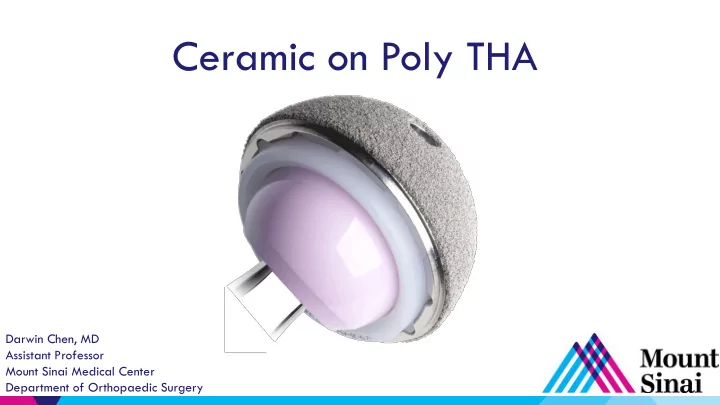
Ceramic on Poly THA Darwin Chen, MD Assistant Professor Mount - - PowerPoint PPT Presentation
Ceramic on Poly THA Darwin Chen, MD Assistant Professor Mount Sinai Medical Center Department of Orthopaedic Surgery Disclosures Monogram Orthopedics Consultant Why Bother With Anything But Ceramic on Poly THA? Ceramic liner fx
Darwin Chen, MD Assistant Professor Mount Sinai Medical Center Department of Orthopaedic Surgery
▶ Monogram Orthopedics
– Consultant
Darwin Chen, MD Assistant Professor Mount Sinai Medical Center Department of Orthopaedic Surgery
Ceramic liner fx Metal-metal failure Dual mobility disassociation Taper corrosion – M on P
▶ The fundamentals have not changed! ▶ Major challenge – implant longevity
– Patients living longer
– Expanding THA indications
Sir John Charnley at his lathe, creating the first THA implants
▶ Minimize wear/biologically active debris ▶ Maximize hip stability ▶ Avoid bearing related complications Pre
Santoro, J
▶ Age? ▶ Activity level?
– Metal on poly – Ceramic on poly – Ceramic on ceramic – Metal on metal – Ceramic on metal
Bedard, Callaghan, JoA 2017
▶ “Threshold” for osteolysis is <0.1mm/yr (~650mm3)
Looney RJ 2002 Dumbelton JH, JoA 2002 Wilkinson JR, JOR 2005 Dowd, JBJS 2000
Berry, 2005
Howie, 2012
At one year following surgery:
28mm 36mm Primary 4.4% 0.8% Revision 12.2% 4.9% Overall 5.4% 1.3%
Garbuz, 2012
▶ Pretty well!
Feb 2013
– CoCr on XLPE, 7-10yr f/u – 28mm wear rate 0.012mm/yr – 32mm wear rate 0.01mm/yr – No osteolysis
▶ Pretty well!
Sept 2016
– CoCr on Longevity XLPE, 28mm and 36mm – Mean wear @ 13 yrs = 0.05mm/yr – No difference between sizes – No osteolysis
▶ Corrosion of CoCr head on Ti stem, ↑ Co/Cr ions ▶ An “emerging” problem with M on P ▶ Multifactorial
– Taper geometry, metallurgy, head size, assembly technique
▶ Can cause mild to severe ALTR
– Late instability, abductor damage, osteolysis
Cooper, 2012
▶ Ceramic head significantly reduces potential for taper corrosion
– Significantly greater metal release (11x increase in Co and 3x increase in Cr) from a CoCr / CoCr interface when compared to a Co-Cr / ceramic interface – Corrosion can still occur
▶ When used with a titanium stem, no source of Co and Cr debris that can
lead to ALTR
Cooper, JBJS(Am) 2013)
▶ Matrix composite ceramic ▶ Zirconia toughened, platelet reinforced,
alumnia ceramic
▶ 82% alumina, 17% zirconia, 0.5%
strontium aluminate, 0.5% chromium oxide
▶ Avoid issues with hard-hard bearings ▶ Properties of ceramics further reduce wear characteristics of
XLPE
▶ Delta ceramics
– 50% stronger than alumina – More abrasion resistant than CoCr – 3x hardness of CoCr – Wettable – Biocompatible
▶ Simulator data shows clear advantage of C-on-P over M-on-P
, 40-50% reduction
Fisher, 2006 Galvin, Proc Inst Mech Eng 2010 Kim, 2005
CoCr Ceramic Total Linear Wear 1.21 mm 0.57mm p = 0.004 Linear Wear Rate 0.17 mm/yr 0.08 mm/yr p = 0.004 Volumetric Wear 744.7 mm3 350.8 mm3 p = 0.004
Bradgon 2006, Greenwald 2006, Manning 2005, Martell 2003, Zichner 1992,1997
▶ Historically, ceramic head fracture was a
significant clinical concern
– Old aluminas were low density, coarse microstructure, not in compliance with today’s specifications
▶ Current alumnia and Delta ceramic substantially
improved mechanical strength
▶ Biolox ceramic head fx rate
– 0.026% 1st gen Alumina – 0.014% 2nd gen Alumina – 0.004% Delta
Willmann, Clin Orthop 2000
▶ Delta head
fractures are negligible with 32/36 heads
Ceramtec, Inc.
▶ In theory, ceramics have less bacterial biofilm formation due to decreased
surface roughness and molecular composition
▶ Reduced wear = reduced bio-burden of PE particles, less inflammation ▶ No Co, Cr ion release – no immune suppression?
March 2017
▶ Medicare database (315,784 patients) ▶ C-P and C-C exhibit lower risk of infection comparted to M-P
(C-P hazard ratio 0.86, p=0.001. C-C hazard ratio 0.74, p=0.01)
▶ C-P reduced risk of dislocation and mortality
(HR 0.81, p<0.001, HR 0.92. p<0.001)
▶ In 2018, ceramic on poly is the best choice for most THAs ▶ Excellent wear properties ▶ Eliminates the metal ion problem ▶ No squeaks, negligible fracture risk ▶ Reduced PJI? ▶ Forgiving, no change in technique
Darwin Chen, MD Assistant Professor Mount Sinai Medical Center Department of Orthopaedic Surgery