SLIDE 1
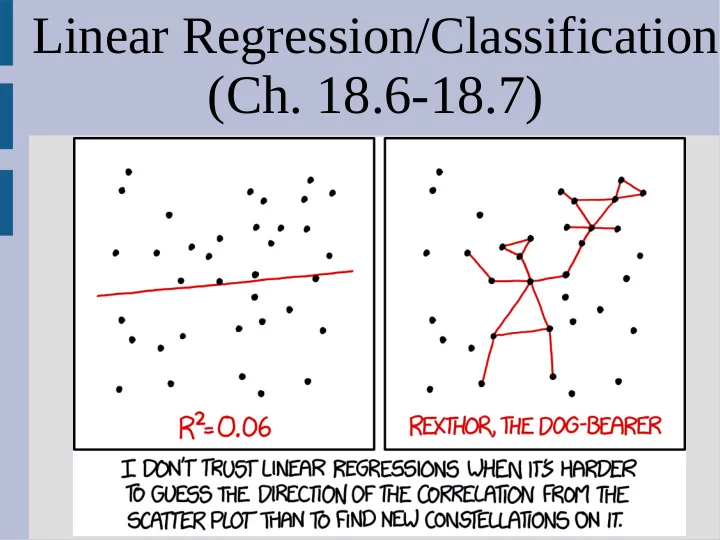
Linear Regression/Classification
(Ch. 18.6-18.7)
SLIDE 2
Announcements
Homework 4 due Sunday Test next Wednesday... covers ch 15-17 (HW 3 & 4)
SLIDE 3 Linear Regression
Let’s move away from decision trees (yay!) and talk about more general learning Today we will look at regression a bit (as I have been ignoring it mostly) This is a concept that you may have encountered before, but not in the context
SLIDE 4
Linear Regression
Idea: You have a bunch of data points, and you want to find the line “closest” to them
SLIDE 5
Linear Regression
Why linear and not some polynomial?
SLIDE 6
Linear Regression
Why linear and not some polynomial? It is a lot harder to “overfit” with a linear fit, yet it still gets the major “trend” of data Also a bit to “visualize” data if high dimension Another bonus is that it makes the calculations much easier (which is always nice...)
SLIDE 7 Linear Regression: How To
To find this line, let’s start with the simple case: only one variable Then our line will look like (call them “h” just like our learning trees): Then we need to define what “fit to data” means (i.e. how do we calculate how “wrong” a line is)
w is {w0, w1} as parameters
SLIDE 8 Linear Regression: How To
There are multiple options, but a common choice is the square difference (called “loss”): ... where N is the number of examples/points This makes sense as it penalizes “wrong” answers more the further they are away (two points off by 1 better than one off by 2)
yj is actual y-coordinate hw(xj) is approximated (line) y-coordinate
SLIDE 9
Linear Regression: How To
You can plot this loss function (z-axis) with respect to the choice of w0 and w1 Regression Loss
SLIDE 10 Linear Regression: How To
We want the regression line (w0, w1) to have the lowest loss possible As the loss function looks convex (it is), the minimum is unique, so from calculus we want:
bottom is when both w0 and w1 derivatives zero
SLIDE 11 Linear Regression: How To
It is not too hard to do a bit of calculus to find the unique solution for w0 and w1: Unfortunately, if you want to do polynomials, you might not have a closed form solution like this (i.e. no “easy” exact answer)
all sum from j=1 to N
SLIDE 12 Linear Regression: Estimate
You can do a gradient descent (much like Newton’s method)(similar to “hill-climbing”)
wold wnew
SLIDE 13 Linear Regression: Estimate
Again, you need calculus to figure out what direction is “down hill”, so to move the weights (w0, w1, ...) towards the bottom: ... where α is basically the “step size” (we will often use alpha in a similar fashion, but call it the “learning factor/rate”)
wnew wold Loss function is what we minimizing (convex), so derivative of it wold
SLIDE 14
Linear Regression: Estimate
The choice of α is somewhat arbitrary... You don’t want it too big, but anything small is fine (even better if you shrink it over time)
SLIDE 15
Linear Regression: Estimate
You can extend this to more than just one variable (or attribute) in a similar fashion If we X as (for attributes a,b,c ...): ... and w as:
SLIDE 16 Linear Regression: Estimate
Then if xj is a single row of X: Then our “line” is just the dot product: Just like for the single variable case, we update
... after math:
attribute for the corresponding weight in example, so if updating “w2” then “bj” as in line we do “w2*bj”
yj is actual output for example/point number j
SLIDE 17
Linear Regression: Exact
However, you can solve for linear regression exactly even with multiple inputs Specifically, you can find optimal weights as: This requires you to find a matrix inverse, which can be a bit ugly... but do-able Thus we estimate our line as:
matrix multiplication
SLIDE 18
Linear Regression: Overfitting
You actually still can overfit even with a linear approximation by using too many variables (can’t overfit “trend”) Another option to minimize (rather than loss): ... where we will treat λ as some constant and: ... where is similar to the p-norm
as before for line fit
SLIDE 19
Side note: “Distance”
The p-norm is a generalized way of measuring distance (you already know some of these) The definition is of a p-norm: Specifically in 2 dimensions: (Manhattan distance) (Euclidean distance)
SLIDE 20
Linear Regression: Overfitting
We drop the exponent for L’s, so in 2D: So we treat the weight vector’s “distance” as the complexity (to minimize) Here L1 is often the best choice as it tends to have 0’s on “irrelevant” attributes/varaibles ... why are 0’s good? Why does it happen?
SLIDE 21 Linear Regression: Overfitting
This is because the L1 (Manhattan distance) has a sharper “angle” than a circle (L2)
has w1 = 0, as on y-axis ... so w1 seems irrelevant (less overfit)
SLIDE 22
Linear Classification
A similar problem is instead of finding the “closest” line, we want to find a line that separates the data points (assume T/F for data) This is more similar to what we were doing with decision trees, except we will use lines rather than trees
SLIDE 23 Linear Classification
This is actually a bit harder than linear regression as you can wiggle the line, yet the classification stays the same This means, most places the derivative are zero, so we cannot do simple gradient descent To classify we check if: ... if yes, then guess True... otherwise guess F
same as before: line defined by weights
SLIDE 24 Linear Classification
For example, in three dimensions: This is simply one side of a plane in 3D, so this is trying to classify all possible points using a single plane...
c = -w0 y is not “output” atm
SLIDE 25
Linear Classification
Despite gradient descent not working, we can still “update” weights until convergence as: Start weight randomly, then update weight for every example with above equation ... what does this equation look like?
SLIDE 26
Linear Classification
Despite gradient descent not working, we can still “update” weights until convergence as: Start weight randomly, then update weight for every example with above equation ... what does this equation look like? Just the gradient descent (but I thought you said we couldn’t since derivative messed up!)
SLIDE 27
Linear Classification
If we had only 2 inputs, it would be everything above a line in 2D, but consider XOR on right There is no way a single line can classify XOR ... what should we do?
SLIDE 28
Linear Classification
If one line isn’t enough... use more! Our next topic will do just this...
SLIDE 29
Biology: brains
Computer science is fundamentally a creative process: building new & interesting algorithms As with other creative processes, this involves mixing ideas together from various places Neural networks get their inspiration from how brains work at a fundamental level (simplification... of course)
SLIDE 30
Biology: brains
(Disclaimer: I am not a neuroscience-person) Brains receive small chemical signals at the “input” side, if there are enough inputs to “activate” it signals an “output”
SLIDE 31
Biology: brains
An analogy is sleeping: when you are asleep, minor sounds will not wake you up However, specific sounds in combination with their volume will wake you up
SLIDE 32
Biology: brains
Other sounds might help you go to sleep (my majestic voice?) Many babies tend to sleep better with “white noise” and some people like the TV/radio on
SLIDE 33
Neural network: basics
Neural networks are connected nodes, which can be arranged into layers (more on this later) First is an example of a perceptron, the most simple NN; a single node on a single layer
SLIDE 34 Neural network: basics
Neural networks are connected nodes, which can be arranged into layers (more on this later) First is an example of a perceptron, the most simple NN; a single node on a single layer inputs
activation function
SLIDE 35
Mammals
Let's do an example with mammals... First the definition of a mammal (wikipedia): Mammals [posses]: (1) a neocortex (a region of the brain), (2) hair, (3) three middle ear bones, (4) and mammary glands
SLIDE 36 Mammals
Common mammal misconceptions: (1) Warm-blooded (2) Does not lay eggs Let's talk dolphins for one second.
http://mentalfloss.com/article/19116/if-dolphins-are-mammals-and-all-mammals-have-hair-why-arent-dolphins-hairy
Dolphins have hair (technically) for the first week after birth, then lose it for the rest of life ... I will count this as “not covered in hair”
SLIDE 37 Perceptrons
Consider this example: we want to classify whether or not an animal is mammal via a perceptron (weighted evaluation) We will evaluate on:
- 1. Warm blooded? (WB) Weight = 2
- 2. Lays eggs? (LE) Weight = -2
- 3. Covered hair? (CH) Weight = 3
SLIDE 38
Perceptrons
Consider the following animals: Humans {WB=y, LE=n, CH=y}, mam=y Bat {WB=sorta, LE=n, CH=y}, mam=y What about these? Platypus {WB=y, LE=y, CH=y}, mam=y Dolphin {WB=y, LE=n, CH=n}, mam=y Fish {WB=n, LE=y, CH=n}, mam=n Birds {WB=y, LE=y, CH=n}, mam=n
SLIDE 39
Neural network: feed-forward
Today we will look at feed-forward NN, where information flows in a single direction Recurrent networks can have outputs of one node loop back to inputs as previous This can cause the NN to not converge on an answer (ask it the same question and it will respond differently) and also has to maintain some “initial state” (all around messy)
SLIDE 40 Neural network: feed-forward
Since in feed-forward neural networks info
- nly flows in one direction, we can group
nodes into “layers” based off dependencies
SLIDE 41 Neural network: feed-forward
Let's expand our mammal classification to 5 nodes in 3 layers (weights on edges): WB LE CH N1 N2 N4 N3 N5 2
3 1
1 2 1 2 if Output(Node 5) > 0, guess mammal
SLIDE 42 Neural network: feed-forward
You try Bat on this:{WB=0, LE=-1, CH=1} WB LE CH N1 N2 N4 N3 N5 2
3 1
1 2 1 2 if Output(Node 5) > 0, guess mammal Assume (for now) output = sum input
SLIDE 43 Neural network: feed-forward
Output is -7, so bats are not mammal... Oops...
1 1 4 5
2
3 1
1 2 1 2 if Output(Node 5) > 0, guess mammal
SLIDE 44
Neural network: feed-forward
In fact, this is no better than our 1 node NN This is because we simply output a linear combination of weights into a linear function (i.e. if f(x) and g(x) are linear... then g(x)+f(x) is also linear) Ideally, we want a activation function that has a limited range so large signals do not always dominate... what should we use?
SLIDE 45 Neural network: feed-forward
One commonly used function is the sigmoid: (in Logistic function family) Why good?
(derivatives exist)
“how similar” not just T/F
SLIDE 46 Back-propagation
The neural network is as good as its structure and weights on edges Structure we will ignore (more complex), but there is an automated way to learn weights Whenever a NN incorrectly answer a problem, the weights play a “blame game”...
- Weights that have a big impact to the wrong
answer are reduced
SLIDE 47 Back-propagation
Let’s go back to our simple Neural Network: WB LE CH N 2
3 When output was threshold (i.e. sum > c), we had: Now if we use the sigmoid for the output instead... how does this change?
SLIDE 48
Back-propagation
Basically we used to have: Now we have: So we have to use our good old friend, the chain rule! So... ... turns into (math needed) ...
compare line output compare output after sigmoid
SLIDE 49
Back-propagation
So if we had input: WB = 1, LE = -1, CH = 0.5 ... and we expected output “1” Then we would update the WB weight as:
SLIDE 50 Back-propagation
The neural network is as good as its structure and weights on edges Structure we will ignore (more complex), but there is an automated way to learn weights Whenever a NN incorrectly answer a problem, the weights play a “blame game”...
- Weights that have a big impact to the wrong
answer are reduced
SLIDE 51 Back-propagation
Consider this example: 4 nodes, 2 layers N1 N2 N4 N3 in2 in1 w1 w2 w3 w4 w5 w6 w7 w8 1 This node as a constant bias of 1
b1 b2
SLIDE 52 Back-propagation
0.593 N2 N4 N3 in2 in1 .15 .2 .25 .3 .4 .45 .5 .55 1 Node 1: 0.15*0.05+0.2*0.1+0.35=0.3775 input thus it outputs (all edges) S(0.3775)=0.59327
0.35 0.6 0.05 0.1
SLIDE 53 Back-propagation
0.593 0.597 0.773 0.751 in2 in1 .15 .2 .25 .3 .4 .45 .5 .55 1 Eventually we get: out1= 0.751, out 2= 0.773 Suppose wanted: out1= 0.01, out 2= 0.99
0.35 0.6 0.05 0.1
SLIDE 54
Back-propagation
We will define the error as: (you will see why shortly) Suppose we want to find how much w5 is to blame for our incorrectness We then need to find: Apply the chain rule:
SLIDE 55
Back-propagation
SLIDE 56
Back-propagation
In a picture we did this: Now that we know w5 is 0.08217 part responsible, we update the weight by: w5 ←w5 - α * 0.0822 = 0.3589 (from 0.4) α is learning rate, set to 0.5
SLIDE 57
Back-propagation
For w1 it would look like: (book describes how to dynamic program this)
SLIDE 58
Back-propagation
Specifically for w1 you would get: Next we have to break down the top equation...
SLIDE 59
Back-propagation
SLIDE 60
Back-propagation
Similarly for Error2 we get: You might notice this is small... This is an issue with neural networks, deeper the network the less earlier nodes update
SLIDE 61
NN examples
Despite this learning shortcoming, NN are useful in a wide range of applications: Reading handwriting Playing games Face detection Economic predictions Neural networks can also be very powerful when combined with other techniques (genetic algorithms, search techniques, ...)
SLIDE 62
NN examples
Examples: https://www.youtube.com/watch?v=umRdt3zGgpU https://www.youtube.com/watch?v=qv6UVOQ0F44 https://www.youtube.com/watch?v=xcIBoPuNIiw https://www.youtube.com/watch?v=0Str0Rdkxxo https://www.youtube.com/watch?v=l2_CPB0uBkc https://www.youtube.com/watch?v=0VTI1BBLydE
SLIDE 63
NN examples
AlphaGo/Zero has been in the news recently, and is also based on neural networks AlphaGo uses Monte-Carlo tree search guided by the neural network to prune useless parts Often limiting Monte-Carlo in a static way reduces the effectiveness, much like mid-state evaluations can limit algorithm effectiveness
SLIDE 64
NN examples
Basically, AlphaGo uses a neural network to “prune” parts for a Monte-carlo search