Challenges in Delivering and Deploying Software at Scale in Large - - PowerPoint PPT Presentation

challenges in delivering and deploying
SMART_READER_LITE
LIVE PREVIEW

Challenges in Delivering and Deploying Software at Scale in Large - - PowerPoint PPT Presentation

Challenges in Delivering and Deploying Software at Scale in Large Clusters Douglas Thain and Kyle Sweeney University of Notre Dame {dthain|ksweene3}@nd.edu Software Deployment on HPC Classic Approach Single process MPI app created by end


slide-1
SLIDE 1

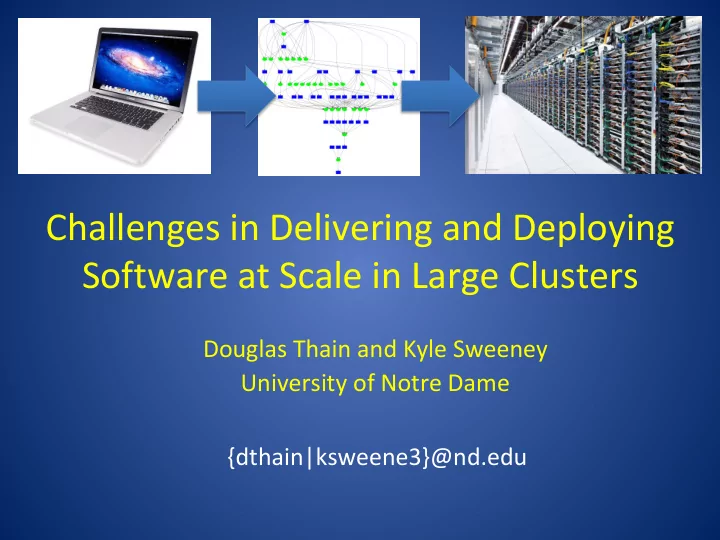
Challenges in Delivering and Deploying Software at Scale in Large Clusters

Douglas Thain and Kyle Sweeney University of Notre Dame {dthain|ksweene3}@nd.edu

slide-2
SLIDE 2

Software Deployment on HPC

  • Classic Approach

– Single process MPI app created by end user. – Sysadmin installs, tests, proves the application. – Adjust to exploit local libraries / capabilities. – Application satisfied with a single site.

  • Evolving Approach

– Complex stacks of commodity software. – Developer is not the user! – Installed by end user just in time. – Users migrate quickly between sites.

slide-3
SLIDE 3

Problem: Software Deployment

  • Getting software installed on a new site is a

big pain! The user (probably) knows the top level package, but doesn't know:

– How they set up the package (sometime last year) – Dependencies of the top-level package. – Which packages are system default vs optional – How to import the package into their environment via PATH, LD_LIBRARY_PATH, etc.

  • Many scientific codes are not distributed via

rpm, yum, pkg, etc. (and user isn't root)

slide-4
SLIDE 4

Typical User Dialog Installing BLAST

"I just need BLAST." "Oh wait, I need Python!" "Sorry, Python 2.7.12" "Python requires SSL?" "What on earth is pcre?" "I give up!"

slide-5
SLIDE 5

VC3: Virtual Clusters for Community Computation

Douglas Thain, University of Notre Dame Rob Gardner, University of Chicago John Hover, Brookhaven National Lab

http://virtualclusters.org

Lincoln Bryant, Jeremy Van, Benedikt Riedel, Robert Gardner, Jose Caballero, John Hover, Ben Tovar, and Douglas Thain, VC3: A Virtual Cluster Service for Community Computation, PEARC 2018. DOI: 10.1145/3219104.3219125

slide-6
SLIDE 6

You have developed a large scale workload which runs successfully at a University cluster. Now, you want to migrate and expand that application to national-scale infrastructure. (And allow others to easily access and run similar workloads.) Traditional HPC Facility Distributed HTC Facility Commercial Cloud

slide-7
SLIDE 7

Traditional HPC Facility Distributed HTC Facility Commercial Cloud

Concept: Virtual Cluster

  • 200 nodes of 24 cores and 64GB RAM/node
  • 150GB local disk per node
  • 100TB shared storage space
  • 10Gb outgoing public internet access for data
  • CMS software 8.1.3 and python 2.7

Virtual Cluster Service Virtual Cluster Factory Deploy Services Deploy Services Deploy Services Virtual Cluster Factory

Virtual Cluster

Virtual Cluster Factory Virtual Cluster Factory Virtual Cluster Factory

slide-8
SLIDE 8

How do we get complex software delivered and deployed to diverse computing resources? (without bothering sysadmins)

slide-9
SLIDE 9

Delivery vs Deployment

  • Delivery: Articulating and installing all of the

necessary components at one site.

  • Deployment: Moving all of the necessary

components to each individual cluster node in an efficient manner.

slide-10
SLIDE 10

Example: CMS Analysis Software

Large Hadron Collider Compact Muon Solenoid Worldwide LHC Computing Grid Many PB Per year Online Trigger 100 GB/s

slide-11
SLIDE 11

Example: CMS Analysis Software

  • Developed over the course of decades by

1000s of contributors with different expertise.

  • Core codes in F77/F90/C99/C++18 + shell

scripts, perl and python, scripts, shared libraries, config files, DSLs…

  • Centrally curated by experts at CERN for

consistency, reproducibility, etc.

  • One release: 975GB, 31.4M files, 3570 dirs.
  • Releases are very frequent!
slide-12
SLIDE 12

Example: MAKER Genome Pipeline

slide-13
SLIDE 13

Example: MAKER Genome Pipeline

  • Large number of software dependencies

(OpenMPI, Perl 5, Python 2.7, RepeatMasker, BLAST, several Perl modules)

  • Composed of many sub-programs written in

different languages (Perl, Python, C/C++)

  • 21,918 files in 1,757 directories
  • Typical installation model:

Ask author for help!

slide-14
SLIDE 14

Software Deployment/Delivery

  • Filesystem Methods

– Big Bucket of Software! – MetaFS: Metadata Acceleration – CVMFS: A Global Filesystem

  • Packaging Methods

– VC3-Builder: Automated Package Installation – Builder + Workflows

  • Container Methods

– Container Technologies – Containers + Workflows

slide-15
SLIDE 15

Big Bucket of Software!

  • Collect everything – binaries, interpreters,

libraries – into one big tarball.

  • Delivery is easy: copy, unpack, setenv.

– (Not all software can be relocated to a new path)

  • User-compatible approach – no sysadmin

support needed, occupies user storage, etc.

  • Just set up batch jobs to refer to the deployed

location, set PATH, and go.

slide-16
SLIDE 16

But: Metadata Storms!

  • Common behavior: long burst of metadata

access at the beginning of an application:

– Search through PATH for executables. – Search through LD_LIBRARY_PATH for libraries. – Load Java classes from CLASSPATH. – Load extensions from file system. – Bash script? Repeat for every single line!

  • Complex program startup can result in

millions of metadata transactions!

slide-17
SLIDE 17

Metadata Storm

Metadata Server Directory Tree Program Data Server Data Server stat readdir access

  • pen

read/write

Same problem on any parallel filesystem: Ceph, HDFS, Panasas, Lustre, …

slide-18
SLIDE 18

MAKER Metadata Storm

Single Node Filesystem Load

Tim Shaffer and Douglas Thain, Taming Metadata Storms in Parallel Filesystems with MetaFS, PDSW Workshop, 2017. http://dx.doi.org/ 10.1145/3149393.3149401

slide-19
SLIDE 19

Idea: Bulk Metadata Distribution

  • We know some things in advance:

– Which nodes need to load the software. – Which software is needed. – Software won't change during the run.

  • Idea:

– Build up all the metadata needed in advance. – Deliver it in bulk to each node. – Cache it for as long as the workflow runs.

slide-20
SLIDE 20

Bulk Metadata Load

Metadata Server Directory Tree Program Metadata Listing Traversal Script FUSE Metadata Listing Bulk Transfer Software metadata is cached

  • n all nodes for the

duration of the workflow and served at $$$ speed. read / write

slide-21
SLIDE 21

CVMFS Filesystem on >100K Cores Around the World

CMS Software 967GB File System at CERN

App

FUSE

Metadata And Checksums

A B C

Individual Files CVMFS

App

FUSE

CVMFS

$$$ $$$ $$$

CVMFS: Cern-VM Filesystem

Generate Index

Proxy Cache Network

slide-22
SLIDE 22

Some Quick Numbers

Jakob Blomer, Predrag Buncic, Rene Meusel, Gerardo Ganis, Igor Sfiligoi and Douglas Thain, The Evolution of Global Scale Filesystems for Scientific Software Distribution, IEEE/AIP Computing in Science and Engineering, 17(6), pages 61-71, December, 2015. DOI: 10.1109/MCSE.2015.111 Nearly 2.5M metadata

  • ps to start application

Reduced to a load of a single 147MB metadata file.

slide-23
SLIDE 23

However CVMFS on HPC is tricky!

  • Mounting filesystem on user nodes

– FUSE -> requires some degree of privilege – Parrot -> requires precise ptrace behavior

  • Live network access can be a problem.

– Cache software in advance locally. – But which parts are needed for job X?

  • CVMFS itself can be metadata intensive!

– One site: Admins limited number of in-memory inodes allocatable by a given user, couldn't run!

slide-24
SLIDE 24

Software Deployment/Delivery

  • Filesystem Methods

– Big Bucket of Software! – MetaFS: Metadata Acceleration – CVMFS: A Global Filesystem

  • Packaging Methods

– VC3-Builder: Automated Package Installation – Builder + Workflows

  • Container Methods

– Wharf: Docker on Shared Filesystems – Containers + Workflows

slide-25
SLIDE 25

User-Level Package Managers

  • Idea: Provide build recipes for many packages.
  • Build software automatically in user space,

each package in its own directory.

  • Only activate software needed for a particular
  • run. (PATH, LD_LIBRARY_PATH,…)
  • Examples:

– Nix – Build from ground up for reproducibility. – Spack – Build for integration with HPC modules. – VC3-Builder – Build via distributed resources.

slide-26
SLIDE 26

MAKER Bioinformatics Pipeline

slide-27
SLIDE 27

Sealed Package

VC3-Builder Architecture

Upstream Sources

Builder

Cached Sources Install Tree

Task Task Sandbox A B C D

Software Recipes Cached Recipes

A B C D

Recipe

Archival or Disconnected Operation

PATH PYTHONPATH LD_LIBRARY_PATH

slide-28
SLIDE 28

..Plan: ncbi-blast => [, ] ..Try: ncbi-blast => v2.2.28 ....Plan: perl => [v5.008, ] ....Try: perl => v5.10.0 ....could not add any source for: perl v5.010 => [v5.8.0, ] ....Try: perl => v5.16.0 ....could not add any source for: perl v5.016 => [v5.8.0, ] ....Try: perl => v5.24.0 ......Plan: perl-vc3-modules => [v0.001.000, ] ......Try: perl-vc3-modules => v0.1.0 ......Success: perl-vc3-modules v0.1.0 => [v0.1.0, ] ....Success: perl v5.24.0 => [v5.8.0, ] ....Plan: python => [v2.006, ] ....Try: python => v2.6.0 ....could not add any source for: python v2.006 => [v2.6.0, ] ....Try: python => v2.7.12 ......Plan: openssl => [v1.000, ] ……………….. Downloading 'Python-2.7.12.tgz' from http://download.virtualclusters.org/builder-files details: /tmp/test/vc3-root/x86_64/redhat6/python/v2.7.12/python-build-log processing for ncbi-blast-v2.2.28 preparing 'ncbi-blast' for x86_64/redhat6 Downloading 'ncbi-blast-2.2.28+-x64-linux.tar.gz' from http://download.virtualclusters.org… details: /tmp/test/vc3-root/x86_64/redhat6/ncbi-blast/v2.2.28/ncbi-blast-build-log

"vc3-builder –require ncbi-blast"

(New Shell with Desired Environment) bash$ which blastx /tmp/test/vc3-root/x86_64/redhat6/ncbi-blast/v2.2.28/ bin/blastx bash$ blastx –help USAGE blastx [-h] [-help] [-import_search_strategy filename] . . . bash$ exit

slide-29
SLIDE 29

Problem: Long Build on Head Node

  • Many computing sites limit the amount of

work that can be done on the head node, so as to maintain quality of service for everyone.

  • Solution: Move the build jobs out to the

cluster nodes. (Which may not have network connections.)

  • Idea: Reduce the problem to something we

already know how to do: Workflow!

  • But how do we bootstrap the workflow

software? With the builder!

slide-30
SLIDE 30

vc3-builder

  • -require makeflow
  • -require ncbi-blast
  • makeflow –T condor blast.mf
slide-31
SLIDE 31

Head Node

Bootstrapping a Workflow

Upstream Sources

Builder

Software Recipes

Worker Nodes

Makeflow Makeflow

Build Task Build Task Build Task Build Task Build Task Build Task

Build Makeflow Build BLAST

BLAST

BLAST Task BLAST Task BLAST Task BLAST Task BLAST Task BLAST Task

slide-32
SLIDE 32

Example Applications

MAKER Octave

Benjamin Tovar, Nicholas Hazekamp, Nathaniel Kremer-Herman, and Douglas Thain, Automatic Dependency Management for Scientific Applications on Clusters, IEEE International Conference on Cloud Engineering (IC2E) , April, 2018.

slide-33
SLIDE 33

Delivering a Global Filesystem with VC3-Builder

slide-34
SLIDE 34

..Plan: cvmfs => [, ] ..Try: cvmfs => v2.0.0 ....Plan: parrot => [v6.0.16, ] ....Try: parrot => v6.1.1 ......Plan: cctools => [v6.1.1, ] ......Try: cctools => v6.1.1 ........Plan: zlib => [v1.002, ] ........Try: zlib => v1.2.8 ........Success: zlib v1.2.8 => [v1.2.0, ] ......Fail-prereq: cctools-v6.1.1 ........Plan: perl => [v5.010.000, v5.010001] ........Try: perl => v5.10.0 ..........Plan: perl-vc3-modules => [v0.001.000, ] ..........Try: perl-vc3-modules => v0.1.0 ..........Success: perl-vc3-modules v0.1.0 => [v0.1.0, ] ........could not add any source for: perl v5.010 => [v5.10.0, v5.10001.0] ........Try: perl => v5.16.0 ..........Plan: perl-vc3-modules => [v0.001.000, ] ..........Try: perl-vc3-modules => v0.1.0 ..........Success: perl-vc3-modules v0.1.0 => [v0.1.0, ] ........could not add any source for: perl v5.016 => [v5.10.0, v5.10001.0] ........Try: perl => v5.24.0 ..........Plan: perl-vc3-modules => [v0.001.000, ] ..........Try: perl-vc3-modules => v0.1.0 ..........Success: perl-vc3-modules v0.1.0 => [v0.1.0, ] ........Success: perl v5.24.0 => [v5.10.0, v5.10001.0]

"vc3-builder –require cvmfs"

(New Shell with Desired Environment) bash$ ls /cvmfs/oasis.opensciencegrid.org atlas csiu geant4 ilc nanohub osg-software auger enmr glow ligo nova sbgrid cmssoft fermilab gluex mis

  • sg

snoplussnolabca . . . bash$ exit

slide-35
SLIDE 35

Software Deployment/Delivery

  • Filesystem Methods

– Big Bucket of Software! – MetaFS: Metadata Acceleration – CVMFS: A Global Filesystem

  • Packaging Methods

– VC3-Builder: Automated Package Installation – Builder + Workflows

  • Container Methods

– Container Technologies – Containers + Workflows

slide-36
SLIDE 36

Many Possible Container Techs

36

✔ Widely used ✔ Convenient global repo ❌ Builds up images locally ❌ Root Daemon ✔ Built on Docker Images ✔ No Root Daemon ❌Requires Very Modern Kernel ✔ No Root Daemon ✔ Only one file ✔ Works with many image types ❌Loop Devices

slide-37
SLIDE 37

"runos slc6 – mysim.exe"

37

Site A Site C Site B slc6 rhel7 debian45 docker singularity charliecloud mysim.exe slc6 mysim.exe slc6 mysim.exe

slide-38
SLIDE 38

Desired Architecture

38

slide-39
SLIDE 39

Types of Data

39

OS Read-Only Workdata

slide-40
SLIDE 40

Container Composition

40

Static Composition Dynamic Composition

Kyle Sweeney and Douglas Thain, Efficient Integration of Containers into Scientific Workflows, Science Cloud Workshop at HPDC, June, 2018. DOI: 10.1145/3217880.3217887

slide-41
SLIDE 41

Experiment: BLAST

41

We delivered 1/3rd less data, and finished in ~3/4ths the runtime using dynamic composition

slide-42
SLIDE 42

Putting it All Together

slide-43
SLIDE 43

Submit Batch Jobs Native RHEL7 Machines RunOS "rhel6" Singularity Container VC3 Builder Parrot + CVMFS Factory Request 128 nodes of16 cores, 4G RAM, 16G disk with RHEL6 operating system, CVMFS and Maker software installed: Worker 128X HTCondor Batch System Makeflow Sand box Task

slide-44
SLIDE 44

Same Thing, Different Site:

slide-45
SLIDE 45

Submit Batch Jobs Native SLES9 Machines w/FUSE RunOS "rhel6" Docker Container VC3 Builder FUSE + CVMFS Factory Request 128 nodes of16 cores, 4G RAM, 16G disk with RHEL6 operating system, CVMFS and Maker software installed: Worker 128X Torque Batch System Makeflow Sand box Task

slide-46
SLIDE 46
  • Big Bucket of Software

+ Maximum portability, compatibility, archivability.

  • Horrible metadata performance.

+ / - Correct with metadata oriented filesystems.

  • User-Level Package Managers

+ Explicit statement of dependences. (repro!) + Deliver only needed components. (sharing!)

  • Long build/deploy processes. (use cluster)
  • Container Technologies

+ Leverage commodity software tools. + Naturally metadata efficient.

  • Requires privileges, kernel tech, specialized tools.
  • Create new storage management problems.
slide-47
SLIDE 47

Thoughts on Dependencies:

  • Make software dependencies more explicit.

– Proposed: Nothing should be available by default, all software should require an "import" step.

  • Need better, portable, ways of expressing:

– What software environment the user wants. – What software components are actually used. – What environment the site provides.

  • The ability to nest environments is critical!

– Sysadmin provisions machine via VM/container. – Batch system provisions slot with container. – User provisions software with container.

slide-48
SLIDE 48

Thoughts on Filesystems

  • Open/read/write/close has worked well for a

long time, but seems to be too small a granularity for large scale systems/software.

  • Can we have flexible transaction to balance

between small changes and wide distribution?

  • Do we need new filesystem ops?

– fd = Opentree("/home/dthain",O_RDONLY); – Results = Search("$PATH","sim.exe"); – Something like SQL for metadata?

slide-49
SLIDE 49

Acknowledgements

DE-SC0015711 VC3: Virtual Clusters for Community Computation ACI-1642409 SI2-SSE: Scaling up Science

  • n Cyberinfrastructure with the

Cooperative Computing Tools

Notre Dame CMS: Kevin Lannon Mike Hildreth Kenyi Hurtado

  • Univ. Chicago:

Rob Gardner Lincoln Bryant Suchandra Thapa Benedikt Riedel Brookhaven Lab: John Hover Jose Caballero

slide-50
SLIDE 50

http://ccl.cse.nd.edu @ProfThain http://virtualclusters.org