Challenging a Business Property Assessment Strategies for Reducing - - PowerPoint PPT Presentation

▶
challenging a business property assessment
SMART_READER_LITE
LIVE PREVIEW

Challenging a Business Property Assessment Strategies for Reducing - - PowerPoint PPT Presentation

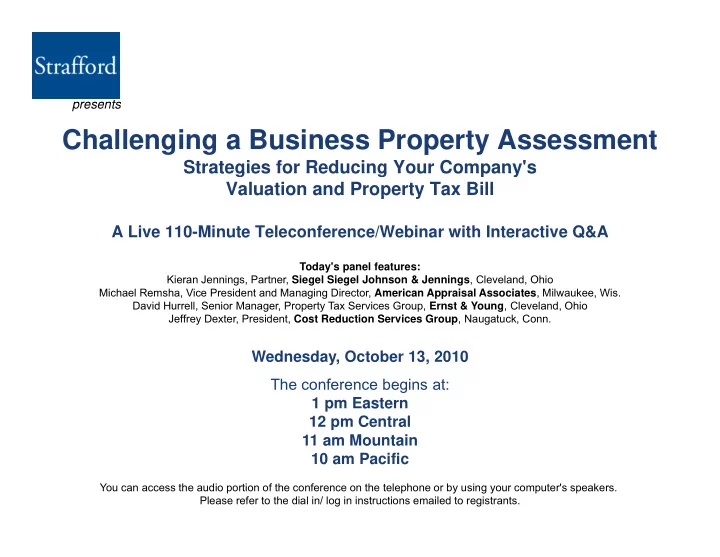
presents presents Challenging a Business Property Assessment Strategies for Reducing Your Company's Strategies for Reducing Your Company s Valuation and Property Tax Bill A Live 110-Minute Teleconference/Webinar with Interactive Q&A


slide-1
SLIDE 1

presents

Challenging a Business Property Assessment

Strategies for Reducing Your Company's

presents

Strategies for Reducing Your Company s Valuation and Property Tax Bill

A Live 110-Minute Teleconference/Webinar with Interactive Q&A

Today's panel features: Kieran Jennings, Partner, Siegel Siegel Johnson & Jennings, Cleveland, Ohio Michael Remsha, Vice President and Managing Director, American Appraisal Associates, Milwaukee, Wis. David Hurrell, Senior Manager, Property Tax Services Group, Ernst & Young, Cleveland, Ohio Jeffrey Dexter, President, Cost Reduction Services Group, Naugatuck, Conn.

Wednesday, October 13, 2010 The conference begins at: The conference begins at: 1 pm Eastern 12 pm Central 11 am Mountain 10 P ifi 10 am Pacific

You can access the audio portion of the conference on the telephone or by using your computer's speakers. Please refer to the dial in/ log in instructions emailed to registrants.

slide-2
SLIDE 2

For Continuing Education purposes, g please let us know how many people are listening at your location by g y y

  • closing the notification box
  • and typing in the chat box your
  • and typing in the chat box your

company name and the number of attendees attendees.

  • Then click the blue icon beside the box

to send to send.

For live event only

slide-3
SLIDE 3
  • If you are listening via your computer

If you are listening via your computer speakers, please note that the quality of your sound will vary depending on the speed and lit f i t t ti quality of your internet connection.

  • If the sound quality is not satisfactory and you

li t i i t k are listening via your computer speakers, please dial 1-866-869-6667 and enter your PIN when prompted. Otherwise, please send e p o p ed O e se, p ease se d us a chat or e-mail sound@straffordpub.com immediately so we can address the problem.

  • If you dialed in and have any difficulties

during the call, press *0 for assistance.

slide-4
SLIDE 4

Challenging A Business Challenging A Business Property Assessment Webinar

  • Oct. 13, 2010

David Hurrell, Ernst & Young david.hurrell@ey.com Jeffrey Dexter, Cost Reduction Services Group Michael Remsha, American cut.costs@att.net Kieran Jennings, Siegel Siegel Johnson & Appraisal Associates mremsha@american- appraisal.com Jennings kjennings@siegeltax.com

slide-5
SLIDE 5

Today’s Program Today s Program

Developing, Leveraging An Assessor Relationship Slides 6-14 (David Hurrell) Creating Your Presentation Slides 15-20 (Jeffrey Dexter) Lessons From Assessment Scenarios Slides 21-31 (Michael Remsha) Negotiating From A Position Of Strength Slides 32-40 (Kieran Jennings)

5

( g )

slide-6
SLIDE 6

Developing, Leveraging An Assessor Relationship Relationship David Hurrell, Ernst & Young

6

slide-7
SLIDE 7

Agenda For This Section

► Understanding the landscape ► What to expect: Know your assessor ► Establishing working relationships with assessors ► Accomplishing your goals: Making the relationship work for you

Page 7

slide-8
SLIDE 8

Understanding The Landscape

Total state and local business taxes, FY2008-FY2009, ($Billions) Total tal One One- ear ear % % T t T tal One One-Year ear Busin Business Tax ss Tax 200 008 200 009 Taxe axes Cha hange Property taxes on business property $209.60 $215.30 36.50% 2.70% General sales taxes on business inputs $133.2 $126.90 21.50%

  • 4.70%

Corporate income lax $58.10 $50.60 8.60

  • 13.00

rp rate i c me lax $ 8. $ .

  • 8. %
  • 3. %

Unemployment insurance 532.5 $30.70 5.20%

  • 5.50%

Business and corporate license $37.50 $38.30 6.50% 2.30% Individual income tax on business income $37.60 $32.30 5.50%

  • 14.10%

Public utility taxes $28.00 $28.80 4.90 2.90 ► Property taxes on real personal and utility property by business account for the largest share of total state and local Public utility taxes $2 . $2 . 4.9 % 2.9 % Excise taxes $29.20 $26.30 4.50% 9.90% Insurance premiums taxes $16.40 $15.60 2.60%

  • 5.20%

Other business taxes 529.1 $25.20 4.30%

  • 3.30%

Total Busin Total Business Taxes ss Taxes $611.10 $590.00 100.00%

  • 3.50%

► Property taxes on real, personal and utility property by business account for the largest share of total state and local business taxes, 36.5% or $215.3 billion. Property taxes increased 2.7% in FY2009, after growing 4.8% in FY2008 and 6.4% in FY2007. Property taxes as a share of total state and local businesses taxes increased by 2.2 percentage points in FY2009. Property taxes are the largest local business tax (74.1% of total local business taxes).

Page 8

slide-9
SLIDE 9

Understanding The Landscape (Cont.)

► Trend: Mounting state and local budget deficits, reflecting fallout

  • f economic recession
  • f economic recession

► State/local taxing jurisdiction responses: ► Use of more hired external auditors for personal property audits ► Use of more hired external auditors for personal property audits

  • n a contingency fee basis.

► Dismissal of distressed sales as evidence of “market value” ► Revaluations reflecting minimal decreases, unless challenged by

taxpayers taxpayers

► Pressure for increased tax levies ► Consideration of split/rolls adverse to business property ► Reconsideration of changes in ownership limits on caps (i e

CA

► Reconsideration of changes in ownership limits on caps (i.e., CA

– proposed change – Prop XIII)

Page 9

slide-10
SLIDE 10

What To Expect: Know Your Assessor

Assessment community – general characteristics

► Mass appraisal techniques ► Comfort level with the cost approach ► Typically slow to react to market changes ► Pushing back with greater force and frequently on appeals, value

reductions and waivers for fees, penalties, etc. , p ,

► Greater flexibility in an informal setting vs. appeals

Page 10

slide-11
SLIDE 11

What To Expect: Know Your Assessor (Cont.)

Local assessor meetings – Tips for preparation

►

Understand the LOCAL landscape N t L l b i d liti l li t

►

News reports: Local economy, business and political climate

►

Research recent and historical property tax cases and hearings

►

Connect with colleagues, business contacts and consultants who operate in the local jurisdiction the local jurisdiction

►

Gain a working understanding of the assessor’s methodologies, comfort levels and acceptable risk parameters

►

Local statutes

►

Local statutes

►

Standard of value

►

Where to get comparables

►

Understand local customs – “When in Rome ”

►

Understand local customs – When in Rome …

►

“Step into the shoes” of the assessor by considering:

►

Jurisdiction responsibilities

►

Reporting requirements

Page 11

►

Reporting requirements

►

Documentation needed

slide-12
SLIDE 12

Establishing Working Relationships With Assessors

Basics

► Respect is a must ► Always be truthful; don’t omit or hide facts ► Identify potential common bonds by observing the assessor’s

surroundings

► Be as transparent as possible. Develop credibility and trust by acting

p p p y y g ethically.

Page 12

slide-13
SLIDE 13

Establishing Working Relationships With Assessors (Cont.) ( )

Practical considerations Practical considerations

► Gain credibility ► Know the subject property ► Site visit ► Spend time with operations people ► Develop a meaningful argument with market-based support ► Thorough preparation is key ► Third-party documentation ► Be comfortable with the information you provide ► Be comfortable with the information you provide ► Special considerations for proprietary information

Page 13

slide-14
SLIDE 14

Accomplishing Your Goals: Making The Relationship Work For You p

The art of negotiation

► Balancing what the assessor will accept with your company’s needs ► Balancing what the assessor will accept with your company s needs ► How aggressive do you have to be to achieve the desired result? ► Political considerations/standing in the community ► Internal buy-in ► Establish acceptable settlement parameters ► Leverage your knowledge of how the assessor operates ► Outline key objectives ► Document settlement options ► Be prepared for pushback ► Be prepared for pushback ► Make it a win-win situation ► Marathon, not a sprint

Page 14

slide-15
SLIDE 15

Creating Your Presentation Jeffrey Dexter, Cost Reduction Services Group

15

slide-16
SLIDE 16

Determining If There’s A Case

  • Gathering property info (see info sheet for this section)
  • Benchmarking resources to check
  • Benchmarking resources to check
  • Review any recent appraisal
  • Tour the property

16

slide-17
SLIDE 17

“Know Your Audience”

  • Revaluation company and staffers

B d f A A l

  • Board of Assessment Appeals
  • Assessor
  • Town/county attorney
  • Your property manager/contact

17

slide-18
SLIDE 18

“D l i Y P t ti ” “Developing Your Presentation”

  • Start with the basics (see presentation handout for this section)
  • Discuss the problems (note what detracts from value)
  • Discuss the problems (note what detracts from value)
  • Know if something adds to value
  • Income/expense info

» Data source, time frame, format

  • Show all rent information
  • Use comparable assessments, if warranted
  • Photos: A picture is worth a thousand words

18

slide-19
SLIDE 19

“Show Time!”

Wh d i h

  • Where to go … and getting there.
  • Listening in (a/k/a “eavesdropping”)
  • The “ice breaker”
  • Asking questions (e.g., of the revaluation company)

A i ti

  • Answering questions
  • Beg for questions

19

slide-20
SLIDE 20

Post-Presentation

  • Any “after the meeting” questions needing an answer?
  • Any amendments to be made?
  • Any amendments to be made?
  • Critique your performance
  • On to the next show

20

slide-21
SLIDE 21

Lessons From Assessment Scenarios

Michael Remsha, American Appraisal Associates

21

slide-22
SLIDE 22

Levels Of Value Levels Of Value

Definitions vary by state M k l

  • Market value
  • Fair market value
  • Full value
  • Fair and cash value
  • Fair and cash value
  • True value
  • Among others

Generally the assessment should reflect what you can Generally, the assessment should reflect what you can sell the property for in the market

  • With or without installation?

22

slide-23
SLIDE 23

Approaches To Value Approaches To Value

Income approach

  • Can be too complex
  • Data may not be available

Data may not be available Sales comparison approach

  • Can be very useful for marketable assets

y Cost approach

  • Can be applied to most assets

23

slide-24
SLIDE 24

Real Life Story No.1 Real Life Story No.1

V l f i l i h i d Very large manufacturing plant in the auto industry

  • Supplied parts to the auto assembly plants
  • Supplied replacement parts to the public
  • Global market
  • Global market
  • 20 years old (effective age of PP = 10 years)
  • Updated many times over the years

Updated many times over the years

  • Major issues with functional obsolescence (FO)
  • FO was not economically curable
  • Technology continually changing

gy y g g

  • County assessor relied on state tables!

24

slide-25
SLIDE 25

Real Life Story No. 1 (Cont.) Real Life Story No. 1 (Cont.)

Replacement plant design

  • Same capacity and utility of actual plant
  • Utilized new, modern machinery and equipment
  • Design, cost and operating characteristics different
  • Smaller workforce
  • Lower energy expense
  • Less scrap

25

slide-26
SLIDE 26

Real Life Story No. 1 (Cont.) y ( )

Economic obsolescence (EO)

  • Compared the returns on invested capital
  • Current returns vs. “the good old days”
  • Value line investment survey data
  • Value line investment survey data
  • Returns as of appraisal date = 15%
  • Returns as of “the good old days” = 19%
  • EO = 21%

EO 21%

  • Compared equity-to-book ratio
  • Subject industry vs. U.S. industry
  • S&P industry surveys data

y y

  • Subject industry = 2.36
  • U.S. industry = 3.90
  • EO = 39%

26

slide-27
SLIDE 27

Real Life Story No. 1 (Cont.) y ( )

Functional obsolescence (FO)

  • Labor: 1,800 people vs. 1,254 people

E 8 35 MMB lb 6 23 MMB lb

  • Energy: 8.35 MMBtu per lb vs. 6.23 MMBtu per lb
  • Scrape: 1.25% of production vs. 0.50% of production

Annual penalty Annual penalty

  • Labor: $35,333,000
  • Energy: 2,045,000
  • Scrap: 3 458 000

Scrap: 3,458,000

  • Total: $40,836,000

Present value of the annual penalty = $158,000,000 p y , , Over the remaining life of the property

27

slide-28
SLIDE 28

Real Life Story No. 1 (Cont.) Real Life Story No. 1 (Cont.)

R d i $420 000 000 Reproduction cost new $420,000,000

  • Less FO due to excess capital costs

(60,000,000) Cost of replacement 480,000,000

  • Less physical depreciation

220 000 000

  • Less physical depreciation

220,000,000

  • Less economic obsolescence

52,000,000

  • Less functional obsolescence

158,000,000 Equals cost indicator of value $ 49 000 000 Equals cost indicator of value $ 49,000,000 Assessment was more than $100 million

28

slide-29
SLIDE 29

Real Life Story No 2 Real Life Story No. 2

Very large manufacturing plant in the telecommunications industry

  • Manufactured high-tech equipment
  • Technology advanced every six months

f i i l h i

  • Manufacturing equipment was constantly changing
  • Global market
  • Major issue with “ghost assets” or “unrecorded retirements”
  • Major issue with “ghost assets” or “unrecorded retirements”
  • Continually being updated
  • Cannibalism was an issue
  • Major issues with functional (technological) obsolescence

Major issues with functional (technological) obsolescence

  • Technology was continually changing
  • County assessor relied on state M&E tables!

29

slide-30
SLIDE 30

Real Life Story No. 2 (Cont.) Real Life Story No. 2 (Cont.)

Cleaned up the property record (asset ledger) Cleaned up the property record (asset ledger) Went to the market to survey selling prices of M&E

  • Obtained actual market data from used equipment dealers

Obtained actual market data from used equipment dealers

  • Age vs. actual selling price
  • Developed a market-based depreciation schedule

p p

  • Age vs. % of historical cost
  • Applied it to the cleaned-up property record
  • Result: Market value of the actual assets on-site
  • Won case
  • State developed a special depreciation schedule for the future!

30

slide-31
SLIDE 31

In Conclusion In Conclusion

Income approach

  • Can be too complex
  • Can be too complex
  • Working capital vs. intangible assets vs. tangible assets

Sales comparison approach

  • Can be very useful for marketable assets

Can be very useful for marketable assets

  • Develop market-based depreciation curves

Cost approach

  • Must be able to quantify all forms of depreciation and obsolescence

q y p Any approach supported by factual evidence will get the point across and can be used in negotiations/court

31

slide-32
SLIDE 32

Negotiating From A Position Of Strength

Kieran Jennings, Siegel Siegel e Je gs, S ege S ege Johnson & Jennings

“If you know your enemies and know yourself, you can win a hundred battles.” – Sun Tzu

32

slide-33
SLIDE 33

Discovery

  • What is discovery?
  • What evidence must we turn over?
  • What evidence must we turn over?
  • Discoverable vs. admissible
  • What can we learn from our opposition?

33

slide-34
SLIDE 34

Knowledge That Is Necessary At Knowledge That Is Necessary At Beginning Of Case

  • Case law
  • Reassessment rules
  • Reassessment rules
  • Opposition
  • Local custom (unwritten rules)
  • Available valuation arguments

34

slide-35
SLIDE 35

When To Start Negotiation

  • Informal reviews
  • Filing the case
  • Filing the case
  • County level
  • Appeal level

Note: Each case is different, but the decision of when to start negotiation must be made after considering your opposition.

35

slide-36
SLIDE 36

Factors With The Case Judge

  • Has this judge decided similar cases?
  • Has this judge heard appeals for the subject?
  • Is the judge strict with rules of evidence and timelines?
  • What other factors may effect the pace of litigation?

36

slide-37
SLIDE 37

Your Evidence/Witness

  • Are you required to provide all evidence in your possession?
  • When do you need an appraisal?
  • What witnesses are needed to preserve evidence and testimony to be

used at trial?

  • How can you effectively start to negotiate?

37

slide-38
SLIDE 38

Opposing Witnesses

  • What cases did the witness testify in previously?
  • What is the style of testimony?
  • Are there potential contradictory statements in other court records?
  • What is the witness’ reputation?

38

slide-39
SLIDE 39

Opposing Attorney

  • What is their style of negotiation/litigation?
  • What is their background?

– Will they pull from other areas of law? – Is your case a test case for them?

39

slide-40
SLIDE 40

Getting Everyone To Agree

  • “One hundred victories in one hundred battles is not the most desired.

Capitulating the enemy without fighting is the most desired.” – Sun Capitulating the enemy without fighting is the most desired. Sun Tzu

  • Mediation
  • Mediation
  • Negotiation face-to-face vs. phone vs. e-mail

40