Challenging Speech Acts Workshop Questioning Speech Acts Universitt - - PDF document

challenging speech acts
SMART_READER_LITE
LIVE PREVIEW

Challenging Speech Acts Workshop Questioning Speech Acts Universitt - - PDF document

Challenging Speech Acts Workshop Questioning Speech Acts Universitt Konstanz September 14-16, 2017 Manfred Krifka Arik Cohen A classical joke: The Trotzky Telegram: Joseph Stalin, The Kremlin, Moscow. I was wrong? You are the true


slide-1
SLIDE 1

Challenging Speech Acts

Workshop Questioning Speech Acts Universität Konstanz September 14-16, 2017

Arik Cohen Manfred Krifka

A classical joke:

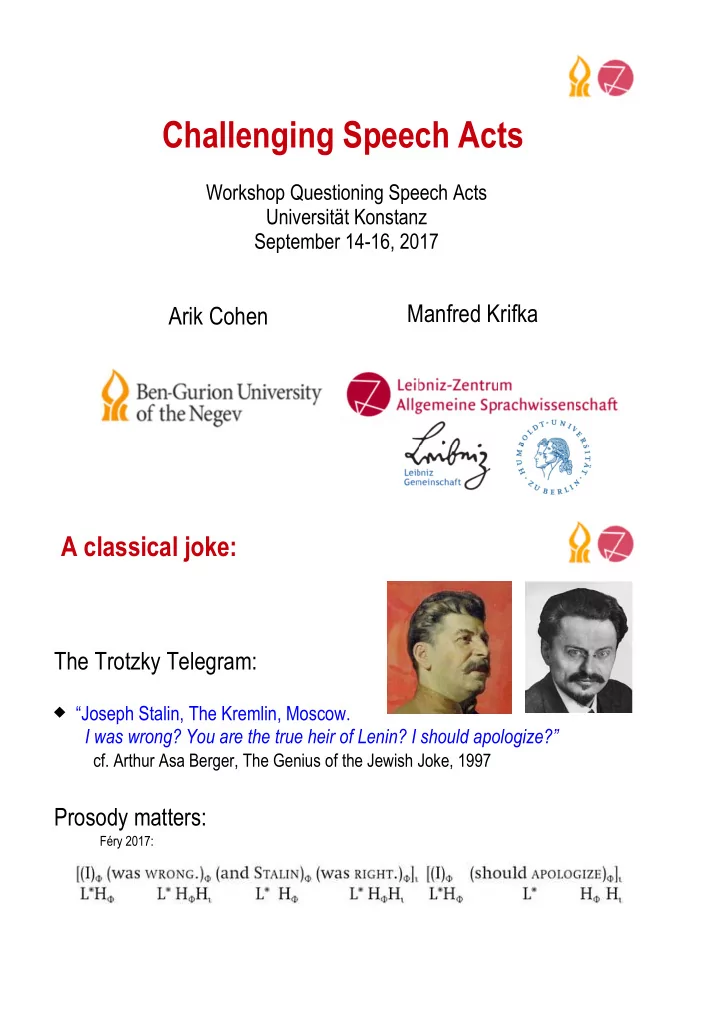
The Trotzky Telegram:

 “Joseph Stalin, The Kremlin, Moscow. I was wrong? You are the true heir of Lenin? I should apologize?”

  • cf. Arthur Asa Berger, The Genius of the Jewish Joke, 1997

Prosody matters:

Féry 2017:

slide-2
SLIDE 2

A Classical Reaction: Challenges to speech acts

 Incredulity questions, cf. Cohen 2007  Examples:

1) A: Donald will become president. B: DONALD will become president?! / Donald will become PRESIDENT?! DONALD will become PRESIDENT?! Are you sure? 2) A: Will Donald become president? B: Will DONALD become PRESIDENT?! What a stupid question! 3) A: If only Donald became president! B: If only Donald became PRESIDENT?! Are you crazy? 4) A: Idiot! B: IDIOT?! Don‘t call me that! 5) Patient: Ouch! Dentist: Ouch?! You are anesthetized, this can’t hurt you!

 Observations:

  • Speaker B expresses incredulity or indignation about the previous contribution
  • Invites explanation of justification by the first speaker, A – hence, a challenge
  • The antecedent contribution can be of any speech act type

(assertion, question, optative, curse, interjection, ...)

  • Prosodic contour, with L* (low focus accent) and H% (high boundary tone),

expanded pitch range

slide-3
SLIDE 3

Challenges beyond speech acts

 Examples:

6) A goes to the farmers market. It is February. One stand offers strawberries. A, to seller: Strawberries in WINTER?!

 Observe:

  • Same prosodic marking: focus L*, boundary H%, expanded pitch
  • No preceding speech act; reference to some phenomenon given in the situation.
  • Speaker expresses incredulity or indignation about this phenomenon
  • Speaker expresses interest in clarification about the phenomenon

Related cases: Contradictions

 Examples

7) A: My fate is sealed. I am diagnosed with elephantiasis. B: Elephantiasis isn’t incurable! L*+H L* L*H%

  • Cf. Liberman, Mark & Ivan Sag. 1975,

Annotation: Ladd, D. Robert. 1996. Contradiction contour onset as L*+H+!H: Bartels, Christine. 1999. [2013]. Variety of possible realizations: Hedberg, Nancy, e.a. 2003.

 How contractions work:

  • Current conversation or situation can be seen as entailing a proposition φ
  • Speaker rejects φ, typically by an assertion of the negation of φ
  • Focal accent on new part (negation, verum focus, etc.)

 Challenges ≠ Contradictions:

  • Contradictions refer to an antecedent proposition and negates it
  • Challenge refers to antecedent speech act or situational given phenomenon

and questions it

slide-4
SLIDE 4

Related cases: Exclamatives

 Examples

8) A: Donald will become president. B: Donald will become president!! Incredible! 9) Stawberries in winter!! Incredible! How fast this car is!!

 How exclamatives work:

  • Speaker expresses astonishment, surprise

about a speech act, a proposition, a degree

Rett 2012)

 Challenges ≠ Exlamatives:

  • Exclamatives do not question the antecedent
  • Challenges express incredulity, give addressee a chance to revoke

Related cases: Echo questions

 Examples:

10) A: The symphony requires four ondes martenots. B: The symphony requires WHAT? wh echo question B: The symphony requires four ONDES MARTENOTS? non wh echo question 11) A: When will he bring his pet tarantula to the vet? B: When will he bring WHAT to the vet? wh echo, antecedent: wh question

 How echo questions work:

  • echo questions refer to preceding speech act, which can be of any type
  • in echo questions one constituent is replaced by wh-element with focal accent,

in non-wh echo question one constituent is realized as focus

  • Speaker indicates that antecedent was not properly understood

w.r.t. wh / focus constituent, asks to repeat the act to achieve better understanding.

 Echo questions ≠ Challenges

  • Echo questions are requests for clarification, speech act was not understood

Challenges: speech acts were understood, expression of indignation / disbelief

  • Challenges have an expanded pitch range (Hirschberg & Ward 1992, Repp & Rosin 2015)
  • Challenges are often accompanied by facial gestures (frowning) (Crespo-Sendra e.a. 2013)
  • Echos but not challenges allow for focus/wh on parts of words: (Cohen 2007):

This is called WHAT-jacency?

 Challenges are sometimes considered a type of echos (Artstein 2002, Poschmann 2015)

slide-5
SLIDE 5

Explaining challenges

 Challenges are not requests for information or confirmation, like questions or rising declaratives.  Challenges express incredulity or indignation about a phenomenon in the situation, i.e. the phenomenon does not fit the epistemic or deontic background

  • f the speaker

(Cohen 2007)

11) A: Donald will become president. B: DONALD will become PRESIDENT?! 12) Strawberries in WINTER?!

 In case the phenomenon is an antecedent speech act, speaker signals resistance against accepting that speech act.  Resistance can be understood as a challenge: The addressee can withdraw that speech act, or stick by it, but then some motivation for sticking by it is expected.

The Commitment Space Model (CSM)

  • cf. Cohen & Krifka 2014, Krifka 2015

 Commitments and other attitudes:

A φ ‘A is committed to truth of φ’ assertions

A φ ‘A prefers φ over alternatives’

  • ptatives

A φ ‘A is impressed by φ’ exclamatives

 Commitment States c:

  • Sets of ostensibly shared propositions

Non-contradictory, i.e. c ≠ Ø

  • Adding of commitments, e.g. c + A⊢

⋃ ⊢ φ = c {A φ}

 Commitment Spaces C:

  • Sets of commitment states, to model possible continuations
  • √C = ∩C: the root, the propositions actually shared
  • C + A: A = C′, update of C with speech act A, actor A, to output C′

 Commitment Space Developments, CD:

⟩ Sequences of pairs of Actor, Commitment Space ,

  • ⟨..., ⟨

⟩ *, C ⟩ + A: A ⟨ = ..., ⟨ ⟩ *, C , ⟨A, C+A⟩⟩, update of last commitment space with speech act A, actor A

slide-6
SLIDE 6

Assertion in Commitment Spaces

 Assertion by A that φ at input commitment space C:

  • A: [ActP . [CommitP ⊢

[IP Donald is president]]]

  • C + A: ASS(φ) = C + A⊢φ

∈ = {c C | ⊢ A φ ∈ c}

  • Restricts C to those commitment states that contain the proposition ⊢

A φ

 Assertion by A that φ at input commitment space development:

⟨ ⟩⟩ ..., *,C + A: ASS(φ) ⟨ ⟨ ⟩ = ..., *,C , ⟨A, C ⊢ ⟩ +A φ ⟩ = CD

  • Conversational implicature introduces φ itself in a second step:

CD + φ ⟨ ⟨ ⟩ ⟨ ⊢ ⟩ = ..., *,C , A,C+A φ , ⟨A, ⊢ [C+A φ] ⟩ +φ ⟩ = CD′

+ A:ASS(φ) =

√C ⊢ +A φ ⊢ +A φ

Reactions to Assertions; Rejection

 ⟨ ⟨ ⟩ ⟨ ⊢ ⟩ CD′ after assertion: ..., *,C , A,C+A φ , ⟨ ⊢ ⟩ A,[C+A φ]+φ ⟩  B: Okay. / Aha. / Ø

  • acceptance, no change

 B: Yes.

  • confirmation, picks up TP proposition in A: [ActP . [ComP ⊢

[TP ...]]], B asserts φ:

  • CD′ + B: ASS(φ)

⟨ ⟨ ⟩ = ..., *,C , ⟨ ⊢ ⟩ A,[C+A φ]+φ , ⟨B, ⊢ [[C+A φ]+φ] ⊢ ⟩ +B φ] ⟩

 B: No. denial, picks up φ, B asserts ¬φ, requires rejection R for consistency:

  • Rejection goes back to previous state:

⟨ ⟨ ⟩ ⟨ ⟩⟩ ..., S,C , S′,C′ + R ⟨ ⟨ ⟩ ⟨ ⟩ = ..., S,C , S′,C′ , ⟨ ⟩ S,C ⟩

  • CD′ + B: No. = CD′ + R + B:ASS(¬φ) =

⟨ ⟨ ⟩ ⟨ ⊢ ⟩ ..., *,C , A,C+A φ , ⟨ ⊢ ⟩ A,[C+A φ]+φ , ⟨ ⊢ ⟩ A,C+A φ , ⟨ B, ⊢ [C+A φ] ⊢ ⟩ +B ¬φ ⟩

⊢ Results in a commitment space with A φ and B ¬φ, A and B make contradictory commitments, but commitment state not contradictory.

  • without R

⊢ , commitment states would contain φ and B ¬φ, incoherent c.state; in general: R is used to maintain consistency.

 Rejection has a similar function as negotiating table in Farkas & Bruce 2010

slide-7
SLIDE 7

Questions in the CSM

 Example: bipolar question 13) Is Donald president or not?  Questions restrict the possible continuations, not the root – meta speech act

  • C + A to B: φ? V ¬φ? = {√C} ⋃

C+B⊢ ⋃ φ C+B⊢¬φ

  • Restricts possible continuations to commitments by addressee B to either φ or ¬φ

√C B+¬φ ⊢ +B φ

+ A to B: φ?V¬φ? =

√C B+¬φ ⊢ +B φ

Reactions to questions

 Reactions to bipolar question:

  • B: Yes, he is.

CD + B: ASS(φ) ⟨ ⟨ ⟩ ⟨ = ..., *,C , A, ⋃ ⊢ ⋃ ⊢ {√C} C+B φ C+B ¬φ⟩, ⟨ ⊢ ⟩ B, C+B φ ⟩

  • B: No, he isn’t.

CD + B: ASS(¬φ) ⟨ ⟨ ⟩ ⟨ = ..., *,C , A, ⋃ ⊢ ⋃ ⊢ ⟩ {√C} C+B φ C+B ¬φ , ⟨ ⊢ ⟩ B, C+B ¬φ ⟩

  • CD + R + B: I don’t know requires rejection for consistency

⟨ ⟨ ⟩ = ..., *,C , ⟨ ⋃ ⊢ ⋃ ⊢ ⟩ A, {√C} C+B φ C+B ¬φ , ⟨ ⟩ *,C , ⟨ ⟩ B,C+B:¬Kφ ⟩

⊢ + B: B ¬φ =

√C B+¬φ ⊢ +B φ √C B+¬φ ⊢ +B φ √C B+¬φ ⊢ +B φ

⊢ + B: B φ =

slide-8
SLIDE 8

Challenges vs. Denials and Questions

 Denials vs. challenges:

  • A: Donald will become president.

B: No. B: Donald will become PRESIDENT?!

  • Denials reject an asserted proposition by asserting its negation
  • Challenges do not negate an assertion,

and the antecedent speech act can be of various types.

 Questions vs. challenges:

  • A: Will Donald become president?

A: Donald will become PRESIDENT?!

  • Questions, including raising declaratives,

indicate informational need how the common ground should develop, i.e. they relate to the possible continuations of the commitment space

  • Challenges express an irritation about how the common ground has developed,

i.e. they relate to the past commitment space development

Modeling Challenges by Speech Act Sets

 A simpleminded analysis: A: A followed by B: CHALLENGE(A: A)  Problems:

  • focus and questioning nature of challenges is not covered.
  • incredulity just postulated.

 Authier (1993), Dayal (1996), Artstein (2002) on echo questions:

  • Echo questions denote sets of alternatives (like regular wh questions)
  • You gave WHAT to George? / You gave FLOWERS to George?

{‘Adr gave flowers to George’, ‘Adr gave chocolate to George’, ...}

 Generalization to challenges:

  • Echo / Challenges denote sets of alternative speech acts
  • We call such sets secondary speech act.
slide-9
SLIDE 9

Creating speech act alternatives

 Speech act alternatives created by focus, modeled by structured meanings

15) DONALDF will become president?!

 Projection of focus (cf. Krifka 1992)

⟩ ASSERT(will(become(P( λx[x], d )))

⟩ λx[ASSERT(will(become(P(x)))], d

 Different from focus in answers to questions (v. Stechow 1990, Rooth 1992)

16) A: Who will become president? B: DONALDF will become president.

⟩ ASSERT( λx[will(become(P(x))], d )

  • Focus bound by illocutionary operator (cf. Jacobs 1984, Krifka 1992),

corresponding to question (for CS approach: Krifka 2015, Kamali & Krifka i.prep)

 WH in challenges and echoes:

17) WHOF will become president?!

⟩ λx[ASSERT(will(become(P(x)))], {d}

  • wh in echo / challenges refer to singleton alternative set that is given by preceding act

(cf. Authier 1993, Beck & Reis 2017)

  • resulting in similar meaning to non-wh-case

Working through an example

 Antecedent act: ⟨ ⟨ ⟩⟩ ..., *, C + A: Donald is president. ⟨ ⟨ ⟩ = ..., *, C , ⟨ ⊢ ⟩ A, C+A P(d) ⟩ = CD  Echo or Challenge: B: DONALD is president?!

  • refers anaphorically to the salient adjacent speech act ⊢

A P(d)

  • focus on DONALD indicates alternatives

represented by structured meaning: ⟨ ⊢ ⟩ λx[A P(x)], d

  • structured speech act is uttered by B,

⟨ ⟨ ⟩⟩ ⟨ ⟨ ⟩ leading to update of ..., *, C to ..., *, C , ⟨ ⟨ ⊢ ⟩ B, λx[C+A P(x)], d ⟩⟩

∈ interpreted as: A should proceed by choosing one C out of {C+A P(x)|x ALT(d)}

 Restriction for updating a CD with a structured update ST:

⟨ ⟩⟩ ∈ ∈ ..., *, ST requires that there is no C in … such that C {ST(x) | x ALT}

  • Reason: If C were already established, there is no reason to provide this choice
  • this may require a reject operation R

 Illustration by example:

  • CD + R

⟨ ⟨ ⟩ ⟨ ⊢ ⟩ ⟨ ⟩⟩ = ..., *, C , A, C+A P(d) , *, C , = CD′

  • Application of speech act set to CD′ results in a commitment space set:

CD′ ⟨ ⊢ ⟩ + B: λx[A P(x)], d ⟨ ⟨ ⟩ ⟨ ⊢ ⟩ ⟨ ⟩ = ..., *, C , A, C+A P(d) , *, C , ⟨ ⟨ ⊢ ⟩⟩ B, λx[C+A P(x)], d ⟩

slide-10
SLIDE 10

Working through an example

 Resulting commitment space development:

⟨ ⟩ ⟨ ⊢ ⟩ ⟨ ⟩ ..., *, C , A, C+A P(d) , *, C , ⟨ ⟨ ⊢ ⟩⟩ B, λx[C+A P(x)], d ⟩, = CD″ B signals a set of options, A should choose one

CD″ + A: A P(d) = ⟨ ⟨ ⟩ ⟨ ⊢ ⟩ ⟨ ⟩ ..., *, C , A, C+A P(d) , *, C , ⟨ ⟨ ⊢ ⟩⟩⟩ B, λx[C+A P(x)], d , ⟨ ⊢ ⟩⟩ A,C+A P(d)

 Contrast with answer to bipolar question whether P(d) or P(h):

⟨ ⟩ ..., *,C , ⟨ ⊢ ⊢ ⟩ B, {C} + C+A P(d)+A P(h) ⟩ = CD ⊢ ⟨ ⟨ ⟩ CD + A: A P(d) = ..., *,C , ⟨ ⊢ ⊢ ⟩ B, {C} + C+A P(d)+A P(h) , ⟨ ⊢ ⟩ A, C+A P(d) ⟩

⊢ +A P(d) ⊢ +A P(h)

,

⊢ + A: A P(d) =

√C ⊢ +A P(h) ⊢ +A P(d) ⊢ +A P(d) ⊢ +A P(d)

⊢ + A: A P(d) =

Generalization to other cases

 Questions:

⟨ ⟩⟩ ..., *, C + A, to B: Will Donald be president?. = ⟨ ⟨ ⟩⟩ ..., *, C ⊢ + A: B P(d)? ⟨ ⟨ ⟩ = ..., *, C , ⟨ ⋃ ⊢ ⟩ A, {√C} C+B P(d) ⟩ = CD

  • CD + R + B: Will DONALD be president?

⟨ ⟨ ⟩ = ..., *, C , ⟨ ⋃ ⊢ ⟩ ⟨ ⟩ A, {√C} C+B P(d) , *, C ⟨ ⟨ ⋃ ⊢ ⟩⟩ B, λx[{C} C P(x)], d ⟩

 Optatives:

⟨ ⟩⟩ ..., *, C + A: If only Donald became president! = ⟨ ⟨ ⟩⟩ ..., *, C ⊤ + A: B P(d) ⟨ ⟨ ⟩ = ..., *, C , ⟨ ⊤ ⟩ A, C+B P(d) ⟩ = CD

  • CD + R + B: If only DONALD became president?!

⟨ ⟨ ⟩ ⟨ ⊤ ⟩ ⟨ ⟩ = ..., *, C , A, C+B P(d) , *, C , ⟨ ⟨ ⊤ ⟩⟩ B, λx[C+B P(x)], d ⟩

 Situations (sketch):

∈ Common ground changes by situational evidence φ assumed to be shared: C + φ = {c C | φ c}

  • Take ψ(t) = ‘They are selling strawberries in the current situation s & s is a situation in t ’

⟨ ⟨ ⟩⟩ ..., *, C + ψ(winter) ⟨ ⟨ ⟩ = ..., *, C , C+ψ(winter)⟩ = CD, i.e. ψ(winter) is treated as becoming part of the common ground

  • CD + R + A: They sell strawberries in WINTER?!

⟨ ⟨ ⟩ ⟨ ⟩ = ..., *, C , C+ψ(winter), *, C , ⟨ ⟨ ⊢ ⟩⟩ A, λx[C+B ψ(x)], winter ⟩

  • A resists accepting non-linguistic, visual evidence for φ(winter),

requests confirmation from addressee, implicating that an alternative would be more likely.
slide-11
SLIDE 11

The challenge of challenges

 Where we are:

  • B rejects a previous speech act by A
  • B offers A a choice of speech acts,

including A’s original speech act, as continuations

 Challenge:

  • Why is this understood as a challenge?

Intensionality

 Challenges are intensional:

  • Assume John is the winner of Best Manager Award

18) a. JOHN will get the job?!

  • b. #THE WINNER OF THE BEST MANAGER AWARD will get the job?!

 Focus normally is taken to induce extensional alternatives:

19) Who will get promoted?

  • a. JOHN will get promoted.
  • b. THE WINNER OF THE BEST MANAGER AWARD will get promoted.

 Since challenges are intensional, it makes sense to suggest that they trigger a set of alternative worlds.  These are determined by the modal base:

  • Doxastic—belief worlds
  • Deontic—normative worlds
slide-12
SLIDE 12

A closer look

19) A: Donald will become president. B: Donald will become PRESIDENT?!

 B resists what (s)he just heard.  B is asking: In which of the worlds compatible with my belief / norms does A assert that Donald will become president?  This is a rhetorical question, since B presumably knows what (s)he considers permissible.  A rhetorical question implies a negative answer (Sadock 1974)  In none of B’s belief / normative worlds does A assert that Donald will become president  Hence, this assertion is incredible / outrageous

World semantic value

 How is this modeled?  The alternatives generated by focus can be formalized ⟦ ⟧ by the focus semantic value, Φ F (Rooth 1985; 1992), but this cannot generate the required intensional interpretation.  Cohen (2009) proposes an additional type of semantic value: ⟦ ⟧ world semantic value, Φ W  ⟦ ⟧ Φ W is a set: each member of this set is the ordinary semantic value of Φ in some world.  Regular focus introduces focus semantic value, extended pitch range: world semantic value

slide-13
SLIDE 13

The denotation of speech acts

 We have treated speech acts as devices that add commitments to the world  Hence speech acts are functions from world/time pairs to world/time pairs (cf. Szabolcsi 1982, Krifka 2014)

The semantic values of speech acts

 The ordinary semantic value:

  • ⟦ASSERT(Donald will become President ⟨

⟩ ⟧ )( w,t ) O ⟨ ⟩ = the unique pair w',t' such that t' immediately follows t and w' is just like w except that the speaker is committed to the truth of the proposition ‘Donald will become President’  The world semantic value is a set of the ordinary semantic values in different worlds in the modal base:  ⟦ASSERT(Donald will become President)(⟨w ⟩ ,t ⟧ ) W = ⟦ ASSERT(Donald will become President)(⟨w1 ⟩ ,t ⟧ ) O, ⟦ ASSERT(Donald will become President ⟨ )( w2 ⟩ ⟧ ,t ) O , …

slide-14
SLIDE 14

Alternative worlds

 Each of the worlds w1, w2, … is a world in B's belief / normative worlds.  B is asking a question by presenting these alternatives: In which of these worlds does A assert that Donald will become President?  This question is rhetorical, B thereby implies that in none of these worlds does A make this assertion.  The fact that A did, after all, make the assertion, is therefore incredible / outrageous, depending on the modal base (epistemic / deontic).  The time t for all alternatives is the same: the time of A's utterance.  This explains the intuition that, at the time the speech act was made, B did not believe that it would be made.  Of course, now that A did make the speech act, B has no choice but to believe this...

The role of focus

 Focus indicates the alternative challenges, as usual:

20) a. DONALD is going to become President?!

  • b. Donald is going to become PRESIDENT?!
  • Both (a) and (b) mean that Donald's becoming President is incredible /
  • utrageous.
  • But (a) and (b) indicate different challenges that are not made

(a) does not challenge the election of other people to President: in B’s belief / normative worlds,

  • ther people may be asserted to become President.

(b) does not challenge giving other positions to Donald: in B’s belief / normative worlds, Donald may be asserted to have other positions.

 In general:

  • A speech act A ⟨

⟩ ( α,β ) is made with the propositional content α(β),

  • and it is presupposed that other speech acts

with the same illocutionary force A but an alternative propositional content α(X) could have been made.

slide-15
SLIDE 15

Putting it all together

 The speech act is represented as follows: ⟨ ⟨ ⟩ ⟩

  • a. λx[ASSERT(x will become President)( w,t )], Donald

⟨ ⟨ ⟩ ⟩

  • b. λx[ASSERT(Donald will become x)( w,t )], President

 And they are interpreted as follows:

  • a. The assertion that Donald will become President

is not made in any of B's belief / normative worlds, but in each of these worlds, assertions of the form “X will become President” could be made.

  • b. The assertion that Donald will become President

is not made in any of B's belief / normative worlds, but in each of these worlds, assertions of the form “Donald will become X” could be made.

Wrapping up

 What we have achieved:

  • model for challenging speech acts in conversation
  • as secondary speech acts that address a surprising previous speech act
  • r a surprising fact that enters the common ground
  • that captures the fact that challenges have a focus that creates alternatives

and that challenges are requests to the addressee, just like questions

  • keeping apart regular use of focus and questions (commitment spaces)

and challenging uses (commitment space developments)

  • deriving the challenging use in a non-stipulative way

 Natural extensions:

  • Echo questions: No challenge, but request for clarification
  • Other types of secondary speech acts:

Haoze Li e.a., S&B 2017, Cantonese: -ho, add to many other speech acts with the meaning: Speaker performs that act; asks addressee for supporting that act.

slide-16
SLIDE 16

References

  • Crespo-Sendra, Verònica et al. 2013. Perceiving incredulity: The role of intonation and facial
  • gestures. Journal of Pragmatics 47: 1-13.
  • Féry, Caroline. 2017. Intonation and prosodic structure, Cambridge University Press.
  • Hedberg, Nancy, Juan M. Sosa & Lorna Fadden. 2003. The intonation of contradiction in American
  • English. Prosody and pragmatics conference.
  • Ward, Gregory & Julia Hirschberg. 1985. Implicating uncertainty: The pragmatics of fall-rise
  • intonation. Language 61: 747-776.
  • Bartels, Christine. [1999] 2013. The intonation of English statements and questions. Outstanding

Dissertations in Linguistics, Routledge.

  • Horn, Laurence R. 1985. Metalinguistic negation and pragmatic ambiguity. Language 61: 121-174.
  • Merin, Arthur & Christine Bartels. 1997. Decision-theoretic semantics for intonation. In: (eds),

Arbeitspapiere der SFB 340. Sprachtheoretische Grundlagen für die Computerlinguistik. Stuttgart, Tübingen:

  • Liberman, Mark & Ivan Sag. 1975. Prosodic form and discourse function. CLS 10. 416-427
  • Ladd, D. Robert. 1996. Intonational phonology. Cambridge University Press.
  • Bartels, Christine. 1999. [2013]. The intonation of English statements and questions. Routledge.
  • Hedberg, Nancy, e.a. 2003. The intonation of contradiction in American English. Prosody and

pragmatics conference

  • Rett, Jessica. 2011. Exclamatives, degrees and speech acts. Linguistics and Philosophy 34: 411-

442.

  • Further References

AUTHIER, J. M. 1993. Nonquantificational wh and weakest

  • crossover. Linguistic Inquiry 24.161–168.

COHEN, A. (2009). No alternative to alternatives. Journal of Semantics, 26(1), 1–48. JACOBS J. (1984): Funktionale Satzperspektive und Illokutionssemantik. Linguistische Berichte 91, 25-28. KRIFKA, M. (1992) A compositional semantics for multiple focus constructions. In J. Jacobs (ed.) Informationsstruktur und Grammatik. Westdeutscher Verlag, Weisbaden, Germany, 17-53. KRIFKA, M. 2014. Embedding illocutionary acts. In: Roeper, T. & M. Speas, (eds), Recursion. Complexity in

  • Cognition. Springer, 125-155.

ROOTH, M. E. 1985. Association with Focus. University of Massachusetts at Amherst dissertation. ROOTH, M. E. 1992. A theory of focus interpretation. Natural Language Semantics 1.75–116. SADOCK, J. M. 1974. Towards a Linguistic Theory of Speech Acts. New York: Academic Pres