Changes in Provisions about Anchoring Components and Structural - - PDF document

changes in provisions about anchoring components and
SMART_READER_LITE
LIVE PREVIEW

Changes in Provisions about Anchoring Components and Structural - - PDF document

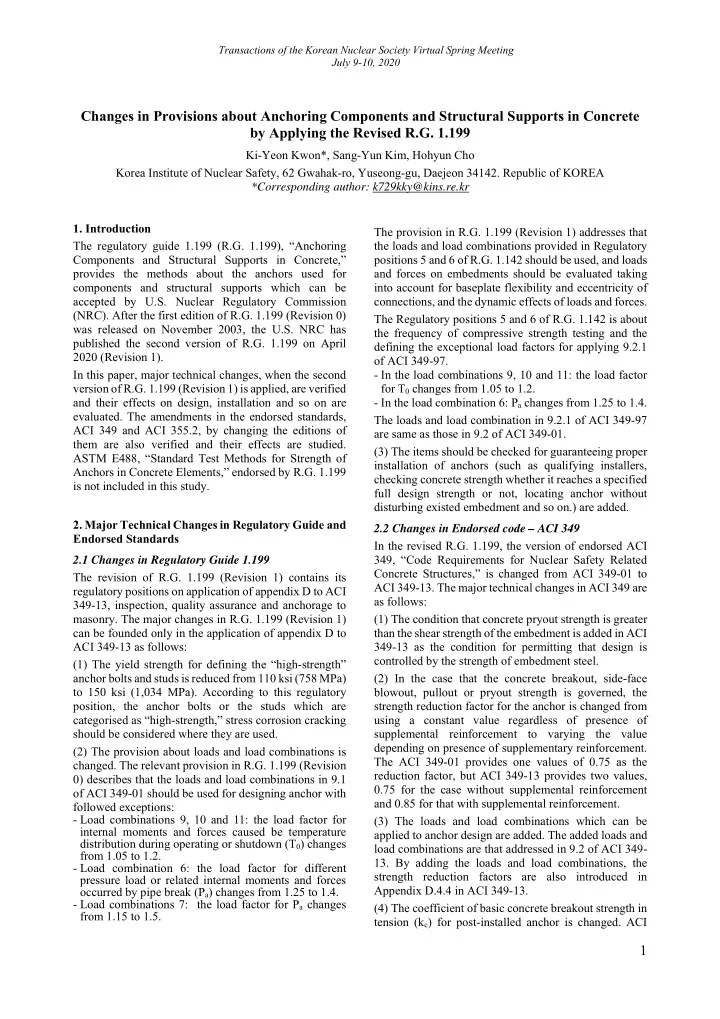
Transactions of the Korean Nuclear Society Virtual Spring Meeting July 9-10, 2020 Changes in Provisions about Anchoring Components and Structural Supports in Concrete by Applying the Revised R.G. 1.199 Ki-Yeon Kwon*, Sang-Yun Kim, Hohyun Cho


slide-1
SLIDE 1

Transactions of the Korean Nuclear Society Virtual Spring Meeting July 9-10, 2020

1 Changes in Provisions about Anchoring Components and Structural Supports in Concrete by Applying the Revised R.G. 1.199

Ki-Yeon Kwon*, Sang-Yun Kim, Hohyun Cho Korea Institute of Nuclear Safety, 62 Gwahak-ro, Yuseong-gu, Daejeon 34142. Republic of KOREA *Corresponding author: k729kky@kins.re.kr

  • 1. Introduction

The regulatory guide 1.199 (R.G. 1.199), “Anchoring Components and Structural Supports in Concrete,” provides the methods about the anchors used for components and structural supports which can be accepted by U.S. Nuclear Regulatory Commission (NRC). After the first edition of R.G. 1.199 (Revision 0) was released on November 2003, the U.S. NRC has published the second version of R.G. 1.199 on April 2020 (Revision 1). In this paper, major technical changes, when the second version of R.G. 1.199 (Revision 1) is applied, are verified and their effects on design, installation and so on are

  • evaluated. The amendments in the endorsed standards,

ACI 349 and ACI 355.2, by changing the editions of them are also verified and their effects are studied. ASTM E488, “Standard Test Methods for Strength of Anchors in Concrete Elements,” endorsed by R.G. 1.199 is not included in this study.

  • 2. Major Technical Changes in Regulatory Guide and

Endorsed Standards 2.1 Changes in Regulatory Guide 1.199 The revision of R.G. 1.199 (Revision 1) contains its regulatory positions on application of appendix D to ACI 349-13, inspection, quality assurance and anchorage to

  • masonry. The major changes in R.G. 1.199 (Revision 1)

can be founded only in the application of appendix D to ACI 349-13 as follows: (1) The yield strength for defining the “high-strength” anchor bolts and studs is reduced from 110 ksi (758 MPa) to 150 ksi (1,034 MPa). According to this regulatory position, the anchor bolts or the studs which are categorised as “high-strength,” stress corrosion cracking should be considered where they are used. (2) The provision about loads and load combinations is

  • changed. The relevant provision in R.G. 1.199 (Revision

0) describes that the loads and load combinations in 9.1

  • f ACI 349-01 should be used for designing anchor with

followed exceptions:

  • Load combinations 9, 10 and 11: the load factor for

internal moments and forces caused be temperature distribution during operating or shutdown (T0) changes from 1.05 to 1.2.

  • Load combination 6: the load factor for different

pressure load or related internal moments and forces

  • ccurred by pipe break (Pa) changes from 1.25 to 1.4.
  • Load combinations 7: the load factor for Pa changes

from 1.15 to 1.5. The provision in R.G. 1.199 (Revision 1) addresses that the loads and load combinations provided in Regulatory positions 5 and 6 of R.G. 1.142 should be used, and loads and forces on embedments should be evaluated taking into account for baseplate flexibility and eccentricity of connections, and the dynamic effects of loads and forces. The Regulatory positions 5 and 6 of R.G. 1.142 is about the frequency of compressive strength testing and the defining the exceptional load factors for applying 9.2.1

  • f ACI 349-97.
  • In the load combinations 9, 10 and 11: the load factor

for T0 changes from 1.05 to 1.2.

  • In the load combination 6: Pa changes from 1.25 to 1.4.

The loads and load combination in 9.2.1 of ACI 349-97 are same as those in 9.2 of ACI 349-01. (3) The items should be checked for guaranteeing proper installation of anchors (such as qualifying installers, checking concrete strength whether it reaches a specified full design strength or not, locating anchor without disturbing existed embedment and so on.) are added. 2.2 Changes in Endorsed code – ACI 349 In the revised R.G. 1.199, the version of endorsed ACI 349, “Code Requirements for Nuclear Safety Related Concrete Structures,” is changed from ACI 349-01 to ACI 349-13. The major technical changes in ACI 349 are as follows: (1) The condition that concrete pryout strength is greater than the shear strength of the embedment is added in ACI 349-13 as the condition for permitting that design is controlled by the strength of embedment steel. (2) In the case that the concrete breakout, side-face blowout, pullout or pryout strength is governed, the strength reduction factor for the anchor is changed from using a constant value regardless of presence of supplemental reinforcement to varying the value depending on presence of supplementary reinforcement. The ACI 349-01 provides one values of 0.75 as the reduction factor, but ACI 349-13 provides two values, 0.75 for the case without supplemental reinforcement and 0.85 for that with supplemental reinforcement. (3) The loads and load combinations which can be applied to anchor design are added. The added loads and load combinations are that addressed in 9.2 of ACI 349-

  • 13. By adding the loads and load combinations, the

strength reduction factors are also introduced in Appendix D.4.4 in ACI 349-13. (4) The coefficient of basic concrete breakout strength in tension (kc) for post-installed anchor is changed. ACI

slide-2
SLIDE 2

Transactions of the Korean Nuclear Society Virtual Spring Meeting July 9-10, 2020

2

349-01 defines the value as a constant of 17. ACI 349-13 permits that the value can be increased above 17 based

  • n test results, but the value shall not exceed 24.

Additionally, the upper limit of the coefficient for post- installed anchor of 24 is equal to the value for coefficient for cast-in anchor. (5) The provision for the value of embedment depth of the anchor (hef) used in equations for calculating concrete breakout strength of anchor in tension is changed. This provision applies to the anchors located less than 1.5hef from three or more edges, and its purpose is not to calculate the strength based on individual break out prism for group anchors. ACI 349-01 provides that the value shall be limited to two-third of the maximum edge distance (ca,max), but ACI 349-13 provides that the value shall be greater than two-third of ca,max and one-third of the maximum spacing between the anchors. It might be expected that the concrete breakout strength in tension calculated by ACI 349-01 will be greater than the strength calculated by ACI 349-13. (6) The modification factor for post-installed anchor (ψcp,N) which is used for calculating concrete breakout strength of anchor in tension is added in ACI 349-13. The purpose for the addition of this modification factor is to prevent that splitting concrete failure occurs before concrete breakout failure. This factor is applied to the anchor if it has the minimum edge distance greater than 1.5hef. Since the value of this factor shall not exceed 1.0, the value of the concrete breakout strength in tension according to ACI 349-13 might be smaller than the value according to ACI 349-01. (7) The provision which allows to use the design strength

  • f the anchor reinforcement instead of the concrete

breakout strength for determining concrete breakout strength in tension and nominal shear strength is added in ACI 349-13. This provision can be applied to the case that the anchor reinforcement is developed according to Chapter 12 on both sides of the breakout surface. According to this added provision, 0.75 is used with the loads and load conditions defined in 9.2, and 0.85 with those defined in Appendix C. Additionally, this provision is suggested based on the test results using the anchor reinforcement of which rhe diameter is equal to or less than No. 5 bar. Therefore, if the diameter of anchor reinforcement is equal to or larger than No. 6 bar, this provisions shall not be applied. (8) In ACI 349-13, determining pullout strength for single cast-in headed studs and headed bolts based on their test results is allowed. This provision is added to consider increase in strength by applying confining reinforcement that can be demonstrated by test. (9) The equation for determining the nominal shear strength for post-installed anchor where sleeves extend through the shear plane as governed by the steel strength (Vsa) is changed from Equation 1 to Equation 2. ACI 349- 13 also allows that Vsa can be determined based on test results. Vsa = n(0.6Asefuta+0.4Aslfutsl) (1) Vsa = n0.6Ase,Vfuta (2) where n is number of anchors; Ase is effective cross- sectional area of anchor; futa is specified tensile strength

  • f anchor steel; futsl is specified tensile strength of anchor

sleeve; Asl is effective cross-sectional area of expansion

  • r undercut anchor sleeve, if sleeve is within shear plane;

and Ase,V is effective cross-sectional area of anchor in shear (10) The provision for the value of the edge distance of the anchor in the direction of the shear applied (ca1) in equations for calculating concrete breakout strength of anchor in shear is changed. This provision applies to the anchors influenced by three or more edges and its purpose is not to calculate the strength based on individual break out prism for group anchors. ACI 349- 01 provided that ca1 shall be limited to two-third of the maximum edge distance (ca,max), but ACI 349-13 provides that the value shall not exceed two-third of ca,max and one-third of the maximum spacing between the

  • anchors. It might be expected that the concrete breakout

strength in shear calculated by ACI 349-01 will be greater than the strength calculated by ACI 349-13. (11) A modification factor for calculating nominal concrete breakout strength in shear is added. The notation for this modification factor is ψh,V, and it is applied if the thickness of the member is less than 1.5ca1. Since the value of this factor shall not exceed 1.0, the value of the concrete breakout strength in tension according to ACI 349-13 might be smaller than the value according to ACI 349-01. (12) The provision about recommended minimum value for edge distance of post-installed anchor is added. The added provision can be applied if product-specific test information is not available, and it suggests the minimum value by multiplying outside diameter of the anchor by certain value of constant. The value of the constant is determined depending on types of anchors. (13) The requirement about the minimum critical edge distance for post-installed anchor is added in ACI 349-

  • 13. This requirement shall be applied to undercut, torque-

controlled and displacement-controlled anchors when the critical edge distance is not determined by the verification tension test performed in field before the anchors’ installation (D3.3 in ACI 349-13). According to this requirement the maximum critical edge distance is proportional to effective embedment depth of the anchor. 2.3 Changes in Endorsed Code – ACI 355.2 In the revised R.G. 1.199, the version of endorsed ACI 355.2, “Evaluating the Performance of Post-Installed Mechanical Anchors in Concrete,” is changed from ACI 355.2-01 to ACI 355.2-07. ACI 355.2 prescribes the testing programs for qualifying post-installed mechanical

  • anchors. The test programs for qualifying anchors in ACI

355.2 are listed in Tables 1 and 2 of this paper.

slide-3
SLIDE 3

Transactions of the Korean Nuclear Society Virtual Spring Meeting July 9-10, 2020

3

The major technical changes in ACI 355.2 are as follows: (1) The provision about un-allowable materials in the concrete mixture for test is changed. ACI 355.2-01 provides that the mixture does not include the cementitious materials (for example, slag, fly ash, silica fume, etc.), but ACI 355.2-07 provides the mixture does not include not only cementitious materials but also chemical admixtures (for example, air entraining agents, water reducers, set retarders, etc.). Both standards (ACI 355.2-01 and 355.2-07) provide that if the concrete mixture with cementitious materials and/or chemical admixtures is used for the tests, the performance of anchor can be guaranteed for the specific concrete mixture used in the tests. (2) In ACI 355.2, there are two nominal compressive strength ranges, low-strength concrete and high-strength concrete based on concrete compressive strength measured in accordance with ASTM C31. The maximum value of low-strength concrete is increased from 3,500 psi (24 MPa) to 4,000 psi (28 MPa). The maximum value

  • f high-strength concrete is increased from 8,000 psi (57

MPa) to 8,500 psi (60 MPa). (3) The required diameters of carbide hammer-drill bits are listed in the tables of ACI 355.2. The minimum diameter covered by these tables is increased from 3/16

  • in. (5 mm) to 1/4 in (6 mm).

(4) The installation method of the anchor for Test 8 in Table 1 and Test 10 in Table 2 is revised to following not

  • nly following manufactures’ instruction but also

loading the group of two anchors in tension to failure. (5) The requirement that the crack width shall be measured by two measurement devices and the measured value shall be within ± 15% of the specified values is added in ACI 355.2-07 for the tests in cracked concrete. (6) The range of the applied load for Test 6 in Table 1 is

  • changed. ACI 355.2-01 provides that the applied load

shall be varied between a minimum load (Nmin.) of 0.25Nk or [0.6 (Ase × 17,400 lb/in.2 (120 MPa))] whichever is larger; and a maximum load (Nmax.) of 0.6Nk or 0.8Asefy whichever is smaller. ACI 355.2-07 provides that the applied load shall be varied between a minimum load of 0.25Nk or Nmax - Aseꞏ17,400 psi (120 MPa) whichever is larger; and a maximum load of 0.6Nk

  • r 0.7Asefy whichever is smaller. Nk and Ase mean the

lowest characteristic tensile capacity in reference tests in uncracked concrete and the effective cross-sectional area

  • f anchor respectively.

It can be expected that the minimum and the maximum loads might be reduced if the applied standard is changed from ACI 355.2-01 to ACI 355.2-07. It is concluded based on the calculation result of Nmin. using the yield strength (fy) of ASTM A36 steel (see Equation 3); and reduction in value of multiplier for the term Asefy for Nmax. Additionally, ASTM A36 steel is used for comparing the values of Nmin. specified in ACI 355.2-01 and ACI 355.2- 07, because the steel is normally used for anchor bolt of nuclear facilities. Table 1 Test program for evaluating anchor systems for use in uncracked concrete

Test no. Purpose Description Concrete strength Reference test

1 Low-strength conc. Tension – single anchor away from edges Low 2 High-strength conc. Tension – single anchor away from edges High

Reliability test

3 Sensitivity to reduced installation effort Tension – single anchor away from edges Varied with anchor type 4 Sensitivity to large hole diameter Tension – single anchor away from edges Low 5 Sensitivity to small hole diameter Tension – single anchor away from edges High 6 Reliability under repeated load Repeated tension – single anchor away from edges, residual capacity Low

Service-condition test

7 Verification of full conc. capacity in corner with edges located at 1.5hef Tension – single anchor in corner with edges located at 1.5hef Low 8

  • Min. spacing and edge

distance to preclude splitting on installation High installation tension (torque or direct) – two anchors near edge Low 9 Shear capacity of steel Shear – single anchor away from edges Low

Table 2 Test program for evaluating anchor systems for use in cracked and uncracked concrete

Test no. Purpose Description

Crack opening width w, in. Concrete strength

Reference test

1 Reference test in uncracked low- strength conc. Tension – single anchor away from edges

  • Low

2 Reference test in uncracked high- strength conc. Tension – single anchor away from edges

  • High

3 Reference test in low-strength. cracked conc. Tension – single anchor away from edges 0.012 Low 4 Reference test in high-strength. cracked conc. Tension – single anchor away from edges 0.012 High

Reliability test

5 Sensitivity to reduced installation effort Tension – single anchor away from edges 0.012 Varied with anchor type 6 Sensitivity to crack width and large hole dia. Tension – single anchor away from edges 0.020 Low 7 Sensitivity to crack width and small hole dia. Tension – single anchor away from edges 0.020 High 8 Test in cracks whose opening width is cycled Sustained tension - single anchor away from edges, residual capacity 0.004 to 0.012 Low

Service-condition test

9 Verification of full

  • conc. capacity in

corner with edges located at 1.5hef Tension—single anchor in corner with edges located at 1.5 hef

  • Low

10

  • Min. spacing and

edge distance to preclude splitting

  • n installation in

uncracked conc. High installation tension (torque or direct)—two anchors near edge

  • Low

11 Shear capacity in uncracked conc. steel Shear—single anchor away from edges

  • Low

12 Seismic tension Pulsating tension, single anchor, away from free edge 0.020 Low 13 Seismic shear Alternating shear, single anchor, away from free edge 0.020 Low

slide-4
SLIDE 4

Transactions of the Korean Nuclear Society Virtual Spring Meeting July 9-10, 2020

4

Aseꞏ7,800 psi (= Nmax – Aseꞏ17,400 psi = 0.7ꞏAsefy – Aseꞏ17,400 psi = 0.7ꞏAseꞏ36,000 psi – Aseꞏ17,400 psi) < Aseꞏ10,440 psi (= Aseꞏ0.6ꞏ17,400 psi) (3) (7) In ACI 355.2-01, the maximum residual capacities of the anchor for Test 6 in Table 1 and Test 8 in Table 2 are specified that the residual capacities shall not be less 80% and 90% of the mean capacity in the corresponding reference test respectively. However, these specifications are omitted in ACI 355.2-07. (8) The static tension load applied to anchor during crack width cycling (Nw) for Test 8 in Table 2 is changed from Equation 4 to Equation 5. Nw=0.9Nb (0.7ϕIR) (4) Nw=0.3Np,cr √(fc,test/fc') (5) where Nb is characteristic tensile resistance in low- strength cracked concrete as determined from reference tests; ϕIR is capacity reduction factor based on category developed from reliability tests (1.0 for Category 1, 0.85 for Category 2, 0.7 for Category 3); Np,cr is characteristic pullout resistance in cracked concrete for the minimum specified concrete strength of 2,500 psi (17 MPa); fc’ is specified concrete compressive strength of 2,500 psi (17 MPa); and fc,test is mean concrete compressive strength as measured at time of testing (9) The maximum allowable crack widths at specific load cycles (20 cycles and 1,000 cycles) for Test 8 in Table 2 are changed. ACI 355.2-01 provides that the crack widths shall not exceed 0.080 in. at 20 cycles and 0.120

  • in. at 1,000 cycles. ACI 355.2-07 provides that the crack

widths shall not exceed 0.120 in at 20 cycles and 0.160

  • in. at 1,000 cycles.

(10) The tolerance for the required distance from the edge of the bearing plate to centre-line of the corresponding anchors for Test 8 in Table 1 and Test 10 in Table 2 is added as ± 10% in ACI 355.2-07. (11) The provision about the minimum characteristics failure load for the Test 8 and Test 10 in Table 2 is added in ACI 355.2-07. According to the added provision, the characteristic failure load shall be equal to and greater than the characteristic resistance for concrete cone breakout failure. The provision also specifies the type of anchors to which the provision can be applied (for example, displacement-controlled expansion and undercut anchors and load-controlled anchors) (12) The provisions about the maximum acceptable crack width and the direction of applied load are added in ACI 355.2-07. The added provisions specify that the crack width shall not exceed 0.012 in. (0.3 mm) and the load shall be applied in the direction parallel to crack. This provision is applied for Test 9 in Table 1 and Test 11 in Table 2. (13) The maximum seismic tension test load (Neq) for Test 12 in Table 2 is revised. ACI 355.2-01 provides that Neq shall be equal to one-half of the mean tension capacity in cracked concrete from reference tests (Fu,test,3). ACI 355.2-07 provide that Neq shall not be equal to the Neq defined in ACI 355.2-01 times the term about measured concrete compressive strength. The term can be determined by calculating square root of the ratio of the concrete compressive strength measured by Test 12 in Table 2 to Test 3 in Table 2. It can be expected that Neq might be reduced if ACI 355.2-07 is applied instead of ACI 355.2-01, because the value of the term about concrete compressive strength will be less than 1. (14) The provision about the maximum seismic shear test load (Veq) for Test 13 in Table 2 is revised. ACI 355.2- 01 provides Veq shall be equal to one-half of the mean capacity of Test 11 in Table 2 (Fu,test,11) or calculated shear capacity of the steel according to ACI 318. ACI 355.2-07 provide that Veq shall be equal to the Veq defined in ACI 355.2-01 times the term about mean steel

  • strength. The term can be determined by dividing the

mean steel strength of the tested anchor in Test 13 of Table 2 by the mean steel strength in Test 11 of Table 2. It can be expected that Veq might be reduced by applying ACI 355.2-07 instead of ACI 355.2-01, because the value of the term will be less than 1. (15) ACI 355.2-01 does not provide the method to determine Veq. when Test 11 in Table 2 is not conducted. However, ACI 355.2-07 provides the equation to be used for determining Veq. when Test 11 in Table 2 is not conducted (see Equation 6). Veq = 0.35Asefu,test,13 (6) where fu,test,13 means the mean steel strength of the tested anchors in the simulated seismic shear tests (16) The provision about placement of the crack-control reinforcement is added in ACI 355.2-07. The purpose of added provision is to get rid of the effects of the crack- control reinforcement on the performance of the anchors. According to the provision, the centre-line distance between the crack-control reinforcement and anchor shall be greater than 0.4hef, and the spacing between the top and bottom crack-control reinforcement shall be less than 10 in. (250 mm).

  • 3. Effects of Changes

3.1 Effects of Changes in Regulatory Positions on Design or Installation The effects of changes in R.G. 1.199 is addressed as

  • below. The numbers are in accordance with the numbers

in 2.1 of this paper.

slide-5
SLIDE 5

Transactions of the Korean Nuclear Society Virtual Spring Meeting July 9-10, 2020

5

(1) It might seem that the design and the installation efforts for “high-strength” anchor which need to check vulnerability of the anchor to stress corrosion cracking are reduced. However, “high-strength” anchor is very rarely used in fields, so the revision on the yield strength

  • f “high strength” anchor might give little effect on

design and installation in fields. (2) Less conservative anchor design might be led when revised R.G. 1.199 is applied by using smaller load factor for Pa with operating basis earthquake. However, the effects of this revision on design cannot be evaluated exactly because the position is expected to be modified further due to the following reasons:

  • Regulatory position 5 of R.G. 1.142 used as provision

for loads and load combinations in R.G. 1.199 (Revision 1) is not directly related to the loads and load combinations

  • R.G. 1.142 has additional regulatory positions related

to loads and load combinations in Regulatory positions 7 through 10 (3) The efforts for proper installation in fields might be increased because several items (for example, drill hole angularity, material properties, location of existed embedment, etc.) should be checked before and during the installation. Moreover, several facilities may need to secure qualified installers and to make approved procedures for certifying and maintaining installer’s eligibility conditions. 3.2 Effects of Changes in ACI 349-13 on Design or Installation The changes in ACI 349 are categorized considering their effects especially on design. In this section, the effects on design conservatism is determined depending

  • n the effect of the revision on the concrete breakout
  • strength. Since the design strength of anchor system

might be set less than the concrete breakout strength in most cases not to lead brittle failure mode (for example, the anchor system is failed not by anchor steel yielding but by ambient concrete breakout), it is determined that the revision might lead more conservative design if the concrete breakout strength is decreased due to the revision. The number in bracket at the end of the following phrases in accordance with the number in the section 2.2 of this paper. (1) The followings are the changes which might lead more conservative design if ACI 349-13 is applied instead of ACI 349-07.

  • Add the condition for assuring that anchor design is

controlled by the strength of the embedment steel (1)

  • Determine the value of effective embedment depth used

for calculating concrete breakout strength in tension (5)

  • Apply the modification factor for post-installed anchor

which has the edge distance greater than 1.5 times the effective embedment depth (6)

  • Determine the value the edge distance of the anchor in

the direction which shear is applied used for calculating concrete breakout strength in shear (10)

  • Introduce the modification factor for the anchor where

the edge distance of the anchor in the direction parallel to the direction of the applied shear force is greater than two-third of the thickness of the member which is used for calculating nominal concrete breakout strength (11) (2) The followings are the changes which might lead less conservative design if ACI 349-13 is applied instead of ACI 349-07.

  • Increase strength reduction factor from 0.75 to 0.85

where the supplementary reinforcement is presented (2)

  • Allow to increase the coefficient of basic concrete

breakout strength in tension based on test results (4)

  • Allow to use design strength of the anchor

reinforcement instead of concrete breakout strength if the anchor reinforcement is well developed on both sides of the breakout surface (7)

  • Allow to determine pullout strength for single cast-in

headed studs and headed bolts based on test results considering effects of confining reinforcement (8) (3) The followings are the changes which might lead more or less conservative design if ACI 349-13 is applied instead of ACI 349-07.

  • Apply load factors and load combinations addressed

not only in Appendix C (equal to 9.2 of ACI 349-01) but also in 9.2 of ACI 349-13 to anchor design (3)

  • Change the calculation method of the shear strength

contributed by anchor sleeve from calculating it separating to the shear strength contributed by the anchor to calculating it combining with the strength of the anchor (9) (4) The followings are the changes which can be applied if the corresponding test results are not available.

  • Recommend the minimum edge distance for post-

installed anchor which can be used when the product- specific test results are not available (12)

  • Recommend the maximum critical edge distance for

post-installed anchor if the distance is not determined based on verification tension test performed in field before the anchors’ installation (13) 3.3 Effects of Changes in ACI 355.2-07 on Design or Installation The changes in ACI 355.2 are categorized considering their effects on necessary for conducting additional tests. The number in bracket at end of following phrases is accordance with the number in the section 2.3 of this paper. (1) The followings are the changes which might require additional tests if ACI 355.2-07 is applied instead of ACI 355.2-01.

  • Change the maximum compressive strength from 3,500

to 4,000 psi for low-strength concrete and 8,000 psi to 8,500 psi for high-strength concrete (2)

  • Increase the minimum size of the anchor covered by

ACI 355.2 from 3/16 in. (5 mm) to 1/4 in. (6 mm) (3)

slide-6
SLIDE 6

Transactions of the Korean Nuclear Society Virtual Spring Meeting July 9-10, 2020

6

  • Revise installation method of the anchor for the test

about minimum spacing and edge distance by adding steps which load the group of two anchors in tension to failure (4)

  • Modify the maximum and the minimum values of the

repeated load for the test about reliability under repeated load (6)

  • Revise the static tension load applied to anchor during

crack width cycling (8)

  • Minimum value for the characteristic failure load for

displacement-controlled expansion and undercut anchors and load-controlled anchors (11)

  • Address the maximum acceptable crack width and the

recommended direction of the applied load for the service-condition shear test of single anchor without spacing and edge effects (12)

  • Modify the maximum seismic tension and shear load

for the tests about simulated seismic loads by applying the term about concrete or steel strength (13, 14)

  • Add the requirements about the minimum distance

between the crack-control internal reinforcement and the anchor, and the maximum spacing between top and bottom crack-control reinforcement bars (16) (2) The followings are the changes which might not require additional tests if ACI 355.2-07 is applied instead

  • f ACI 355.2-01. The number in bracket at end of

following phrases accords with the number in the section 2.3 of this paper.

  • Include chemical admixtures as the materials which are

not recommended to use for making test member (1)

  • Make clear the method of crack measurement and

acceptable tolerance of crack width (5)

  • Delete the requirements about the minimum residual

capacity for the tests about reliability under repeated load and about reliability in cracked concrete where crack width is cycled (7)

  • Increase the maximum allowable crack width at

specific load cycles (9)

  • Add the tolerance for the minimum distance between

the bearing plates to the corresponding anchors (10)

  • Provide the method to determine the maximum seismic

shear load for the simulated seismic load test if the service condition shear test is not performed (15)

  • 4. Conclusions

The amendments of R.G. 1.199 and its endorsed standards (ACI 349 and ACI 355.2) are confirmed and their effects are evaluated. Among the amendments addressed in section 2 of this paper, the followings are expected to give significant effects on design, installation and test of anchors. Including the follows, the interested parties should give efforts to understand the contents of the amendments for applying them in fields. (1) Amendments in R.G. 1.199 The number in bracket at end of following phrases are in accordance with the number in the section 2.1.

  • Change the load factors for the load combination in 9.2
  • f ACI 349-13 (2)
  • Involvement of qualified examiners, inspectors or

installers (2, 3)

  • Check field conditions before installing works (for

example, concrete strength in fields, placement of existed embedment, etc.) (3) (2) Amendments in ACI 349 The number in bracket at end of following phrases accords with the number in the section 2.2.

  • Allow to consider confinement effects of reinforcing

bars on concrete (2, 4, 8)

  • Apply new load factors and load combinations

addressed in 9.2 of ACI 349-13 (3)

  • Prevent strength calculation for group anchor base on

individual beak out prism (5, 10)

  • Provide additional modification factors for calculating

concrete breakout strength in tension and shear (6, 11) (3) Amendment in ACI 355.2 The number in bracket at end of following phrases accords with the number in the section 2.3.

  • Change the maximum concrete strength of the nominal

compressive strength ranges (2)

  • Add to load the group of two anchor in tension to failure

as a installing step for the test about minimum spacing and edge distance (4)

  • Change maximum and minimum loads for the test

about reliability under repeated load (6)

  • Revise the static tension load and the allowable crack

width at specific cycles for the test about reliability in cracked concrete where crack width is cycled (8, 9)

  • Change the maximum seismic tension and shear loads

for the simulated seismic tests (13, 14) Moreover, the effects of each amendment are evaluated separately in this study. However, an amendment can give effects on other amendments, integrated approaches to evaluate effects of amendments are needed. REFERENCES [1] Regulatory Guide 1.199, “Anchoring Components and Structural Supports in Concrete,” U.S. Government Printing Office, Washington, DC. (2003 and 2020) [2] ACI Committee 349, “Evaluation of Existing Nuclear Safety Related Concrete Structures and Commentary,” American Concrete Institute, Farmington Hills, Mich. (2001 and 2013) [3] ACI Committee 355.2, “Qualification of Post- Installed Mechanical Anchors in Concrete and Commentary,” American Concrete Institute, Farmington Hills, Mich., (2001 and 2007) [4] Regulatory Guide 1.142, “Safety-Related Concrete Structures for Nuclear Power Plants (Other than Reactor Vessels and Containments),” U.S. Government Printing Office, Washington, DC. (2001)